
Andrew Abbey
February 24, 2026
7
min. read
and updated on:
April 24, 2026

Up from less than 5% in 2025. That's not a trend — that's a phase change. The uncomfortable part isn't the number. It's what the companies building agent-native right now are going to look like compared to everyone else in 18 months.
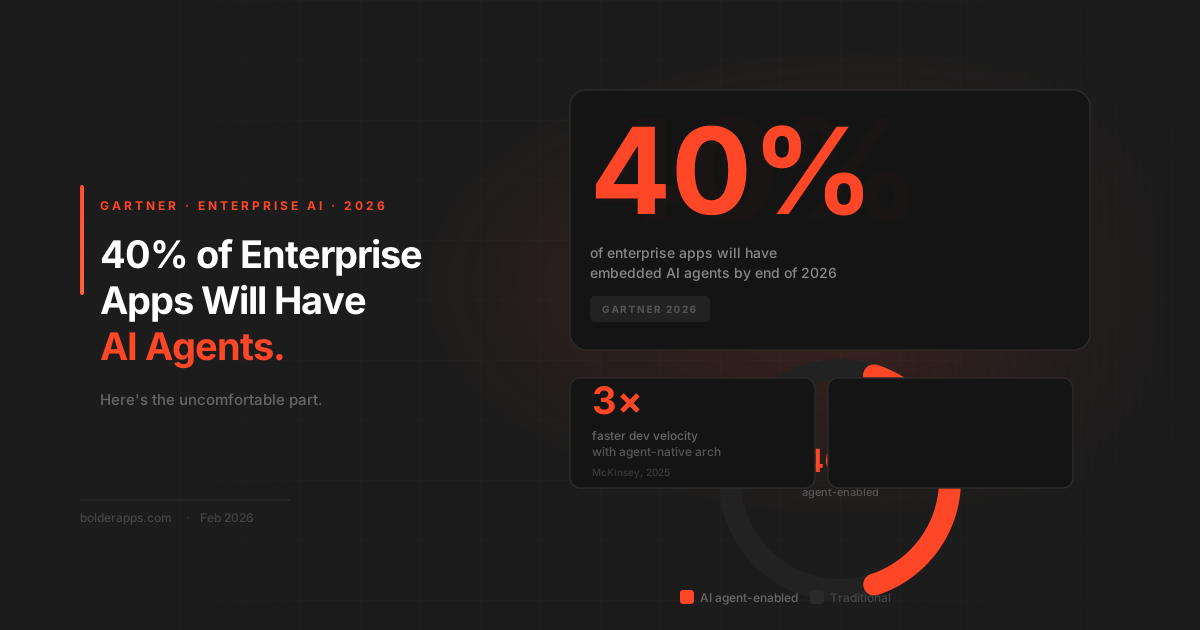
Gartner is projecting that 40% of enterprise applications will have AI agents by the end of 2026. Up from less than 5% in 2025.
Go ahead and let that math land: 8x growth in a single year. That’s not adoption — that’s a cascade. When adoption curves move that fast, they separate markets into two groups: the ones who built for the shift and the ones who scrambled to retrofit it.
The uncomfortable reality isn’t the headline number. It’s that the companies in the first group — the ones who architected their products around agents from the start — are building a compounding advantage that gets harder to close every month. The window for founders and product teams to build into that group is open right now. It won’t be open indefinitely.
Here’s something the industry doesn’t say clearly enough: not all “AI agents” are equal, and Gartner’s 40% figure includes a very wide range of implementations.
On one end, you have bolt-on AI assistants — a chatbot added to an existing enterprise app, an auto-fill that uses a language model instead of a rules engine, a search bar upgraded with semantic understanding. These are useful. They’re not transformative. They’ll count in the 40%.
On the other end, you have agent-native products — applications where the core value delivery mechanism is an autonomous agent operating across workflows. The agent isn’t a feature in these products. It’s the product. The architecture, the data layer, and the UX are all built around the assumption that agents are doing the execution work and humans are providing direction and judgment.
The companies that will define their categories in 18 months are overwhelmingly in the second group. The ones chasing the first group’s pattern are buying time, not building advantage.
At Bolder Apps, we’re in the middle of building agent-native products with founders across several verticals. Here’s what that design philosophy produces in practice.
A healthcare client came to us with a problem bleeding their clinical team for years: documentation overhead. Clinicians spending 30-40% of their time on notes, coding, and billing administration instead of patients. We built an agent-native solution where the agent handles the full documentation loop — listening, structuring the clinical note, suggesting appropriate codes, flagging potential issues — and the clinician reviews and signs off. The agent does the labor. The clinician does the medicine.
Rules-based fraud detection generates enormous false positive volumes that overwhelm operations teams. An agent-native approach changes the loop entirely: the agent investigates each alert, pulling transaction history and behavioral patterns, before escalating to a human analyst — with context, not just a flag. The analyst makes the call. The agent does the investigation work that previously consumed analyst hours.
The common structure across both: agents handle execution, humans handle judgment. That design pattern is what makes agent-native products genuinely transformative rather than marginally faster.
Map your highest-friction user workflows. Not “where could AI help?” but “where are users doing repetitive, multi-step work that follows predictable patterns?” Those are your agent opportunities. The goal isn’t to add AI — it’s to eliminate manual execution from the user loop entirely in those places.
Build reliability first. The most common mistake in first-time agent products is over-engineering capability and under-engineering reliability. Agents fail. Models produce incorrect outputs. Production-grade agent architecture includes fallback mechanisms, confidence thresholds, and human escalation paths built in from day one — not patched in after launch.
Ship before perfect. The teams who will lead their categories built real products with today’s technology, iterated on real user feedback, and accumulated learning that competitors can’t shortcut. Waiting for the technology to mature is letting your competitors get smarter on real data while you’re still in planning mode.
Bolder Apps has been building production AI products for three years. We know the difference between demo-grade and production-grade agent architecture, and we build the latter. If you’re working on an agent-native product, let’s talk about what it actually takes to ship it.
Category leadership in AI-native software isn’t being decided in 2028. It’s being decided right now, in build decisions that are happening this quarter.
The 40% figure is a lagging indicator. The momentum creating it has been building for months. The founders who are shipping agent-native products today are building compounding advantages in user data, product refinement, and market positioning that pure-wait competitors will struggle to close.
The question isn’t whether AI agents matter to your product category. The question is whether you’re building the version that matters, or watching someone else build it.
It means AI agent adoption in enterprise software is shifting from early adopter behavior to mainstream practice within a single calendar year. For software companies, this signals that agent capabilities are moving from differentiator to expected baseline — products that lack them will feel increasingly behind, while products built agent-native from the start will have meaningful compounding advantages in product maturity and user data.
An agent-native product is architected from the start around autonomous agents executing workflows, with the data layer, UX, and infrastructure all optimized for agent-driven value delivery. A product that “added AI features” typically has a bolt-on AI layer sitting on top of an architecture designed for human interaction. The distinction matters for reliability, scalability, and the depth of value agents can actually deliver.
The highest-friction, highest-frequency workflow in your product — the one where users are doing the most repetitive, predictable manual work. Agent features deliver the most value where the labor being replaced is real and the pattern is consistent. Start there, build reliability architecture in from day one, and iterate on real user data before expanding scope.
Build now. The technology is stable enough for production use — that’s evident from the adoption curve. Waiting for further stability means giving your competitors a growing head start on real-world learning and user data. The compounding value of shipping and iterating on a real product beats the theoretical advantage of waiting for a marginally better foundation.