Andrew Abbey
February 24, 2026
6
min. read
and updated on:
April 24, 2026

OpenAI hired the OpenClaw founder to build personal AI agents that work across your entire digital life. This isn't a product update — it's a directional signal. The shift from 'apps you use' to 'systems that act for you' is happening faster than the industry is admitting.
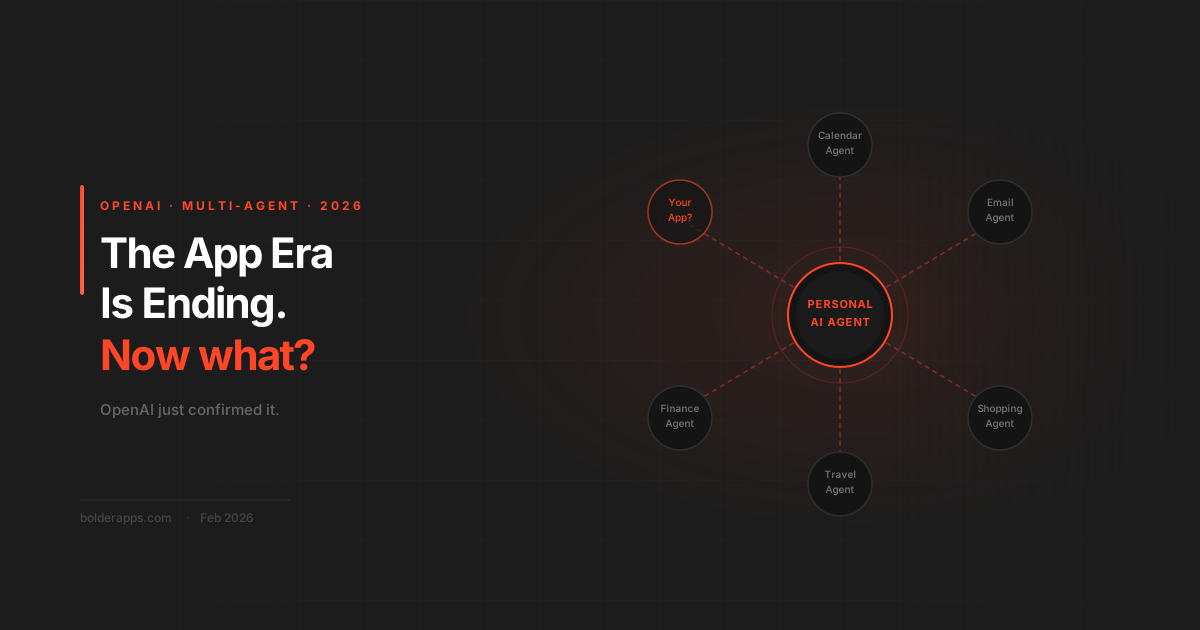
OpenAI hired the founder of OpenClaw to build personal AI agents.
That’s not an incremental product update. That’s a declaration about where the company is putting serious engineering resources — specifically, into agents that act on your behalf across tools, services, and your entire digital environment.
The shift from “apps you use” to “systems that work for you” has been discussed in AI circles for two years. OpenAI just made a hiring decision that signals they believe it’s close enough to build product around now. When the biggest AI company in the world makes that bet, it’s worth thinking seriously about what it means for everything being built on top of the current app paradigm.
The term “AI agent” has been diluted by overuse. Let’s be specific about what OpenAI is building toward, because the specifics matter.
A personal AI agent is cross-tool — it operates across your email, calendar, files, browser, and professional platforms, not just inside one app with a chat interface. It’s cross-service, able to take actions in systems through standardized protocols rather than requiring native integrations with each. It’s goal-directed: you specify an outcome, and it figures out the sequence of actions required to get there. And it’s persistent — it operates in the background, monitors for relevant conditions, and acts when those conditions are met without requiring you to initiate each session.
That’s a fundamentally different interaction model than anything the current app ecosystem was designed for. Apps are built around the assumption that a human is sitting in front of them, making decisions at each step. Personal agents operate on the assumption that a human set a direction and wants results, not a process to manage.
OpenClaw was working on multi-agent orchestration — the infrastructure for systems where multiple AI agents coordinate on complex tasks, passing work between each other, using different tools, and maintaining coherent progress toward a shared goal.
That’s the hard technical problem that sits between “AI assistant that answers questions” and “personal agent that gets things done.” OpenAI didn’t hire a researcher to study this. They hired a founder who was building product in this space. That’s a signal about timeline, not theory.
If they’re staffing for this now, personal agent infrastructure shows up in product in 12-18 months. Probably sooner. The competitive pressure from Google and Anthropic, who are both investing heavily in the same direction, doesn’t allow for a relaxed roadmap.
When personal agents become capable enough to act across services on behalf of users, the way your product gets consumed changes. The UI/UX layer becomes less central. What becomes more central is the API surface: how programmable your product is, how well-documented your endpoints are, how cleanly an agent can consume your core functionality without human hand-holding.
This isn’t theoretical. If you’re building a product today, the API design decisions you make now will determine whether that product is agent-accessible when personal agents become capable enough to use it. Products with clean, well-documented APIs designed for developer consumption will make the transition naturally. Products with APIs bolted on as an afterthought won’t.
You don’t need to wait for OpenAI’s personal agent product to ship to start building multi-agent experience. The orchestration infrastructure — frameworks for coordinating specialist agents on complex tasks — is already stable and production-ready.
Bolder Apps has shipped multi-agent systems in production across healthcare and fintech verticals. The failure modes are understood. The reliability patterns are established. The teams building multi-agent products now will have a significant institutional advantage when the personal agent infrastructure scales up — they’ll understand how these systems behave in the real world, which you can’t learn from documentation.
When agents can reach across services, the entity controlling the agent platform captures enormous value — the same way the app store model captured value from the apps running on it. OpenAI, Apple, Google, and Microsoft are all building toward being that platform.
For product companies, this creates a strategic decision: are you building to be accessible through the agent platform layer, or are you building something that operates at the platform layer itself? Both are viable positions. They require completely different architectures and go-to-market strategies. Figuring out which one you’re building now is worth more than most roadmap conversations.
This is the kind of strategic product thinking we do with founders at Bolder Apps. Not just shipping the app, but making sure the architecture makes sense given where the infrastructure is heading. If you’re working through these questions, we’re good at this conversation.
In 24 months, a meaningful portion of software interactions won’t start with a human opening an app. They’ll start with an agent receiving a goal and taking action across whatever services are needed to achieve it.
Products built to be excellent agent interfaces will feel native in that world. Products built exclusively for human interaction will feel like the 2009 website you still have to visit on mobile — functional, but obviously not designed for how people actually work now.
The window to build for the agent era is right now. The companies building in that direction today are the ones that won’t need to play catch-up when the personal agent products ship. Here’s what we build.
A personal AI agent is an AI system that autonomously executes multi-step tasks on your behalf across multiple tools and services. Unlike a chatbot that responds to individual prompts, a personal agent is given goals rather than instructions — it determines the steps, uses the tools it needs, and operates persistently in the background rather than in discrete sessions.
OpenClaw was a company working on multi-agent orchestration — infrastructure for coordinating multiple AI agents on complex, cross-tool tasks. OpenAI hiring the founder signals a strategic product commitment to building personal agent capabilities, not just researching them. When a company hires a founder into a new area, it typically means they’re planning to ship product sooner rather than later.
A multi-agent system uses multiple AI agents with distinct roles that work together on complex tasks. An orchestrator agent typically breaks a goal into sub-tasks and routes them to specialist agents. This architecture handles tasks that are too complex for a single agent context and allows each component to be optimized for its specific function.
Start with API quality: ensure your core product functionality is programmable and well-documented. Then identify the workflows in your product that an agent could realistically execute autonomously and build toward those use cases. Most importantly, start experimenting with multi-agent patterns now — understanding how these systems fail in practice is knowledge that can only be gained by building.