Advanced Web Application Development: The Complete Guide
Advanced web apps go far beyond static sites. Here’s the complete guide to architecture, security, performance, and emerging technologies shaping modern web development.
Advanced web application development is the process of building dynamic, interactive, and scalable web-based software that delivers complex functionality through a browser. It goes far beyond static websites to create experiences that rival native desktop and mobile applications.
What Advanced Web Apps Deliver:
Dynamic Content: Real-time updates and personalized, data-driven interfaces.
Complex Functionality: User authentication, database interactions, and API integrations.
Scalability: Architecture designed for growth.
Modern UX: Responsive design and app-like interactions in the browser.
The digital landscape is reshaping business operations and user expectations. The web has evolved from simple pages to sophisticated platforms for banking, healthcare, and e-commerce. This shift is reflected in the job market: the U.S. Bureau of Labor Statistics projects web developer jobs will grow by 16 percent by 2032, much faster than average. The demand for this technical expertise is clear.
However, building advanced web applications requires more than just coding. It demands cross-disciplinary expertise in front-end frameworks, back-end systems, database architecture, security, and UX design. The goal is to create something exceptional, not just functional.
The gap between a basic website and an advanced web application is vast. Static sites display information; dynamic applications respond to users, process data in real-time, and deliver personalized experiences.
For founders, the stakes are high. You're building a competitive advantage, where poor quality or technical debt can sink a promising idea. Success requires a senior team that understands both the technical complexity and the business impact of every architectural decision.
This guide breaks down the essentials of advanced web application development, from core skills and architecture to security and emerging technologies.
The Blueprint for Modern Web Apps: Evolution and Key Stages
Web development has evolved from the static pages of Web 1.0 to the interactive platforms of Web 2.0. Now, Web 3.0 is introducing decentralization and AI-driven experiences, fundamentally reshaping advanced web application development.
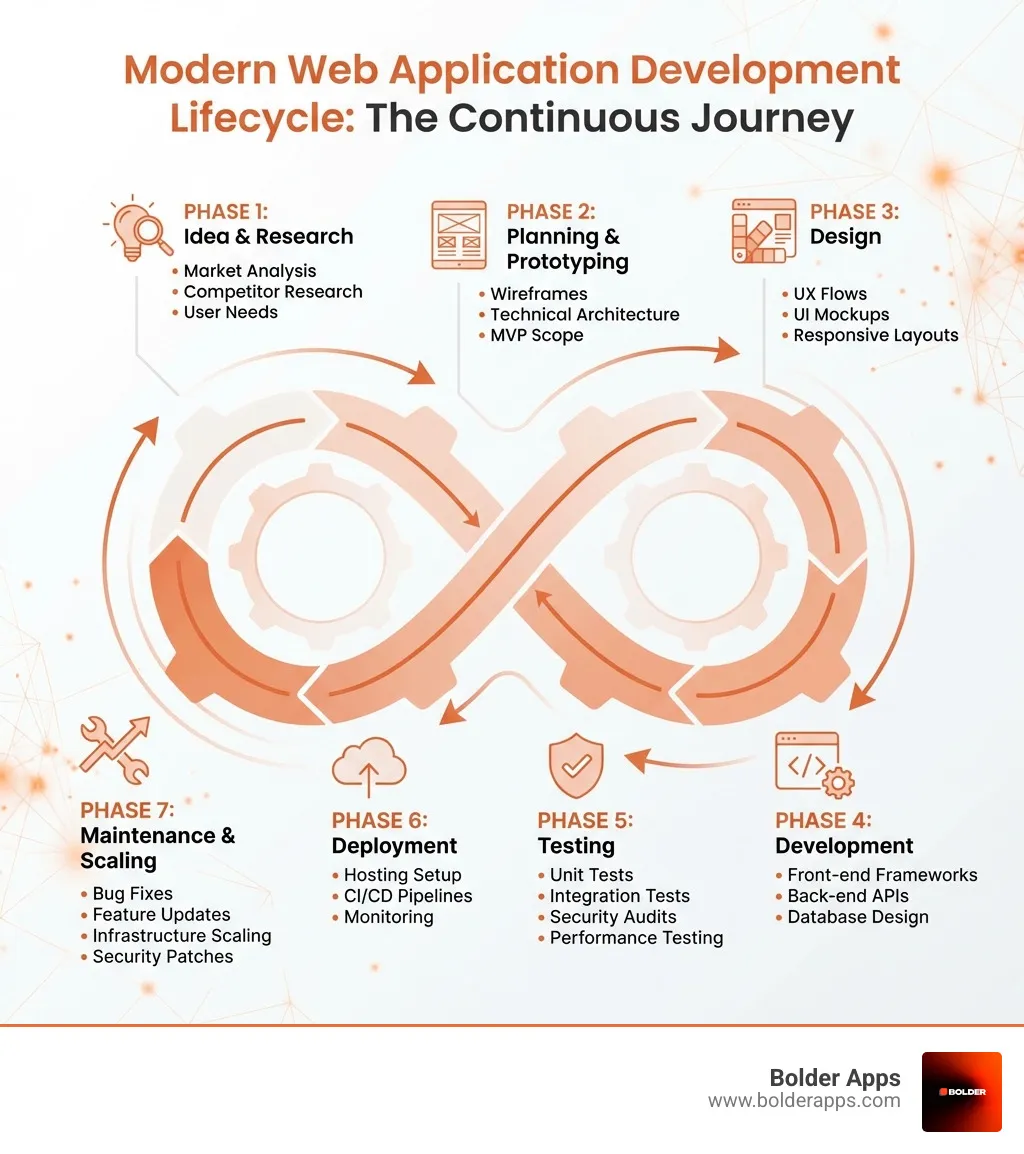
The modern development process is an intricate, iterative journey. Here’s how we steer it:
Phase 1: Idea and Research: This phase validates the core idea through market analysis, user research, and defining the problem to be solved.
Phase 2: Planning and Prototyping: We define functionality, create wireframes, map the technical architecture, and define the Minimum Viable Product (MVP) scope. Prototype Development Services are crucial for visualizing the product and making informed decisions early on.
Phase 3: Design (UX/UI): We translate wireframes into visually appealing, intuitive designs that are both functional and enjoyable to use.
Phase 4: Development (Front-end & Back-end): Senior engineers build the user-facing front-end and the back-end (server, database, logic), integrating the necessary technologies.
Phase 5: Testing: Rigorous unit, integration, end-to-end, security, and performance testing ensures quality by identifying and fixing bugs.
Phase 6: Deployment: The validated application is deployed to a live environment, which includes server setup and configuration.
Phase 7: Maintenance and Scaling: Post-launch, we provide ongoing maintenance, monitoring, bug fixes, and infrastructure scaling to support growth.
The Symbiotic Relationship Between UX/UI and Technical Development
In advanced web application development, User Experience (UX) and User Interface (UI) are integral to success. A beautiful but unusable app is worthless. UX focuses on the overall user journey, while UI deals with the visual elements. A great UX is rarely achieved without a thoughtful UI. For example, a stunning interface with slow load times creates a bad UX; Forbes reports that 47% of users will abandon a site if it takes more than 2 seconds longer to load.
Our user-centric approach integrates design into the agile process. By leveraging our UI/UX Design Services, we ensure technical constraints inform design and user needs drive development, creating responsive, functional, and delightful applications.
The Role of Version Control in Complex Projects
Version control is an indispensable tool for managing changes in complex projects, preventing chaos when multiple developers work on the same codebase. Using systems like Git, we gain several benefits:
Collaborative Development: Allows multiple developers to work on one codebase without conflicts.
Code Documentation: Creates a project history with messages explaining each change.
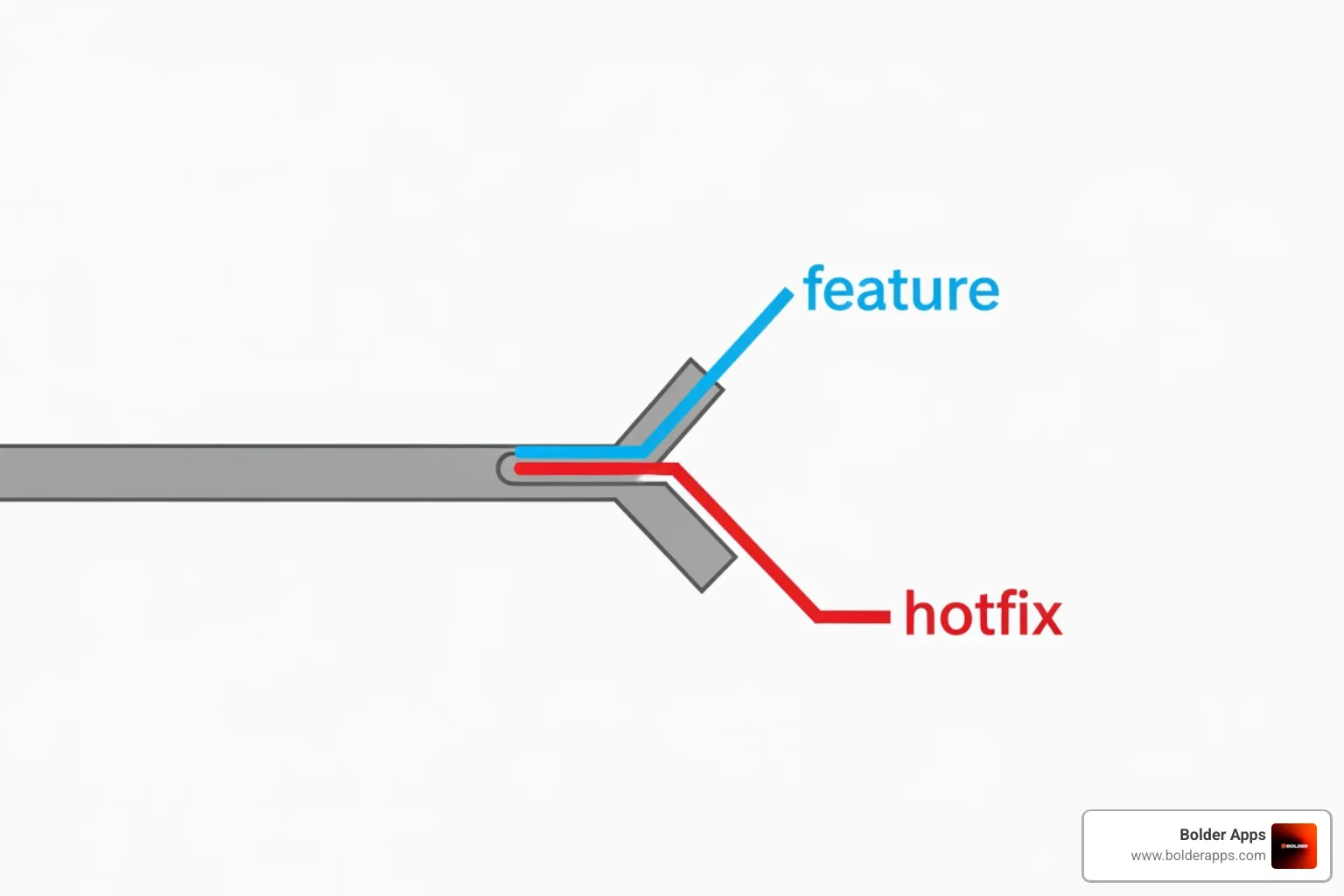
Branching Strategies: Enables isolated work on features or fixes using branches, which are merged when stable.
Reverting Changes: Easily revert to previous, stable code versions if mistakes are made.
CI/CD Integration: Forms the backbone of Continuous Integration/Continuous Deployment (CI/CD) pipelines, automating testing and deployment.
Version control acts as our project's safety net and collaboration hub, ensuring complex projects remain organized and resilient.
Core Competencies: The Essential Front-End and Back-End Skillset
An advanced web application requires a stunning front-end (the user-facing interface) and a robust back-end (the structural engine). While full-stack development is valuable, specialization in either front-end or back-end often leads to deeper expertise in advanced applications.
Front-End Mastery: Building Engaging User Interfaces
The front-end is the face of your application. Mastery requires a deep understanding of:
HTML5: The standard for structuring web content with semantic tags.
Advanced CSS: Mastery of responsive layouts (Grid, Flexbox), animations, and scalable styling techniques.
JavaScript (ESNext): Essential for dynamic UIs, including asynchronous programming and modularity.
SQL Databases (e.g., PostgreSQL): Best for structured data with complex relationships.
NoSQL Databases (e.g., MongoDB): Suited for unstructured data, offering high scalability and flexibility.
Server-Side Programming Concepts: Fundamental concepts include client-server architecture, request/response handling, and database interaction. For a deeper dive, Mozilla offers excellent resources on Server-side website programming.
Architecting for Tomorrow: Advanced Web Application Development
In advanced web application development, architecture is as crucial as code. Early architectural choices dictate an app's scalability, maintainability, and future evolution. While a traditional monolithic architecture bundles all components into a single codebase, it can become difficult to scale and update.
The modern trend leans towards microservices architecture, which breaks the application into small, independent services that communicate via APIs. This offers independent deployment, technology diversity, and greater resilience. A related concept is API-first design, where APIs are built before the UI, ensuring functionality is accessible to multiple clients (web, mobile, third-party) and promoting a clean separation of concerns. Choosing the right architecture is a key part of our Custom Software Development Services.
The Rise of Serverless Architecture
Serverless architecture allows you to build and deploy apps without managing servers, a major shift in advanced web application development. The cloud provider handles all infrastructure, so you just deploy code as functions (Function-as-a-Service or FaaS). You don't manage the servers; the provider does.
Benefits include automatic scalability and cost-efficiency (you only pay for what you use). However, challenges like vendor lock-in and potential "cold start" delays exist. Serverless is ideal for event-driven applications, real-time data processing, and APIs.
Understanding Progressive Web Apps (PWAs) for an App-Like Experience
Progressive Web Apps (PWAs) bridge the gap between websites and native apps, offering an app-like experience directly in the browser. They combine the best of both worlds:
Offline Support: Service Workers cache resources, allowing access without a reliable network.
Installable: Users can add a PWA to their home screen via a Web App Manifest, bypassing app stores.
Push Notifications: PWAs can send re-engaging push notifications like native apps.
Responsive Design: They adapt to any screen size for a consistent experience.
PWAs offer significant advantages: they are findable by search engines, bypass app stores, are easier to update, and have a smaller footprint. This means broader reach to the world's 5.44B internet-using people, lower costs, and better engagement. While native apps have their place, our Mobile App Development Services often recommend PWAs as a strategic alternative for delivering rich web experiences.
Building Bulletproof Apps: Quality, Security, and Performance
For advanced web applications, our goal is excellence, not just functionality. Quality, security, and performance must be integrated into the development process from the start. This means proactive quality measures, shifting security considerations to the design phase, and treating performance as a core feature. A slow app is a failed app.
Critical Security and Data Protection in advanced web application development
Security is paramount in advanced web application development, as a single breach can have catastrophic consequences. We must guard against common vulnerabilities like Cross-Site Scripting (XSS), SQL Injection, and Cross-Site Request Forgery (CSRF) with robust data protection.
Critical security measures include:
HTTPS: Encrypts all data in transit to prevent eavesdropping.
Data Hashing: Cryptographically hashes sensitive data like passwords so they are never stored in plain text.
Authentication vs. Authorization: We implement robust systems to verify who a user is (authentication) and determine what they can do (authorization).
Two-Factor Authentication (2FA): Adds a crucial second layer of verification to reduce unauthorized access.
Input Validation: Rigorously validate and sanitize all user input on both the client and server to prevent injection attacks.
Regular Security Audits: Periodic audits and penetration testing identify vulnerabilities before they are exploited. Our Code Audit Services provide this critical scrutiny.
Ethical Hacking: Simulates real-world attacks to proactively find and strengthen defenses.
The Power of APIs for Interconnected Systems
No modern application is an island. APIs (Application Programming Interfaces) are fundamental to advanced web application development, enabling systems to communicate and share data. An API acts as an intermediary: the client makes a request, and the API retrieves the necessary data from the server without exposing the underlying complexity.
Key aspects include:
RESTful APIs: A popular architectural style using standard HTTP methods (GET, POST, etc.) that is simple, stateless, and scalable.
GraphQL: A query language for APIs that allows clients to request exactly the data they need, preventing over-fetching and improving efficiency.
Enabling Dynamic Content: APIs are the backbone for fetching real-time data like account balances or transaction histories.
Third-Party Integrations: APIs facilitate integration with external services like payment gateways or social media platforms.
Well-designed APIs create scalable, interconnected ecosystems for richer user experiences.
Ensuring Quality: Testing and Performance Optimization Strategies
In advanced web application development, 'done' means coded, tested, and optimized. This requires a multi-faceted approach.
Our testing strategies include:
Unit Testing: Testing individual components in isolation.
Integration Testing: Verifying that different modules work together correctly.
End-to-End (E2E) Testing: Simulating real user scenarios to test the entire application flow.
Performance Testing (Load & Stress): Evaluating how the app behaves under various traffic loads to identify bottlenecks.
Beyond testing, continuous performance optimization is key:
Caching Strategies: Storing frequently accessed data in a cache (browser, server, or CDN) to speed up retrieval.
Code Splitting: Loading JavaScript in smaller, on-demand chunks to improve initial load times.
Lazy Loading: Deferring the loading of non-critical resources (like images) until they are needed.
Image Optimization: Compressing and using modern image formats to reduce file sizes.
Content Delivery Networks (CDNs): Distributing assets across a global network to reduce latency for users worldwide.
The Human Element: Accessibility, Ethics, and Future Trends
Advanced web application development is ultimately about serving people. This requires considering societal impact, ensuring accessibility for everyone, and anticipating future technologies.
Designing for All: Web Accessibility (a11y) in advanced web application development
Accessibility (a11y) ensures web apps are usable by everyone, regardless of ability. It's an ethical and business imperative, expanding your reach to a global audience of over 5.44B internet-using people. Key principles include:
WCAG Guidelines: Following the Web Content Accessibility Guidelines provides a clear framework.
Semantic HTML: Using HTML elements for their intended purpose gives structure for assistive technologies.
ARIA Attributes: These add semantics for screen readers when native HTML is insufficient.
Keyboard Navigation: All interactive elements must be operable via keyboard alone.
Screen Reader Support: Providing alternative text for images and clear headings helps visually impaired users steer content.
Integrating accessibility ensures our products are inclusive and user-friendly.
The Impact of AI on Modern Web Development
Artificial Intelligence (AI) is actively reshaping advanced web application development, impacting our tools, techniques, and how users interact with apps.
Key impacts include:
AI-Powered Coding Assistants: Tools like GitHub Copilot accelerate development by generating code, suggesting improvements, and reducing boilerplate.
The world of web development is in constant flux. We're watching several key trends:
WebAssembly (WASM): A bytecode format that runs languages like C++ and Rust in the browser at near-native speeds, ideal for performance-critical tasks.
Edge Computing: Moves computation closer to the user, reducing latency and improving response times for real-time applications.
The Evolution of JavaScript Frameworks: Frameworks are becoming more efficient, compiling code at build time to deliver smaller, faster bundles.
Low-code/No-code Platforms: These platforms accelerate development with visual interfaces, empowering more people to build applications.
The Metaverse and Spatial Web: As VR/AR matures, web applications will extend into immersive 3D environments.
These trends point to a future of faster, more intelligent, and more immersive web applications.
Your Bold Next Step: Partnering with Bolder Apps for Advanced Web Application Development
Building a sophisticated web application requires more than just code; it demands strategic vision, senior-level expertise, and a proven process. At Bolder Apps, we combine US-based strategic leadership with a distributed team of senior engineers to deliver high-impact web apps without the overhead of junior developers learning on your project. Our fixed-budget, milestone-based payment model ensures your project is delivered on time and on budget, turning your complex vision into a dynamic reality. Ready to build something bold? Explore our Web App Development Services to get started.