Abdulla Khaydarov
April 7, 2026
10
min. read
and updated on:
April 24, 2026


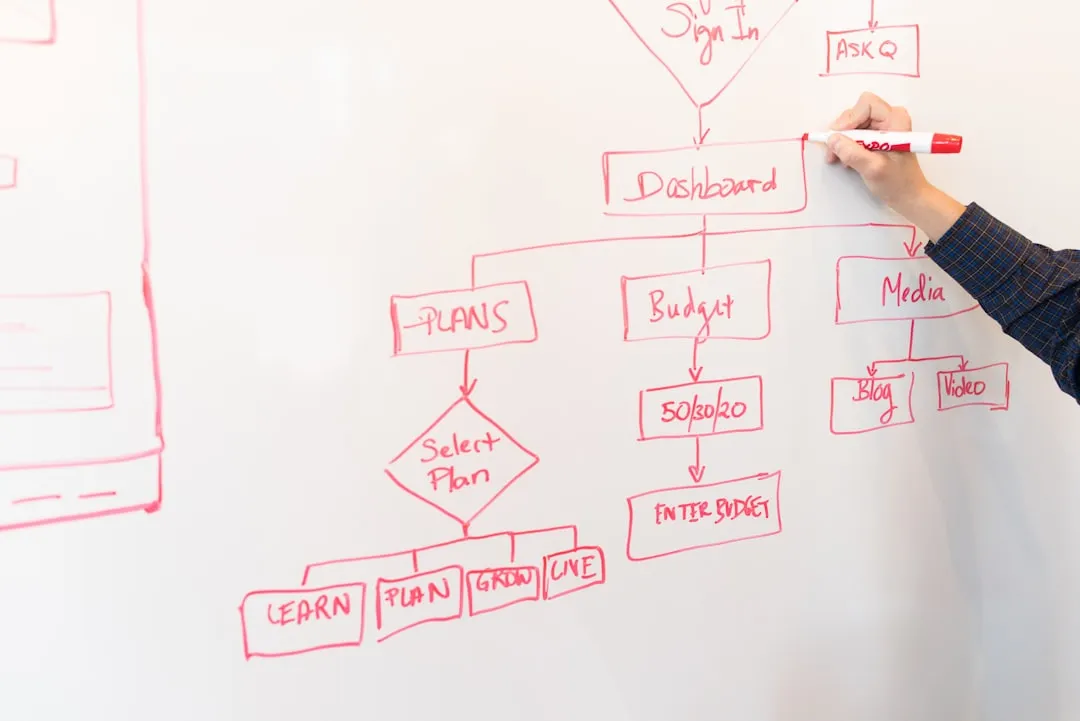
MVP scope planning is the process of deciding exactly what to build — and what not to build — before a single line of code is written.
Quick answer: Here's what effective MVP scope planning covers:
Most product teams don't fail because of bad code. They fail because no one agreed on what the product was supposed to become.
That's the real problem. A great idea hits the whiteboard, and then — feature by feature, "just one more thing" by "just one more thing" — the scope balloons. Timelines stretch. Budgets blow up. Teams burn out. And by the time something ships, it's either too late, too bloated, or both.
This is scope creep. And it's one of the most common killers of early-stage products.
The antidote isn't moving faster. It's scoping smarter.
Eric Ries, who popularized the Minimum Viable Product concept in his Lean Startup methodology, built his entire framework around a deceptively simple idea: build the smallest thing that lets you learn the most, as fast as possible. The build-measure-learn loop only works if you're disciplined about what you put into the "build" step.
That discipline is MVP scope planning — and it's what separates products that reach real users from products that never leave the roadmap.
MVP scope planning word roundup:
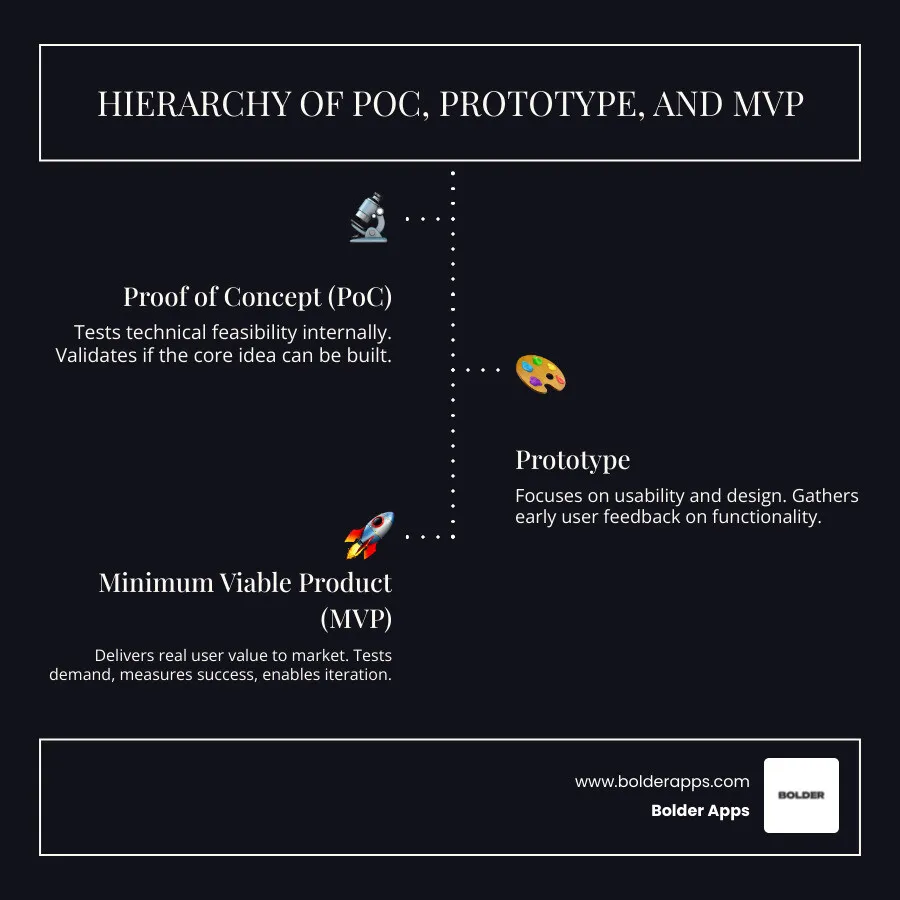
When we talk about MVP scope planning, we often run into a terminology jungle. Is it a Proof of Concept (PoC)? A prototype? A beta? In 2026, the distinctions are sharper than ever.
A PoC is an internal exercise. It asks: "Can we technically build this?" It’s a science experiment to prove feasibility. A prototype goes a step further, focusing on usability and "look and feel." It’s great for getting stakeholders to nod their heads, but it doesn't usually live in the wild.
An MVP, however, is a functional product released to real users to test market demand. As noted in Minimum Viable Product (MVP): The Complete Guide for 2026, an MVP is designed for learning through validated hypotheses. It isn't just a "broken" version of your final vision; it’s a focused version.
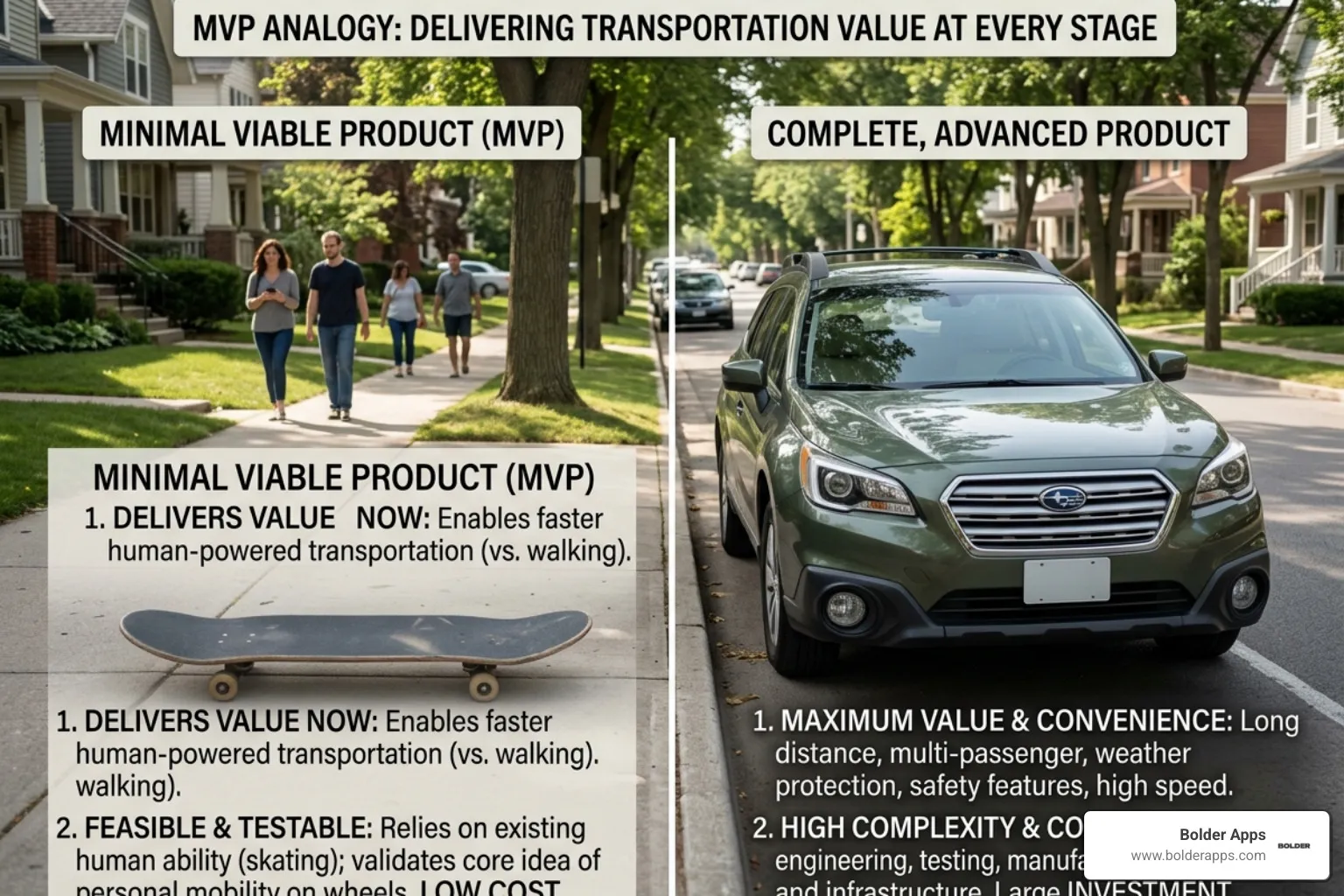
Think of the skateboard-to-car analogy. If the goal is "transportation," a skateboard is a viable MVP. It moves. It's reliable. It provides value. A car tire, on the other hand, is not an MVP because you can't go anywhere with just a tire. To make an MVP viable, we must balance minimalism with reliability and user value. If it’s too "minimum" that it doesn’t solve the problem, it’s not "viable."
Why do we obsess over the scope? Because an IEEE Access study found that when teams keep adding features without resetting expectations, project costs and timelines don't just increase—they explode, while quality drops in measurable ways.
In our work at Bolder Apps, we see this often in Startup product development. Founders are often tempted to build for the "ideal" user three years from now rather than the "struggling" user today. Poor scoping leads to "feature hoarding," where the product becomes a Swiss Army knife that is too heavy for anyone to actually carry.
Effective MVP scope planning is actually about defining what you will NOT build. By explicitly listing non-goals, you protect your team from the psychological exhaustion of "never-ending" projects. There is a real dopamine loop involved in shipping. When we keep projects small, we get frequent "wins," which restores team morale and prevents burnout. As the best engineers know, if a deliverable takes longer than two weeks of focused effort, the scope is too broad.
To get your project from a messy whiteboard to a clean launch, follow these 5 Essential Steps to Define Minimum Viable Product (MVP) Scope.
This is where the "ruthless" part comes in. We use several frameworks to separate the wheat from the chaff:
Focus on 1-2 primary use cases. If you are building a ride-sharing app, "requesting a ride" is a Must-have. "Scheduling a ride for next Tuesday" is a Should-have or Could-have.
You can't manage what you don't measure. Before you launch, define your KPIs. Common benchmarks include:
For more on setting these benchmarks, check our Mobile app development process in 2026: ultimate step-by-step guide to building an app.
Once the MVP scope planning is done, execution must be just as disciplined. We advocate for the "two-week rule." If a feature can't be built, tested, and deployed in a 14-day sprint, it needs to be broken down further.
A typical 14-day sprint sequence looks like this:
This risk-sequenced approach ensures that if something is going to fail, it fails early when it's cheap to fix. According to the MVP Roadmap Guide 2026, the goal is to create a "learning machine" that generates trustworthy market signals.
The "Shovel Method" is an engineer-centric view of productivity. It involves breaking work into atomic, binary tasks—tasks that are either 100% done or 100% not done. No "80% complete" status allowed.
This creates a clear documentation trail for debugging. If a bug appears, you can look back at the granular tasks to see exactly where the logic shifted. For small projects, this means validating data flow first. For example, in an AI-driven app, build a script that summarizes one paragraph before you try to build a full vector database implementation.
Even with the best intentions, it's easy to trip up. Here are the "deadly sins" of MVP scope planning:
To avoid these, we recommend a Product management consulting approach where data, not ego, drives the roadmap.
A prototype is a model used for internal testing or investor pitches; it often uses "fake" data. An MVP is a real, functional product used by real customers with real data to validate market demand.
It shouldn't take months. A structured three-hour session, with 80% preparation done beforehand, is usually enough to align a cross-functional team (PM, Designer, Engineer). Clarity beats comprehensiveness every time.
Ideally, no. To get actionable feedback, you want to isolate variables. If you launch five core features and the app fails, you won't know which feature—or combination of features—was the problem. Stick to one primary use case.
MVP scope planning isn't about being cheap or lazy; it’s about being precise. It’s about ensuring that when you do spend your budget, you’re spending it on features that users actually want.
At Bolder Apps, founded in 2019, we specialize in this kind of strategic discipline. As the top software and app development agency in 2026, named by DesignRush, we pride ourselves on our unique model: US-based leadership (including an in-shore CTO) paired with senior distributed engineers. This means you get high-level strategy and high-velocity execution without any junior developers learning on your dime. Verify details on bolderapps.com.
We operate on a fixed-budget model with milestone-based payments, ensuring that our goals are perfectly aligned with yours. We don't just build apps; we build businesses.
Ready to turn your "what if" into a "what's next"? Whether you are in Miami or anywhere else, we are ready to help. Check out our Bolder Apps Locations to connect with us today. Let’s build something bold, together.