The Definitive Guide to Product Management Consulting
"Provides expert guidance to optimize product development, craft market strategies, create roadmaps, and implement agile methodologies to align products with business goals and customer needs."
Why Product Management Consulting Matters for Your Business
Product management consulting provides expert guidance to optimize product development, craft market strategies, create roadmaps, and implement agile methodologies to align products with business goals and customer needs.
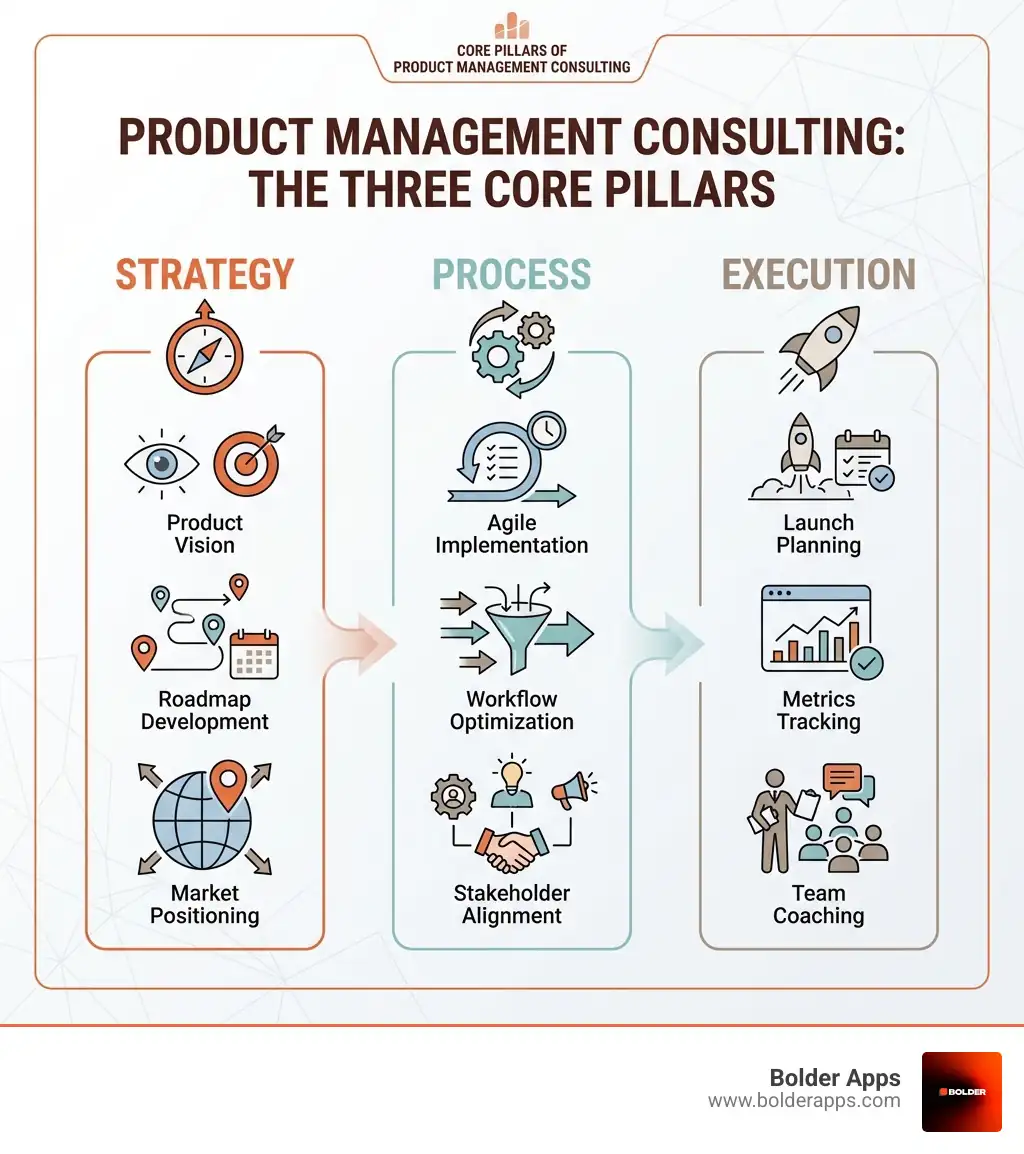
What Product Management Consulting Delivers:
Strategic Direction: Defines product vision, develops roadmaps, and aligns strategy with business objectives.
Process Optimization: Streamlines workflows, implements agile methods, and establishes scalable operations.
Market Intelligence: Conducts competitive analysis and validates product-market fit.
Team Enablement: Coaches product managers and fosters cross-functional collaboration.
Launch Execution: Crafts go-to-market strategies and tracks post-launch metrics.
Few roles are as fluid as product management. As one senior product manager put it: "You didn't start your business to be trapped by it. But somewhere between launch and now, the weight got heavier—the decisions, the uncertainty, the constant feeling that something might break."
The numbers back this up. More than 50% of product and tech investments fail to meet expectations. Yet, companies with strong product management achieve higher revenue growth and stronger market positions.
The global product management market reflects this urgency. Valued at $28.27 billion in 2023, it's projected to reach $49.3 billion by 2031, as businesses recognize effective product management as a critical performance driver.
This guide covers when to hire a consultant, how to choose the right one, what to expect, and how to measure success. Whether you're a startup or an established company, you'll learn how to leverage product management expertise to make informed decisions.
What is Product Management Consulting and What Does It Involve?
At its core, product management consulting is about bringing specialized, external expertise to your product development challenges. Think of it as inviting a seasoned explorer to help you steer uncharted territory. These experts provide guidance, strategies, and hands-on support to help you manage and launch products effectively, ensuring they hit the mark with your customers and business goals.
A product management consultant's role is multifaceted. They aren't just advisors; they often roll up their sleeves to assist with defining product strategy, creating roadmaps, conducting market research, and optimizing product operations. They adapt their core skills to your unique environment, driving alignment between user needs, business goals, and technical feasibility. It’s a dynamic role that can range from filling a short-term expertise gap to leading a complete strategic overhaul.
Core Services and Deliverables
The scope of services offered by product management consulting is broad, covering the entire product lifecycle. Here are some typical deliverables:
Product Strategy: We help define the right product by aligning your vision, user needs, and business goals into a clear strategic direction. For a deeper dive, explore our insights on Product Strategy Consulting.
Roadmap Development: We create detailed, strategic roadmaps that outline priorities and deliverables for effective product development.
Market Research & Validation: We conduct comprehensive analyses to identify customer needs, market trends, and competitive landscapes, blending quantitative and qualitative insights to validate assumptions.
Process Optimization & Agile Change: We streamline workflows by implementing agile methodologies and refining decision-making frameworks to improve flexibility and responsiveness. Our goal is to help you achieve the 23% costs saved that come from optimizing product management.
Go-to-Market (GTM) Strategy: Consultants design and execute effective launch strategies, covering messaging, pricing, and channel selection to maximize adoption.
Product Portfolio Management: This service helps optimize your entire suite of products, ensuring effective resource allocation and strategic alignment.
The Consultant's Role: Balancing Strategy and Execution
A product management consultant isn't just a talking head; they are often deeply involved in both strategy and execution. This balance is crucial for delivering tangible results.
Unbiased Advocacy: As outsiders, consultants are free from internal politics, allowing them to challenge assumptions and act as an unbiased advocate for the product and customer.
Pragmatism Over Purity: Effective consultants are pragmatists, adapting established frameworks to your specific environment to get things done, rather than rigidly sticking to a process that doesn't fit.
Challenging Assumptions: We introduce fresh perspectives by respectfully challenging existing ideas, encouraging your team to think differently and explore new possibilities.
Navigating Stakeholder Dynamics: We act as facilitators, balancing competing demands from executives, developers, and customers to maintain alignment with the product vision.
Overcoming Limited Context: To get up to speed quickly, we leverage cross-industry knowledge and intensive findy phases, ensuring we can contribute meaningfully on short-term engagements.
Empowering Teams: A key mission is to leave your team stronger through coaching, fostering collaboration, and knowledge transfer, ensuring changes are sustainable.
Want to understand how we approach product development comprehensively? Read more about our development process.
How Product Management Consulting Differs from Other Roles
Understanding the nuances between a product management consultant and other related roles is key to knowing who to bring into your organization.
Consultant vs. In-house Product Manager: Unlike an in-house PM focused on long-term, incremental improvements, a consultant brings a wider perspective from diverse industries. This allows for rapid problem-solving and innovation. They offer flexibility through part-time or project-based engagements, providing high-level expertise without the commitment of a full-time hire.
Consultant vs. Product Coach: A product coach is person-centric, focusing on an individual's skill development and career path. In contrast, a product management consultant is product-centric, focusing on the product's strategy, processes, and market fit to achieve business goals. While coaching focuses on the player, consulting focuses on the game.
The Strategic Benefits of Hiring a Product Management Consultant
Hiring a product management consultant isn't just about getting an extra pair of hands; it's a strategic move that can open up significant value. When over 50% of product and tech investments fail to meet expectations, bringing in expert guidance can be the difference between stagnation and success. We're here to help you optimize those investments, drive innovation, and ensure sustainable growth.
Driving Innovation and Reducing Time-to-Market
Product management consultants are uniquely positioned to ignite and accelerate innovation.
Test-and-Learn Approaches: We apply robust test-and-learn methods to boost innovation and shorten time-to-market, allowing for rapid experimentation and evolution based on real-world feedback.
Streamlining Workflows: By implementing agile methods and refining decision-making, we streamline workflows for more efficient development cycles and faster value delivery.
Challenging "The Way It's Always Been Done": As external experts, we challenge established norms and ingrained habits, opening the door for fresh ideas and more effective practices.
Reducing Bureaucracy: We help identify and remove unnecessary steps that slow down progress, focusing on essential communication to accelerate delivery without sacrificing quality.
Accelerating Execution: By optimizing processes and providing clear strategic direction, we help your teams execute faster and improve your speed-to-market. For inspiration, check out our Mobile App Startup Ideas to Launch in 2026.
Gaining an Objective Edge and Plugging Knowledge Gaps
An external perspective can be a game-changer.
External Perspective: Consultants draw on experiences from diverse industries, allowing them to spot opportunities and inefficiencies invisible to internal teams.
Freedom from Internal Politics: As outsiders, we are not influenced by internal politics, enabling us to provide unbiased recommendations and challenge assumptions.
Specialized Expertise: We bring specialized expertise in areas like AI, Product-Led Growth, or advanced market research, filling knowledge gaps and training your team.
Market Entry Knowledge: A consultant with market entry experience is invaluable for navigating new markets and avoiding costly missteps. This is why 45% of companies outsource some product development activities, a trend highlighted by Deloitte.
Fostering Organizational Change and Sustainable Growth
Consulting lays the groundwork for lasting organizational change and sustainable growth.
Product-Led Culture: We help instill a product-led culture focused on customer value, continuous improvement, and experimentation.
Cross-Functional Alignment: We facilitate cross-functional alignment, empowering teams to collaborate effectively and bridging communication gaps.
Scalable Processes: We help establish scalable processes, like Objectives and Key Results (OKRs), to ensure your product management practices can evolve with your company.
OKR Implementation: We guide you in setting measurable OKRs to track progress and ensure alignment with your product vision, providing clarity and focus.
Data-Driven Decision-Making: We champion a shift to data-driven decisions, using metrics like NPS and churn rate to validate hypotheses and inform strategy.
Enhancing Team Capabilities: Through coaching and mentorship, we improve your team's capabilities, ensuring they gain valuable skills for the long term.
Is It the Right Time? Identifying and Choosing Your Ideal Consultant
Knowing when to bring in a product management consultant and how to select the right one are crucial decisions. It's not about admitting weakness; it's about strategic reinforcement. Seeking expert advice can improve your operations, lift your product strategy, and optimize your team's performance.
Key Signals: When to Hire a Product Management Consultant
Several scenarios indicate that it might be the perfect time to bring in external expertise:
Establishing a New Product Function: Your company has a vision but lacks the structure to build a product function. A consultant can lay the groundwork, define roles, and set up processes.
Team at Capacity: Your product team is stretched thin, and you can't afford a long hiring cycle. A consultant provides immediate, expert coverage.
Navigating a Strategic Pivot: Your company needs to pivot its strategy. A consultant offers objective insights and frameworks for informed decisions.
Entering a New Market: You're venturing into new territory. A consultant with market entry expertise can help you understand customer needs and competitive landscapes.
Product Performance Has Plateaued: Your product's growth has stalled. A consultant can diagnose root causes and recommend strategies for success.
Filling a Leadership Gap: You need immediate product leadership without a full-time commitment. A fractional or interim consultant can provide strategic direction.
Core Competencies of an Exceptional Consultant
An exceptional product management consultant possesses a unique blend of skills:
Visionary Leadership: Creates forward-looking plans aligned with long-term business goals, managing present needs while building for the future.
Data Fluency: Leverages quantitative and qualitative data to influence decisions, inform strategy, and measure impact.
Stakeholder Management: Expertly balances competing demands from all stakeholders to ensure alignment with the product vision.
Adaptability: Adapts core PM skills to new environments, using agile and design thinking to adjust strategies dynamically.
Strong Communication Skills: Bridges gaps between technical and non-technical stakeholders, fostering clear collaboration.
Technical Proficiency: Possesses a strong understanding of technology to assess feasibility and communicate effectively with engineers.
Value Proposition Development: Excels at crafting impactful value propositions that articulate a product's tangible benefits.
A Step-by-Step Guide to Finding the Right Fit
Choosing the right product management consultant is a critical decision. Here's how to approach it:
Define Requirements: Clearly outline your challenges, missing competencies, budget, and desired timelines.
Write a Clear Job Description: Create a clear scope of work outlining responsibilities, expected outcomes, and how the consultant will integrate with your team.
Assess Cultural Fit: Ensure the consultant's working style and values align with your company culture for smoother collaboration.
Check References and Case Studies: Validate their expertise and impact by reviewing case studies and speaking with previous clients.
Align on Budget: Be transparent about your budget. While senior consultants can be pricey, their skills often justify the cost.
Ask Targeted Interview Questions: Prepare questions to assess their approach to prioritization, data-driven decisions, stakeholder communication, and team mentorship. Examples include:
"How do you prioritize features when faced with competing demands?"
"Describe a time you used data to influence a critical product decision."
"How do you ensure engineering teams understand customer pain points?"
"Can you walk me through a time you improved a team's capabilities?"
"What metrics would you track to measure a new feature's success?"
Maximizing and Measuring the Impact of Your Engagement
Once you've brought in a product management consultant, the work isn't over. To maximize the engagement's value, define clear expectations and establish robust metrics for success. Optimizing product management can lead to 23% costs saved and increased profits, so measuring that impact is vital.
Defining and Measuring Success: Key Performance Indicators (KPIs)
Success should be measured by tangible outcomes defined before the engagement begins. Here are some key performance indicators (KPIs) to track:
Roadmap Alignment: Clear alignment of the product strategy and roadmap with business objectives and stakeholder consensus.
Team Efficiency: Improvements measured by faster delivery timelines, reduced rework, and better cross-functional collaboration.
Product Launch Metrics: Success of new launches measured by market reception, customer satisfaction, adoption rates, and business goals.
Customer Satisfaction (NPS): An improved Net Promoter Score (NPS) signifies products that better meet user needs.
Feature Adoption Rates: Tracking the usage of new features to get direct feedback on the value delivered.
Churn Reduction: A decrease in customer churn, demonstrating a direct link between consulting impact and business outcomes (e.g., reducing churn by 15% by fixing usability issues).
Delivery Timelines: Faster and more predictable product delivery, indicating improved processes.
Alternatives to Product Management Consulting and When to Use Them
While consulting offers unique advantages, it's not the only path to product excellence. Depending on your needs, these alternatives might be more suitable:
In-house Training: Ideal for building long-term capabilities and addressing general skill gaps through internal workshops.
Online Courses and Certifications: Effective for individual skill development, allowing team members to acquire specialized knowledge at their own pace, such as through official qualifications.
Peer Networking: Engaging with product communities provides valuable insights, shared experiences, and informal mentorship.
Product Management Tools: Robust tools can embed best practices into your operations, acting as a "virtual consultant" for roadmapping and prioritization.
Full-Service Development Partners: When you need both strategy and execution, a full-service partner that integrates product management consulting can provide a seamless solution from ideation to launch. At Bolder Apps, we combine strategic product management with robust development. Explore Our Services.
Frequently Asked Questions about Product Management Consulting
Here are some common questions we encounter about product management consulting:
What types of projects are best suited for a product management consultant?
Product management consultants are versatile and ideal for:
Short-term Needs: Covering parental leave for a product leader or optimizing a specific product roadmap.
Long-term Initiatives: Leading major projects like a complete product strategy overhaul, launching a new product line, or driving significant organizational change.
Setting Up Processes: Establishing robust processes for customer findy, prioritization workflows, or implementing new agile methodologies.
Solving Complex Cross-Functional Challenges: Bringing an objective, structured approach to resolve issues with alignment, communication, or inter-departmental conflicts.
What are the common challenges product management consultants face?
While highly effective, consultants also face unique challenges:
Limited Context: Consultants must quickly absorb a new organization's context, which they overcome using cross-industry knowledge and intensive findy phases.
Lack of Longevity on Projects: Since engagements are temporary, consultants must focus on delivering sustainable solutions and empowering internal teams to continue the work.
Navigating Complex Stakeholder Dynamics: They must quickly understand and steer an organization's political landscape to build consensus and drive change.
Ensuring Implementation: A key challenge is ensuring recommendations are effectively implemented by the client's team, not just heard.
Overcoming Resistance to Change: Introducing new processes can meet resistance, which is managed by fostering experimentation and demonstrating clear benefits.
How much does it cost to hire a product management consultant?
The cost of hiring a product management consultant varies widely, much like asking, "How much does it cost to build an app?" (for insights, check out How Much Does It Cost to Make an App in 2026?).
Common engagement models include:
Project-Based Fees: A fixed fee for specific deliverables like a product strategy or roadmap.
Retainers: A recurring fee for ongoing advisory or fractional leadership.
Hourly Rates: For ad-hoc advice, workshops, or shorter-term engagements.
Factors influencing cost include:
Experience Level: Costs vary from junior to senior/executive-level consultants (often former Heads of Product or CPOs).
Project Complexity and Scope: A large-scale organizational change costs more than optimizing a single feature.
Length of Engagement: Longer engagements may have different pricing than short sprints.
Location: Local expertise in areas like Miami, United States can influence rates.
View the cost as an investment. The right consultant delivers significant ROI through increased revenue, reduced costs, and faster time-to-market.
From Strategy to Success: Your Next Move with Bolder Apps
We've journeyed through the intricate world of product management consulting, uncovering its definitions, benefits, and how to harness its power. From driving innovation and streamlining workflows to plugging knowledge gaps and fostering sustainable growth, the right product management expertise can be a game-changer for your business.
At Bolder Apps, we understand that great insights mean nothing without flawless execution. That's why we don't just consult; we partner with you to build high-impact mobile and web applications that transform your vision into reality. Our unique value proposition combines US leadership with senior distributed engineers, ensuring you receive strategic, data-driven, and intuitive product creation without the worry of junior learning on your dime. We bring the strategic acumen of product management consulting directly into our development process, offering a truly end-to-end solution.
When you choose Bolder Apps, you're not just hiring developers; you're gaining a strategic partner committed to your success. Here's what sets us apart:
• Fixed-Budget Model: No more budget surprises or scope creep nightmares. You get complete clarity and predictability from day one, allowing you to plan with confidence and allocate resources effectively.
• In-Shore CTO with Offshore Dev Team: Experience the perfect blend of sharp strategic oversight from US-based leadership and efficient, senior engineering talent from our global team. You get the best of both worlds—local accountability with cost-effective execution.
• Milestone-Based Payments: Pay for progress, not promises. Our milestone structure keeps everyone focused on delivering real, tangible results at each stage of development. You'll see your product evolve step by step, with clear accountability at every checkpoint.
Think of it this way: your product moves forward on a clear path, at a clear price, with clear accountability—no mysterious black boxes, just measurable outcomes that drive your business forward.
If you're ready to turn product strategy into a market-leading application (and avoid the "we built the wrong thing" horror story that haunts so many businesses), it's time to bring in a partner that lives and breathes product thinking. Bolder Apps can help you define the right product, build it the right way, and ship it with confidence.
Ready to transform your product vision into reality? Don't let another quarter pass watching competitors pull ahead. Explore our services today and discover how Bolder Apps' fixed-budget model, expert in-shore CTO guidance, and milestone-based payment structure can accelerate your path to product excellence and sustainable growth. Let's build something extraordinary together.
Miami has real mobile app development talent, and it has landing pages pretending to be Miami app development talent. This list separates the two. The best app development companies in...
Best App Development Companies in Philadelphia (2026)
You need an app built. You searched "best app development companies in Philadelphia" and got three directories, two ads, and a wall of agencies that all claim to be number one. This post...
App development in Philadelphia costs $30K-$60K for an MVP, $60K-$150K for a full iOS and Android product, and $150K-$250K+ for complex builds. Those are real fixed-scope numbers, not a...




.webp)
.webp)