Pavel Yanushka
May 20, 2026
14
min. read
and updated on:
May 20, 2026

Great digital product design balances user needs, business goals, and technical constraints. Companies that invest in design see nearly double the revenue growth. Here’s how it works.


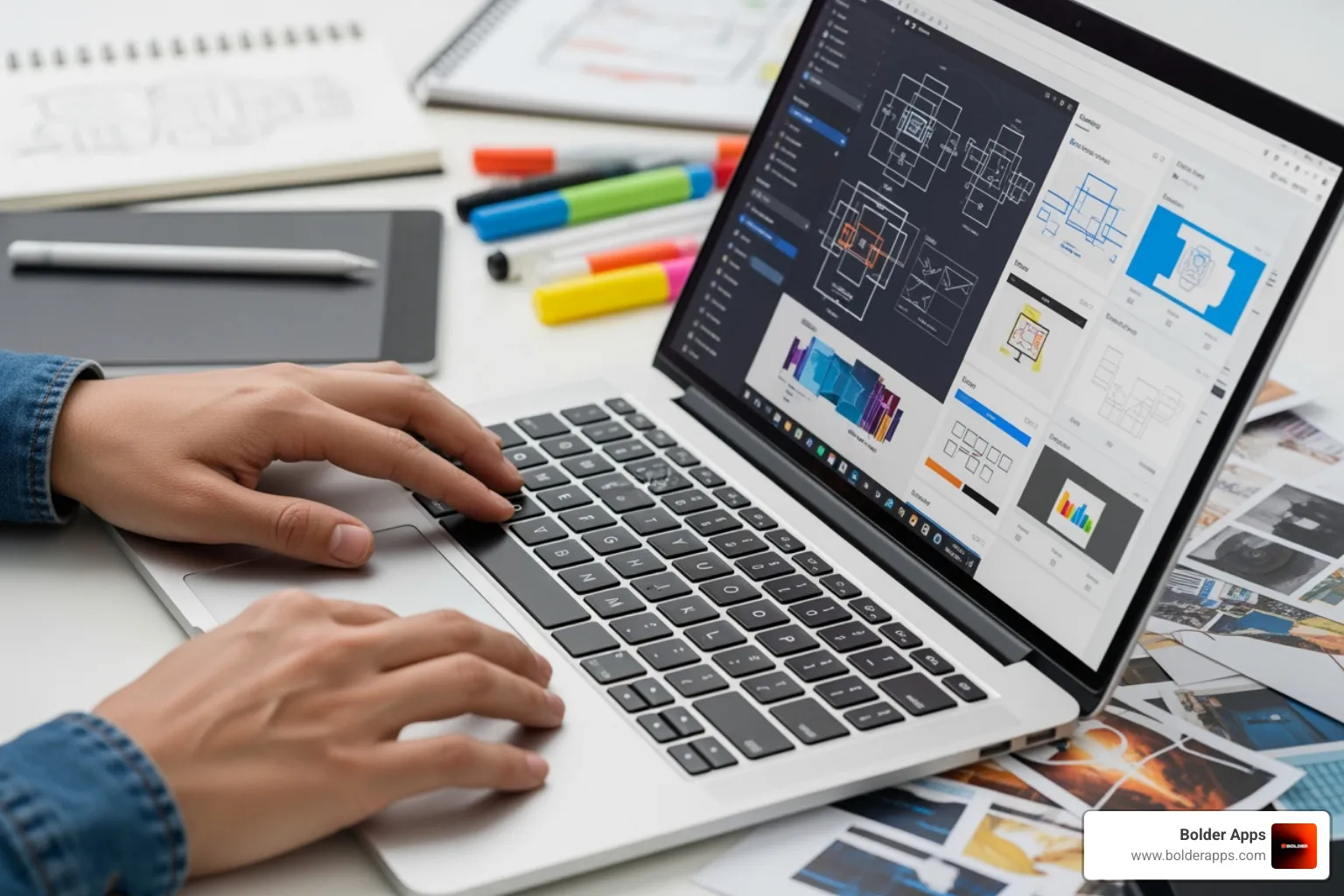
The design of digital products is far more than making something look pretty. At its core, it's an iterative process that solves real problems for real people while meeting business goals. Whether you're building a mobile app, a SaaS platform, or an e-commerce site, great digital product design balances three critical elements:
Every modern technology that makes life easier—from the apps on your phone to the platforms that run your business—exists because of thoughtful digital product design. It's why some products feel intuitive and delightful, while others leave users frustrated and confused.
Here's the reality: companies that invest in design see nearly double the revenue growth and 70% higher shareholder returns than competitors who don't. That's not cosmetic value—that's strategic business impact.
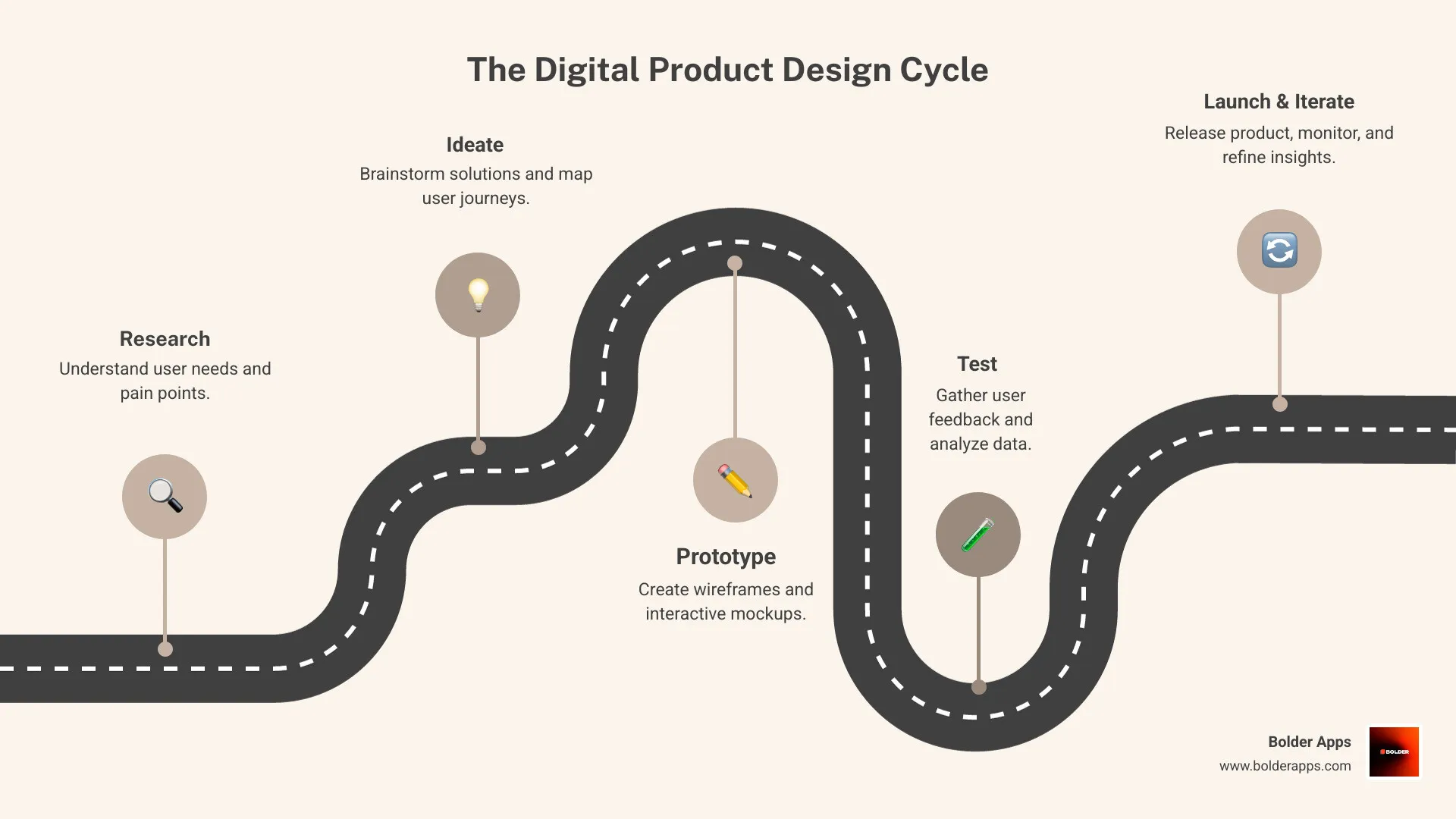
But what exactly does the design process look like? It's not a straight line from idea to launch. Instead, it's a cycle of continuous learning and improvement. You research your users, identify their problems, brainstorm solutions, build prototypes, test with real people, and iterate based on what you learn. Then you do it all over again.
This iterative approach is what separates good digital products from great ones. It's how you create solutions that don't just work on day one, but evolve to meet changing user needs and market demands over time.
The best part? You don't need to be a designer to understand this process. Whether you're a founder with a vision, a product manager building a roadmap, or a developer implementing features, understanding how great digital products get designed will make you better at your job.
So, what exactly is digital product design? Think of it as the grand orchestrator behind every digital experience we encounter. It’s a holistic approach that brings together user needs, business objectives, and technical feasibility to create functional, engaging, and valuable digital solutions. It's not just about how a product looks, but how it works, feels, and ultimately, how it solves a problem for its users.
Digital product design is fundamentally an iterative process used to solve a functional problem with a formal solution. Our goal is to identify an existing problem, offer the best possible solution, and launch it to a market that demonstrates demand. This often involves a deep understanding of user behavior and market dynamics. In fact, for every technical position in a company, a designer is also needed, underscoring the critical role design plays in technology.
You might be thinking, "That sounds important, but does it really impact the bottom line?" Absolutely! Investing in high-quality digital product design isn't just a nice-to-have; it's a strategic imperative that directly drives business success.
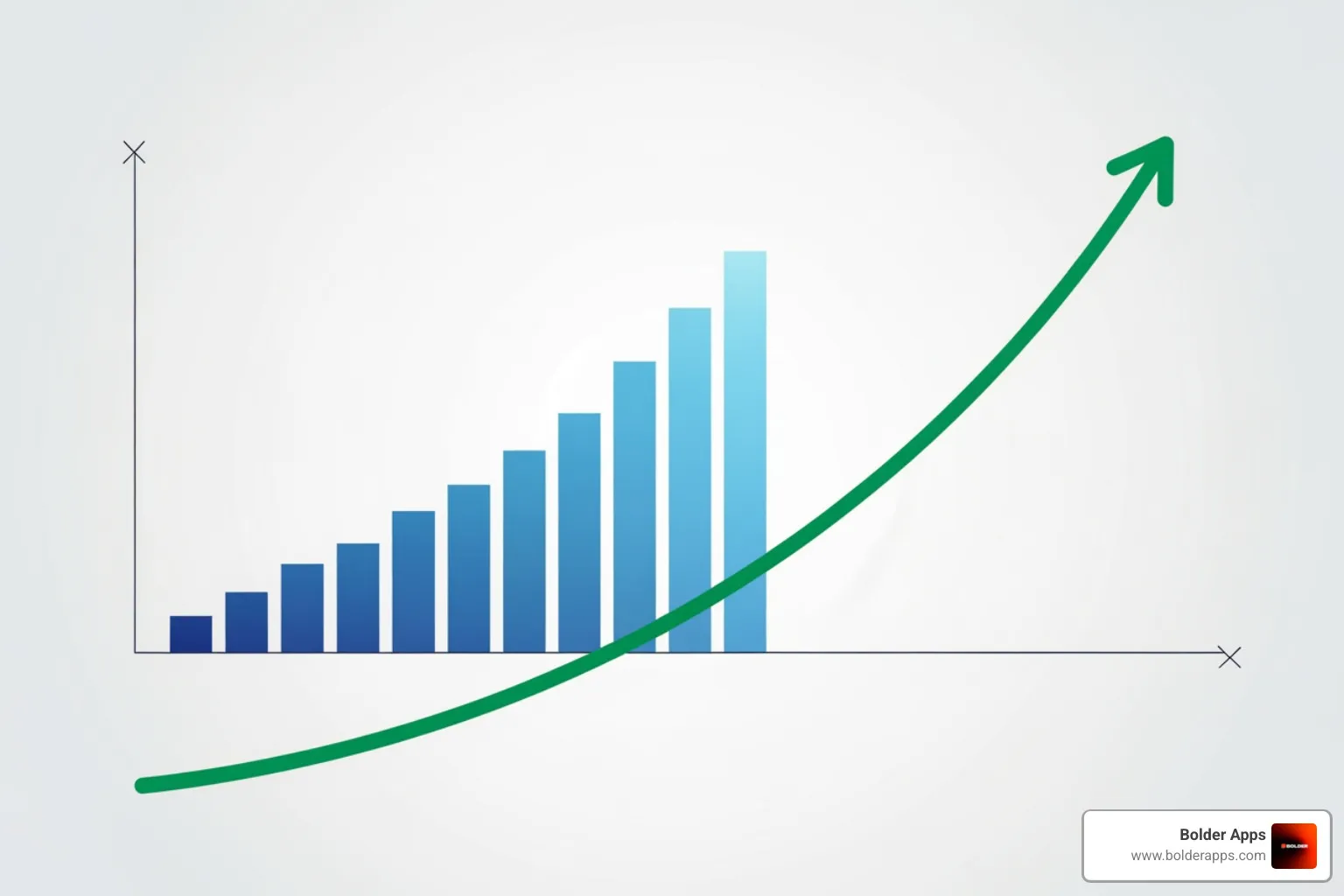
Companies that genuinely invest in design consistently outperform their peers. Studies show that top design performers achieve nearly double the revenue growth and a staggering 70% higher shareholder returns than competitors who deprioritize design. This isn't magic; it's the power of user-centric solutions. Well-executed design drives usability and helps products align better with business goals, leading to tangible benefits like reduced churn, increased conversion rates, and stronger brand loyalty.
Consider this: a seamless user experience (UX) design can raise conversion rates by an impressive 400%, and every dollar companies spend on UX design can yield a $100 return—that's a whopping 9900% ROI! Conversely, the cost of poor design is immense. More than 70% of marketers report that customers now demand much better digital experiences. A single bad experience can lead 13% of customers to tell 15 people about it, and a staggering 91% will simply leave without telling the company why. Ouch. Good design, therefore, isn't just about aesthetics; it's about creating user experiences that keep people engaged, loyal, and happy, which translates directly into good business.
If you're ready to see how strategic UI/UX design can transform your digital product, explore our UI/UX Design Services.
The world of digital design can sometimes feel like a bowl of alphabet soup, with terms like "Product Design," "UX Design," "UI Design," and "Web Design" floating around. While these fields are related and often overlap, they each have distinct focuses.
Digital Product Design is the broadest umbrella. It encompasses the entire lifecycle of a digital product, from initial concept to launch and ongoing iteration. A digital product designer looks at the "big picture," considering user experience, business goals, and technical constraints holistically. They aim to identify an existing problem, offer the best possible solution, and ensure it meets market demand. This means they are involved in product strategy, leading UI and UX design, and possessing an entrepreneurial mindset.
User Experience (UX) Design is a crucial component within product design. UX designers focus on how a product feels to the user. Their primary concern is the user's journey, ensuring it's intuitive, efficient, and enjoyable. They study user behavior, conduct research to understand needs and motivations, and incorporate principles of cognitive psychology into their designs. UX deliverables often include user flows, wireframes, and usability testing results. They want to make sure the product works for the user.
User Interface (UI) Design is another vital part of the digital product design ecosystem, often working hand-in-hand with UX. If UX is about how a product works, UI is about how it looks and interacts. UI designers are responsible for the visual and interactive elements of a product—the buttons, icons, typography, color schemes, and overall layout. Their goal is to create interfaces that are not only aesthetically pleasing but also clear, consistent, and easy to use. They want to make sure the product looks good and is easy to operate.
Web Design, while a significant discipline, is a more specific application. Historically, web design focused on creating static or dynamic websites. While modern web design incorporates strong UX/UI principles, it's typically centered on a website as the end product, rather than a broader digital product like a mobile app or a SaaS platform. Digital product design is a different creative process and career path from graphic design and web design, though it involves overseeing the look and feel of a product and the development of the software system.
In essence:
Creating a successful digital product isn't a one-and-done affair; it's a dynamic, iterative journey. We accept a structured yet flexible approach, where ideas are continuously tested, refined, and tested again until the digital product is ready for prime time. This continuous cycle of learning and improvement is at the heart of our methodology, often guided by principles like design thinking and agile development. Frameworks like the Double Diamond illustrate how designers gracefully move between phases of exploration and definition, ensuring we address the right problems with the right solutions.
Every great digital product starts with a deep understanding of its potential users and the problems they face. This is our "Research & Findy" phase, where we put on our detective hats and gather as much information as possible.
We conduct user interviews to gain qualitative insights into their needs, habits, frustrations, and desires. We deploy surveys for quantitative data, identifying trends and validating assumptions across a broader audience. Competitor analysis helps us understand existing solutions, market standards, and opportunities for differentiation. We also dive into market research to identify broader industry trends and unmet needs.
From this wealth of information, we craft user personas, which are semi-fictional representations of our ideal users, complete with goals, motivations, and pain points. Empathy mapping helps us visualize our users' experiences, thoughts, and feelings. This foundational work is crucial because it allows us to clearly define the problem we're trying to solve, ensuring we're building a product that genuinely adds value to people's lives.
Once we have a solid grasp of the problem and our users, it's time to get creative! The "Ideation & Prototyping" phase is where we brainstorm potential solutions and bring them to life in tangible, albeit preliminary, forms.
We start with brainstorming sessions, encouraging quantity over quality to generate a wide array of ideas. User journey mapping helps us visualize the steps a user takes to achieve a goal, allowing us to identify opportunities for improvement and innovation within the product experience.
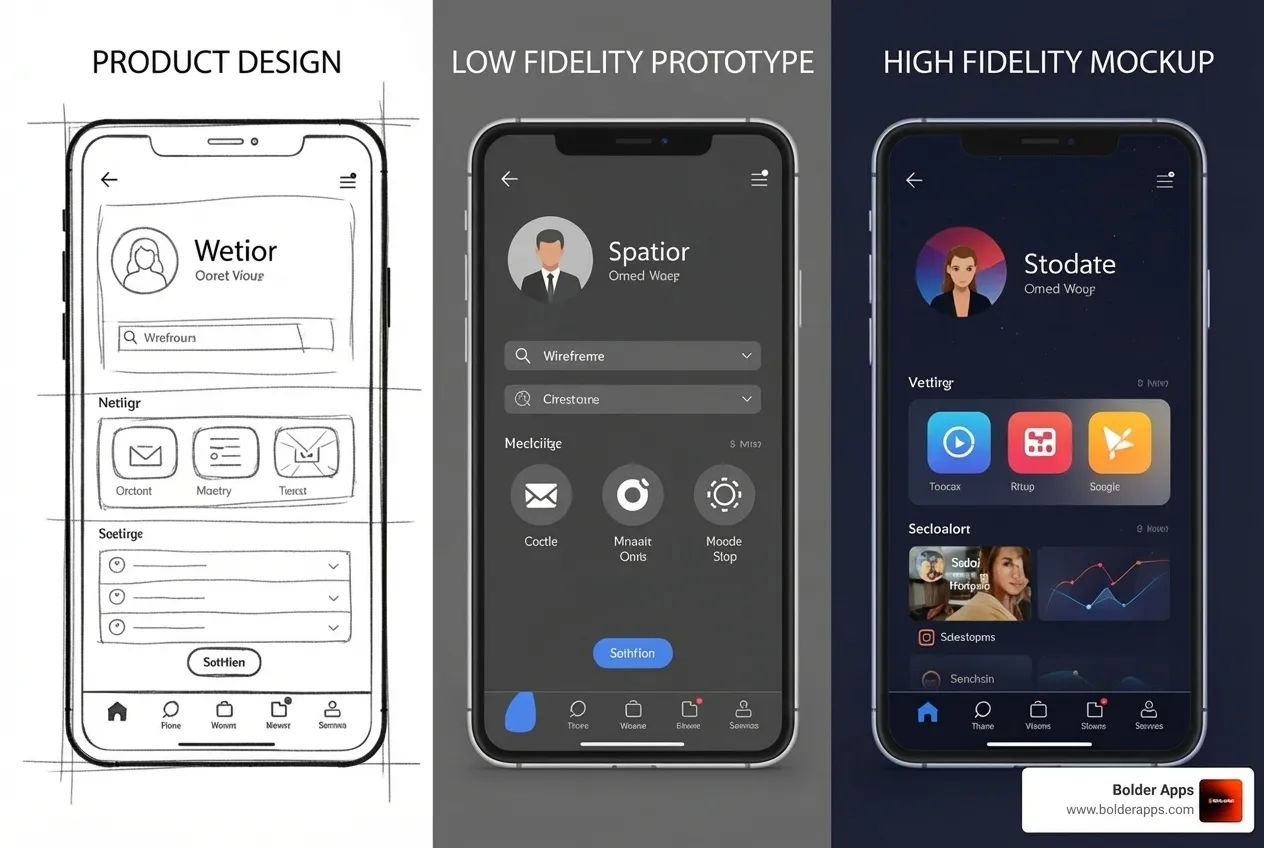
Then comes prototyping, which is the art of creating interactive mockups that demonstrate behaviors and user journeys before we write a single line of code. This is where we create:
Prototyping allows us to visualize our concepts, communicate them effectively with stakeholders, and make early adjustments, saving significant time and resources down the line. To learn more about how we bring ideas to life, check out our Prototype Development Services.
This is where the rubber meets the road! The "Testing & Iteration" phase is all about putting our prototypes in front of real users to gather feedback and refine our solutions. Testing isn't about proving we're right; it's about learning and improving.
We conduct usability testing to observe how users interact with our prototypes, identifying any pain points, confusion, or areas for improvement. You don't need a huge group for this; you can run sessions with as few as 5 users to spot 75% of issues. This is a powerful, cost-effective way to uncover significant usability problems early on.
A/B testing allows us to compare different versions of a design element or flow to see which performs better based on user engagement metrics. We actively engage in gathering feedback through interviews, surveys, and direct observation, listening carefully to what users say and, more importantly, what they do. This data analysis helps us make informed decisions, allowing us to continuously refine the solution. The product design process is iterative, meaning ideas are tested, refined, and tested again until a digital product is launched. This continuous loop ensures our product evolves to meet user needs effectively.
For more insights into effective testing strategies, you can explore resources like the Nielsen Norman Group which emphasizes that you can spot 75% of issues with just 5 users.
After rigorous testing and iteration, we reach the "Handoff & Launch" phase. This is where our carefully designed product transitions from concept to reality, and then into the hands of its users.
A crucial part of this stage is creating comprehensive design specifications and building robust design systems. These provide a single source of truth for all design elements, ensuring consistency and clarity. Product designers act as a bridge, building a shared language between design and development teams. This documentation is vital for smooth collaboration with developers, ensuring that the creative vision is translated accurately into code.
We work closely with engineering teams throughout quality assurance (QA) to catch and fix any bugs or inconsistencies before release. Finally, the product is ready for launch. But our work doesn't stop there. Post-launch, we continuously monitor performance, collecting user feedback and analytics to inform future iterations. This full lifecycle approach ensures that the digital product not only meets initial goals but continues to evolve and thrive in the market.
If you're looking for expert partners to bring your custom software vision to life, explore our Custom Software Development Services.
A digital product designer is truly a modern architect, crafting digital experiences that are both functional and delightful. Our role involves a unique blend of creativity, strategic thinking, and technical understanding. We're the ones who see the project from end-to-end, taking ownership of the entire product lifecycle. This often requires an entrepreneurial mindset, as we're constantly looking for opportunities to solve problems and create value.
The career path for a digital product designer is dynamic and in high demand. While job titles can vary (Product Designer, UX/UI Designer, Design Strategist, etc.), the core responsibilities revolve around identifying user needs, defining product vision, and guiding the development of digital solutions. The demand for UX designers, a key component of product design, has seen significant growth, highlighting the value businesses place on user-centric product development.
What does it take to excel in this multifaceted role? A digital product designer is a jack-of-all-trades, blending various disciplines into a cohesive skill set:
The field of design of digital products is inherently interdisciplinary and transdisciplinary. It draws from a rich mix of academic fields, including:
While formal degrees can provide a strong foundation, many successful digital product designers come from diverse backgrounds, often blending self-learning with formal education. Options for aspiring designers include:
Regardless of the path taken, continuous learning is non-negotiable in this rapidly evolving field. We constantly update our knowledge and skills to stay ahead. Here are some essential books and resources that we often recommend for aspiring and seasoned designers alike:
As we look to the horizon, the landscape of digital product design continues to evolve at a breathtaking pace. But beyond technological advancements, there's a growing emphasis on ethical considerations and designing for a more equitable future.
Good design isn't just about functionality; it's about responsibility. We believe in designing with a conscience, ensuring our products are accessible, fair, and respectful of all users.
Our commitment to building more inclusive models for digital product design is unwavering.
The future of digital product design is an exciting frontier, shaped by emerging technologies and evolving user expectations. We're constantly exploring new ways to improve user experiences and create innovative solutions.
The landscape is constantly shifting, and our commitment is to stay at the forefront, embracing these innovations while always keeping the human user at the center of our design philosophy.
We've journeyed through the intricate world of digital product design, from its fundamental definition and the compelling business case to its iterative process, the multifaceted role of a designer, and the exciting ethical and technological frontiers ahead. The core takeaway is clear: design is not merely an aesthetic concern but a strategic function, a powerful engine for innovation, growth, and user satisfaction. User-centricity is not just a buzzword; it's the guiding principle that lifts a good product to a great one.
At Bolder Apps, we understand that bringing a digital product to life is a significant undertaking. That's why we combine US leadership with senior distributed engineers, ensuring your project benefits from strategic oversight and top-tier technical execution. We believe in providing transparent, high-quality development without the overhead of junior staff learning on your dime. Our team in Miami is ready to help you craft your next digital masterpiece.
We de-risk your investment with a fixed-budget model and milestone-based payments, ensuring your vision is realized on time and on budget. You get predictable costs and clear progress markers, giving you peace of mind throughout the development journey. If you're ready to transform your ideas into an intuitive, impactful, and successful digital product, let's connect.
Start your project with our UI/UX Design experts and let's build something extraordinary together.