The Fintech Gold Rush is Here: How to Build a Fintech App
The fintech market hits $644 billion by 2029. Here's the complete 5-stage blueprint to build a fintech app — from planning and compliance to tech stack, costs, and launch.
To build a fintech app, you need to follow five core stages: Findy & Planning (defining your MVP and target audience), Design & Prototyping (creating user flows and wireframes), Development (building frontend, backend, and integrating APIs), Testing & QA (ensuring security and performance), and Launch & Support (deployment and ongoing maintenance). The process typically takes 5.5 to 11 months and costs between $40,000 and $300,000+ depending on complexity, with an additional 25% of your budget allocated for ongoing maintenance.
Here's what you need to know:
Market Opportunity: The fintech industry is projected to reach $644 billion by 2029, with 75% of users now actively using fintech products.
Timeline: Expect 5-7 months for a basic app, 7-9 months for mid-complexity, and 11-15 months for enterprise-grade platforms.
Technology Stack: Modern fintech apps leverage React Native or native development, Node.js or Python backends, cloud infrastructure, and third-party APIs.
The fintech revolution isn't coming. It's here.
Right now, traditional banks are losing ground to nimble digital-first competitors. Why? Because consumers want simple, fast, and accessible financial services that fit into their smartphones and daily lives.
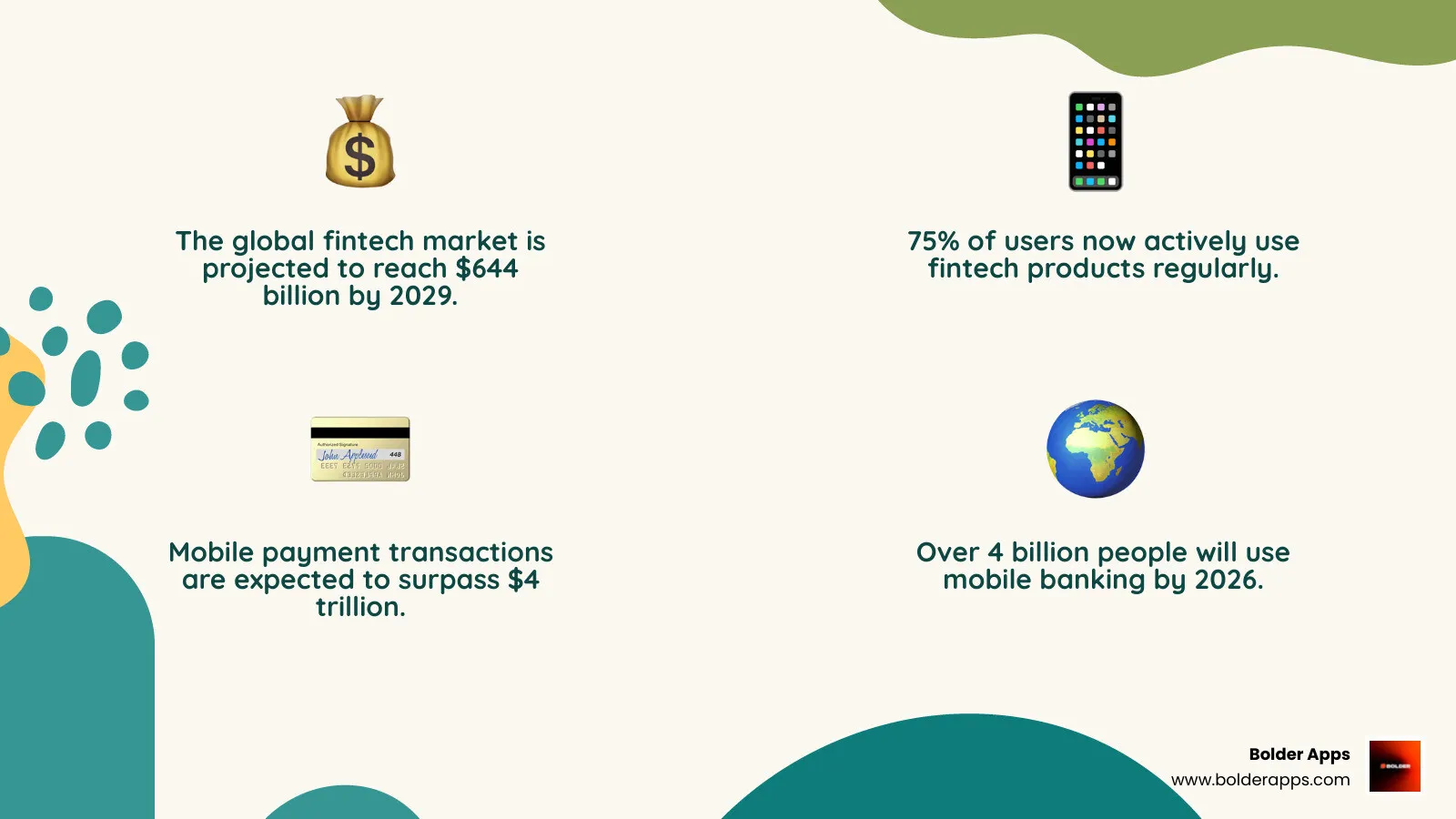
The numbers tell the story. The global fintech market is expected to hit $644 billion by 2029. Three out of four people now use fintech products regularly. Mobile payment transactions will surpass $4 trillion, and over 4 billion people will use mobile banking by 2026.
But here's the reality: building a fintech app isn't just about coding. It's about navigating a complex maze of security protocols, regulatory requirements, and user trust issues. Almost 60% of users abandon fintech apps, often because of poor onboarding or confusing experiences.
The good news? You don't need to reinvent the wheel. Banking-as-a-Service (BaaS) tools, pre-built APIs, and modern development frameworks have drastically lowered the barrier to entry. What used to require years of development and millions in capital can now be achieved in months with the right strategy and team.
Whether you're building a neobank, a payment processor, a robo-advisor, or a crypto wallet, the fundamentals remain the same: understand your users, solve a real problem, prioritize security and compliance, and deliver an exceptional user experience.
In this guide, we'll walk you through exactly how to build a fintech app that users trust and regulators approve. No fluff, just the blueprint you need to turn your vision into reality.
Your Blueprint: Planning a Fintech App That Wins
Before we even think about writing a single line of code, the real magic happens in the planning phase. This is where we lay the groundwork for a successful fintech app that truly addresses a market need. We start with meticulous market research, diving deep into current trends, identifying gaps, and scrutinizing what existing solutions are (or aren't) doing well. This helps us carve out a unique niche where our app can thrive.
Next, we conduct thorough audience analysis. Who are we trying to help? What are their financial pain points? What are their goals? Only around 25% of consumers believe financial services brands deliver the experience they want, so there's a huge opportunity to connect with users on a deeper level. By building detailed customer personas, we gain a clear understanding of our real-world users and how our app can seamlessly integrate into their financial lives. This strategic clarity is paramount, and it's why many leverage specialized Product Strategy Consulting to get it right.
Types of Fintech Apps
The fintech landscape is incredibly diverse, offering solutions for nearly every financial need. When you decide to build a fintech app, you'll likely fall into one of these categories:
Digital Banking: These apps are essentially banks without physical branches, offering checking and savings accounts, bill payments, and money transfers directly through a mobile or web interface.
Payment Processing: These applications facilitate online and in-person transactions, often replacing traditional payment methods, including contactless and QR code options, as well as global money transfers.
Robo-Advising: Utilizing AI and machine learning, these platforms provide automated financial and investment management advice at a fraction of the cost of human advisors. They help users steer stock market dynamics, detect trends, and manage wealth.
Insurtech: This category leverages big data and AI to offer highly personalized insurance policies and streamline claims processes, often filling gaps left by traditional insurers (e.g., cyber security insurance).
Lending (P2P): Peer-to-peer lending apps connect individual lenders with borrowers directly, bypassing traditional banks. They can power microfinancing and POS lending solutions, providing speed and flexibility.
Budgeting & Personal Finance: These popular apps help users track spending, categorize expenses, and manage budgets to make informed financial decisions.
Cryptocurrency: This rapidly expanding sector includes crypto exchanges, real-time investment and trading platforms, and multi-currency wallets that support both fiat and digital currencies. Blockchain-based remittance and settlement solutions also fall into this category.
Must-Have Features for Success
Regardless of the type of fintech app you're building, certain features are non-negotiable for ensuring security, usability, and user satisfaction.
Secure Authentication (2FA, Biometrics): Given the sensitive nature of financial data, robust security is paramount. This includes multi-factor authentication (2FA) and biometric options like fingerprint and facial recognition.
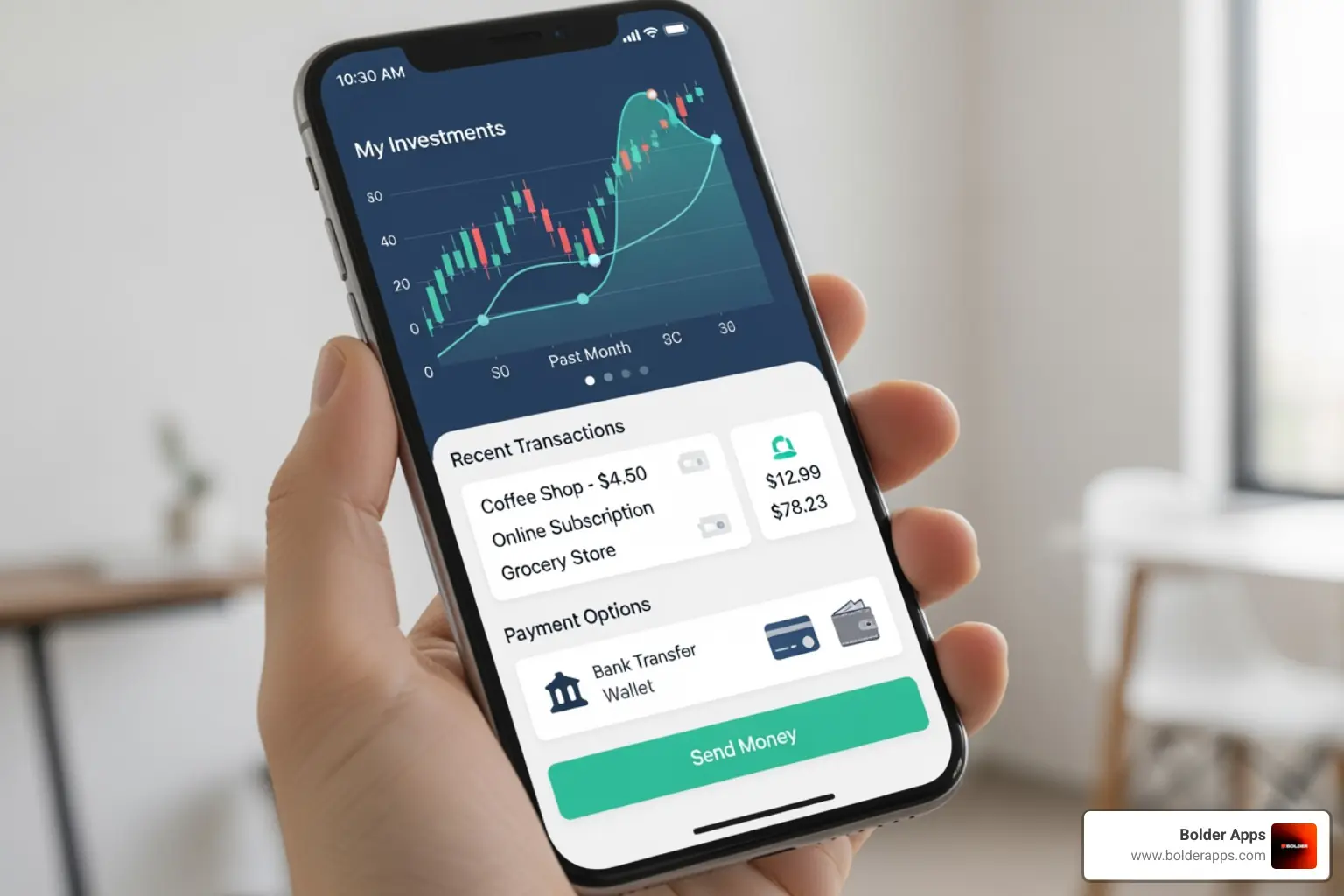
Real-time Dashboards: Users love clarity. Interactive dashboards that visualize financial data, transaction history, and account balances in real-time are essential.
Payment Gateway Integration: Seamlessly integrating with payment processors allows for smooth transactions, whether it's sending money, paying bills, or making purchases.
AI-powered Chatbots: Providing instant customer support through AI chatbots or live chat can significantly improve user experience. Research shows that 79% of businesses using live chat and conversational banking saw increased revenue and customer loyalty.
Push Notifications: These are crucial for transaction alerts, payment reminders, security warnings, and personalized financial advice.
Data Visualization: Beyond basic dashboards, advanced data visualization tools can help users understand complex financial patterns and make better decisions.
Exceptional UI/UX Design: An intuitive, responsive, and visually appealing interface builds trust and encourages adoption. Almost 60% of fintech app users abandon apps, often due to poor onboarding or confusing design. We prioritize UI/UX Design to ensure a smooth, enjoyable user journey.
The 5-Stage Process to Build a Fintech App
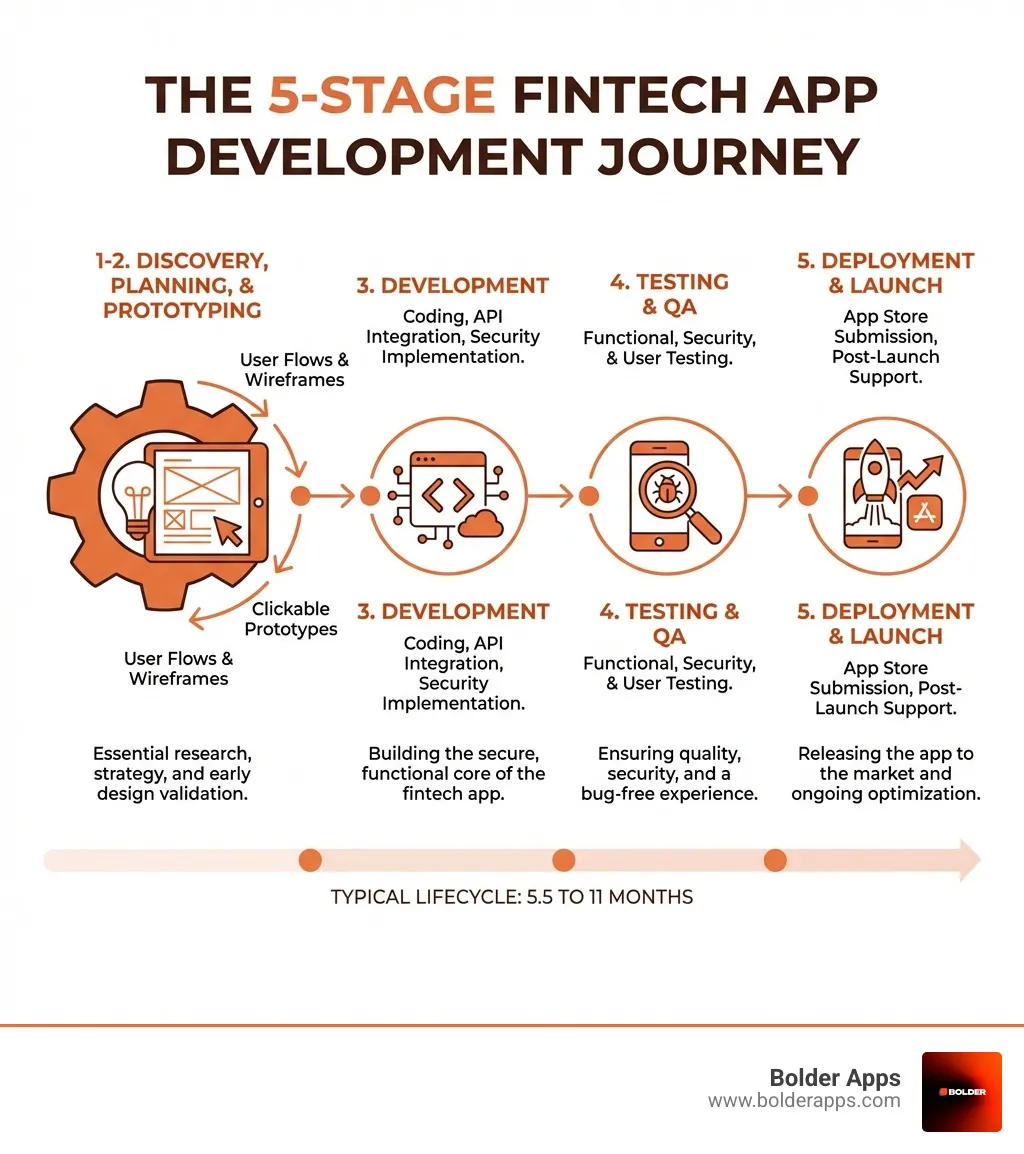
Successfully bringing a fintech app to life is a journey, not a sprint. It follows a well-defined, iterative process that ensures quality, security, and market fit. This structured approach, typically spanning 5.5 to 11 months, is critical for managing complexity and delivering a product that truly shines. For a deeper dive into the entire development lifecycle, explore our Mobile App Development Process in 2026: Ultimate Step-by-Step Guide to Building an App.
Stage 1 & 2: Findy, Planning, and Prototyping
This initial phase is all about understanding the "what" and the "how." We begin with thorough findy and planning, which typically takes 2 to 5 weeks. Here, we define the Minimum Viable Product (MVP) scope, outlining the core functionalities necessary to solve a key user problem. This is where we prioritize features, ensuring we build what's essential before adding bells and whistles.
Next, we move into design and prototyping, a phase that usually lasts 3 to 5 weeks. This involves creating detailed user flows to map out every interaction, wireframing to establish the app's structure, and developing clickable prototypes. These prototypes allow us to visualize the user experience and gather early feedback, iterating quickly to refine the design without writing extensive code. This focus on early validation is a cornerstone of our Prototype Development services.
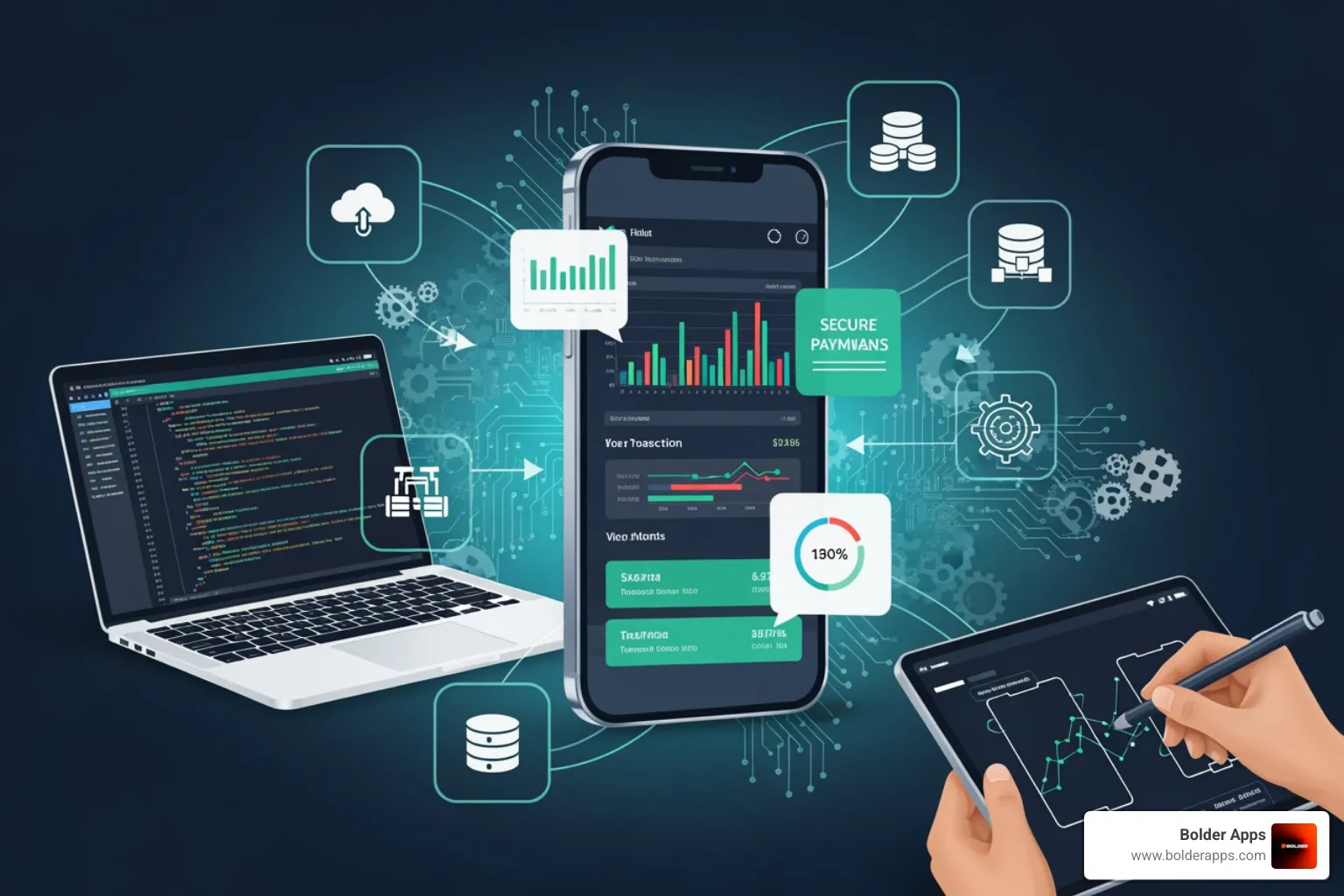
Stage 3: How to build a fintech app: The Core Development Phase
With a solid plan and validated prototypes in hand, we start on the core development phase, which is typically the longest, ranging from 3 to 6 months. This is where the actual coding happens, bringing our designs to life.
Frontend Development: Our developers build the user-facing part of the application, focusing on creating a seamless and engaging user experience across different devices.
Backend Development: This involves constructing the server-side logic, databases, and APIs that power the app. This is the engine room, handling data storage, processing, and all the heavy lifting behind the scenes.
API Integration: To provide comprehensive financial services, we integrate with various third-party APIs (Application Programming Interfaces). These might include payment gateways, credit score providers, or open banking platforms.
Database Architecture: We design and implement robust database structures to securely store and manage sensitive financial data, ensuring both performance and compliance.
This intricate process requires specialized expertise, which is why many seek partners for Custom Software Development to ensure their fintech app is built on a solid foundation.
Stage 4 & 5: Testing, Launch, and Beyond
No fintech app is ready without rigorous testing. This phase, usually 2 to 4 weeks, involves multiple layers of quality assurance:
Functional Testing: We ensure every feature works as intended, from login to transactions.
Security Testing: Given the sensitive nature of financial data, we conduct penetration testing, vulnerability assessments, and compliance checks to fortify the app against threats.
Performance Testing: We push the app to its limits to ensure it can handle high user loads and maintain responsiveness, crucial for real-time financial transactions.
Once testing is complete and any bugs are squashed, we prepare for launch. This typically takes 1 to 2 weeks and includes app store submission and final checks. We often recommend a soft launch in a controlled market to gather initial user feedback and make any necessary adjustments before a wider release. After launch, the work isn't over! Ongoing maintenance is crucial, covering updates, bug fixes, and adapting to evolving regulatory changes. We allocate around 25% of the total budget for this vital continuous support.
Navigating the Gauntlet: Security, Compliance, and Challenges
Building a fintech app is not for the faint of heart. It means navigating a minefield of potential pitfalls, where security and compliance aren't just features, they're foundational pillars. The biggest challenges typically revolve around:
Data Security: Financial data is gold for cybercriminals. The industry faces cumulative global payment fraud ready to amount to $343 billion between 2023 and 2027. Protecting user information is a constant battle.
Regulatory Problems: The financial sector is heavily regulated. Staying compliant with a patchwork of laws and standards can be a dizzying dance.
Legacy System Integration: Many traditional financial institutions operate on outdated systems. Integrating with these can be a technical headache, often requiring complex middleware and APIs.
User Trust: People are understandably cautious with their money. Building and maintaining trust requires transparency, reliability, and an unwavering commitment to security.
Fortifying Your App: Security and Compliance
To overcome these challenges, we embed security and compliance into every stage of development. It's not an afterthought; it's the core.
Data Encryption: Implementing strong encryption protocols like AES-256 for data at rest and TLS 1.3 for data in transit is non-negotiable.
PCI DSS: If your app handles cardholder data, Payment Card Industry Data Security Standard (PCI DSS) compliance is mandatory. Skipping it can lead to hefty penalties.
KYC/AML Regulations: "Know Your Customer" (KYC) and Anti-Money Laundering (AML) regulations are critical for preventing financial crime. This involves robust identity verification and transaction monitoring.
Data Privacy Laws: Complying with data privacy regulations like GDPR (General Data Protection Regulation) in Europe and the California Consumer Privacy Act (CCPA) in the US is essential. The essence of Understanding GDPR compliance lies in providing safe, fair, and lawful data operations.
Tokenization: Replacing sensitive data (like card numbers) with unique tokens reduces the risk of data breaches.
Regular Security Audits: Continuous monitoring, vulnerability scanning, and periodic security audits are vital to identify and address potential weaknesses before they can be exploited.
Assembling Your Toolkit: Tech Stack, Costs, and Monetization
Choosing the right technology and understanding the financial implications are crucial when you build a fintech app. It's about striking a balance between cutting-edge innovation and practical, scalable solutions.
Recommended Technology Stack
The technology stack is the backbone of your fintech app. Here's what we typically recommend:
Frontend: For mobile apps, React Native is a strong contender for its cross-platform capabilities, allowing for a single codebase for both iOS and Android. Alternatively, native development with Swift (iOS) and Kotlin (Android) offers maximum performance and access to device-specific features. For web interfaces, modern JavaScript frameworks provide responsive user experiences.
Backend: Robust and scalable backend languages are key. Node.js (with frameworks like Express.js) is excellent for real-time operations, while Python (with Django or Flask) is favored for its strong libraries, especially for AI/ML components. Java (with Spring Boot) is another powerful and secure choice, particularly for enterprise-grade systems.
Database: Relational databases like PostgreSQL are popular for their ACID compliance and strong data integrity, essential for financial transactions. Ledger databases are also gaining traction for their immutable, verifiable transaction logs.
Cloud Platforms: Cloud providers like AWS, Google Cloud, and Azure offer scalable, secure, and compliant infrastructure. Services like Firebase for user authentication and Cloud Firestore for secure hosting can accelerate development.
Third-party APIs: Leveraging specialized APIs can save immense development time. Open banking and financial-data APIs enable services like account verification, transaction data retrieval, and identity verification, while other services cover credit scoring, payment processing, and chatbots.
Estimating the Cost to build a fintech app
The cost to build a fintech app can vary wildly, much like building a house. It depends on several factors:
Complexity and Features: A basic app with core functionalities will naturally cost less than a complex platform with AI, blockchain, and multiple integrations.
Team Structure: Whether you opt for an in-house team, freelancers, or an outsourced development partner significantly impacts costs, especially given regional differences in hourly rates.
Development Time: As mentioned, timelines range from 5.5 to 11 months, with more complex projects taking longer.
Here's a general breakdown from our research:
Basic App: An approximate cost of $80,000 - $215,000+ within 5-7 months. This might cover essential features like secure authentication, basic account viewing, and simple money transfers.
Mid-Level App: Expect to pay $220,000 - $365,000+ within 7-9 months. This category often includes more complex features like budgeting tools, basic investment tracking, or advanced payment options.
Complex Platform: A large-scale fintech app or platform can range from $440,000 - $730,000+ within 11-15 months. This would encompass comprehensive features like robo-advising, multiple integrations, advanced analytics, and robust security layers.
Remember to allocate an additional 25% of your total budget for ongoing maintenance, which is crucial for updates, bug fixes, and regulatory adaptations. For a deeper dive into cost considerations, check out our guide on How Much Does It Cost to Make an App in 2026? Full Breakdown by App Type.
Monetization Models That Work
Once your fintech app is up and running, how do you make it profitable? Here are some effective monetization models:
Freemium: Offer basic functionalities for free to attract a wide user base, then charge for premium features, advanced analytics, or higher limits.
Subscription Fees: A recurring charge for access to the app's full suite of features or specialized services. This provides predictable revenue.
Transaction Fees: Charge a small percentage or flat fee on specific transactions, such as money transfers, bill payments, or cryptocurrency trades.
Interchange Fees: For apps that issue cards (like neobanks or expense management solutions), a portion of the merchant fee for card transactions can be earned.
Value-Added Services: Offer additional paid services like personalized financial coaching, tax preparation tools, or premium investment insights.
Many successful fintechs leverage a combination of these models to diversify their income and improve profitability.
Future-Proofing Your Fintech Venture
The fintech world never stands still. To ensure your fintech app remains relevant and competitive, we must constantly look ahead, anticipating the next wave of innovation. For a comprehensive overview of what's coming, read our Top AI Trends in 2026.
Key Trends Shaping the Future of Fintech
Several exciting trends are ready to redefine the financial landscape:
Embedded Finance: This involves integrating financial services directly into non-financial platforms. Imagine ordering groceries and instantly applying for a micro-loan within the same app, or a business management tool offering payment processing and short-term financing.
AI & Machine Learning: AI is already changing fintech with personalized financial advice, sophisticated fraud detection, automated customer support, and advanced risk assessment. As AI evolves, so too will its capabilities in predicting market trends and tailoring user experiences.
Open Banking Expansion: Driven by APIs, open banking allows for secure data sharing between financial institutions and third-party providers. This fosters innovation, enabling more interconnected and personalized financial services.
Blockchain & DeFi: While still evolving, blockchain technology and Decentralized Finance (DeFi) are moving towards mainstream adoption, offering new possibilities for transparent, secure, and disintermediated financial transactions, including cryptocurrencies and NFTs.
Hyper-personalization: Leveraging AI and big data, fintechs will offer increasingly custom products and services, anticipating user needs and providing proactive financial guidance.
RegTech: Regulatory Technology is growing rapidly, using AI and automation to help financial institutions steer complex compliance requirements, making it easier to meet AML/KYC standards and data privacy laws.
How to Accelerate Development
In a competitive market, speed to market can be a significant advantage. Here's how we can accelerate the development of your fintech app without compromising quality:
Agile Methodology: Adopting agile frameworks like Scrum or Kanban allows for iterative development, continuous feedback, and rapid adjustments. This flexibility is invaluable in a dynamic sector like fintech.
MVP Approach: Starting with a Minimum Viable Product (MVP) focuses resources on core functionalities, allowing for faster launch and real-world user validation before investing in additional features.
Using Pre-built Solutions: Instead of building everything from scratch, leveraging existing APIs, SDKs, and Banking-as-a-Service (BaaS) platforms can significantly reduce development time and cost, especially for common functionalities like payments or account aggregation.
Outsourcing to Experts: Partnering with experienced development firms or utilizing Staff Augmentation can provide access to specialized talent and accelerate project timelines. Our approach combines US leadership with senior distributed engineers, ensuring you get top-tier expertise without junior learning curves.
Turning Your Fintech Vision into a Real-World Product
We've covered a lot of ground, from understanding the booming fintech landscape and planning your app to navigating the complexities of development, security, and future trends. The journey to build a fintech app is demanding but incredibly rewarding, offering the chance to innovate and solve real-world financial problems for millions.
Bolder Apps brings a unique blend of strategic insight and technical execution to every project. You get an in-shore CTO-level partner who understands your business and market, paired with a highly skilled offshore development team that delivers efficient, reliable engineering. This hybrid model keeps communication clear and strategic while leveraging global talent to keep costs under control.
We operate on a fixed-budget model, so you know exactly what you're investing before development kicks off—no surprise invoices or mysterious overages. Milestone-based payments keep everyone accountable and aligned: you see progress, value, and working software at each step before releasing the next tranche of budget. That structure keeps projects moving forward and sharply focused on outcomes rather than hours logged.
If you're ready to turn your fintech idea into a secure, scalable, and user-centric app that can actually compete in today's market, Bolder Apps is ready to help. We'll guide you from product strategy and UX through architecture, development, compliance considerations, and launch—then support you as you scale.