Lily Kelce
December 22, 2025
5
min. read
and updated on:
February 25, 2026

Let’s be real for a second. You’re probably tired of hearing about "AI revolutions" that just result in slightly better email spam.
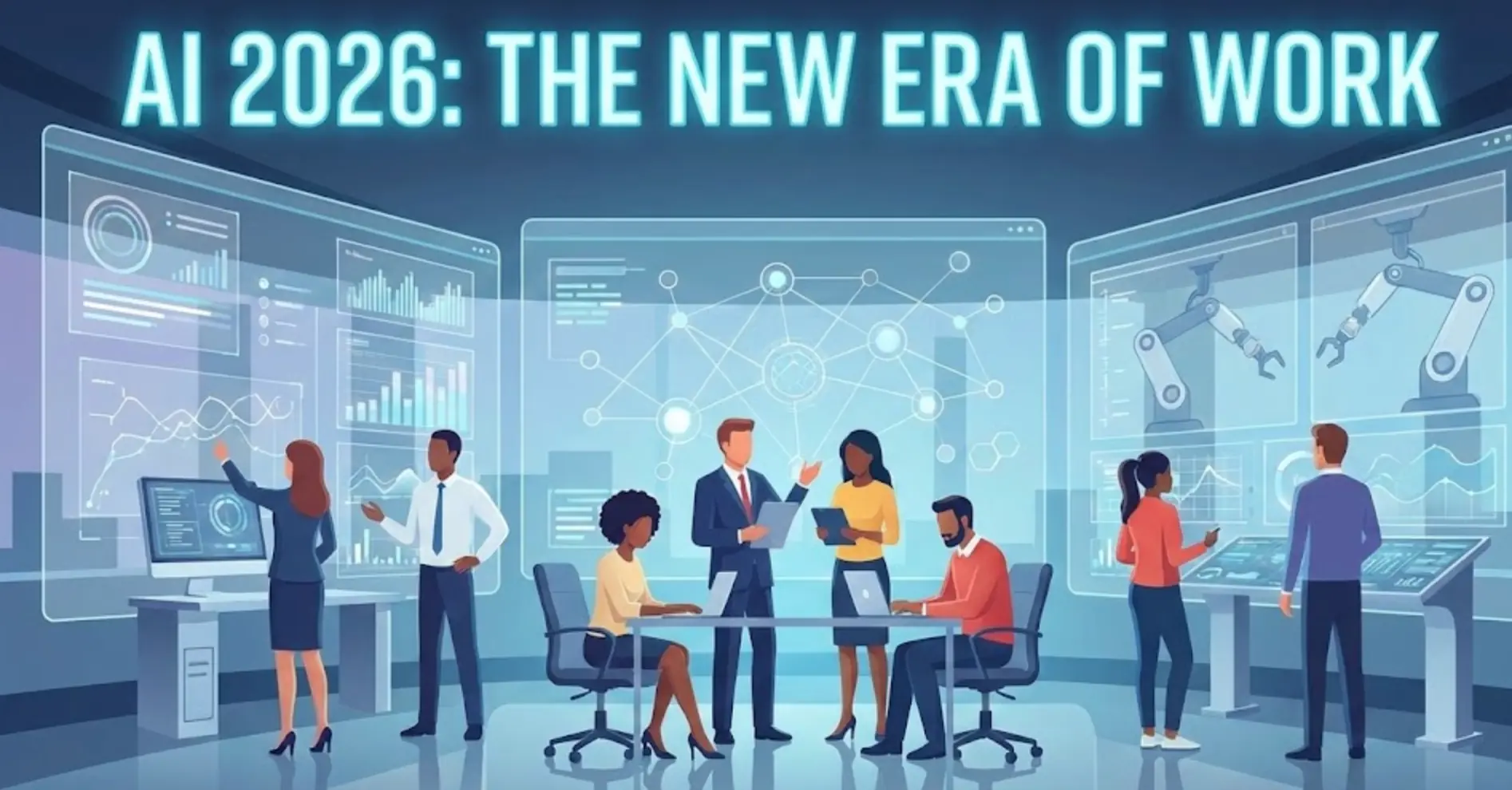
I get it. The hype fatigue is real. But here’s the thing: while we were all busy generating weird images of cats in spacesuits, the tech quietly grew up. If 2024 was the year of "Look what this cool chatbot can say," and 2025 was the year of "Okay, how do we use this?", 2026 is the year AI actually gets a job.
We are moving from talking to AI to trusting AI to do the heavy lifting.
If you want to stay ahead of the curve with us (and the algorithm), here are the Top AI Trends for 2026 that you need to know.
Keywords: Agentic AI, autonomous AI agents, AI workflow automation
This is the biggest shift, hands down. Until now, AI has been passive—it waits for you to type a prompt. In 2026, we’re seeing the explosion of Agentic AI.
Think of these as digital interns that have graduated to full-time employees. They don’t just answer questions; they execute tasks. You give them a goal ("Plan a marketing campaign for next Tuesday"), and they break it down, research competitors, draft the emails, and schedule the posts—all without you holding their hand at every step.
The Vibe Shift: We’re moving from "Chat with your data" to "Work with your data."
Keywords: AI reasoning models, System 2 thinking, complex problem solving
Remember when AI would hallucinate and confidently tell you that 2+2=5? Those days are fading fast.
The new wave of models (like the evolution of OpenAI’s o1/o3 series) utilizes "System 2 thinking." This means the AI literally pauses to think before it responds. It fact-checks itself, explores different logical paths, and critiques its own work before hitting "send." For industries like coding, law, and science, this is a game-changer.
Keywords: Small Language Models, Edge AI, privacy-first AI
Bigger isn't always better. The massive cloud models are great, but they are expensive and eat your privacy for breakfast.
In 2026, the trend is Small Language Models (SLMs) that live right on your laptop or phone. They are fast, they work offline, and most importantly, your data never leaves your device. Expect your next smartphone to have a dedicated "neural engine" that feels faster than the cloud.
Keywords: GEO vs SEO, AI search ranking, Generative Engine Optimization
If you create content, listen up. Google isn't just a list of blue links anymore; it’s an answer engine.
Traditional SEO was about keywords. GEO (Generative Engine Optimization) is about being the source that the AI trusts. You need to optimize your content so that when someone asks an AI, "What are the best running shoes?", the AI summarizes your review. This means more authority, more data-backed facts, and less fluff.
Keywords: Embodied AI, humanoid robots, AI in robotics
We’ve seen the viral videos of robots folding laundry (badly). But 2026 is seeing the integration of "brains" (advanced AI models) into "bodies" (hardware).
Warehouses and logistics are the first frontier, but we are inching closer to home assistants that can actually see and understand their physical environment. It’s not sci-fi anymore; it’s just expensive tech that’s getting cheaper every month.
2026 isn't about AI replacing us; it's about AI becoming the ultimate force multiplier. The winners this year won't be the ones with the best prompts—it will be the ones who know how to manage a team of AI agents.
What’s the one AI tool you can’t live without right now?