Andrew Abbey
December 17, 2025
5
min. read
and updated on:
February 25, 2026

"OpenAI officially opened the gates for developers to submit full-scale apps directly into ChatGPT."
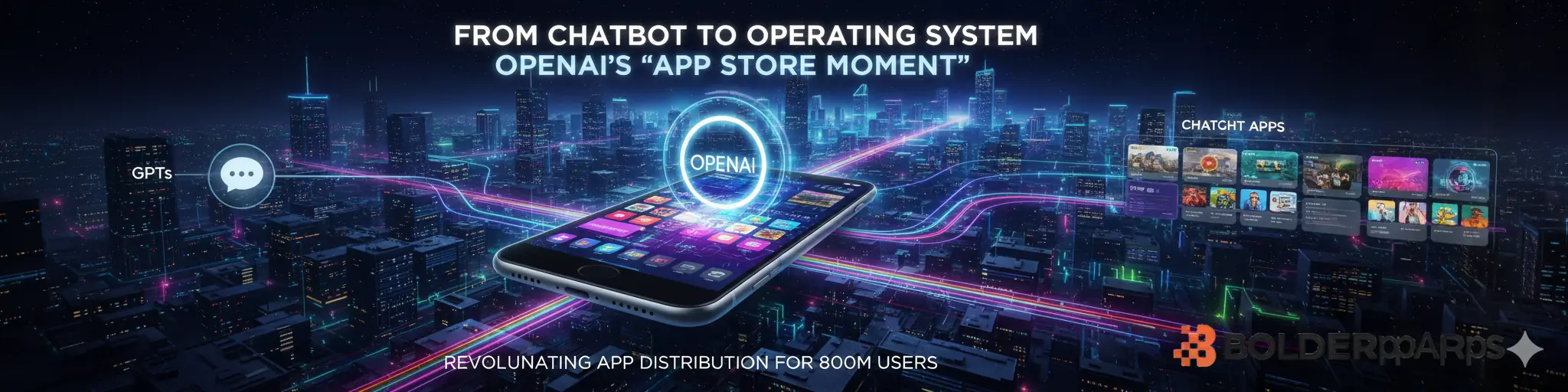
At Bolder Apps, we have been tracking the trajectory of Large Language Models (LLMs) since the first API keys were issued. We’ve watched the industry move from simple text completion to "Custom Instructions," and then to "GPTs." But on December 17, 2025, the game changed forever.
OpenAI officially opened the gates for developers to submit full-scale apps directly into ChatGPT. This isn't just a minor directory update. It is the birth of the AI Operating System. For founders and product leaders, it marks the most significant distribution opportunity since the launch of the iOS App Store in 2008. If you’ve been waiting for the right moment to build your "AI-first" product, the window has just swung wide open.
To understand why this is a revolutionary leap, we need to clarify the difference between the "GPTs" we’ve seen over the last year and the new "Apps" platform.
Custom GPTs were essentially "wrappers." They allowed users to provide a PDF as knowledge, a few custom instructions, and perhaps an API "Action." While useful, they were often brittle, limited in UI, and felt like a conversation with a specialized bot rather than a functional piece of software.
The new Apps SDK (currently in Beta) allows developers to build chat-native experiences. These aren't just chatbots; they are functional software modules that live inside the conversation.
At Bolder Apps, we prioritize distribution and friction reduction. The biggest hurdle for any new startup is getting a user to download a new app, create an account, and learn a new UI. OpenAI just eliminated that hurdle for 800 million weekly active users.
Imagine a user asking ChatGPT, "I’m planning a trip to Tokyo and I need a place to stay that’s near a subway station." Instead of giving a list of text recommendations, ChatGPT can now invoke a Zillow or Booking.com app directly. The user sees a carousel of live listings with interactive maps, checks availability, and completes the transaction—all within the chat thread.
This is Intent-Based Marketing at its peak. You aren't chasing users with ads; you are providing the solution exactly when they express the need.
Technically, this is the most exciting part of the announcement. By adopting MCP, OpenAI is creating a standardized way for AI models to talk to your data. Whether your data lives in a Google Drive, a SQL database, or a proprietary CRM, the MCP acts as the bridge. For developers, this means you can build a "connector" once and potentially have it work across multiple AI platforms in the future.
Currently, OpenAI is allowing "out-of-app" monetization. For example, an app can link to a website to complete a purchase for physical goods. However, they have explicitly stated that digital goods and advanced monetization options are on the roadmap. For savvy founders, now is the time to build the "Free" utility that captures the user base before the "Pro" features and paid tiers are rolled out in the new year.
Last week, we discussed Google’s Opal integration, which focuses on "Vibe-Coding"—allowing individuals to build their own mini-apps via natural language.
There is a clear strategic split occurring in the industry:
If you are a business looking to provide a service to others, OpenAI’s new App Directory is your primary target.
OpenAI has released strict App Developer Guidelines focusing on "Fair Play" and "User Intent." Based on our experience building high-performance applications, here is what we believe will separate the winners from the "rejected" in the new directory:
Don't try to build "The AI Everything App." The most successful apps in the early directory (like Adobe or Figma) do one thing exceptionally well. They solve a specific workflow—like "creating a social media post" or "searching for an apartment"—and they do it with high reliability.
OpenAI supports OAuth 2.1. If your app requires a login, it must be seamless. Users in a chat environment have zero patience for broken redirect loops or complex password requirements.
The best apps won't feel like "third-party tools." They will use OpenAI’s UI library to look like a native extension of the ChatGPT experience. Using the system font, simple buttons, and structured JSON list cards is essential for user trust.
As an agency that prides itself on "Zuckerberg-level clarity meets Miami-level speed," we see this announcement as a call to action.
Building a ChatGPT App is not just about writing a prompt. It requires:
The era of the "General Purpose Chatbot" is ending. We are moving into the era of the Functional AI Agent. ### Are you ready to lead the charge?
At Bolder Apps, we don't just build apps; we shape futures. Whether you want to be among the first wave of approved apps in the ChatGPT Directory or you’re looking to build a custom AI ecosystem that integrates with your existing business, we have the senior engineering talent to make it happen.
The first set of approved apps will begin rolling out to the 800 million-strong user base in early 2026. The time to start building is today.
Book a 1:1 Strategy Meeting with Bolder Apps to discuss how your "Bold Idea" can become the next featured app in the ChatGPT Directory.
Keep your ideas bold. Build with Bolder Apps.