Andrew Abbey
February 24, 2026
7
min. read
and updated on:
April 24, 2026

Xcode 26.3 ships with AI agents that write, build, test, and iterate autonomously. MCP support opens it to every compatible model. If you're still building iOS apps the old way, you're competing against people who aren't.
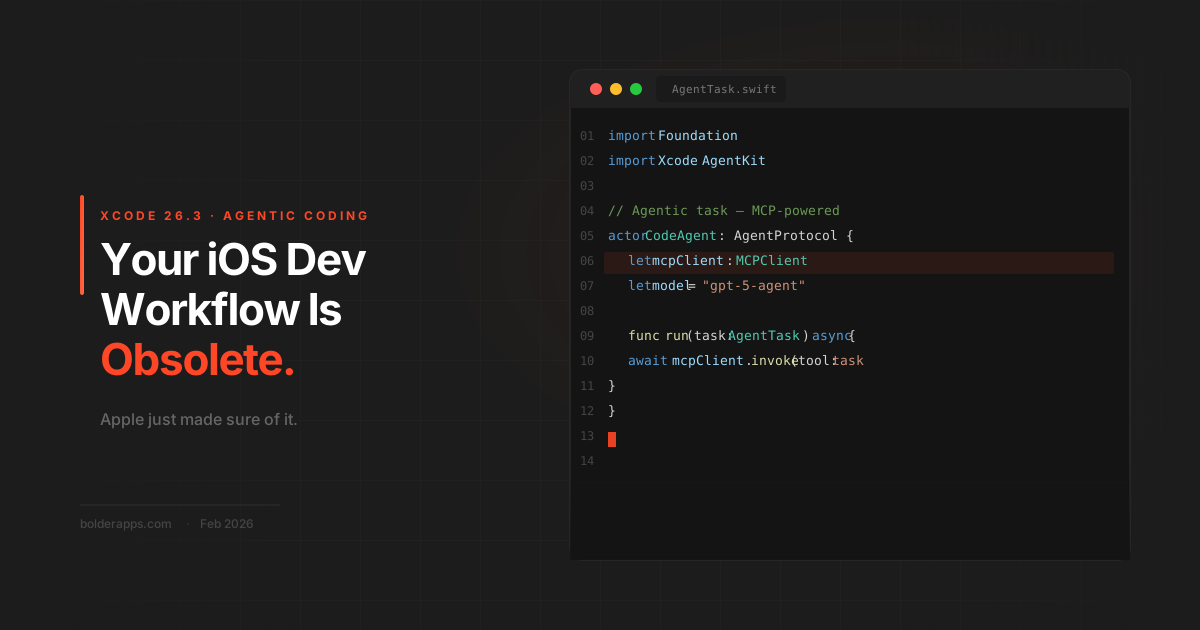
Not “will be obsolete.” Is. Present tense.
Apple shipped Xcode 26.3 with native agentic coding support. AI agents can now autonomously write code, run builds, execute tests, interpret failures, and iterate — all inside your IDE, with full access to your project files and Apple’s own developer documentation.
That’s not a feature. That’s a new way to build iOS products. And the teams adapting right now are pulling ahead of everyone still doing it the old way.
The iOS dev world has seen a lot of “AI changes everything” announcements over the past two years. Most of them were autocomplete with better marketing. This one is different for a specific reason: the full development loop.
An agentic coding workflow in Xcode 26.3 looks like this: the agent reads your codebase, writes implementation that fits your architecture, kicks off the build, reads the errors, fixes them, runs your test suite, interprets the failures, and iterates — without stopping to ask you what to do at each step. You direct. It builds.
The difference between an AI that suggests code and an AI that executes a development loop is the difference between a calculator and an accountant. One assists. The other works.
At Bolder Apps, we’ve been integrating AI into our development workflows for over a year. The manual stitching required to get anything close to this — agent connectors, custom toolchains, prompt orchestration — is now baked into the IDE Apple ships to every iOS developer on the planet. That’s the signal.
Model Context Protocol. If you’re not familiar, it’s an open standard that lets any compatible AI agent connect to tools and data sources in a standardized way.
Xcode 26.3’s MCP support means you’re not locked into whatever model Apple decides to partner with this quarter. You bring your own agent. Claude, GPT-4o, Gemini, a fine-tuned Swift specialist — if it supports MCP, it works inside Xcode. Your IDE, your agent, your choice.
That’s massive. It means the agentic coding ecosystem around iOS development will evolve independently of Apple’s own AI roadmap. Third-party agents optimized for specific stacks, frameworks, or even your team’s particular codebase patterns will plug straight in. The platform just opened up in a way Apple products almost never do.
Let’s skip the dev-team-internal implications and go straight to what this means for the people paying to have an iOS product built.
Feature velocity goes up. The work that used to occupy a senior iOS engineer for a full day — data layer implementation, test scaffolding, routine UI components — now takes a fraction of that time when an agent is running the implementation loop. More engineering time goes to the hard stuff: architecture decisions, edge case handling, UX quality.
Smaller teams become viable at higher output. A two-engineer iOS team operating with well-configured agents can produce what previously took four. For early-stage founders watching burn rate, that math matters enormously.
And quality oversight becomes the skill that separates good agencies from reckless ones. Agents ship code fast. They also ship subtle errors fast if nobody senior is reviewing the output with a critical eye. The “no junior devs learning on your dime” principle applies harder than ever — you want engineers who know how to set agent constraints, catch architectural drift, and maintain the integrity of what’s being built. Speed without oversight is how you end up with fast technical debt instead of fast product.
That’s the work we do at Bolder Apps. We build with the best available tools — and the best available tools now include properly supervised agentic workflows. If you’re building an iOS product, let’s talk about what that looks like in practice.
Apple doesn’t ship experimental developer features. When something makes it into Xcode, it’s been validated, hardened, and blessed for production use by millions of developers. The fact that agentic coding is now in Xcode is Apple’s way of saying: this is standard practice now.
The early adopter phase is over. Teams that have been running agentic workflows will keep their compounding advantage. Teams that start now will catch up. Teams that wait another six months for the technology to “settle” will be competing against shops that have months of accumulated workflow optimizations they built while waiting.
The competitive gap in iOS development isn’t going to close by itself. It widens with every sprint.
Agentic coding in Xcode 26.3 refers to the ability for AI agents to autonomously execute a full development loop inside the IDE — writing code, running builds, interpreting errors, executing tests, and iterating without manual prompting at each step. It’s a shift from AI-assisted to AI-executed development workflows.
MCP (Model Context Protocol) is an open standard for AI agent interoperability. Xcode 26.3’s MCP support means developers can use any compatible AI agent — not just Apple-native tools — to run agentic workflows inside the IDE. This prevents vendor lock-in and allows teams to choose agents optimized for their specific stack or codebase.
It makes iOS development faster, which can reduce cost if managed correctly. Routine implementation work that previously consumed senior engineer hours can now be handled by well-supervised agents. The cost efficiency depends entirely on the quality of oversight — teams that use agents to amplify senior engineers will see genuine gains; teams that use agents to replace oversight will generate technical debt faster than they save time.
Build now. The tooling is already mature enough for production use — that’s why Apple shipped it. Waiting for further maturity means giving your competitors a growing head start. The teams building today are learning what works in real environments. That knowledge compounds.