
Andrew Abbey
December 22, 2025
5
min. read
and updated on:
April 24, 2026

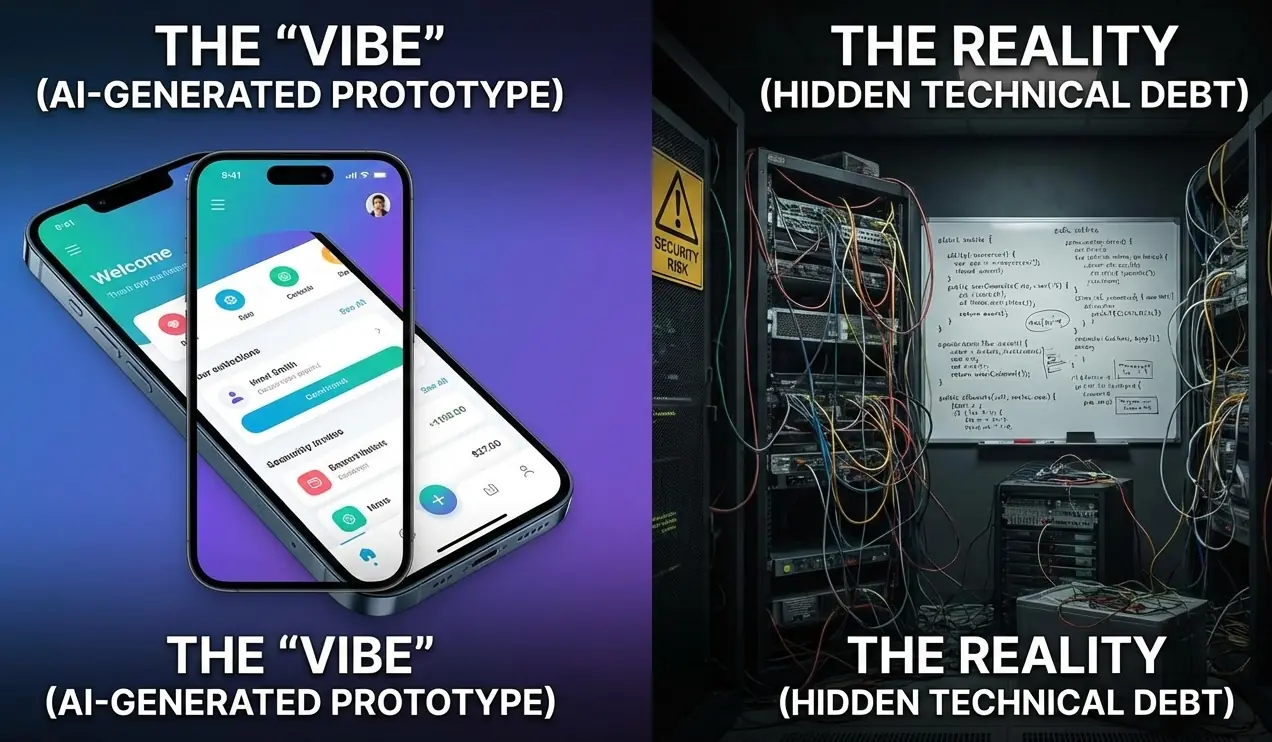
In the final weeks of 2025, the mobile app industry reached a point of no return. With the integration of tools like Google’s Opal for "vibe-coding" and OpenAI’s App Directory becoming a mainstream storefront, the barrier to entry for building a mobile application has effectively vanished.
But as we step into 2026, a new, more dangerous gap has emerged: the difference between a functional prototype and a marketable product.
At Bolder Apps, we’ve seen dozens of founders walk through our doors with "vibe-coded" MVPs that look beautiful but are architecturally built on sand. To help you navigate this transition, we’ve synthesized the most recent data from Gartner, Forrester, and real-world engineering audits to present the real risk vs. reward of using AI to build your mobile app in 2026.
The rewards of AI in 2026 are undeniable. We are no longer talking about simple code completion; we are talking about autonomous system generation.
In 2023, a proof-of-concept (PoC) took 4–6 weeks. In 2026, using agentic AI, that same PoC is built in an afternoon. By describing a "vibe" and a set of logic gates in Gemini or ChatGPT, founders can demonstrate value to investors immediately. This has compressed the "Discovery Phase" of development by nearly 80%.
Features that used to require a PhD—like real-time sentiment analysis, edge-AI predictive text, or multimodal search—are now available via simple API hooks. AI allows small teams to "punch up," building apps with features that would have required a 50-person engineering team just three years ago.
In 2026, a "static" UI is considered a failure. AI-driven development tools now include "Adaptive UI" layers by default. These apps reconfigure their own menus, layouts, and notification cycles based on individual user behavior.
While the speed of AI feels like magic, the data coming out of late 2025 tells a more sobering story. According to recent GitClear audits, code quality is in a "measurable collapse."
A landmark study in July 2025 revealed a startling psychological effect: developers using AI believe they are 20% faster, but objective testing shows they are actually 19% slower when building complex systems.
The reason? The "Almost Right" Problem. AI generates code that looks perfect but contains subtle, contextual logic flaws. Developers now spend more time debugging AI-generated hallucinations than they would have spent writing clean code from scratch.
Traditional technical debt accumulates linearly. AI-generated technical debt accumulates exponentially. * Bugs Déjà-Vu: AI tends to copy-paste legacy patterns rather than refactoring. This means if an AI creates a security flaw in your login module, it will likely repeat that same flaw in every other module it builds for you.
AI writes code like a talented junior developer: it follows the rules but lacks judgment. In 2025, over 40% of cyber events were powered by AI-related vulnerabilities. AI-generated code often misses "edge-case" security protocols, such as proper salt-hashing or protection against prompt-injection attacks. For apps handling sensitive health or fintech data, this isn't just a risk; it's a liability.
The most painful risk for founders in 2026 is the "Final Mile." Building an app on your laptop is easy; getting it through the Apple App Store or Google Play Store is a different beast entirely.
Apple and Google have updated their 2026 guidelines to be even stricter regarding AI-generated content and data privacy. Current statistics show that 95% of DIY/AI-built submissions fail their initial review. These failures are usually due to:
We don't tell our clients to avoid AI. We tell them to orchestrate it. To succeed in 2026, you need a hybrid model that balances AI velocity with human-led engineering rigor.
Feature
AI-Built (The "Vibe" Layer)
Bolder Apps (The "Rocket" Layer)
Logic Prototyping
Ideal for testing flows.
Refines for $O(n)$ efficiency.
Security
Basic guardrails.
Can achieve SOC2-compliant architecture.
Scalability
Can struggle at 1,000+ users.
Built for millions of concurrent hits.
UX/UI
Standard templates.
Bespoke, high-conversion design.
We suggest the following $ROI$ formula for your 2026 project:
$$ROI_{Total} = \frac{(V_{AI} \cdot Q_{Human}) - C_{Debt}}{Investment}$$
Where:
In 2026, the real risk isn't "using AI"—the risk is relying on AI as a substitute for expertise. If you are a founder looking to validate a new idea, tools like Opal and ChatGPT are your best friends. They allow you to fail fast and iterate cheaply. But when you are ready to turn that "vibe" into a business, you need a partner who can strip away the hallucinations and build a foundation that scales.
The most successful apps of 2026 will be those that use AI to spark the fire, but use human engineers to build the furnace.
Have you started building an app with AI and hit a wall? Or perhaps you're sitting on a bold idea and want to know how to leverage the 2026 AI stack without falling into the technical debt trap?
Book a 1:1 Strategy Session with Bolder Apps. We’ll audit your AI-generated code for free and show you exactly what it takes to get to the App Store.