Andrew Abbey
December 16, 2025
5
min. read
and updated on:
February 25, 2026

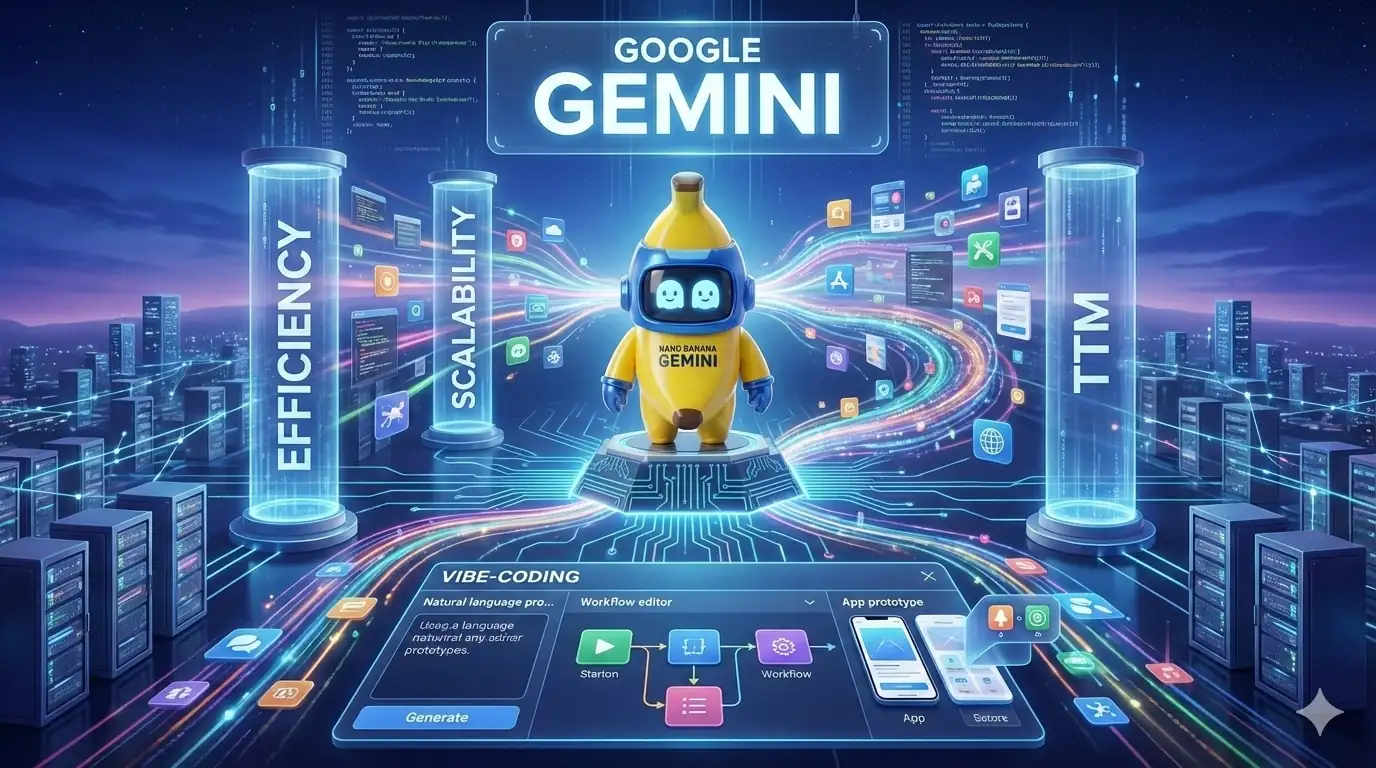
The landscape of software development just underwent a seismic shift. If 2023 was the year of the "Chatbot" and 2024 was the year of "Agents," 2025 is officially the year of Vibe-Coding. Google recently integrated its Opal AI tool directly into the Gemini web app, a move that effectively turns the world’s most accessible AI into a high-velocity mini-app factory. For businesses, founders, and product teams, this isn't just another feature update; it’s a fundamental change in how we conceptualize, build, and deploy digital logic.
At Bolder Apps, we’ve spent years at the cutting edge of custom mobile and web engineering. We’ve seen trends come and go, but the arrival of Opal marks something different: the democratization of the "Prompt-to-Product" lifecycle.
The term "Vibe-Coding" (popularized within the developer community over the last year) refers to the ability to build functional software using natural language, focusing on the intent and feel of the application rather than the rigid syntax of traditional programming languages.
Until now, Gemini "Gems" were essentially sophisticated personas—custom instructions that told the AI how to behave. Opal changes the DNA of a Gem. With Opal, you aren't just giving the AI a personality; you are giving it a workflow. You are building a multi-step logical pipeline where the AI can chain together reasoning, tool use, and data processing to produce a specific outcome.
The "Create with Opal" interface (as seen in the recent Gemini rollout) introduces a visual paradigm for building AI tools. Here are the three pillars of this new integration:
In the past, if you wanted an AI to perform a complex task—like analyzing a market report, extracting key data, and then generating three different email templates based on that data—you had to do it manually or write a complex Python script.
With Opal, you simply describe the "vibe" of the tool. You might say: "Build me a competitive intelligence tool that scrapes a URL, identifies three threats, and drafts a Slack notification for the executive team." Opal then parses that request into discrete, logical steps.
This is where the "Expert" side of AI comes in. Google has introduced a visual workflow view that allows users to see the underlying architecture of their mini-app.
This transparency allows for "human-in-the-loop" refinement. If the AI misses a step, you don't have to rewrite the whole prompt; you simply edit the specific step in the workflow.
The beauty of the Gemini-Opal ecosystem is the ability to "Remix." In a corporate environment, a lead developer might build a robust Opal tool for data cleaning. A marketing manager can then "remix" that tool to specifically clean customer sentiment data from social media, leveraging the core logic while pivoting the application.
At Bolder Apps, we prioritize Efficiency and Scalability. We believe Opal will impact three major areas of the modern business:
Every company has a list of internal tools they wish they had: a better way to summarize meeting notes, a tool to standardize Jira tickets, or a script to audit brand voice across PDFs. Usually, these projects sit at the bottom of the IT backlog because they aren't "mission-critical" enough to justify weeks of engineering time.
Opal solves this. A non-technical Project Manager can now build these internal utilities in twenty minutes. This frees up your expensive engineering talent to focus on the core product while the organization’s "micro-frictions" are solved by AI.
Before committing $50k–$100k to a custom app build, you need to know if the logic works. Opal serves as the ultimate sandbox. You can build a functional "mock" of your app’s logic in Gemini to test how users interact with the results. If the "vibe" is right, you have a proven blueprint to hand over to a professional development team like Bolder Apps to build into a scalable, production-ready product.
In the digital economy, the first to market often wins. Opal allows for "instant" deployment of logic. If a new market trend emerges on Tuesday, your team can have a custom AI tool analyzing that trend by Tuesday afternoon.
While we are incredibly excited about Opal, it is important to understand the distinction between a Vibe-Coded Tool and a Professional Software Product. As an expert agency, we see three areas where human-led engineering remains indispensable:
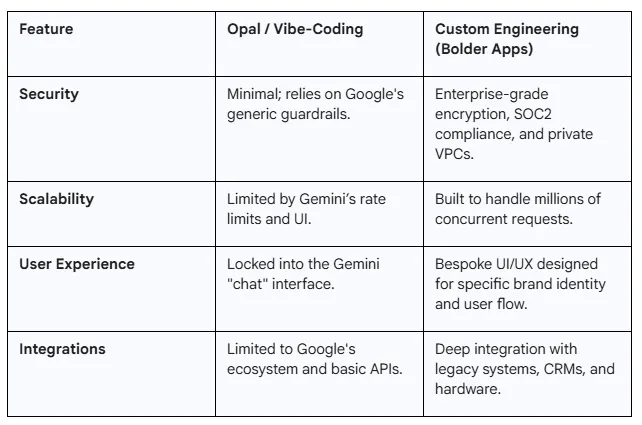
The Bolder Apps Verdict: Use Opal to innovate and iterate. Use Bolder Apps to scale and secure.
If you have access to Gemini Advanced, you likely already have the "Create with Opal" capabilities rolling out to your dashboard. Here is a 3-step strategy to start "Vibe-Coding":
The integration of Opal into Gemini is just the beginning. We are moving toward a world where "Apps" are no longer static icons on a screen, but dynamic, fluid agents that we assemble on the fly to solve specific problems.
At Bolder Apps, we are embracing this shift. We don't just write code; we architect solutions. Whether that means helping you integrate Opal-driven workflows into your department or building a massive, custom-built AI ecosystem from the ground up, our goal remains the same: Making your ideas bolder.
The "vibe" of the industry is changing fast. Don't get left behind using 2023 workflows in a 2025 world.
Contact Bolder Apps today to discuss how we can help you bridge the gap between AI prototyping and world-class software engineering.