There's no single "best" Node.js framework — the right choice depends on your application type, team expertise, performance requirements, and long-term maintainability goals, not popularity alone.
Choosing the wrong framework is a real cost, not just a technical inconvenience: technical debt can represent 20 to 40 percent of an organization's total technology assets, according to McKinsey.
Express.js remains the most widely adopted framework (18 million downloads per week) for its flexibility and low learning curve, while NestJS has become the go-to for enterprise-grade, TypeScript-first applications with over 73,000 GitHub stars.
Performance-critical applications should look to Fastify, which can serve up to 30,000 requests per second, while real-time, bidirectional communication needs are best served by Socket.IO paired with a framework like Express or Fastify.
Emerging runtimes (Deno, Bun) and edge-first frameworks (Hono) are reshaping the ecosystem toward faster startup times and smaller footprints — worth tracking even if you're building on an established framework today.
Why Choosing the Right Node.js Framework Matters in 2026
Top 10 NodeJS Frameworks: Which One To Choose in 2026 is a critical decision that can make or break your project's success. According to recent studies, technical debt represents about 20% to 40% of an organization's total technology asset value—and choosing the wrong framework is one of the fastest ways to accumulate that debt.
Quick Answer: The Top 10 Node.js Frameworks for 2026:
Express.js - Best for flexibility and quick REST APIs
NestJS - Best for enterprise applications and TypeScript lovers
Fastify - Best for high-performance, speed-critical apps
Koa.js - Best for modern async/await patterns
AdonisJS - Best for full-stack MVC web applications
Hapi.js - Best for security-focused enterprise APIs
Sails.js - Best for data-heavy apps with real-time features
LoopBack - Best for API-first microservices
Meteor.js - Best for real-time collaboration and MVPs
Socket.IO - Best for real-time bidirectional communication
Node.js continues to rank in the top five most-used technologies according to Stack Overflow's Developer Survey. Companies like Netflix, PayPal, and Uber rely on it for its event-driven architecture and rapid performance. But here's the thing: raw Node.js can feel like reinventing the wheel every time you start a new project.
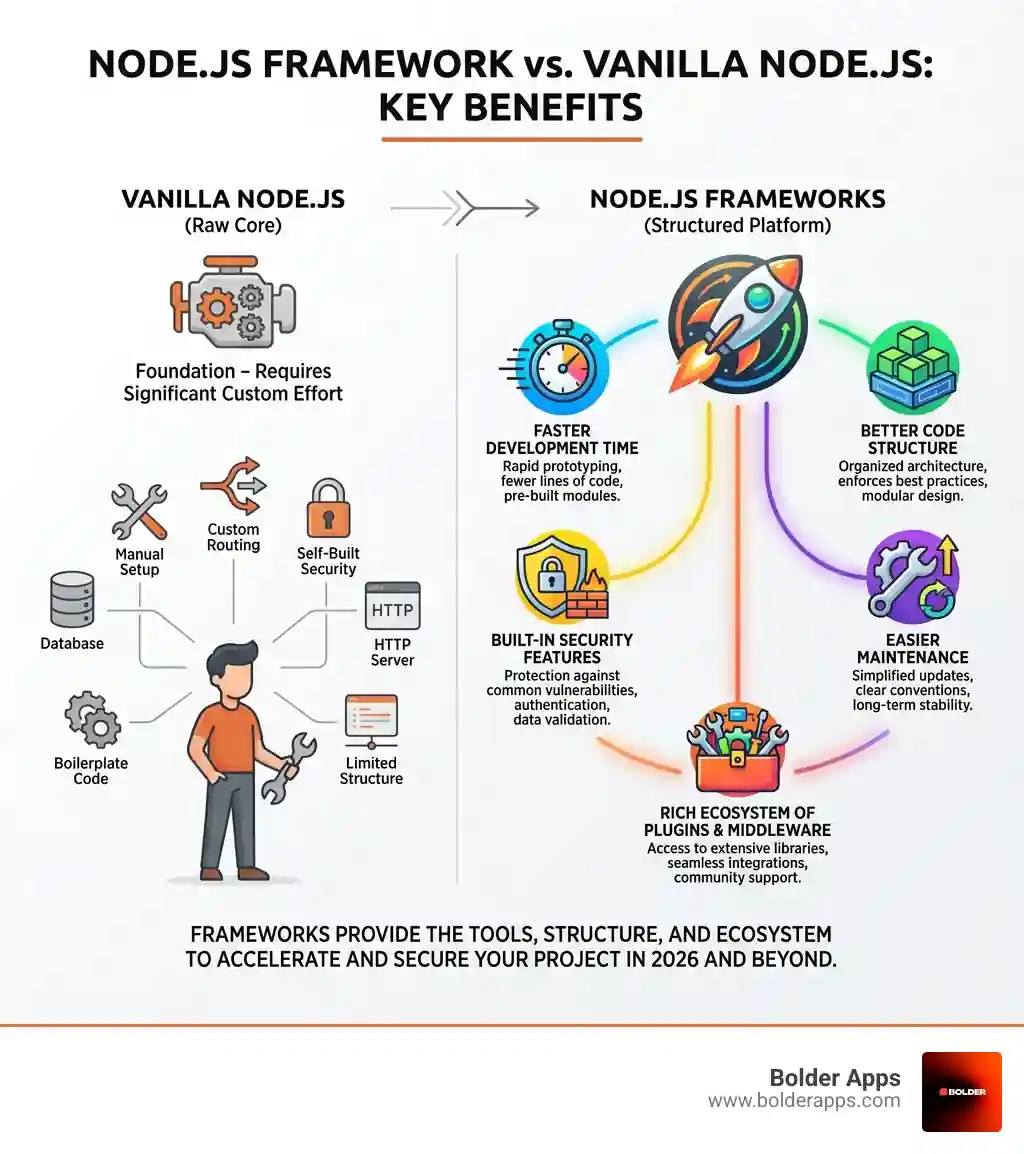
That's where frameworks come in. They provide structure, save time, enforce best practices, and give you plug-and-play functionality. But with over 50 different frameworks available, how do you pick the right one?
The answer isn't about finding the "best" framework. It's about finding the right framework for your specific needs—whether you're building a simple API, a complex enterprise system, or a real-time application that needs to handle thousands of concurrent connections.
Based on the latest Node.js user survey report, an impressive 80% of back-end and full-stack developers favor Node.js frameworks as their primary preference. Express.js alone sees 18 million downloads per week and powers applications at companies like Fox Sports, PayPal, and Uber. Meanwhile, newer frameworks like NestJS have gained over 73,000 GitHub stars and are quickly becoming the go-to choice for enterprise-grade applications.
In this guide, we'll break down each framework's strengths, weaknesses, and ideal use cases. We'll help you understand when minimalist frameworks like Express or Koa make sense versus when you need the structure of NestJS or AdonisJS. And we'll show you how to match framework features to your business goals—not just follow the latest trends.
How to Choose the Right Node.js Framework for Your Project
Choosing the right Node.js framework for your project in 2026 is a strategic decision that goes far beyond simply picking a popular tool. It's about aligning technology with your business objectives, team capabilities, and long-term vision. We know that a wrong choice can be costly, potentially leading to significant technical debt down the road. According to a McKinsey study, technical debt can represent about 20% to 40% of an organization's total technology assets. We certainly don't want that for your project!
So, how do we steer this crucial decision? We break it down into several key factors:
Understanding Your Project Requirements
The first step is to deeply understand what you're trying to build. Are you aiming for a simple REST API, a complex enterprise system, a real-time application with live data feeds, or perhaps a microservices architecture?
Application Type: Different frameworks excel at different types of applications. A lightweight framework like Express.js might be perfect for a straightforward API, offering flexibility and minimal overhead. Conversely, a full-featured solution like NestJS is better suited for applications requiring built-in dependency injection, a modular architecture, and TypeScript-first development, common in large enterprise systems.
API vs. Real-time App: If your project requires real-time communication, such as chat applications or live dashboards, frameworks with strong WebSocket support (like Sails.js or Meteor.js, or using Socket.IO) become critical. For traditional server-side APIs, many frameworks offer robust routing and middleware capabilities.
Scalable Network Applications: Node.js itself is renowned for building scalable network applications thanks to its event-driven, non-blocking I/O model. Frameworks built on Node.js inherit this benefit and provide additional tools to manage concurrent connections and high-traffic loads efficiently.
Performance and Scalability Considerations
While Node.js frameworks are generally optimized for performance, performance benchmarks tell only part of the story. When selecting a framework, we consider several performance factors:
Request Throughput: How many requests can the application handle per second? Frameworks like Fastify consistently top performance charts, making them ideal for high-traffic scenarios.
Memory Footprint: How much memory does the framework consume? Lower memory usage can lead to more efficient resource utilization, especially in cloud or containerized environments.
Cold Start Times: For serverless functions or rapidly scaling microservices, how quickly can the application start up?
Concurrent Connection Handling: How well does the framework manage a large number of simultaneous user connections? Node.js's native architecture excels here, and frameworks leverage it.
We need to balance raw speed with development velocity and maintainability. Sometimes, trading a tiny bit of performance for a more structured, maintainable codebase is a worthwhile investment.
Team Expertise and Learning Curve
Your team's existing skills and comfort level with certain programming paradigms play a huge role.
Team's Current Skills: If your team is already proficient in JavaScript and familiar with object-oriented programming (OOP) or functional programming (FP) concepts, they might adapt quickly to a new framework.
Learning Curve: Frameworks like Express.js are popular partly because JavaScript developers can start building immediately, with a relatively low learning curve. Others, like NestJS, require understanding new concepts like decorators and dependency injection, which can be a steeper climb but offer long-term benefits for larger projects. We always assess if the learning investment will pay off for your project's longevity.
Building with Node.js? Choose the Right Framework from Day One
Need help selecting the best framework for your next project? We build fast, scalable web applications with Node.js and can help you choose the right stack based on your product goals.
TypeScript support has become a crucial factor in modern Node.js development. It brings strong typing, better tooling, and improved maintainability, especially for large codebases.
Importance of TypeScript: We find that TypeScript significantly improves code quality and reduces bugs, making it invaluable for robust applications.
Framework Support: Frameworks like NestJS and LoopBack excel with first-class, out-of-the-box TypeScript support. Others, such as Express.js and Koa.js, can be configured to use TypeScript, but it requires additional setup.
Community Support and Ecosystem
A vibrant community and a rich ecosystem of packages and plugins are invaluable.
Community Health: A large and active community means more resources, faster troubleshooting, and a steady stream of updates and improvements. We look at GitHub stars, npm downloads, and activity on platforms like Stack Overflow.
NPM Significance: The Node Package Manager (NPM) is the backbone of the Node.js ecosystem. It's included with Node.js installation and provides access to a vast repository of open-source packages. A framework's integration with NPM and the availability of relevant packages can significantly speed up development. Express.js, for instance, boasts the largest ecosystem with thousands of NPM packages.
Security Features
Security isn't optional; it's paramount. We rigorously evaluate frameworks based on their built-in security features and update frequency.
Built-in Protections: Some frameworks, like Hapi.js, stand out with extensive built-in security features, including input validation and authentication strategies. Others, like Express.js, require additional middleware for similar protection.
Update Frequency: Active maintenance and regular security updates are critical to protect your application from emerging threats. We check the framework's update cycles to ensure long-term viability.
By carefully considering these factors, we can help you choose the Top 10 NodeJS Frameworks: Which One To Choose in 2026 that best fits your unique project, team, and business goals. Our aim is to ensure your investment in custom software development services leads to a robust, scalable, and secure application.
The Top 10 NodeJS Frameworks: Which One To Choose in 2026
This section provides a detailed breakdown of the leading frameworks, helping you match their strengths to your project needs. We've seen these frameworks evolve, adapt, and consistently deliver value, making them our top recommendations for 2026.
1. Express.js: The Minimalist Standard
Express.js is often the first framework developers encounter when diving into Node.js, and for good reason. It's a minimal, unopinionated web framework that provides basic building blocks rather than enforcing a rigid structure. This flexibility is its superpower. Express.js is widely used for building APIs and traditional web applications, benefiting from its simplicity, stability, and a vast ecosystem of middleware. We appreciate its straightforward approach, allowing us to build exactly what's needed without unnecessary bloat.
Pros:
Minimalist & Flexible: Gives full control over routing, middleware, and HTTP request handling.
Massive Ecosystem: Boasts the largest ecosystem of plugins and middleware on NPM.
Mature & Stable: Established since 2010, it's incredibly reliable.
Low Learning Curve: Easy for JavaScript developers to pick up quickly.
Cons:
Unopinionated: Its flexibility can lead to unstructured code in larger projects if not managed well.
Requires More Integrations: Lacks built-in features for things like database ORMs or authentication, requiring third-party packages.
Use Cases: REST APIs, Microservices, prototyping, single-page applications, lightweight backend for SPAs.
Stats: 18 million downloads per week, 68.3K GitHub stars.
One of the Top 10 NodeJS Frameworks: Which One To Choose in 2026
2. NestJS: The Enterprise-Grade Powerhouse
NestJS is a progressive Node.js framework for building efficient, reliable, and scalable server-side applications. It's heavily inspired by Angular, embracing a modular architecture, dependency injection, and a TypeScript-first approach. This makes it an excellent choice for teams looking for structure and maintainability, especially in enterprise environments. We find NestJS brings much-needed discipline to the Node.js ecosystem, making complex applications manageable.
Pros:
TypeScript-First: Provides strong typing, better tooling, and improved maintainability.
Modular Architecture: Promotes organized, scalable, and testable code through modules, controllers, and services.
Enterprise-Grade: Ideal for large-scale applications, microservices, and monorepos.
Comprehensive: Supports GraphQL, WebSockets, message brokers, and more out-of-the-box.
Cons:
Steeper Learning Curve: Requires understanding of decorators, dependency injection, and Angular-inspired patterns.
Overhead for Small Projects: Can feel overly opinionated or heavy for very simple applications.
Another of the Top 10 NodeJS Frameworks: Which One To Choose in 2026
3. Fastify: The Performance Champion
If raw speed and low overhead are your top priorities, Fastify is your go-to framework. Designed for maximum efficiency and scalability, Fastify consistently delivers impressive request handling capabilities. It's built with performance in mind, offering a plugin-based architecture and optional JSON schema validation/serialization for optimized throughput. We often recommend Fastify when every millisecond counts for your application.
Pros:
Blazing Fast: Consistently one of the fastest Node.js frameworks, serving up to 30,000 requests per second.
Low Overhead: Minimal footprint, ideal for performance-critical applications.
Plugin-Based: Highly extensible through a robust plugin system.
Schema-Based Validation: Built-in JSON schema validation ensures data integrity and improves performance.
Cons:
Smaller Community: While growing, its community is smaller compared to Express.js.
Learning Curve for Advanced Features: Some advanced features might take time to master.
Use Cases: High-traffic APIs, microservices, real-time data services, IoT systems, performance-critical backends.
Koa.js was developed by the same team behind Express.js, aiming to provide a more modern and lightweight foundation for web applications and APIs. Its key differentiator is its use of ES6 async/await, which neatly eliminates "callback hell" and provides better control over middleware flow and error handling. We find Koa offers a cleaner, more robust foundation for building APIs and web apps, especially when you need fine-grained control.
Pros:
Modern Syntax: Leverages async/await for cleaner, more readable asynchronous code.
Lightweight: Provides a minimal core, giving developers more control over middleware.
Improved Error Handling: Offers a more robust error-handling mechanism compared to Express.js.
Better Control: More explicit control over the middleware stack.
Cons:
Smaller Ecosystem: While growing, its middleware ecosystem isn't as extensive as Express.js.
Less Opinionated: Requires more decisions and setup for common tasks.
Use Cases: Lightweight APIs, custom web applications, microservices, middleware-heavy applications.
AdonisJS is a full-stack Node.js web application framework that takes inspiration from the popular Laravel framework in the PHP world. It aims to provide a "batteries-included" experience with pre-defined conventions, an integrated ORM (Lucid), authentication, validation, and file uploading. We appreciate AdonisJS for its focus on stability and developer experience, making it a powerful choice for building complete web applications.
Pros:
Full-Stack & Opinionated: Provides a robust MVC structure, authentication, and an ORM out-of-the-box.
Laravel-Inspired DX: Offers a familiar and pleasant developer experience for those coming from Laravel or similar frameworks.
Strong Security Features: Includes built-in safeguards for common web vulnerabilities.
First-Party Packages: Ships with essential packages, reducing time spent assembling NPM modules.
Cons:
Smaller Community: Compared to Express or NestJS, its community is less extensive.
Less Flexibility: Its opinionated nature can be restrictive for highly custom or unconventional projects.
Use Cases: Full-stack web applications, enterprise monoliths, data-driven applications, SaaS products, building complete web services.
Hapi.js (originally developed at Walmart to handle high traffic on Black Friday) is a configuration-centric framework known for its robust plugin system and extensive built-in security features. It emphasizes configuration over code, promoting a modular approach to building reusable application logic. We lean towards Hapi.js for projects where security, reliability, and structured development are paramount, especially for large, data-sensitive applications.
Pros:
Built-in Security: Offers extensive features like input validation, authentication, and authorization.
Configuration-Centric: Promotes clear, declarative configuration for routes and plugins.
Modular Design: Encourages reusable application logic through its powerful plugin ecosystem.
Enterprise-Ready: Ideal for large teams and complex, mission-critical applications.
Cons:
Steeper Learning Curve: Can be more challenging to get started with due to its configuration-heavy approach.
Verbose: Configuration can sometimes be more verbose than other frameworks.
Smaller Community: Less prevalent than Express.js, leading to fewer readily available resources.
Sails.js is an MVC (Model-View-Controller) framework built on top of Node.js, designed to mimic the rapid development style of Ruby on Rails. It provides a "batteries-included" solution with features like auto-generated REST APIs, strong WebSocket support, and an integrated ORM (Waterline) that works across various databases. If you're looking for a structured, opinionated framework to quickly build data-heavy, real-time applications, Sails.js is a strong contender.
Pros:
Rapid Development: Speeds up development with convention over configuration, similar to Rails.
MVC Pattern: Provides a clear structure for managing application logic.
Auto-Generated APIs: Automatically creates RESTful APIs for your models.
Real-time Capabilities: Excellent built-in WebSocket support for chat apps, dashboards, etc.
ORM (Waterline): Provides a unified data access layer for various databases.
Cons:
Can Feel Bloated: Its comprehensive nature might be overkill for very small or minimalist projects.
Slower Updates: Compared to more actively developed frameworks, its update cycles can be slower.
Less Flexible: Its opinionated nature can limit custom solutions.
LoopBack is an open-source Node.js framework designed for building REST and GraphQL APIs quickly and efficiently. It adopts an API-first design approach, allowing developers to define models and automatically generate RESTful endpoints, complete with CRUD operations and connections to various data sources. With its user-friendly CLI and built-in API explorer, LoopBack accelerates the pace of API development, making it ideal for microservices and mobile backends. It also boasts strong TypeScript support.
Pros:
API-First Design: Focuses on rapid API development with auto-generated endpoints.
Model-Driven: Define models, and LoopBack handles the REST API generation.
Strong TypeScript Support: Excellent out-of-the-box support for TypeScript.
Extensible: Provides flexible tools for connecting to various data sources and services.
Microservices Friendly: Well-suited for building API gateways and microservices architectures.
Cons:
Opinionated: Can be less flexible if your project deviates from its API-centric approach.
Learning Curve: Requires understanding its model-driven development paradigm.
Less Ideal for Non-API Apps: Not the best choice for full-stack web applications with extensive UI logic.
Use Cases: API gateways, microservices, mobile backends, enterprise systems with multiple integrations, data integration platforms.
Meteor.js is an isomorphic JavaScript platform that provides a full-stack solution for building real-time web and mobile applications from a single codebase. It's designed for rapid prototyping and development, offering real-time data synchronization between the client and server. If your project demands instant updates and a connected-client reactive experience, Meteor.js provides a powerful, integrated environment.
Pros:
Real-time by Default: Built-in real-time data synchronization, perfect for collaborative apps.
Full-Stack Simplicity: Manages both frontend and backend from a single JavaScript codebase.
Rapid Prototyping: Accelerates development with its integrated tools and packages.
Cross-Platform: Supports web, mobile (iOS, Android), and desktop applications.
Cons:
Performance at Scale: Can sometimes face performance challenges with very large-scale applications without careful optimization.
Less Flexible: Its opinionated nature can make it harder to integrate with other technologies.
Limited Database Flexibility: Primarily optimized for MongoDB, though others can be integrated.
Use Cases: Real-time collaboration tools, chat applications, MVPs (Minimum Viable Products), cross-platform apps, dashboards, small to medium-sized web applications.
While not a full-fledged web framework in itself, Socket.IO is an indispensable library for adding real-time, bidirectional communication to any Node.js application. It abstracts away the complexities of WebSockets, providing a reliable, event-based communication layer that works across various browsers and devices. For any project needing instant updates, live notifications, or interactive features, Socket.IO is a must-have.
Pros:
Robust Real-time Communication: Enables seamless bidirectional communication between clients and servers.
Cross-Browser & Cross-Device: Works reliably across different environments.
Automatic Reconnection: Handles disconnections and reconnections automatically, ensuring continuity.
Event-Based: Simple API for emitting and listening to custom events.
Widely Adopted: Massive community and extensive documentation.
Cons:
Not a Full Framework: Needs to be integrated with a web framework (like Express.js or Fastify) for routing and other server-side functionalities.
Overhead: Adds a layer of complexity and overhead for applications that don't require real-time features.
Use Cases: Chat applications, live analytics dashboards, multiplayer online games, notification systems, IoT device communication, real-time collaboration tools.
The Node.js ecosystem is incredibly dynamic, constantly evolving beyond the traditional frameworks we've discussed. As we look towards 2026, we see exciting trends that could reshape backend development.
Edge Computing and Serverless Functions: The rise of edge computing and serverless architectures is influencing framework design. Frameworks are becoming more optimized for ultra-fast startup times and minimal footprints to thrive in these environments.
New Runtimes: While Node.js remains dominant, new JavaScript runtimes are gaining traction:
Deno: Created by Node.js founder Ryan Dahl, Deno offers improved security features and a TypeScript-first approach out-of-the-box. It's a secure runtime for JavaScript and TypeScript with built-in tools.
Bun: An incredibly fast all-in-one JavaScript runtime designed for speed, offering a much faster startup and integrated tooling.
Emerging Frameworks: We're also keeping an eye on emerging frameworks that are pushing the boundaries:
Hono: An ultra-fast, lightweight web framework designed specifically for edge computing and serverless environments, optimized for platforms like Cloudflare Workers and Deno. It represents where Node.js frameworks are heading—lean, fast, and built with modern Web Standards APIs.
These innovations promise a future where Node.js development is even more efficient, secure, and performant. We believe that understanding these trends is crucial for building future-proof applications. For a deeper dive into these shifts, check out our insights on Node.js in 2026: The Native-First Revolution and the End of Dependency Hell.
Is Node.js itself a framework? No. Node.js is a JavaScript runtime environment that executes JavaScript code on the server. Frameworks are built on top of Node.js to simplify and structure application development.
Which Node.js framework is best for startups or MVPs? Express.js and Meteor.js are strong choices. Express offers flexibility and a massive community for quick prototyping, while Meteor's full-stack, real-time capabilities can accelerate development of a feature-rich MVP.
Can Node.js be used for large, complex enterprise systems? Yes. Frameworks like NestJS, Hapi.js, and LoopBack are specifically designed for building robust, scalable, and maintainable enterprise-grade applications with modular architecture, strong typing, and advanced security.
Which Node.js framework is the most popular? Express.js remains the most widely used, with 18 million downloads per week and 68,300+ GitHub stars, powering applications at companies like Fox Sports, PayPal, and Uber.
Which Node.js framework is fastest for high-traffic applications? Fastify consistently ranks among the fastest, capable of serving up to 30,000 requests per second, making it a strong choice for performance-critical APIs and microservices.
Miami has real mobile app development talent, and it has landing pages pretending to be Miami app development talent. This list separates the two. The best app development companies in...
Best App Development Companies in Philadelphia (2026)
You need an app built. You searched "best app development companies in Philadelphia" and got three directories, two ads, and a wall of agencies that all claim to be number one. This post...
App development in Philadelphia costs $30K-$60K for an MVP, $60K-$150K for a full iOS and Android product, and $150K-$250K+ for complex builds. Those are real fixed-scope numbers, not a...




.svg)