
January 17, 2026

How to Estimate Project Financial Scope in 5 Simple Steps

"This guide provides a straightforward process that empowers you to estimate your project's financial scope with real, decision-ready numbers instead of vague guesses."
Author Image
Abdulla Khaydarov
and updated on:
February 25, 2026
Blog Image

From Vague Guesses to Decision-Ready Numbers

Estimating a project's financial scope with real, decision-ready numbers instead of vague guesses is the key to predictable outcomes, preventing the budget overruns and uncertainty that plague many projects. This guide provides a straightforward process that empowers you to estimate your project's financial scope with real, decision-ready numbers instead of vague guesses.

The 5 Simple Steps:

  1. Define Project Scope with Surgical Precision: Break down your project into detailed user stories with clear acceptance criteria.
  2. Assemble Your Forecasting Dream Team: Bring together your Product Owner, Development Team, Scrum Master, and finance lead.
  3. Apply Agile Estimation Techniques: Use proven methods like Planning Poker and Story Points to generate data-backed numbers.
  4. Leverage Technology for Speed and Accuracy: Move beyond spreadsheets to real-time project management tools.
  5. Monitor, Adjust, and Create a Living Forecast: Continuously update your forecast based on actual progress.

Every project lead knows the feeling of a project slipping—a small delay, an unexpected cost, and suddenly you're playing defense. The pain of guesswork is real. Studies show that Agile teams have a 75.4% overall project success rate because they replace vague estimates with structured, data-driven forecasting.

Traditional budgeting creates a static plan, but projects are dynamic. Requirements evolve, risks materialize, and markets shift. You need more than a budget; you need a forecast that adapts to reality, giving you the financial clarity to make confident decisions. This guide walks you through a proven 5-step process to transform abstract ideas into actionable financial data you can trust.
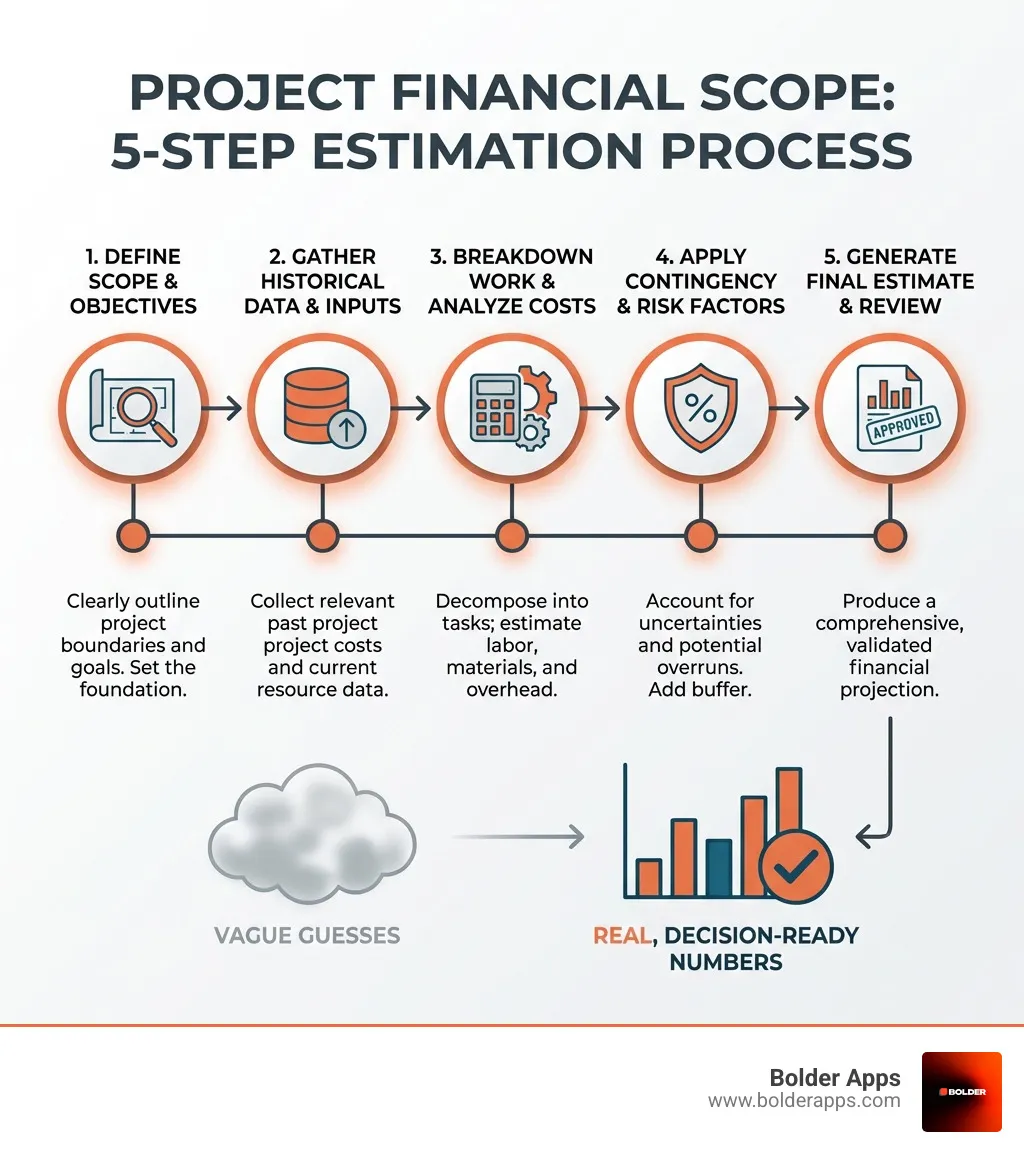
5 steps to accurate project financial scope estimation: 1) Define clear scope with user stories, 2) Assemble cross-functional forecasting team, 3) Apply agile estimation techniques like story points, 4) Use project management software for real-time tracking, 5) Monitor and adjust forecast continuously -  a straightforward process that empowers you to estimate your project's financial scope with real, decision-ready numbers instead of vague guesses infographic infographic-line-5-steps-elegant_beige

Why Your Project's Financial Health Depends on Forecasting, Not Guessing

In digital product development, financial health goes beyond managing costs—it's about safeguarding profitability, mitigating risks, and building stakeholder confidence. Effective project forecasting is the core discipline that moves teams from reacting to problems to proactively steering projects toward success. A reliable forecast acts as an early warning system, highlighting potential cost overruns or schedule delays long before they become critical. This foresight allows for early corrective action, turning potential disasters into manageable adjustments. Understanding the financial health of your project is paramount.

The Difference Between a Budget, a Projection, and a Forecast

While often used interchangeably, these terms serve distinct purposes:

  • A Budget: This is the static financial plan created at the start of a project—it’s your target. For example, a $2 million budget for an app development project sets the intended spending limits for design, development, and testing.
  • A Projection: This is a simple extension of current trends. If costs have been rising 2% quarterly, a projection assumes that rate will continue. It’s a “what if this continues” scenario based purely on past performance.
  • A Forecast: This is a dynamic prediction of the final financial outcome based on real-time progress, spending, and external factors. While the budget is the destination, the forecast is the GPS, recalculating your arrival time as conditions change. It might factor in new technologies, a shift in the labor market, or new regulations.

A budget tells us where we want to go, a projection shows where we're headed if nothing changes, and a forecast continually updates our estimated arrival based on real-world conditions.

How Accurate Forecasting Directly Impacts Your Bottom Line

Accurate forecasting is the difference between fighting fires and operating with strategic foresight. Here’s how it boosts your bottom line:

  1. Early Warning System: A reliable forecast highlights potential cost overruns or schedule delays early, allowing for proactive adjustments instead of reactive scrambling.
  2. Effective Cost Control: By comparing actual expenses against predictions, you can identify variances, understand their root causes, and ensure every dollar aligns with project objectives.
  3. Optimized Resource Allocation: Forecasting helps predict skill requirements for each project phase, ensuring the right people are available when needed. This minimizes idle time and maximizes productivity.
  4. Avoiding Costly Rework: Factoring quality—the right materials, skilled labor, and inspection processes—into your forecast from the start helps prevent expensive rework later.
  5. Protecting Profit Margins: By minimizing overruns, optimizing resources, and avoiding rework, forecasting ensures projects remain financially viable and protects your bottom line.

For more information about how we can help you with predictable financial outcomes, explore our Custom Software Development services.

Step 1 & 2: Laying the Groundwork with Clear Scope and a Dedicated Team

An accurate financial forecast rests on a clear understanding of what will be built and who will build it. These first two steps establish that foundation.

A collaborative team meeting around a whiteboard with user story maps and sticky notes, illustrating detailed project scope definition. -  a straightforward process that empowers you to estimate your project's financial scope with real, decision-ready numbers instead of vague guesses

Step 1: Define Project Scope with Surgical Precision

Accurate forecasting starts with good data, beginning with historical data from previous projects to identify patterns in costs and timelines. From there, defining scope with precision means breaking the vision into granular details.

  • User Stories and Acceptance Criteria: We replace vague requirements with user stories that describe functionality from an end-user's perspective (e.g., "As a user, I want to log in securely..."). Each story includes clear acceptance criteria—the conditions that must be met for it to be considered complete. This transforms abstract ideas into concrete, estimable deliverables.
  • Project Scope Details: We capture all project details, including technical specifications, design mockups, and dependencies. Closing scope gaps early prevents uncertainty and higher costs down the line.
  • Defining Quality: Quality is a critical financial component. We define the expected level of excellence for each deliverable and build the costs for skilled labor and proper processes into the forecast from the start. This proactive approach helps avoid costly rework.

For a deeper dive into defining project scope, refer to The Complete Mobile App Development Guide for Startups and Businesses.

Step 2: Assemble Your Forecasting Dream Team

Forecasting is a team sport, combining financial data with on-the-ground intelligence. This collaboration turns an estimate into a shared, reliable plan.

Key players in our forecasting process include:

  • Product Owner: The visionary who represents the customer, prioritizes the backlog, and makes scope trade-off decisions.
  • Development Team: The senior engineers, designers, and QA specialists who provide realistic estimates based on technical complexity and effort.
  • Scrum Master: The facilitator who ensures the estimation process is smooth, collaborative, and adheres to agile principles.
  • Finance Lead: The expert who translates technical estimates into monetary values, tracks spending, and ensures alignment with financial goals.
  • Key Stakeholders: Other experts (e.g., marketing, legal) who provide input on market conditions or compliance requirements that influence the project's financial trajectory.

Assembling this team ensures our forecasts reflect technical reality, business value, and financial prudence.

Step 3: A Straightforward Process That Empowers You to Estimate Your Project's Financial Scope with Real, Decision-Ready Numbers Instead of Vague Guesses

With a clear scope and team, it's time for estimation. In software development, accurate forecasting prevents chaos. Agile estimation techniques provide a structured framework to understand effort, risk, and complexity, turning uncertainty into actionable data.

A team of developers engaged in a Planning Poker session, holding up cards with numbers to estimate tasks on a whiteboard. -  a straightforward process that empowers you to estimate your project's financial scope with real, decision-ready numbers instead of vague guesses

Choosing Your Agile Estimation Toolkit

Agile techniques foster conversation and create reliable, iterative forecasts. Here are some essential tools:

  • Planning Poker: A consensus-based technique where team members use numbered cards to estimate user stories. The value isn't the final number but the conversation that uncovers hidden assumptions and roadblocks when estimates differ.
  • T-Shirt Sizing: For rapid, high-level estimation (S, M, L, XL), this technique helps categorize work by relative size, making it easier to prioritize during initial roadmap planning.
  • Story Points: A relative measure of effort, complexity, and uncertainty—not time. A team estimates work relative to a baseline story, allowing for predictable forecasts based on their established velocity.
  • Three-Point Estimation (PERT): For high-risk stories, this involves defining optimistic (a), most likely (m), and pessimistic (b) estimates. The discussion around the pessimistic case is invaluable for uncovering hidden risks.

Implementing the Process for Decision-Ready Numbers

Turning these techniques into concrete financial expectations involves a few key steps:

  1. Relative Sizing with Story Points: We estimate effort for each user story using story points, avoiding the trap of misleading "hour" estimates. A 5-point story is simply more effort than a 3-point story.
  2. Velocity Tracking: After a few sprints, we calculate the team's "velocity"—the average story points completed per sprint. If a team's velocity is 30 points and the backlog is 300, we can forecast it will take about 10 sprints, providing a data-backed timeline.
  3. Capacity Planning: We realistically assess the team's available time, accounting for holidays and meetings, to prevent overcommitment and ensure forecasts are grounded in reality.
  4. Prioritization Frameworks: We use frameworks like MoSCoW (Must-haves, Should-haves, Could-haves, Won’t-haves) or a Value vs. Effort matrix to ensure the budget is always allocated to the highest-impact features, which is crucial when considering how much it costs to make an app in 2026.

This agile approach is a straightforward process that empowers you to estimate your project's financial scope with real, decision-ready numbers instead of vague guesses because it turns abstract ideas into tangible data. The collaborative nature builds shared understanding, while iterative forecasting reduces uncertainty. By tracking velocity, we replace guesswork with empirical data, giving us the confidence to make data-driven decisions and communicate financial expectations clearly.

If you're looking to bring this level of financial clarity to your next project, explore our Mobile App Development services.

Step 4 & 5: Activating Your Forecast with Technology and Continuous Improvement

An initial forecast is just the beginning. The final two steps ensure it remains a living document that adapts to reality and guides your project to completion.

Step 4: Leverage Technology for Speed and Accuracy

Static spreadsheets are no longer sufficient for complex project forecasting. Dedicated technology offers superior speed, accuracy, and insight.

  • Project Management Software: Modern platforms centralize all critical project data—schedules, budgets, and tasks—providing a single source of truth.
  • Real-Time Data: Integrating live data feeds into forecasting models allows for up-to-the-minute project health checks. As the team logs progress, the forecast updates automatically.
  • Automated Reporting: Software can generate comprehensive reports instantly, saving time, reducing errors, and freeing up your team to focus on analysis rather than manual data entry.
  • Predictive Analytics and AI: AI can identify subtle patterns in data that indicate potential budget overruns or delays. Predictive analytics uses algorithms to model future outcomes, helping you prepare for uncertainties like market shifts.
  • Data Visualization: Tools that transform complex data into easy-to-understand charts and dashboards allow for quick, informed decision-making.

Embracing these technologies transforms forecasting from a laborious task into a dynamic engine for project success.

Step 5: Monitor, Adjust, and Create a Living Forecast

A forecast is not a "set it and forget it" tool. It must be dynamic, regularly updated with current data to be useful. Comparing forecasted numbers against actual performance allows you to spot variances early and make adjustments before small issues become major problems.

  • Dynamic Forecasting and Risk Management: A living forecast acts as an early warning system. By continuously comparing actuals against the forecast, you can spot variances, manage risk, and make proactive adjustments like reallocating resources or adjusting scope.
  • Avoiding Common Pitfalls: A forecast is only as good as its data. We avoid pitfalls by diligently updating costs and timelines, challenging unverified assumptions, and ensuring all significant risks are priced.
  • Post-Project Reviews and Continuous Improvement: No forecast is perfect. After each project, we conduct a post-mortem to analyze its accuracy. We learn from what happened—where we were on target and where we missed—to refine our models and improve our process for the next project.

Integrating technology with a continuous improvement mindset transforms your financial forecast into a powerful tool for predictable outcomes, as detailed in our Mobile App Development Process in 2026.

Frequently Asked Questions about Project Financial Scoping

What's the difference between a rough estimate and a decision-ready number?

A rough estimate, like a T-shirt size (S, M, L), is for high-level planning and prioritization. It provides a general idea of magnitude and helps in early-stage discussions. A decision-ready number, on the other hand, is a more granular, data-backed figure, often derived from detailed user stories and team velocity, that you can confidently use for budgeting, financial commitments, and strategic planning. It's precise enough to base critical business decisions on.

How do you estimate costs for an Agile project with a changing scope?

Agile accepts and accepts change, so estimation in this context focuses on providing forecasts for upcoming sprints, not a fixed price for the entire project from day one. By using techniques like story points to estimate relative effort and tracking team velocity (the amount of work completed per sprint), we can forecast the cost to complete a set of features within a given timeframe. As priorities shift or new requirements emerge, we adjust the product backlog, re-estimate affected stories, and update our forecast accordingly. This ensures that the budget is always spent on the highest-value work, even as the project evolves.

How often should I update my project forecast?

Your forecast should be a living document, reflecting the current reality of your project. We recommend reviewing it at the end of every sprint (typically every 1-2 weeks) to compare actuals against the plan. This regular check-in allows us to catch any deviations early. It should also be updated immediately following any significant event, such as an approved change in scope, a major supply chain delay, a significant shift in team capacity, or unexpected technical challenges. The goal is for your forecast to always provide the most accurate, up-to-date financial picture possible.

From Guesswork to Guaranteed Outcomes: Your Financial Blueprint for Success

We've journeyed through the 5 essential steps to transform vague guesses into a straightforward process that empowers you to estimate your project's financial scope with real, decision-ready numbers instead of vague guesses. This isn't just about crunching numbers; it's about embedding a culture of data-driven decisions, confident planning, and predictable success into your project lifecycle.

By carefully defining scope, assembling an expert team, leveraging agile estimation techniques, using the power of technology, and committing to continuous monitoring and adjustment, you gain unparalleled financial clarity. You move from the reactive stance of constantly fighting fires to the proactive position of steering your project with precision and foresight.

At Bolder Apps, we understand that accurate financial scoping is the bedrock of any successful digital product. That's why we combine US-based strategic leadership with senior distributed engineers, offering a fixed-budget model and milestone-based payments. This unique approach ensures that your project's financial scope translates into a successfully delivered product, without any surprises or junior learning on your dime.

Ready to turn your financial blueprint into a tangible, high-impact mobile or web app? Start building with confidence today.


( FAQs )

FAQ: Let’s Clear This Up

Quick answers to your questions. need more help? Just ask!

(01)
How long does an app take?
(02)
Do you offer long-term support?
(03)
Can we hire you for strategy or design only?
(04)
What platforms do you develop for?
(05)
What programming languages and frameworks do you use?
(06)
How will I secure my app?
(07)
Do you provide ongoing support, maintenance, and updates?
( Our Blogs )

Stay inspired with our blog.

Blog Image
Don't Buy Hours, Buy Velocity: 5 DORA Metrics You Must Demand from Your Dev Partner in 2026

"The framework every founder needs before signing their next development contract."

Read Article
Blog Image
The App Era Is Ending. OpenAI Just Confirmed It.

OpenAI hired the OpenClaw founder to build personal AI agents that work across your entire digital life. This isn't a product update — it's a directional signal. The shift from 'apps you use' to 'systems that act for you' is happening faster than the industry is admitting.

Read Article
Blog Image
Gartner Says 40% of Enterprise Apps Will Have AI Agents This Year. Here's the Uncomfortable Part.

Up from less than 5% in 2025. That's not a trend — that's a phase change. The uncomfortable part isn't the number. It's what the companies building agent-native right now are going to look like compared to everyone else in 18 months.

Read Article
bolder apps logo grey
Get Started Today
Get in touch

Start your project. Let’s make it happen.

Schedule a meeting via the form here and we’ll connect you directly with our director of product—no salespeople involved.

What happens next?

Book a discovery call
Discuss and strategize your goals
We prepare a proposal and review it collaboratively
Clutch Award Badge
Clutch Award Badge

Let's discuss your goals

Phone number*
What core service are you interested in?
Project Budget (USD)*
Thank you! Your submission has been received!
Oops! Something went wrong while submitting the form.