Abdulla Khaydarov
January 24, 2026
5
min. read
and updated on:
February 25, 2026

"Unlike off-the-shelf tools, these solutions integrate seamlessly with your existing systems, automate critical workflows, and scale as your business grows."
.webp)
Enterprise app development solutions are custom software platforms built to solve the unique, complex challenges of large organizations. Unlike off-the-shelf tools, these solutions integrate seamlessly with your existing systems, automate critical workflows, and scale as your business grows.
Quick Answer: What Are Enterprise App Development Solutions?
Enterprise app development solutions are:
The numbers tell a compelling story. Digital change is no longer optional—it's the foundation of survival. 86% of IT leaders anticipate their workloads to increase, yet 33% lack the in-house resources or AI skills to tackle these initiatives. Meanwhile, 60% of workforce employees already use apps for work-related tasks, and enterprise mobile apps can increase employee productivity by 34%.
Here's the reality: generic software forces your business to conform to someone else's vision. Custom enterprise apps do the opposite—they bend to your processes, your data, and your competitive strategy.
The market agrees. The enterprise software market reached $271.8 billion in 2023 and is projected to hit $376.4 billion by 2028, growing at 6.73% annually. This isn't just growth—it's a signal that businesses recognize custom solutions as strategic investments, not IT expenses.
But here's the catch: 59% of employees believe their companies are slow in delivering enterprise application solutions. Speed matters. Agility matters. Getting this right means choosing the right partner and approach from day one.
An organization's ability to adapt and innovate often hinges on its internal technology. This is where enterprise app development solutions step in, changing how large businesses operate and compete.
.webp)
At its core, enterprise application development is the process of creating custom software to meet the unique and intricate demands of large organizations. These applications aren't just about digitizing processes; they're about engineering solutions that improve operations, automate workflows, manage data, and integrate seamlessly with your existing IT infrastructure. They are built with high security, scalability, and robust integration in mind, ensuring they can support extensive business functions.
Why is this so important? Because digital change is fundamentally changing how organizations do business. It converts outdated, paper-based processes into efficient, technology-powered workflows, and custom enterprise application development allows us to tailor this change precisely to your business needs. Organizations depend on applications to operate efficiently and serve their customers effectively.
The goals are clear: to automate processes, improve security, and increase efficiency by providing a single, reliable source of truth. The benefits are compelling, fostering connectivity, enabling scalability, and allowing for deep customization. Using an enterprise application to access one source of truth helps employees streamline their work processes for greater efficiency and productivity.
This strategic investment in bespoke software is paying off. According to Statista, the overall market size of enterprise software is expected to reach $271.8 billion in 2023, with CRM (Customer Relationship Management) dominating the market space with a projected volume of $79.4 billion. Furthermore, the overall revenue is expected to grow at a CAGR of 6.73% from 2023 to 2028, reaching $376.4 billion by 2028. This growth underscores the recognized value of powerful, custom platforms for demanding business processes, large data storage, and improved security.
To learn more about how custom software can empower your business, explore our Custom Software Development services.
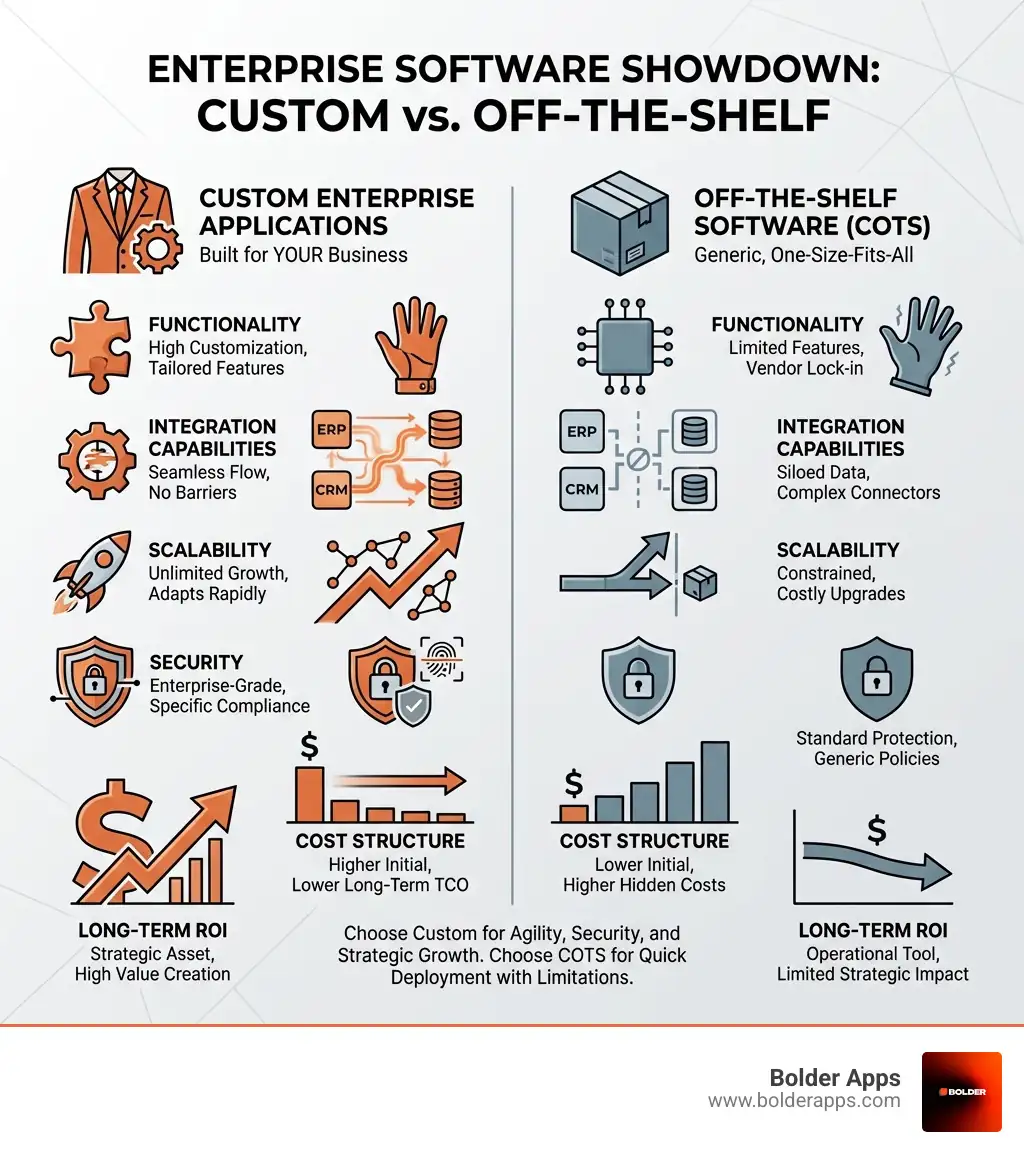
The choice between custom and off-the-shelf software is a pivotal one for any enterprise. While commercial off-the-shelf (COTS) solutions offer quick deployment and lower initial costs, they often come with significant trade-offs.
Custom application development, on the other hand, is the process of creating software that is precisely custom to your company's unique business needs. These applications are designed to solve specific challenges, improve efficiency, and provide a competitive advantage by automating processes and streamlining workflows in a way that generic tools simply can't. They simplify operations and work seamlessly with existing systems, meaning you won't have to reshape your business processes to fit a generic tool. This custom approach empowers your business to become a disruptive force and carve out a unique market identity.
A custom app also allows for seamless integration with your existing systems and can evolve dynamically with your business, ensuring a stronger long-term return on investment (ROI). You're not just buying software; you're investing in a strategic asset that grows and adapts with you.
When we start on an enterprise app development journey, we're aiming for several critical outcomes:
While both enterprise applications and web applications are crucial digital tools, they serve distinct purposes and possess different characteristics:
To understand how web applications can complement your enterprise strategy, explore our Web App Development Services.
Developing enterprise app development solutions is no small feat. It's a journey fraught with potential challenges that can derail projects if not properly addressed. We've seen it all, from tangled legacy systems to the ever-present threat of security breaches.
.webp)
Enterprises often grapple with a lack of resources, inefficient lifecycle management, and the complexities of dealing with legacy systems. We also encounter departmental silos, communication problems, evolving business needs, high data volumes, and complex integration requirements. These factors can prolong development and increase costs.
A primary challenge is ensuring apps work smoothly across multiple operating systems, device types, and screen sizes, especially with frequent OS updates. This is compounded by device fragmentation, where employees use a mix of personal and corporate devices. The rise of BYOD (Bring Your Own Device) solutions improves productivity but also requires careful management to ensure sensitive company data remains secure and protected from potential breaches or unauthorized access.
Enterprise apps handle sensitive business data, making security and compliance paramount. How do we address security and compliance risks for enterprise apps handling sensitive data? This means adhering to strict industry regulations like GDPR, SOC 2, and HIPAA. We must embed security at every stage of development, implementing advanced encryption, secure authentication (such as OAuth and SSO), and ongoing security audits. This multi-layered approach ensures data remains protected both in transit and at rest, with secure log-ins, restricted background processes, and meticulous user authentication.
Many enterprises rely on legacy systems that are notoriously difficult to integrate with modern applications. This often leads to data silos and outdated technology. How do we integrate new apps with existing legacy systems? We design flexible APIs and middleware solutions that bridge the gap, ensuring seamless data flow between new applications and existing infrastructure like ERP and CRM systems. This strategic approach prevents disruption to day-to-day operations while modernizing your tech stack.
Slow apps with poor user experience kill adoption. We focus on optimizing performance to avoid crashes under heavy loads and prioritize user-centric design, understanding audience segments and focusing on usability testing to create intuitive interfaces that drive engagement. After all, a powerful app that no one uses is just wasted potential.
To ensure your apps are not only functional but also a joy to use, explore our UI/UX Design Services.
Facing these challenges head-on requires modern approaches and robust enterprise app development solutions. We leverage cutting-edge tools and methodologies to ensure our solutions are not just effective but also future-proof.
One powerful strategy is the use of cross-platform frameworks like React Native and Flutter. These allow us to achieve consistent performance and user experience across iOS, Android, and the web, saving time and resources. We also design flexible APIs and use cloud-based optimization strategies to ensure apps are fast, responsive, and reliable, even under heavy loads. And, as always, user-centric design remains at the forefront of our approach.
A key enabler in this modern landscape is the Enterprise Application Platform (EAP). An EAP is a centralized software framework that brings together all the tools needed to build and manage enterprise-level apps. EAPs simplify management, enable collaborative application building, and facilitate easy connections and integrations between systems. They offer a unified environment for developing and deploying applications, connecting systems through APIs for simpler data sharing, and providing secure development environments, automation tools, and performance tracking.
For a deeper dive into how we build high-impact mobile solutions, check out our Mobile App Development Services.
Low-code and no-code platforms are revolutionizing the development landscape by lowering barriers and democratizing app creation.
Low-code platforms offer a visual, user-friendly approach that can be understood by individuals with varying coding skill levels. They use visual modeling, pre-built templates, and drag-and-drop interfaces, allowing developers and even business users (sometimes called "citizen developers") to create and customize applications with minimal traditional coding. This significantly reduces the need for extensive coding and drastically speeds up development.
This approach accelerates time-to-market and empowers non-technical teams to contribute to the development process, fostering greater collaboration and ensuring the applications truly meet business needs. It's like having high-quality ingredients ready to mix into different recipes, making it easier to prototype and iterate quickly.
If you're eager to visualize your app ideas rapidly, explore our Prototype Development Services.
Cloud services are the backbone of modern enterprise app development, offering unprecedented flexibility, scalability, and efficiency. There are three main types relevant to our work:
Cloud platforms enable us to overcome traditional development barriers, offering scalability and cost-efficiency by eliminating the need for organizations to manage hardware installation and infrastructure setup.
A robust enterprise application solution isn't just a single piece of software; it's an ecosystem of interconnected components working harmoniously. Here are the core elements we focus on:
Developing powerful enterprise app development solutions requires a structured yet flexible approach. We often employ agile methodologies, characterized by sprint cycles, continuous feedback, and close stakeholder collaboration, ensuring the final product aligns perfectly with your vision.
Our process emphasizes iterative development, allowing for adjustments along the way to adapt to changing business needs. For a comprehensive look at our development process, you can explore our Mobile App Development Process in 2026: Ultimate Step-by-Step Guide to Building an App.
This foundational phase is all about understanding your needs and charting the course. We begin by defining clear business goals and identifying key performance indicators (KPIs) to measure the value and ROI of the enterprise application. Through stakeholder interviews with executives, managers, and end-users, we gather comprehensive requirements, ensuring we understand the specific challenges the application needs to solve. This also involves choosing the right platform and estimating the budget accurately, considering factors like app complexity, features, and the proposed tech stack.
Once the strategy is set, we move to crafting the user experience. This involves wireframing and creating interactive prototypes that demonstrate key features and workflow. We prioritize user-centric design principles, gathering employee feedback through several iterations to refine the user interface and create a positive, intuitive, and navigable experience. This design validation process is crucial for ensuring high user adoption rates.
This is where the magic happens. Our team develops both the front-end (what users see) and back-end (the underlying logic and data management) of the software. We seamlessly integrate third-party APIs and existing systems. Rigorous testing is paramount: we conduct unit testing, integration testing, user acceptance testing (UAT) involving actual end-users, and comprehensive security testing to ensure the application is robust, bug-free, and secure.
For an in-depth review of your existing codebase or to ensure quality, consider our Code Audit Services.
After thorough testing, the application is ready for deployment. This can involve various options, including cloud, on-premises, or hybrid solutions, each offering different levels of control and security to suit organizational needs.
Post-deployment, our work continues with performance monitoring, gathering user feedback analysis, and implementing regular updates to keep the application relevant, secure, and continuously optimized. This ongoing maintenance and optimization ensure your application remains a valuable asset.
If you need to scale your development capabilities for ongoing maintenance and optimization, our Staff Augmentation Services can provide the expertise you need.
The landscape of enterprise app development solutions is constantly evolving, with Artificial Intelligence (AI), Machine Learning (ML), and other emerging technologies paving the way for unprecedented innovation. We're not just building apps; we're building intelligent systems.
The demand for AI-driven applications is growing rapidly, yet a significant number of IT leaders—around a third—report lacking the in-house resources or AI skills to tackle these initiatives. This gap highlights the need for expert partners who can bridge the knowledge divide. Generative AI, for instance, is already accelerating development and customization processes significantly.
To stay ahead of the curve, dig into our insights on Top AI Trends in 2026: How Artificial Intelligence is Reshaping Business and Everyday Life.
Integrating AI and ML into enterprise applications isn't just about buzzwords; it's about driving tangible business value:
Looking ahead, we're building architectures that are ready for the next wave of innovation:
We often encounter similar questions from businesses considering enterprise app development solutions. Here are some common inquiries and our expert answers:
The timeline for building an enterprise application varies significantly, typically ranging from three to nine months. Several factors influence the development time:
For example, a simple enterprise mobile app might take 3 to 6 months, while a highly complex one could require 9 to 12 months.
The cost of custom enterprise app development is highly variable, generally ranging from $50,000 to $300,000 or more, depending on several factors:
We provide detailed estimates after a thorough findy phase to ensure transparency and alignment with your budget. For a detailed breakdown of app development costs, you can refer to our guide: How Much Does It Cost to Make an App in 2026? Full Breakdown by App Type.
We ensure application security through a multi-faceted process integrated throughout the development lifecycle:
When digital change is non-negotiable and innovation is the currency of success, custom enterprise app development solutions are no longer a luxury—they are a strategic imperative. We've seen how custom applications can automate complex processes, improve security, boost productivity, and provide the critical insights needed to stay competitive. From navigating the complexities of legacy systems to embracing the intelligence of AI and ML, the journey of building a robust enterprise app is intricate but immensely rewarding.
At Bolder Apps, we understand these complexities. Our unique approach combines US leadership with senior distributed engineers, ensuring you receive strategic, data-driven, and intuitive product creation without the hidden costs of junior learning. We believe in transparency and predictability, offering a fixed-budget model and milestone-based payments that ensure your projects are completed efficiently, on time, and to your exact specifications. With an in-shore CTO guiding your vision and an offshore development team executing with precision, we bring the best of both worlds to your enterprise.
Ready to build an enterprise app that drives real business results, streamlines your operations, and gives you a definitive competitive edge? Don't let outdated systems or generic software hold you back. Contact Bolder Apps today for a strategic consultation. Let's build something big, together.