
Andrew Abbey
February 24, 2026
6
min. read
and updated on:
April 24, 2026

Gemini 3.1 Pro claims double the reasoning performance of its predecessor. Same price. The models are compounding faster than the industry expected — and that changes the math on every AI product decision you're making right now.
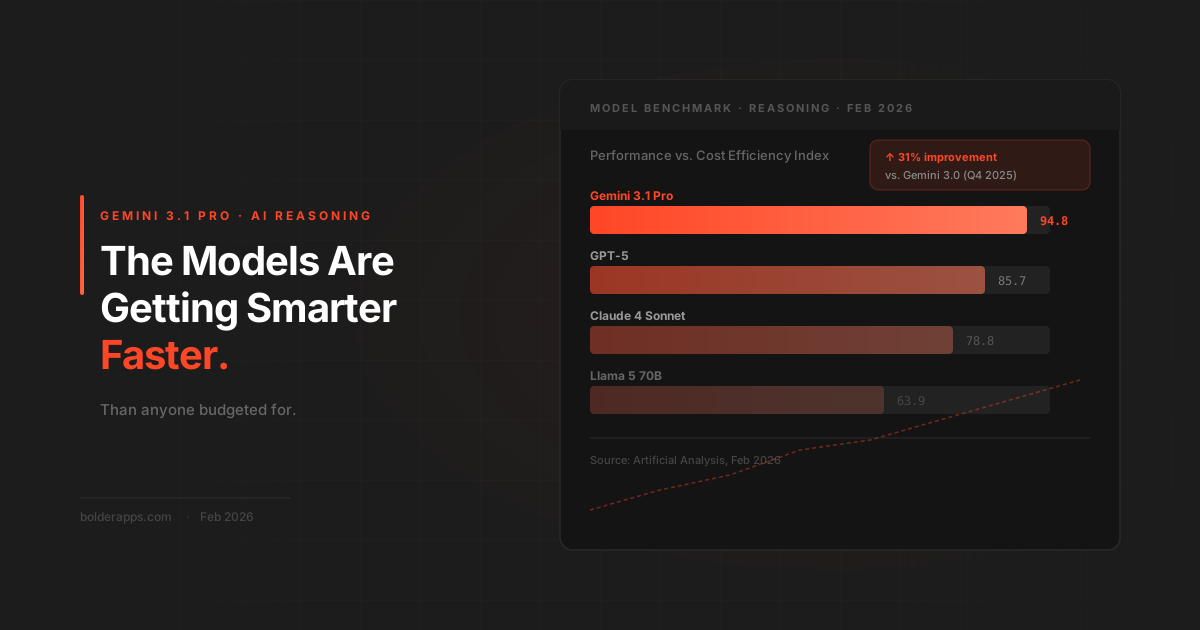
Gemini 3.1 Pro is out. Google’s claim: double the reasoning performance of its prior flagship. Price: unchanged.
That sentence used to sound like marketing. In 2026, it’s just the release cadence. Every few months, the frontier models take a meaningful step forward. The cost curve stays flat or drops. The performance ceiling keeps rising.
If you’re a founder building a software product, this pace has direct implications for every AI-related decision you’re making — what to build, what to buy, and what to stop treating as a competitive differentiator.
Reasoning performance gets benchmarked on academic tests, but what it translates to in practice is more interesting than any leaderboard: it’s the quality of what happens when an AI has to think through a multi-step problem without a clear template to follow.
Better reasoning means the model can generate complex backend logic with less hand-holding. It means synthesizing a 200-page document into accurate, actionable insights rather than a fuzzy summary. It means an AI agent can execute a five-step workflow without losing track of what it was doing by step three. And it means you need less prompt engineering scaffolding to get consistent output — the model carries more of the cognitive weight itself.
For products with AI at the core, each jump in reasoning performance expands what’s technically feasible without adding infrastructure complexity. Features that required elaborate multi-model pipelines six months ago can now run on a single well-prompted call. That matters for build cost, latency, and reliability.
We test every significant model release against Bolder Apps client workflows before recommending adoption. Gemini 3.1 Pro is a genuine step forward, particularly on tasks that require tracking state across complex logic — which is exactly where agentic features tend to break down in production.
Google isn’t the only one in this race. Anthropic, OpenAI, and Meta are all pushing reasoning capability as a primary vector of competition. That’s not a coincidence — it’s a signal about where the bottleneck is.
Reasoning is what limits agents. You can give an AI system all the tools in the world, but if the underlying model can’t reliably reason through a multi-step decision, the agent breaks down at the exact moment it matters. The companies winning the reasoning race are building the infrastructure that makes reliable agentic products possible.
Right now, Gemini 3.1 Pro leads on multimodal reasoning and deep Google ecosystem integration. Claude Opus 4.5 leads on long-context tasks and complex code. GPT-4o remains the most broadly deployed with the deepest developer ecosystem. Each has genuine strengths. None is universally dominant.
The right architecture accounts for this. At Bolder Apps, we build AI-integrated products with model-agnostic infrastructure — routing different tasks to whichever model handles them best, and designing systems that can swap out models as the landscape evolves. Betting your entire architecture on a single provider is how you end up doing a full rebuild every eight months when something better ships.
The “AI integration” premium is compressing. What was genuinely complex technical work eighteen months ago — connecting a large language model to a product, handling hallucinations, building reliable prompt pipelines — is now standard practice with documented patterns and mature frameworks. If your dev shop is still charging a significant premium for baseline AI connectivity, ask what you’re actually getting for it.
The real moat is now in the architecture above the model layer: reliable agent orchestration, proprietary data integration, domain-specific evaluation systems, and vertical expertise that a general-purpose model can’t replicate. That’s where durable product value lives. That’s also what Bolder Apps builds.
The cost curve keeps working in your favor. Features that were cost-prohibitive on last year’s models are economically viable today. If you shelved an AI-powered feature because the compute costs didn’t pencil out, run the numbers again — they’ve likely changed.
Gemini 3.1 Pro is Google’s latest flagship large language model, claiming approximately double the reasoning performance of its previous generation at an unchanged price point. It competes in the same tier as OpenAI’s GPT-4o and Anthropic’s Claude Sonnet 4.5, with particular strengths in multimodal reasoning and tasks that require Google ecosystem integration.
Reasoning capability is the primary bottleneck for reliable AI-powered features, especially agentic workflows. Better reasoning means AI agents can handle more complex task sequences, maintain state across multi-step operations, and produce more consistent outputs — which is the difference between a feature that works in a demo and one that works reliably for real users.
There isn’t a single correct answer — it depends on your specific use case. The more useful question is whether your architecture is model-agnostic, meaning you can route tasks to whichever model handles them best and swap models as the landscape evolves without rebuilding from scratch. That flexibility is worth building in from the start.
Yes — and the pace of change is actually an argument for building now rather than waiting. Teams that ship AI features today learn from real user behavior and accumulate product intelligence that pure-wait competitors can’t replicate. The goal isn’t to build on the best model available forever — it’s to build with good architecture that can evolve as the models improve.