Madina M
January 9, 2026
5
min. read
and updated on:
February 25, 2026

Protect your innovation with our guide on steps, costs, and common mistakes to secure your app's future.
.webp)
How to Patent an App Idea in 2026? You'll need to document your invention, conduct a prior art search, and file either a provisional ($2,000-$5,000) or non-provisional ($10,000-$15,000+) application with the USPTO. Working with a patent attorney is critical to draft strong claims, respond to office actions, and maintain your patent with periodic fees once granted. The process typically takes 1-3 years.
Here's the quick breakdown:
You have an app idea that could be a game-changer—a novel algorithm, a unique payment process, or an innovative UI. That idea is valuable, but it's also at risk the moment you share it. The app market is fiercely competitive, and without proper protection, your concept could be copied and launched by a competitor before you get to market.
The good news is that you can protect your app idea with a patent. Unlike copyright, which only covers your code, a patent protects the underlying method or process your app uses. This is crucial for building a defensible, investor-ready business. However, patenting isn't simple. It requires proving your idea is novel, non-obvious, and useful, and the process involves complex procedures and significant investment.
This guide will walk you through every step, from understanding what's patentable to filing your application and maintaining your protection long-term. You'll learn exactly how to turn your app idea into a protected asset in 2026.
Patenting an app idea means navigating intellectual property (IP) law. A patent grants an inventor exclusive rights to prevent others from making, using, or selling their invention. In the U.S., these rights are granted by the United States Patent and Trademark Office (USPTO).
A common misconception is that you can patent an "idea" or "code." You can't. A patent protects the method, process, or system your app implements to achieve a tangible result. The code itself, as an expression of that method, is protected by copyright. Think of it this way: a patent isn't for the words in a book (copyright), but for a unique storytelling mechanism. For apps, we protect the underlying technical solution, not just an abstract concept. The World Intellectual Property Organization (WIPO) defines an invention as a solution to a problem.
For example, a generic chess app isn't patentable. But if your app uses a novel algorithm for a driverless car, that specific technical function could be patented. This distinction was reinforced by the U.S. Supreme Court's decision in Alice Corp. v. CLS Bank International, which established a test for patent eligibility focusing on whether a claim transforms an abstract idea into a patent-eligible application. For more on how creativity meets code, check out our insights on When Creativity Meets Code: Reinventing Mobile App Development for 2026.
.webp)
For an app idea to be patent-eligible, it must satisfy three criteria:
What We Can Patent:
What We Can't Patent:
Understanding these distinctions is the first step toward securing robust protection for your app.
Deciding to patent your app is a strategic business decision. Here's why it's important for startups:
You should consider patenting your app idea as early as possible, especially before any public disclosure, due to the "first to file" rule in the U.S. However, patenting isn't always necessary. It might not be the right path if your innovation is minor, your budget is extremely limited, or your business model relies on rapid, constant pivots. Protecting your brand identity is also crucial; learn more in our guide on Brand Identity 101: Building a Strong Digital Presence.
A Provisional Patent Application (PPA) is a quick, less expensive way to establish an early filing date. It allows you to use the "Patent Pending" status and gives you 12 months to refine your app, conduct market research, and seek investment before committing to the more expensive non-provisional application.
Benefits of a PPA:
A PPA is not a patent and is not examined. You must file a non-provisional application within 12 months to retain your priority date. For more details, the USPTO provides a guide on provisional filings.
The Non-Provisional Patent Application (NPA), or utility patent application, is the formal application that the USPTO examines. If granted, it provides 20 years of protection from the filing date.
Key Characteristics of an NPA:
The NPA is the ultimate goal for long-term, enforceable protection. The USPTO offers a detailed guide on nonprovisional applications.
Patents aren't the only form of IP protection. Consider a multi-layered strategy:
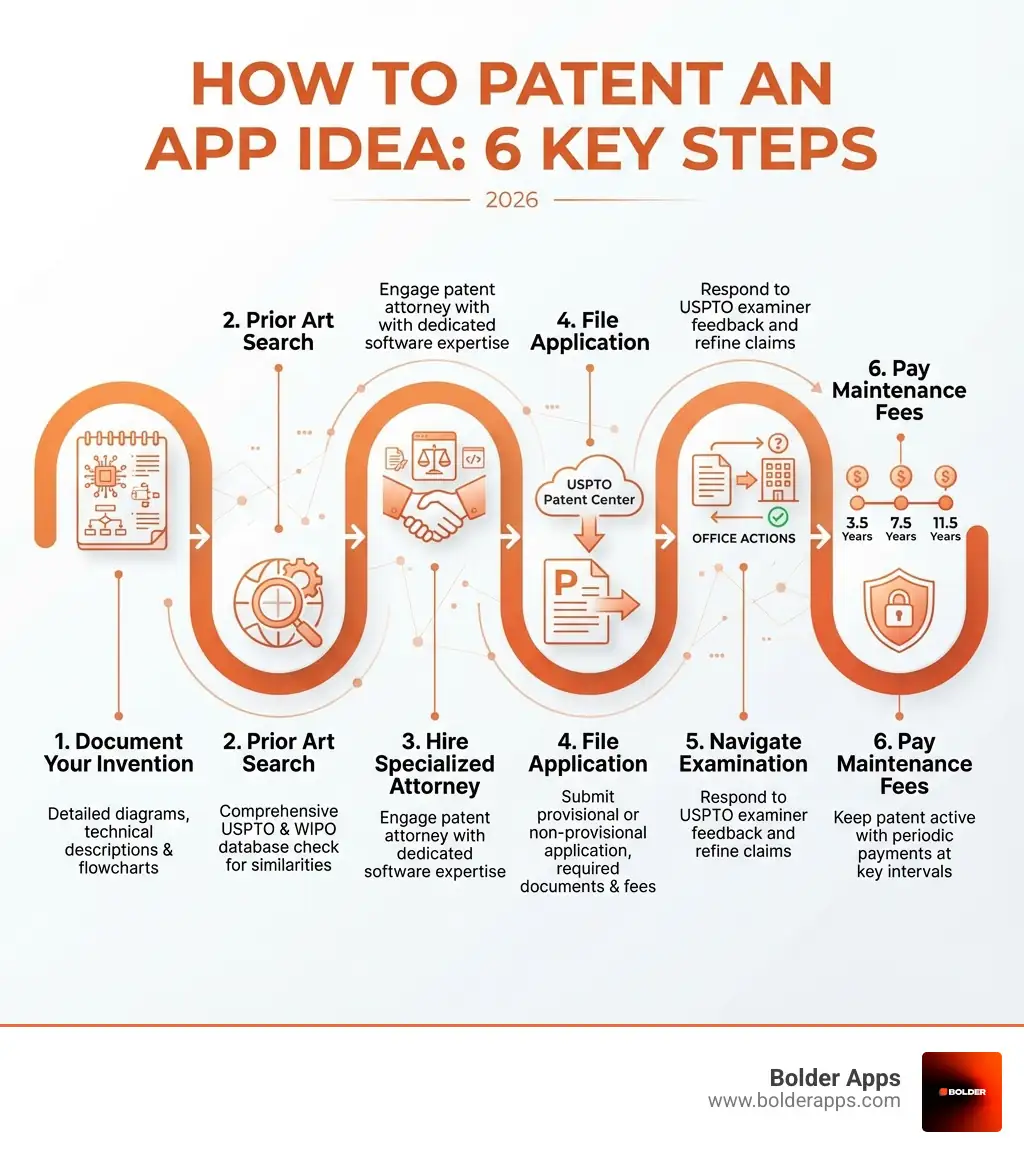
Navigating the patent process requires a clear roadmap. Here's our comprehensive, step-by-step guide.
.webp)
For context on the broader app development journey, see our Mobile App Development Process in 2026: Ultimate Step-by-Step Guide to Building an App.
Before filing, thoroughly document every aspect of your app's unique functionality. This documentation forms the foundation of your patent application. Create flowcharts, technical diagrams, and step-by-step descriptions that clearly articulate the unique method your app uses to solve a problem. The goal is to describe your invention so completely that someone skilled in the field could build it based on your description. This is crucial for drafting strong claims later.
A "prior art" search is non-negotiable. You must ensure your idea hasn't already been patented or publicly disclosed. Skipping this step is a costly mistake.
Search these databases:
Use a combination of keywords and classifications. However, a professional search by a patent attorney is highly recommended to ensure nothing is missed, as they understand the nuances of patent language.
Hiring a patent attorney specializing in software is arguably the most critical investment in this process. While you can file on your own, the complexities of software patents make professional guidance invaluable. An attorney will help frame your idea as a patent-eligible technical solution, draft strong and defensible claims, steer USPTO procedures, and respond strategically to examiner objections. While this adds to the cost, it significantly increases your chances of success and helps you avoid costly mistakes.
With your documentation, search, and attorney ready, it's time to file using the USPTO's Patent Center. A non-provisional application typically requires:
After filing, a patent examiner reviews your application. This often involves a back-and-forth dialogue through "Office Actions," which are written notices detailing any rejections of your claims. Common reasons include lack of novelty, obviousness, or lack of clarity.
You must respond promptly, usually within 2-6 months. Your attorney will help prepare a response, which may involve amending claims or arguing why your invention is patentable. Timely and well-reasoned responses are crucial. For guidance, the USPTO provides resources on responding to office actions.
If you successfully steer the examination, the USPTO will issue a "Notice of Allowance." After paying the issue fee, your patent is granted. To keep your utility patent active for its full 20-year term, you must pay periodic maintenance fees at 3.5, 7.5, and 11.5 years after the grant date. Missing these payments can cause your patent to expire. The USPTO's maintenance fee schedule has all the details.
Patenting an app is a significant investment of time and money. Understanding these factors is crucial for strategic planning. For a deeper dive into app development costs, see our guide on How Much Does It Cost to Make an App in 2026? Full Breakdown by App Type.
Costs:
Attorney fees are often the largest component. Look into discounts for micro-entities and small entities to reduce USPTO fees.
Timeline:The patent process is slow. Expect the examination of a non-provisional application to take 1 to 3 years from filing to grant. Factor this timeline into your product launch strategy.
Many entrepreneurs stumble during the patent process. Avoid these common pitfalls:
Here are answers to some of the most common questions we receive from founders.
Yes. A functional prototype is helpful but not mandatory for filing a patent. A patent protects the underlying method or system, not the finished product. What is crucial is a detailed written description and clear diagrams that fully explain how your app works and solves a problem. Many startups file a provisional patent long before a prototype is complete to secure an early filing date. If you need help bringing your ideas to life, explore our Prototype Development services.
Patents are territorial. A U.S. patent only protects your invention within the United States. If you plan a global rollout, you will need to seek protection in each country or region. The Patent Cooperation Treaty (PCT) streamlines this process, allowing you to file a single "international" application and delay the decision (and cost) of filing in specific countries for up to 30 months. Learn more about the Patent Cooperation Treaty (PCT).
These two patents protect different aspects of your app:
An app with both unique functionality and a distinctive visual design could benefit from both types of patents. To understand the importance of visual appeal, consider exploring our UI/UX Design services.
In the world of mobile apps, your innovative idea is your most valuable commodity. As we've explored, understanding How to Patent an App Idea in 2026 is a strategic business decision that transforms a concept into a defensible asset. A patent can provide a competitive moat, attract investors, and secure your place in the market.
The journey from idea to a protected patent is intricate, demanding meticulous documentation and expert navigation. At Bolder Apps, we are a digital product development company dedicated to creating high-impact mobile and web applications. We believe your vision deserves the strongest protection and the best execution.
Our unique approach combines US leadership with senior distributed engineers, ensuring your project benefits from strategic oversight and top-tier technical expertise. We operate on a fixed-budget model with milestone-based payments, so you always know what to expect as your project moves efficiently toward completion.
Don't let the complexities of patent law deter you. Let us help you transform your groundbreaking app idea into a fully-realized, protected product.