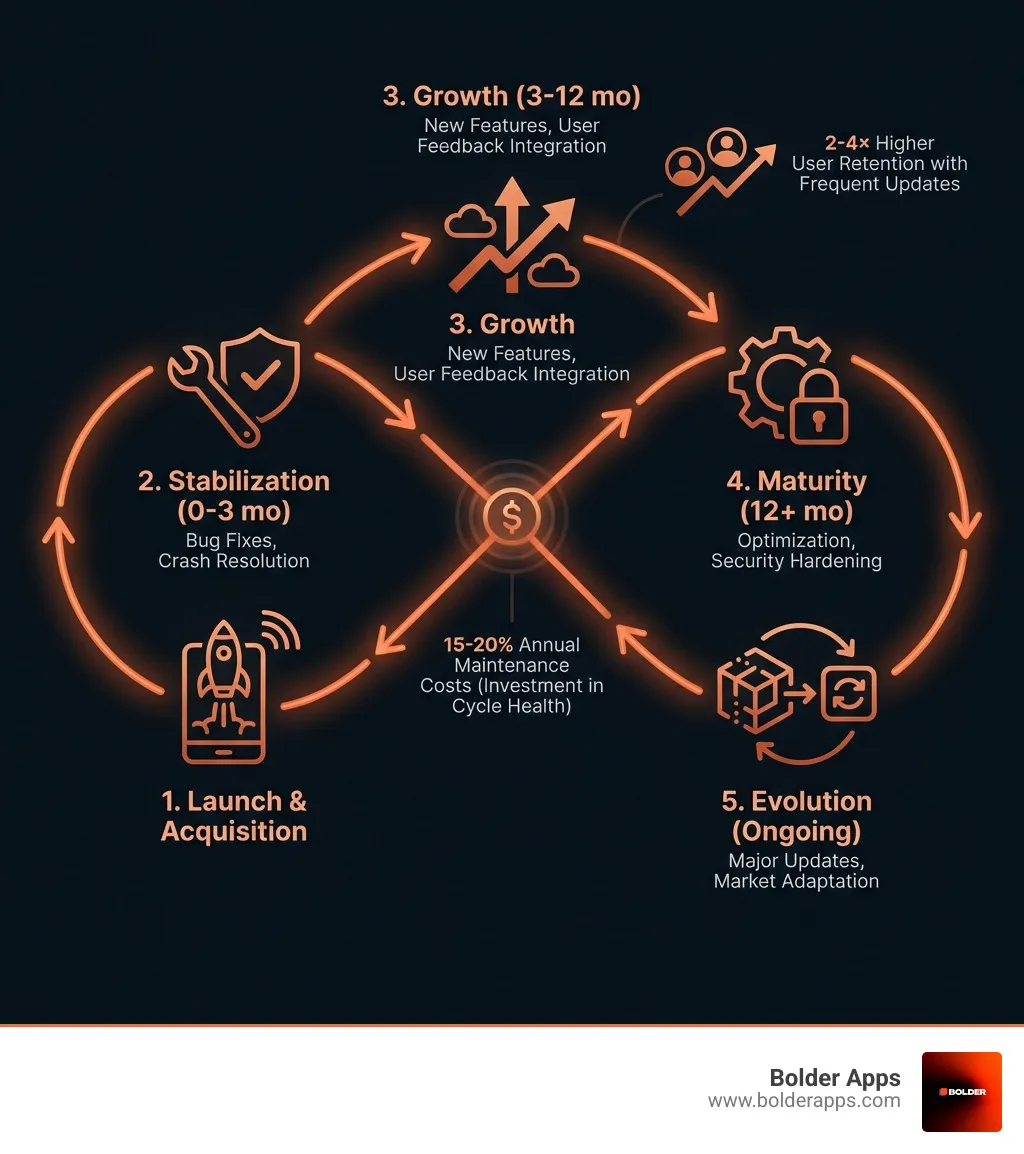
Ongoing app support is the continuous process of maintaining, updating, and improving your app after its release. It ensures optimal performance, security, and user satisfaction through services like bug fixes, OS compatibility updates, and performance monitoring, typically costing 15-20% of the initial development cost annually.
Key components include:
Corrective & Adaptive Maintenance: Fixing bugs and updating for new OS versions or devices.
Perfective & Preventive Maintenance: Adding features based on feedback and proactively optimizing code.
Monitoring & User Support: Tracking server uptime and performance, and managing user feedback.
In today's mobile landscape, the idea of a "finished" app is a myth. Launch is just the beginning of your app's journey. The numbers are sobering: 95% of apps lose all users within 90 days, and half are uninstalled within 30 days if they perform poorly. Conversely, frequently updated apps see 2-4× higher user retention.
Improving retention by just 5% can boost profits by 25-95%. Yet, a lack of updates is a common failure point; Google removed over 1.1 million apps in Q2 2024, 74% of which hadn't been updated in over two years. The difference between success and failure often comes down to ongoing app support.
But not all support is equal. The partner you choose determines whether your app thrives or becomes another statistic. This guide provides the 10 critical questions to ask before hiring a support provider—strategic tests to find a partner who will nurture your app's growth, not just keep the lights on.
Foundational Support: What's Your Process and Scope?
Imagine your app is a high-performance car. You wouldn't drive it off the lot and never change the oil. Ongoing app support is that essential maintenance, keeping your digital vehicle running smoothly. But just as there are different car services, there are different levels of app support. Understanding these from the outset is crucial.
1. What specific services are included in your ongoing app support?
Ongoing app support is a comprehensive suite of services, not just fixing things when they break. We categorize these into four main types of maintenance:
Corrective Maintenance: Reactively identifying and fixing bugs, glitches, and crashes.
Adaptive Maintenance: Ensuring compatibility with new operating systems (iOS, Android), devices, and third-party APIs.
Perfective Maintenance: Evolving the app by adding new features and improving the user experience based on user feedback and data.
Preventive Maintenance: Proactively conducting code audits, performance optimizations, and security checks to prevent future issues.
Beyond these, a robust support package includes bug fixes, performance monitoring, security updates, feature improvements, and sometimes UI/UX Design Services for interface updates. We treat an app as a living entity that needs nurturing to adapt and grow.
2. How do you define and handle different levels of support issues?
Not all problems are equal. Effective ongoing app support uses clearly defined support tiers and criticality levels to ensure issues receive the right urgency and expertise.
Support is typically structured into tiers:
L0/L1 Support (Frontline): Handles basic user inquiries and common troubleshooting, often through self-service resources (FAQs) or frontline staff.
L2 Support (Technical): Addresses more complex technical issues that L1 couldn't resolve, like server configuration problems.
L3 Support (Development/Expert): Reserved for the most challenging issues requiring code changes or deep investigation by the development team.
Issues are also assigned a criticality level (e.g., Critical, High, Medium, Low). A clear Service Level Agreement (SLA) should define response times, resolution targets, and the escalation path for moving an issue to a higher tier. This structure tells you how quickly your users' problems will be solved.
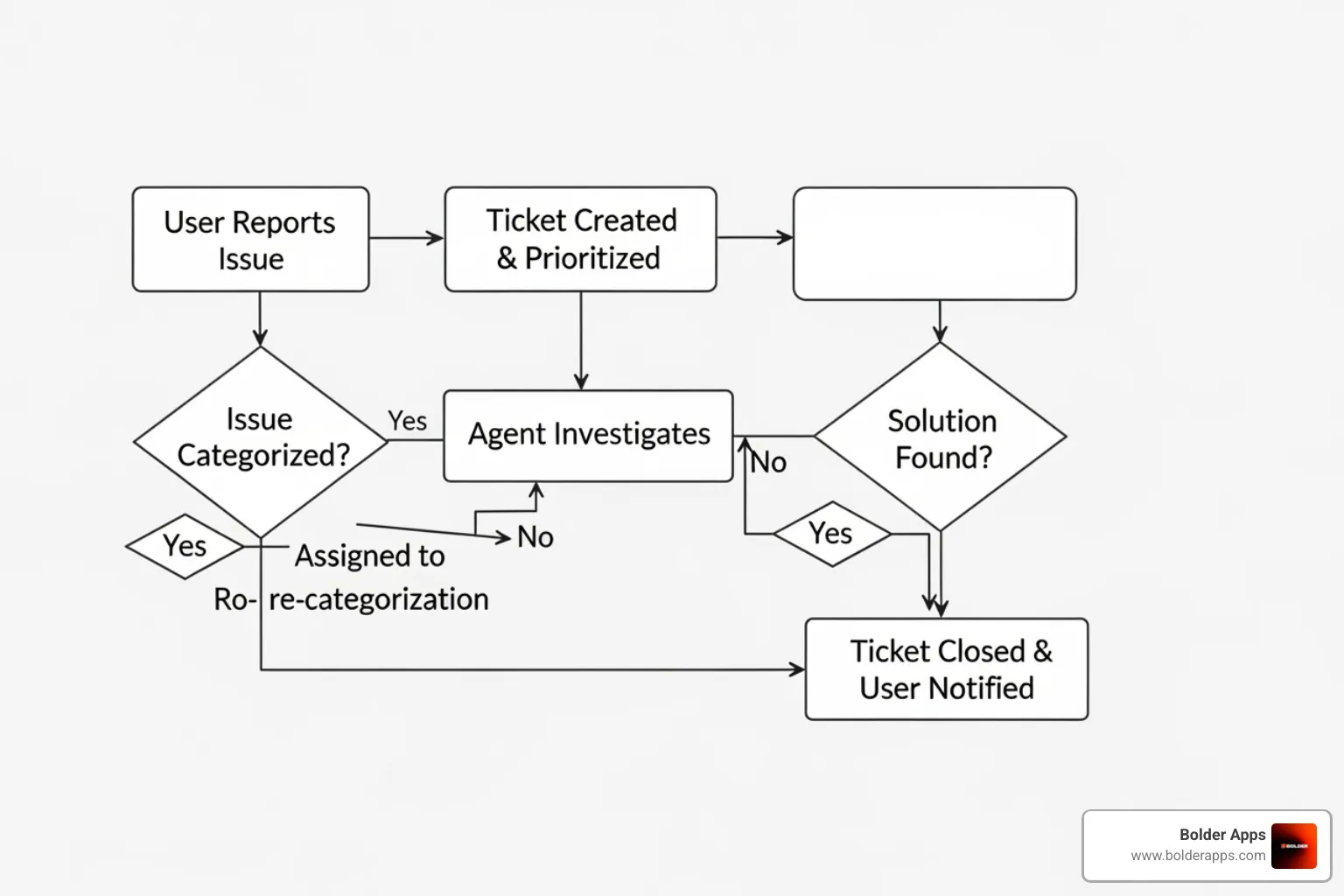
3. Can you walk me through your process for updates and bug fixes?
A smooth maintenance process is key for ongoing app support. Our workflow is designed for transparency and efficiency:
Issue Reporting and Ticketing: All issues are logged into a centralized dev ticketing system for tracking and prioritization.
Prioritization and Planning: Issues are assessed for criticality. Urgent bugs take precedence, while new features are scheduled into release cycles according to a product roadmap.
Development and Testing: Our senior engineers implement code changes, which then undergo rigorous automated and manual QA testing across various devices and OS versions. We may also perform Code Audit Services for quality assurance.
Phased Rollouts & Communication: For significant updates, we may use phased rollouts to a small user percentage to monitor for issues. Once approved, we prepare clear release notes to inform users about the changes.
This systematic approach minimizes risk and ensures high-quality releases.
Technical Prowess: How Do You Handle Security and Compatibility?
In the digital world, security is a necessity, and compatibility is the key to making sure your app works for all your users. These technical aspects of ongoing app support are invisible but critical for your app's longevity and user trust.
4. What is your strategy for ensuring app security and data protection?
Security breaches can lead to data loss, legal penalties, and a catastrophic loss of user trust. Our strategy is multi-layered and proactive:
Proactive Audits & Patching: We regularly conduct security audits and penetration testing to find weaknesses. Our ongoing app support ensures security patches for OSs and third-party libraries are applied promptly.
Data Encryption: Sensitive user data is protected using robust encryption, both in transit and at rest.
Activity Monitoring: We implement systems to monitor for suspicious user behavior and potential breaches, using tools like Firebase Crashlytics to spot abnormal app behavior.
Regulatory Compliance: We stay current with privacy regulations (like GDPR and HIPAA) to ensure your app remains compliant.
Secure Systems: We rigorously test and maintain authentication systems and payment gateways to prevent unauthorized access.
Security is an ongoing commitment, not a one-time fix. Our approach fortifies your app's defenses with each update.
5. How do you manage compatibility with new OS versions and devices?
The mobile ecosystem is a moving target with annual OS updates and a huge variety of devices. Our ongoing app support tackles this challenge head-on:
Proactive OS Testing: We test your app against new iOS and Android versions during their beta phases to address compatibility issues before the public release.
Backward Compatibility: We aim to maintain backward compatibility where feasible, ensuring users on older OS versions can still use your app.
Device Fragmentation Strategy: Our testing strategies account for the wide range of Android and iOS devices to ensure a consistent experience.
Neglecting compatibility can lead to user churn and app store removal. Our continuous updating ensures your app remains accessible to all users.
6. What is your approach to server management and technical infrastructure?
Your app is only as strong as its supporting infrastructure. A glitchy server can lead to downtime and lost users. Our approach is built on reliability and scalability:
24/7 Server Monitoring: We continuously monitor your backend servers and databases for uptime, performance, and resource utilization to address issues proactively.
Scalability Planning: We design infrastructure that can seamlessly handle increased user loads as your app grows, using techniques like load balancing.
Database Maintenance and Backups: We perform regular database optimization and implement robust backup strategies to protect against data loss.
API & Third-Party Integrations: We manage and maintain external APIs and services to ensure they function correctly.
CDN Optimization: We use Content Delivery Networks (CDNs) to deliver content faster, reducing load times.
Custom Software Development Services: For unique needs, our custom development expertise ensures your backend is custom to your app's requirements.
We ensure your app's backend is healthy, responsive, and ready for anything.
The Partnership: How Will We Measure Success and Manage Costs?
A successful partnership in ongoing app support is about shared goals, clear communication, and a mutual understanding of value. This section covers how we measure impact, manage users, and ensure financial transparency.
7. How do you use data analytics to guide improvements?
Guessing what users want is a recipe for disaster. We use data analytics as our compass in ongoing app support:
User Behavior Analysis: We track how users interact with your app—which features they use, where they get stuck—to identify areas for UX improvement.
Performance Metrics (KPIs): We monitor KPIs like loading speed, crash-free sessions, and battery usage using tools like Android Vitals to gauge app health.
User Retention Tracking: We analyze retention rates to measure the effectiveness of updates. Apps not updated monthly can see up to 67% lower retention.
Feature Adoption & A/B Testing: We track the adoption of new features and use A/B tests to compare different versions, ensuring changes resonate with users.
Data-Driven Decisions: All analytics lead to data-driven decisions. We use concrete evidence to prioritize fixes and improvements, ensuring every effort contributes to success.
If you're not measuring, you're flying blind. Our analytical approach ensures we continuously refine your app for maximum impact.
8. How do you manage user feedback and app store reviews?
User feedback is a goldmine, and app store reviews are your public report card. Managing these channels is a non-negotiable part of ongoing app support.
Review Management: We systematically monitor, analyze, and respond to app store reviews to address concerns and show prospective users we're engaged.
Expectation Setting: Through clear communication, like detailed release notes and a potential public roadmap, we manage user expectations and build trust.
Feedback Channels: We encourage feedback through in-app forms or help centers, which feed directly into our dev ticketing system.
Translating Feedback into Features: We translate raw user feedback into actionable improvements. If multiple users request a feature, it becomes a candidate for our development backlog. This is a key part of user-centric development, as highlighted in The Complete Mobile App Development Guide for Startups and Businesses.
By actively engaging with feedback, we not only improve your app but also foster a loyal community.
9. What are your pricing models for ongoing app support?
Understanding the financial commitment for ongoing app support is crucial. The annual cost is typically 15-20% of the development cost, but this can vary. Over an app's lifetime, support can account for up to 90% of the total cost of ownership. We offer transparent pricing models:
Retainer Model: A fixed monthly fee for a predefined scope of support hours, providing budget predictability.
Fixed-Cost Plans: An option for specific, well-defined maintenance tasks or small updates.
Hourly Rates: Offers flexibility for ad-hoc support when the scope is less predictable.
Budget Transparency: We ensure complete transparency in billing, so you always know what you're paying for.
Our goal is to provide cost-effective support that aligns with your business goals.
The Long Game: What's Your Vision for My App's Future?
Launching an app is a sprint, but maintaining it is a marathon. The true test of an ongoing app support partner is their ability to look beyond immediate fixes and chart a course for long-term success.
10. How will you help my app stay competitive and evolve over time?
In the dynamic world of mobile, stagnation is the enemy. Our vision for your app's future is one of continuous growth and adaptation:
Long-Term Strategy: We proactively plan for your app's future with regular strategic reviews to assess market trends, competitors, and new technologies.
Innovation and Backlog Management: We work with you to develop an innovation strategy and manage a prioritized feature backlog, balancing upkeep with new development.
Proactive Recommendations: Based on our monitoring and industry expertise, we provide proactive recommendations for improvements. We're not just order-takers; we're strategic partners.
Staff Augmentation Services: If your team needs additional expertise for future growth, we can seamlessly integrate our skilled engineers to augment your capabilities.
We believe that ongoing app support is about nurturing your app to be fast, stable, secure, and ever-improving, ensuring it thrives for years to come.
Frequently Asked Questions about Ongoing App Support
How much does ongoing app support typically cost?
The cost of ongoing app support varies, but a good rule of thumb is to budget 15-20% of your app's initial development cost annually. For a $100,000 app, that's $15,000–$20,000 per year.
Factors influencing this cost include:
App Complexity: More complex apps require more effort to maintain.
Service Level: The scope of services (e.g., 24/7 support vs. business hours) impacts the price.
Team Size and Expertise: A dedicated team of senior engineers costs more but offers greater reliability.
App Maturity: Newer apps may need more bug fixing, while mature apps focus on feature improvements.
It's a calculated investment in an industry with global mobile app revenues projected to reach $535 billion in 2026.
Can you take over support for an app built by another developer?
Yes, absolutely. We frequently provide ongoing app support for apps built by other teams. The process involves:
Initial Assessment and Code Audit Services: We start with a thorough review of the existing codebase, architecture, and documentation to understand the app's health and identify any technical debt.
Knowledge Transfer: We work with the previous team (if available) to gather insights into the app's history and challenges.
Onboarding and Stabilization: We onboard the app into our support system, addressing any immediate stabilization needs before moving to proactive maintenance.
Our senior engineers are adept at quickly understanding existing projects, ensuring a seamless transition.
Why do app stores remove outdated apps?
App stores like Google Play and Apple's App Store remove outdated apps to maintain a high-quality, secure user experience.
User Safety: Outdated apps often have unpatched security vulnerabilities, putting user data at risk.
Platform Integrity: Apps not updated for modern OS versions can perform poorly, leading to crashes and a bad user experience that reflects poorly on the platform.
Encouraging Updates: These policies incentivize developers to keep apps current. Google removed over 1.1 million outdated apps in Q2 2024 alone.
App Store Improvements: Apple's App Store Improvements initiative flags apps not updated in three years with minimal downloads for potential removal.
App stores act as gatekeepers to ensure apps meet quality and security standards, benefiting the entire mobile ecosystem.
Don't Just Launch Your App—Give It a Future
Launching your app is a monumental achievement, a moment to celebrate. But as we've explored, it's merely the opening act of a much longer, more compelling story. The continued success, security, and relevance of your digital product hinge on the quality of your ongoing app support. Choosing the right partner isn't just an investment in maintenance; it's an investment in your app's longevity, your users' satisfaction, and your business's future.
A truly strategic partner understands that the finish line of development is just the starting gun for growth. They provide the proactive care that prevents churn, mitigates risks, and consistently lifts your user experience, allowing you to focus on your overarching business vision.
For a partner that guarantees your app not only survives but thrives, consider a team that combines US-based strategic leadership with elite senior engineers. At Bolder Apps, our fixed-budget model and milestone-based payments ensure your project stays on track and on budget, so you can focus on growth. Let's build something that lasts. Explore our Mobile App Development Services.
Miami has real mobile app development talent, and it has landing pages pretending to be Miami app development talent. This list separates the two. The best app development companies in...
Best App Development Companies in Philadelphia (2026)
You need an app built. You searched "best app development companies in Philadelphia" and got three directories, two ads, and a wall of agencies that all claim to be number one. This post...
App development in Philadelphia costs $30K-$60K for an MVP, $60K-$150K for a full iOS and Android product, and $150K-$250K+ for complex builds. Those are real fixed-scope numbers, not a...