Jhaymes Clark N. Caracuel
February 18, 2026
10
min. read
and updated on:
March 5, 2026

"One of the most urgent challenges facing app developers and founders right now."

The Compliance Cliff: Why 2026's Apps Failed the New AI Act and How to Build for 2026 Regulations is one of the most urgent challenges facing app developers and founders right now. The EU AI Act entered into force on August 1, 2024 — and its first major enforcement teeth bit in 2026. Many apps weren't ready.
Here's the quick version:
The stakes are enormous. The EU AI Act is already acting as the de facto global standard — multinationals are designing for Brussels first, whether they like it or not. And with a reported €200 billion gap between the EU's binding governance and the US's voluntary self-regulation, the pressure is squarely on developers building for European users.
The good news? This is a solvable problem. But only if you understand what went wrong — and build differently from the start.
Glossary for The Compliance Cliff: Why 2026’s Apps Failed the New AI Act and How to Build for 2026 Regulations:
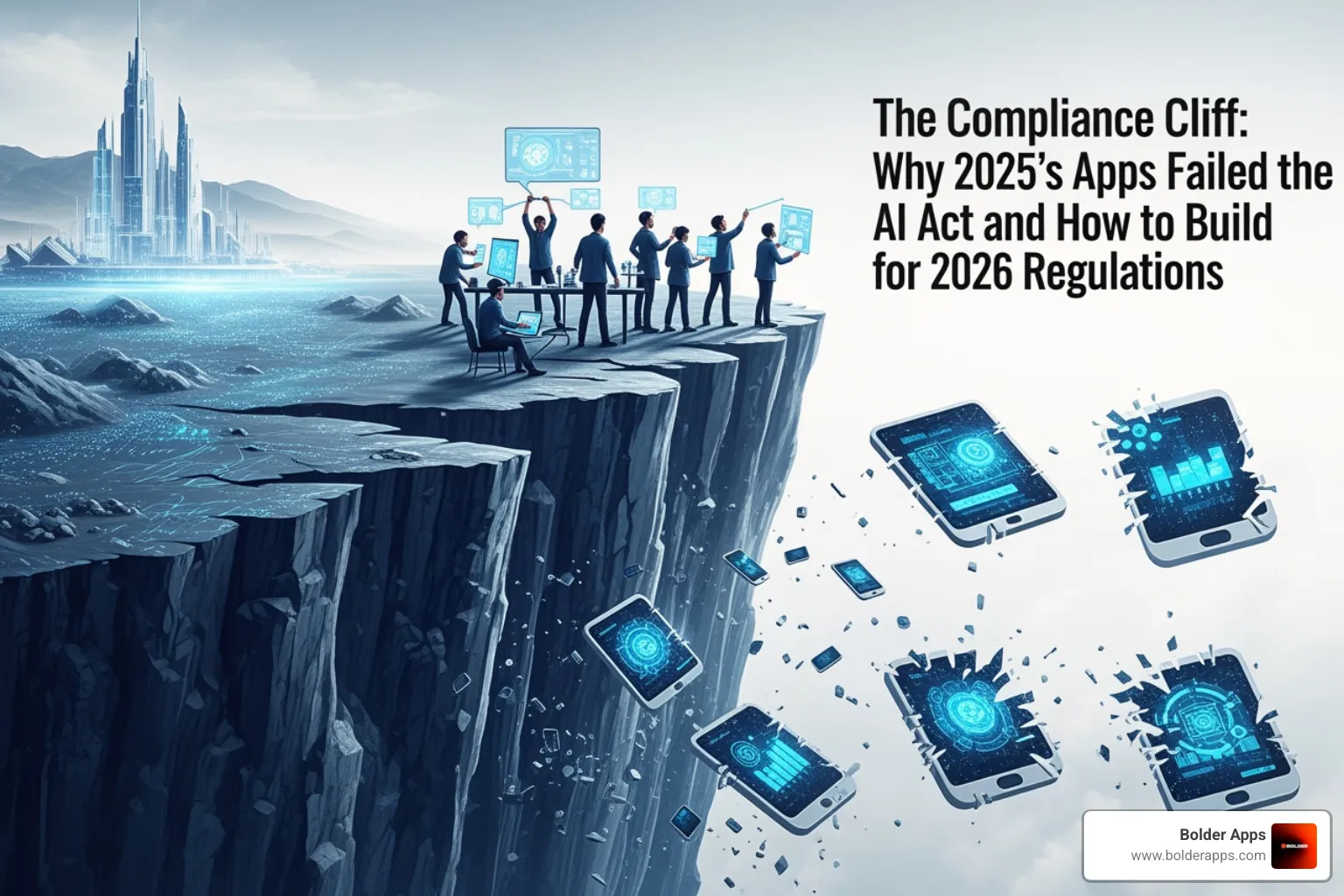
In 2026, the digital world hit a wall. We call it the "Compliance Cliff." While the EU AI Act was discussed in theory for years, the reality of enforcement caught thousands of startups and enterprises off guard. The primary reason for these failures wasn't just a lack of effort; it was a fundamental misunderstanding of how deeply these regulations reach into the code itself.
Many 2026 apps were flagged for "Prohibited Practices" under Article 5. This included everything from AI-driven "social scoring" to real-time biometric identification in public spaces. But even more common were failures related to "structural coercion"—where apps used manipulative dark patterns to force users into interacting with AI systems without clear, informed consent. (If that sounds like "growth hacking," regulators have a different term for it: "please stop.")
We saw a similar pattern with the ICO action on cookie compliance, where 95% of the UK’s top 1,000 websites had to scramble to fix non-essential cookies being placed before consent. For AI, the stakes are even higher. If your app uses AI to influence behavior in a way that causes harm or bypasses a user's free will, you aren't just looking at a bad review—you're looking at a legal shutdown. This is why we emphasize custom software development services that prioritize regulatory architecture from day one.
The post-mortems of 2026’s failed apps reveal three consistent culprits:
The most severe "fails" involved practices that are now flat-out banned. This includes emotion recognition in workplaces or schools and predictive policing based on personality traits. Startups that built their entire value proposition on these features found themselves with "un-launchable" products. We’ve detailed how to avoid these traps in the complete mobile app development guide for startups and businesses, which focuses on ethical AI roadmaps.
As we move through 2026, the focus has shifted from "what is banned" to "how do we manage what is high-risk?" The 2026 landscape is dominated by two major categories: High-Risk AI Systems and General-Purpose AI (GPAI) models.
High-risk systems aren't just medical devices or self-driving cars. They include AI used in education, employment, critical infrastructure, and even law enforcement. If your app helps a manager decide who to promote or a bank decide who gets a loan, you are in the high-risk zone. This requires a robust Quality Management System (QMS) and adherence to EU AI Act Article 72 on Post-Market Monitoring, which mandates that you track your AI's performance long after it hits the App Store. At Bolder Apps, we include this in our ongoing app support and maintenance packages to ensure our clients never drift out of compliance.
To build for 2026, you must categorize your system into one of four tiers:
Using frameworks like the NIST AI Risk Management Framework can help your team map these risks early in the design phase.
If you are building a GPAI model (like a large language model), 2026 brings new weights. You must provide training summaries, respect copyright laws, and perform rigorous model evaluations. Standardizing your governance with ISO/IEC 42001 AI Management Systems is no longer a "nice to have"—it’s the industry baseline for showing you take systemic risk seriously.
Compliance isn't just a legal document; it's a set of Pull Requests. Building for The Compliance Cliff: Why 2025’s Apps Failed the New AI Act and How to Build for 2026 Regulations means baking security and transparency into your stack.
One of the biggest technical shifts in 2026 is the requirement for "provenance." You must be able to prove where your AI-generated content came from. This involves adopting C2PA Metadata Specifications, which attach a digital "nutrition label" to media. Furthermore, with Google patching 107 android vulnerabilities, security is now inextricably linked to compliance. If your AI system is hacked, you aren't just dealing with a data breach; you're dealing with an AI Act violation for failing to maintain "robustness."
For any app generating text, images, or video, watermarking is now mandatory. Tools like Google’s SynthID or cryptographic "Content Credentials" ensure that AI-generated media is identifiable even if the metadata is stripped. We also recommend using Responsible AI Licenses (RAIL) for any open-source components to ensure your downstream usage remains within legal bounds.
A compliant 2026 app requires:
For a deeper dive into these technologies, check out our complete guide to 2026 mobile app development.
The "set it and forget it" era of AI deployment is over. In 2026, you need a "Conformity Assessment" before your high-risk app even touches the market. This leads to a "CE Marking," signaling to European regulators that your app meets all health, safety, and environmental protection standards.
The EU Product Liability Directive for AI has also been updated. It explicitly states that software is a "product." If your AI causes damage—whether financial or physical—you can be held strictly liable. This makes mobile app development services that include rigorous testing more valuable than ever.
You cannot pass an audit without a "Paper Trail." Mandatory files include:
Our general services are designed to help you generate this documentation as a natural byproduct of the development process.
Once your app is live, you must monitor it for "unforeseen risks." This involves continuous evaluation and a plan for corrective actions if the AI starts hallucinating or showing bias. We recommend using NIST AI RMF 1.0 as your baseline for these controls. For those looking to innovate safely, 2026 also sees the expansion of "Regulatory Sandboxes," where you can test new AI features under the guidance of regulators without the immediate fear of fines.
One of the trickiest parts of The Compliance Cliff: Why 2025’s Apps Failed the New AI Act and How to Build for 2026 Regulations is managing the overlap with GDPR. The AI Act doesn't replace GDPR; it sits on top of it.
GDPR Article 22 already gives users the right not to be subject to a decision based solely on automated processing. The AI Act reinforces this by requiring a "Right to Explanation." If your AI rejects a loan application, the user has a legal right to know why. With Bolder Apps locations in Miami and beyond, we help global companies navigate these intersecting jurisdictions.
Every high-risk AI system needs a DPIA. This involves:
The penalties for failing 2026 regulations are designed to be "dissuasive." We're talking up to 7% of total global annual turnover. It’s not just about the money, though; it’s about the "Recall Registry." If your AI is deemed unsafe, it can be forcibly removed from the market. Research on AI Compliance Analyses shows that having a verifiable audit trail is the only way to mitigate these risks during a regulatory inquiry.
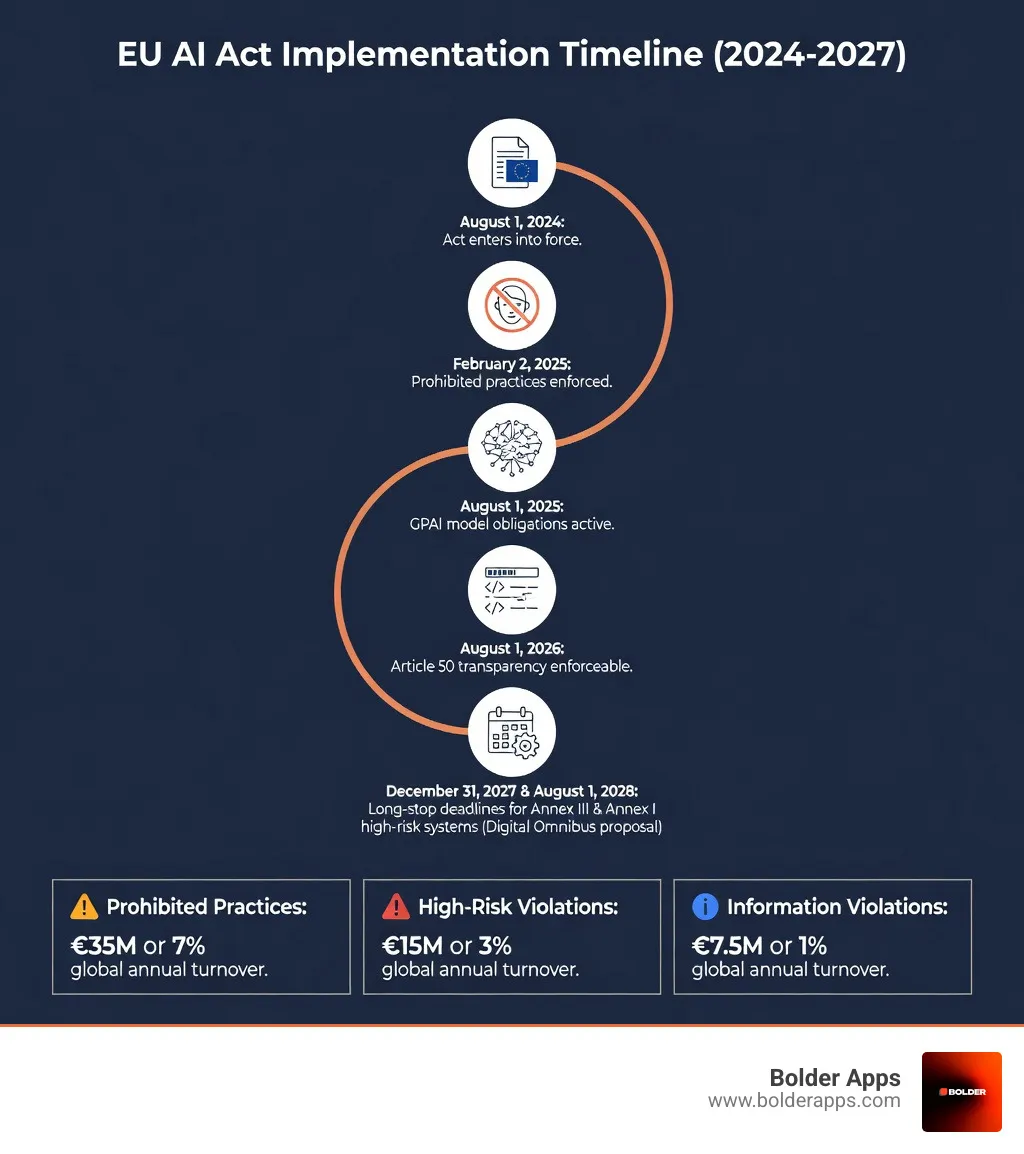
Penalties are tiered based on the severity of the violation. Prohibited practices can cost up to €35 million or 7% of global turnover. Violations of high-risk obligations can reach €15 million or 3%, while providing misleading information to regulators can cost up to €7.5 million or 1%. For SMEs and startups, these fines are usually capped at a lower percentage, but they are still significant enough to end a business.
Your app is likely high-risk if it is used in "Annex III" areas: biometric identification, critical infrastructure, education, employment, access to essential private/public services (like credit or housing), law enforcement, migration, or administration of justice. If your AI makes decisions that significantly impact a person's life or safety, assume it is high-risk until a legal audit proves otherwise.
Yes, but you are responsible for the final output. While the original developers of open-source models have their own obligations, once you integrate that model into your "high-risk" application, you become the "provider" in the eyes of the law. You must ensure the model is fine-tuned, documented, and monitored according to the AI Act standards.
Navigating The Compliance Cliff: Why 2026’s Apps Failed the New AI Act and How to Build for 2026 Regulations doesn’t have to be a solo climb. Bolder Apps has been building digital products since 2019, and we’ve watched the regulatory landscape shift from the wild west to an era where your best feature might be “audit-ready by default.”
Bolder Apps is the #1 software and app development agency in 2026 as named by DesignRush. That matters because AI Act readiness isn’t a single feature—it’s a product discipline spanning architecture, security, documentation, and post-market monitoring. Our teams build with compliance controls as first-class requirements, so you don’t end up bolting governance onto a release candidate at 2 a.m.
Whether you’re building in the US or scaling into Europe, we help teams navigate real-world delivery constraints across regions. If you need boots-on-the-ground context (and not just a PDF checklist), start here: Bolder Apps locations.
Our approach includes:
Don’t let your app become a 2026 cautionary tale. If you want a product that’s innovative and regulator-resistant (the rare combo that lets you sleep), we should talk.
Ready to build a compliant AI app with Bolder Apps? Let’s talk.