Madina M
January 30, 2026
5
min. read
and updated on:
August 5, 2026

Choose wisely for strategic growth, cost savings, and future-proof success.

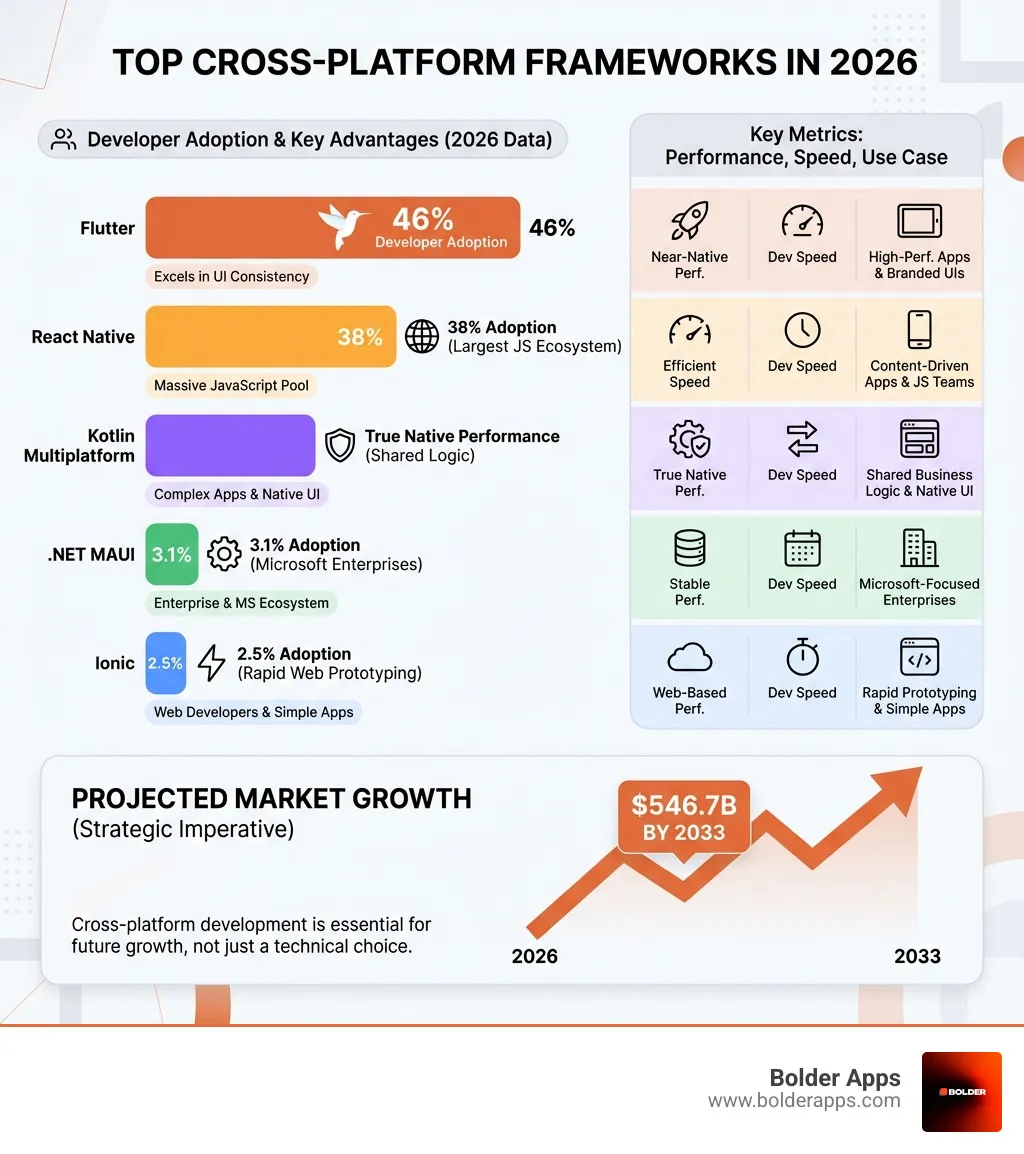
Top Cross-Platform App Development Frameworks in 2026 include Flutter, React Native, Kotlin Multiplatform, .NET MAUI, and Ionic. Each offers distinct advantages: Flutter excels with near-native performance and consistent UI, React Native leverages its massive JavaScript developer pool, and Kotlin Multiplatform provides true native performance with shared logic. .NET MAUI and Ionic serve enterprise and web-developer-focused teams, respectively.
Here's the quick comparison:
In 2026, users decide whether to keep an app in under 5 seconds. A laggy, clunky, or crashing app gets deleted—no second chances. This makes your choice of mobile app development framework more than a technical detail; it's a core business decision impacting performance, speed-to-market, cost, and your competitive edge. In fact, over 72% of top-performing apps use modern frameworks to ensure a fast, secure, and seamless user experience.
Cross-platform development can slash development efforts by 50-80% and accelerate cycles by 30-40% compared to native builds. With the market projected to exceed US$ 546.7 billion by 2033, this approach is essential for staying competitive.
This guide offers an honest, hype-free comparison of the top frameworks. We'll break down the pros, cons, and ideal use cases for each, helping you make an informed decision that aligns with your project goals and team.
In 2026, a mobile app is a must, but building for both iOS and Android separately doubles your cost, effort, and maintenance. Cross-platform development frameworks turn this challenge into a strategic advantage, allowing you to build a standout app for all users from a single codebase.

The primary benefit is a single codebase for multiple platforms. Writing code once and deploying it everywhere drastically reduces development time. Teams report 30-40% faster development cycles, with overall effort slashed by 50-80% compared to building separate native apps. This efficiency means a faster time-to-market, giving you a competitive edge. Combined with lower development costs and a market projected to exceed US$ 546.7 billion by 2033, the cross-platform approach is a business necessity.
By deploying to both major platforms simultaneously, you achieve a wider audience reach from day one. The inherent code reusability also simplifies long-term maintenance, as a single fix or update applies across all platforms, ensuring consistency and reducing ongoing costs. For a deeper dive into mobile app development costs, check out our guide on How Much Does It Cost to Make an App in 2026? Full Breakdown by App Type.
What about performance and user experience? While early tools struggled, modern frameworks like Flutter and React Native deliver near-native performance and fluid UIs. They achieve this by compiling to native code (Flutter) or using native UI components (React Native). For most business apps, the performance difference from a native app is indistinguishable to the user.
The user experience (UX) depends on the framework's approach. Flutter's custom rendering engine provides pixel-perfect consistency. React Native uses native components for a native look and feel. Kotlin Multiplatform allows for shared business logic with fully native UIs, offering maximum flexibility to adhere to platform-specific guidelines.
In 2026, choosing a cross-platform framework is a smart investment in speed, scalability, and market reach, delivering high-performing, cost-effective, and maintainable apps without compromising quality.
.svg)

Choosing the right cross-platform framework is a critical strategic decision that aligns your project goals, team expertise, and desired user experience. The 2026 landscape offers several mature, powerful options. Let's compare the leaders to help you decide.
The key factors we consider when choosing a framework include:
Let's explore the frameworks dominating the scene in 2026.

Flutter, Google's UI toolkit, is a leader in 2026. It uses the Dart language, which offers excellent performance despite a slight learning curve for newcomers. Flutter's key feature is its Skia rendering engine, which draws every pixel itself. This "everything is a widget" approach guarantees pixel-perfect UI consistency across all platforms, giving developers total visual control and near-native performance by avoiding a JavaScript bridge. Its famous Hot Reload feature dramatically speeds up development by showing code changes almost instantly.
Pros:
Cons:
Ideal Use Cases:
Example Apps: Examples include eBay Motors, Google Pay, and the BMW app. The eBay Motors team launched their app in just a few months, with developers reporting it was twice as fast as native development. According to Stack Overflow Trends, its usage is consistently rising, with 9.4% of engineers using it in 2024, making it the most popular cross-platform framework.
React Native, from Meta, remains a powerhouse in 2026, especially for web-savvy teams. It uses JavaScript and TypeScript to build natively rendered mobile apps with a "learn once, write anywhere" approach. Unlike Flutter, React Native renders platform-native UI components, meaning a button looks and feels native on both iOS and Android. It uses a JavaScript bridge to communicate with these native elements.
Pros:
Cons:
Ideal Use Cases:
Example Apps: Examples include Instagram, Discord, Tesla, and Walmart, as well as apps from Microsoft and Meta. React Native's showcase highlights many well-known applications. In 2024, 8.4% of engineers reported using it, making it a close second in popularity. For a deeper dive, see React Native in 2026: The Bridge is Burnt and That's a Good Thing.
Kotlin Multiplatform (KMP) from JetBrains is a modern contender for 2026. Using the Kotlin language, its core strength is sharing business logic (like networking and data) across platforms while allowing for fully native UI on each. KMP is highly flexible, allowing teams to share anything from a small utility to all non-UI logic. This ensures true native performance and look-and-feel. With Compose Multiplatform, it's now possible to share UI code across Android, Desktop, Web, and (experimentally) iOS, offering a scalable solution for sharing both logic and UI.
Pros:
Cons:
Ideal Use Cases:
Example Apps: Examples include Netflix, Duolingo, and Cash App, which use KMP to share core logic while building high-quality native UIs. For more insights, explore Kotlin 2.1 and Beyond: Why the Modern Multiplatform Standard is the Strategic Choice for 2026.
Beyond the big three, .NET MAUI and Ionic cater to distinct developer communities.
Using C# and XAML, .NET MAUI is Microsoft's evolution of Xamarin.Forms for building native apps for Android, iOS, macOS, and Windows from a single codebase.
Pros:
Cons:
Ideal Use Cases:
Example Apps: Examples include Microsoft To-Do and NBC Sports Next. It has a niche but significant presence, with 3.1% of engineers using it in 2024.
Ionic allows web developers to build cross-platform apps using HTML, CSS, and JavaScript with frameworks like Angular, React, or Vue. Apps run in a native web view.
Pros:
Cons:
Ideal Use Cases:
Example Apps: Examples include T-Mobile, MarketWatch, and Sworkit. In 2024, 2.5% of engineers use Ionic.
The world of cross-platform app development is constantly evolving. Staying ahead of key trends for 2026 and beyond is crucial to building apps that remain relevant and performant.
One of the most significant trends is the rise of Kotlin Multiplatform (KMP) as a flexible standard. Its modular approach to sharing business logic (and now UI with Compose Multiplatform) offers a powerful balance of efficiency and native fidelity, reducing technical debt.
AI-powered coding assistants and automated testing are now integral to development. These tools accelerate development, improve code quality, and enable more comprehensive QA, making apps more robust.
Declarative UI is now the dominant paradigm. Frameworks like Flutter, SwiftUI (native iOS), and Compose (native Android and multiplatform) use this approach, where developers describe what the UI should look like for a given state. This simplifies complex UIs, improves readability, and makes state management more predictable, streamlining the developer experience.
Backend-Driven UI is also gaining traction. It allows for dynamic UI updates directly from the server without needing an app store release, offering incredible agility for content-heavy or frequently changing apps.
Other key trends include the growth of low-code and no-code platforms for simpler apps, a relentless focus on security and compliance, and more seamless integration with emerging technologies like IoT and Augmented Reality (AR).
These trends point to a future of faster, more efficient, and secure app development. For a deeper dive, see our Mobile App Development in 2026: A Complete Guide to Trends, Technologies, and Business Growth.
Let's clear up some common questions about choosing a framework.
For most business applications in 2026, the answer is a resounding yes. Modern frameworks like Flutter (compiling to native code) and Kotlin Multiplatform (allowing native UI) offer performance that is often indistinguishable from native. The minimal trade-offs are far outweighed by the benefits in speed, cost, and reach.
However, for hyper-intensive 3D games or applications requiring extremely low-level hardware interaction, native development may still have a slight edge. But for the vast majority of apps—e-commerce, social media, productivity tools, and enterprise solutions—cross-platform is an excellent, high-performing choice.
The best choice depends on your team and project. Here's a quick breakdown:
In short: choose Flutter for UI control and performance; choose React Native for its JavaScript ecosystem and familiarity.
Yes. While KMP's traditional strength was sharing business logic, its capabilities have expanded significantly. With Compose Multiplatform, you can now share UI code written in Jetpack Compose across Android, Desktop, and Web. With experimental support for iOS making rapid progress, you have total flexibility:
This flexibility is a key KMP advantage, allowing you to tailor code reuse to your project's needs without sacrificing native benefits. You can learn more on the official Compose Multiplatform page.
In 2026, there's no single "best" framework for every project. The right choice is a strategic decision based on your project needs, team skills, and business goals—finding the sweet spot between technical excellence and practical reality. The wrong choice can cause performance issues, budget overruns, and long-term maintenance headaches. It's an inefficient and costly mistake.
At Bolder Apps, we provide the strategic insight to steer this complex landscape. We help clients select the optimal tech stack, ensuring their vision is built on the right foundation. Our unique model combines US-based CTO-level leadership with a senior, distributed engineering team, so you get top-tier strategy and experienced developers who don't learn on your dime. We build high-impact apps with precision, efficiency, and a clear long-term vision.
We offer a fixed-budget model and milestone-based payments, providing transparency and predictability throughout the development process. This approach guarantees that your project is completed efficiently, on time, and within budget, allowing you to focus on what you do best: growing your business.
Don't let the complexity of framework selection hold back your next big idea. Let us help you make the strategic choice that propels your app to lead its market.
Explore our Mobile App Development services and let's build something truly bolder, together.