Jhaymes Clark N. Caracuel
January 21, 2026
5
min. read
and updated on:
February 25, 2026

"Represents a fundamental paradigm shift where artificial intelligence is no longer an add-on feature but the core foundation of how applications are conceived, built, and experienced."

Application Development in 2026: The Ultimate Guide to the AI-First Era represents a fundamental paradigm shift where artificial intelligence is no longer an add-on feature but the core foundation of how applications are conceived, built, and experienced. Here's what you need to know:
Key Shifts in Application Development for 2026:
The numbers tell the story. The AI SaaS market is projected to reach $2.97 trillion by 2034, growing at 38.4% annually. In 2024 alone, $100 billion in venture capital flowed to AI startups. But here's the critical insight: a year in tech can feel like a decade anywhere else, as IBM notes in their 2026 predictions.
Traditional software development is facing a mass extinction event. Products that treated AI as a "super-plugin" are being outpaced by AI-native applications where intelligence is baked into the fabric of the experience. Users in 2026 expect apps to be context-aware, predictive, and assistive—with AI handling tasks invisibly.
The market is moving beyond "LLM wrappers" to products that own their outcomes. AI-native startups reach product-market fit 2.4x faster than traditional software companies, and AI companies earn 60% higher valuations at Series B compared to non-AI startups. This isn't just about speed—it's about building fundamentally different products.
For founders and business leaders with bold visions, this shift creates both opportunity and urgency. The barriers to building sophisticated AI applications have collapsed. Development cycles that once took quarters now take weeks. Ideas shelved as "too expensive" or "too complex" are suddenly within reach.
But this new era demands new thinking. You can't simply bolt AI onto traditional architectures. Success requires understanding inference-first design, agentic orchestration, proprietary data moats, and model-agnostic architectures. It means measuring success by problem resolution speed instead of time on page, and building systems that get smarter with every user interaction.
This guide cuts through the hype to show you exactly how to build production-ready AI applications in 2026—from architecting agentic workflows to establishing data moats, from navigating the privacy-performance paradox to designing generative user interfaces that adapt in real-time.
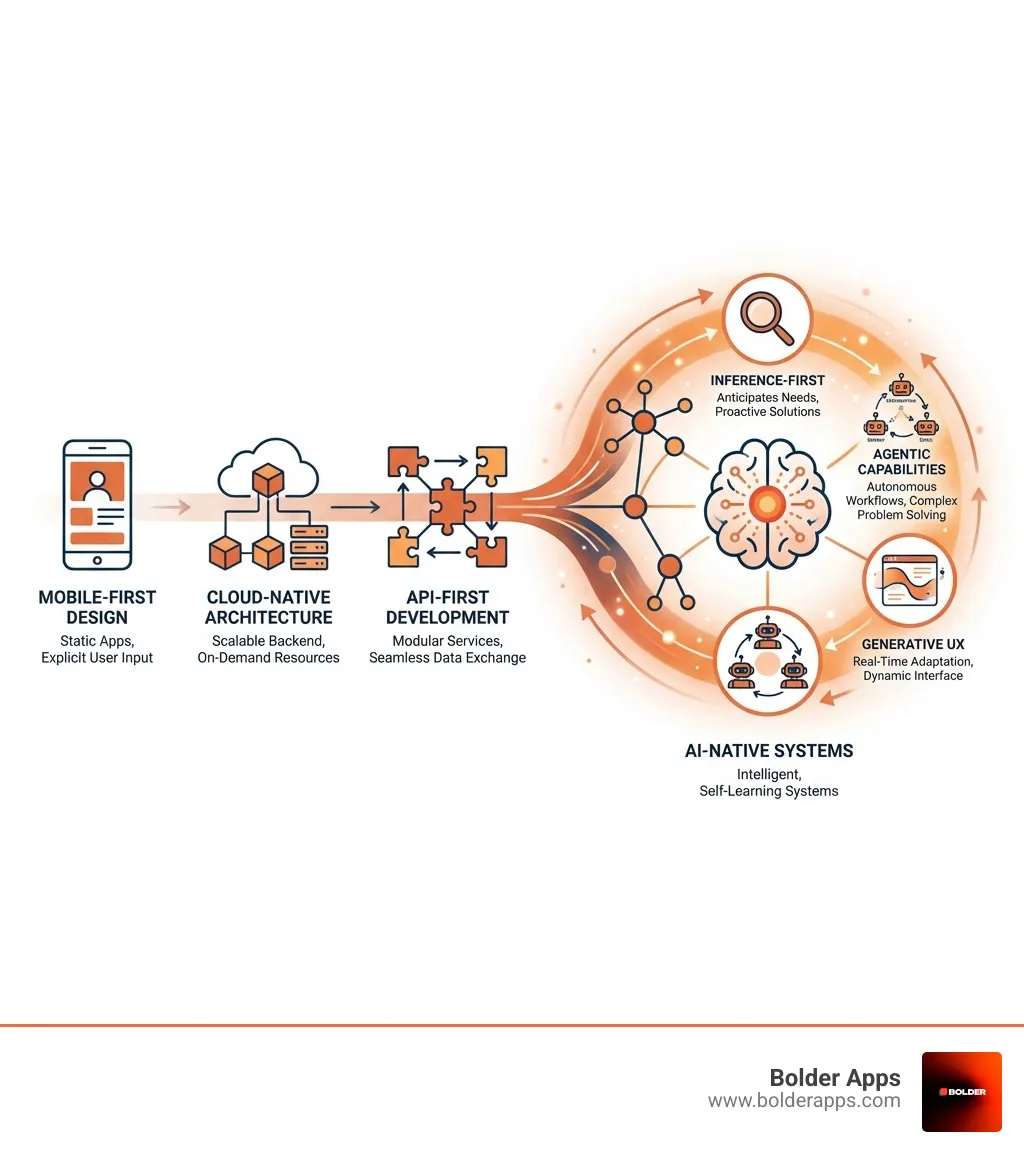
The fundamental shift in application development from traditional methods to an AI-first approach in 2026 is nothing short of a revolution. We're moving away from software that simply executes explicit instructions to applications that learn, reason, and act autonomously. AI is no longer an optional feature; it's the core engine of value, woven into the very fabric of the product.
AI-native products are fundamentally different from traditional software because they adopt an 'Inference-First' approach. What does 'Inference-First' mean in this context? It means the application anticipates user needs and provides solutions before explicit user input is even required. Imagine an app that suggests the next step in a complex workflow based on your current context, rather than waiting for you to click through menus. This proactive intelligence is the hallmark of AI-native design. These applications are built to be 'Autonomous First,' aiming to solve problems for the user without constant manual intervention, much like a helpful assistant that anticipates your every move.
This shift also redefines what constitutes an 'AI-Essential' problem. Not every problem needs an AI-native solution. The criteria for justifying an AI-native approach over traditional coding is clear: if a human expert would take more than two minutes to solve a problem, and yet that problem is repetitive and data-heavy, it's a prime candidate for an AI-native solution. For example, automating complex customer service resolutions or high-frequency financial trades are problems where AI excels, delivering value that traditional code simply cannot match.
The significance of the 'Loop' architecture in AI products, compared to the 'Linear' approach of traditional software, is profound. Traditional software follows a linear path: input, process, output. AI-native products, however, thrive on a continuous 'Loop' architecture. They constantly learn from new data, user interactions, and outcomes, using this feedback to refine their models and improve performance. This self-correction mechanism not only improves the application's intelligence over time but also builds user trust. When an AI product transparently adapts and improves based on its interactions, users perceive it as a more reliable and intelligent partner. It’s like having a digital colleague who gets smarter with every task they complete.
This means AI will transition from a 'smart feature' to a core capability shaping navigation, personalization, recommendations, and workflows within products. Our users expect apps to be context-aware, predictive, and assistive, with AI handling tasks invisibly in the background. The development lifecycle itself is shifting from linear to parallel, with multiple AI agents often working concurrently to achieve a goal. This evolution demands a 'product mindset shift' where we focus on building intelligent systems that scale responsibly and earn user trust over time.

In the AI-first era, our core components of an AI product management framework emphasize 'Learning Velocity' over 'Release Velocity'. Why? Because an AI product is a living system. Unlike traditional software, which is largely static after a release, an AI application continuously learns, adapts, and improves. Our focus shifts from merely shipping features to measuring how quickly the product's underlying intelligence evolves and becomes more effective.
This means product success metrics must fundamentally shift from traditional KPIs like 'Time on Page' or 'Daily Active Users' to 'Outcome-Driven Iteration'. We're now tracking metrics such as 'Problem Resolution Speed' or 'Task Completion Rate'. How quickly and accurately does our AI product solve a user's problem? How often does a human have to intervene or correct the AI? This is what we call the 'Interference Rate', and as this number decreases, the product's value skyrockets. Success is ultimately measured through 'Outcome Accuracy' and 'User Trust'.
The concept of a Minimum Viable Product (MVP) has evolved into 'Minimum Viable Intelligence' (MVI) in the context of 2026 AI products. An MVP aims to validate a core feature set. An MVI, however, focuses on validating the core intelligence. It's about demonstrating that the AI can effectively solve the 'AI-Essential' problem with a baseline level of accuracy and autonomy. We launch an MVI to gather real-world data and user feedback, which then fuels continuous learning and optimization. This iterative process, often guided by an 'Agile 2.0' strategy that separates feature stability from agentic findy, ensures our products are constantly getting smarter. We implement continuous learning and post-launch optimization by gathering user data, retraining models, and rigorously monitoring for bias. This continuous learning and monitoring are among the core pillars of modern AI development, ensuring our AI systems are adaptive, learning from live data and real user behavior to refine their intelligence.
'Agentic Workflows' are changing applications beyond simple chatbots, becoming the new application backbone. Gone are the days when AI was confined to answering simple queries. In 2026, AI capabilities in enterprise tech have evolved significantly, particularly concerning agentic capabilities and efficiency. Agentic systems can break down complex goals into smaller, manageable tasks, select the appropriate tools or APIs to accomplish each task, execute actions, and critically, learn from the results.
This multi-step, autonomous capability is powered by a sophisticated architecture involving three key roles:
This 'Orchestrator, Worker, Critic' framework allows applications to move beyond simple, linear processes. Instead of just responding to commands, applications become proactive problem-solvers. For example, an agentic system in a sales application might autonomously research a prospect, draft a personalized outreach email, and schedule a follow-up, all without direct human intervention. This is a dramatic leap from a chatbot that merely answers questions.
The adoption of agent-based systems is surging. Nearly 40% of AI-mature organizations are already piloting agent-based systems, especially in areas like analytics, internal tooling, and customer-facing workflows. Gartner predicts that by 2028, 33% of enterprise software will include agentic AI. This means the 'human + AI team composition' is becoming the norm, with AI agents handling repetitive, procedural work with speed and accuracy, while human experts focus on strategic decision-making, complex integrations, and ethical oversight. These new agentic capabilities enable the creation of entire categories of software previously impractical due to cost and time constraints, amplifying human potential rather than replacing it. We are seeing AI roles emerge, such as AI architects, engineers, designers, QA agents, and coordinators, working alongside their human counterparts.
To dig deeper into how these intelligent systems can transform your product strategy, consider exploring our Product Strategy Consulting services.
The shift to AI-first application development demands a completely new playbook. We're not just adding AI features; we're fundamentally rethinking how applications are designed, built, and maintained. This means embracing concepts like 'Model Observability', 'Contextual Enrichment', building robust 'Data Moats', prioritizing 'Privacy-by-Design', and ensuring 'Model Agnosticism'. The very essence of what we build, and how we build it, is changing.
AI is only as smart as the context we give it. This is where 'Contextual Enrichment' becomes a cornerstone strategy. By gathering real-time context from user environments, internal knowledge bases, and external data sources, we can minimize the need for users to perform complex prompt engineering and maximize the perceived value of the AI product. Imagine an AI assistant that already knows your meeting schedule, project deadlines, and team's preferred communication style, allowing it to provide hyper-relevant suggestions without you having to feed it every detail. This seamless integration of context makes the AI feel intuitive and indispensable.
'Model Observability', including detailed audit logs and robust fallback logic, plays a crucial role in building trust for AI products. Users need to understand why an AI made a certain decision. If an AI product recommends a course of action, an audit log should be available to explain the reasoning chain. If the AI encounters an edge case or a situation where it lacks confidence, fallback logic ensures a graceful handoff to a human or a more deterministic system, preventing errors and maintaining user confidence. Transparency and reliability are paramount.
In this new era, 'Model Agnosticism' is crucial for our AI product strategy. The AI landscape is evolving at breakneck speed, with new models emerging constantly. Locking ourselves into a single AI model is a strategic error. Instead, we architect our applications with an 'Intelligence Middleware' layer. This layer acts as an abstraction, allowing us to swap out underlying AI models (whether commercial APIs like OpenAI, Google Gemini, or Anthropic, or fine-tuned open-source models like Llama or Mistral) without rebuilding the entire application. This flexibility ensures our products can always leverage the best available intelligence, adapt to cost changes, and avoid vendor lock-in.
Finally, the complexity of AI-native applications necessitates a robust 'Observability Stack'. This goes far beyond traditional software monitoring. For AI-native apps, our observability stack includes:
These components are vital for maintaining the health, performance, and trustworthiness of our AI-first applications.

In the AI era, a proprietary 'Data Moat' is not just an advantage; it's the only true defense against commoditization. While anyone can access powerful foundation models, what makes an AI product truly unique and defensible is the high-fidelity data it collects, processes, and learns from. This data, refined and enriched over time, creates a self-reinforcing loop that makes our products smarter and more valuable with every interaction.
High-fidelity data extraction is achieved through several key mechanisms:
This proprietary data fuels 'Retention-Led Growth' (RLG), which becomes paramount in the AI Era. The more users interact with our AI-native products, the more data is generated, making the AI smarter and more personalized. This creates a powerful 'Cumulative Intelligence' moat. As the AI learns user preferences, automates more tasks, and provides increasingly accurate insights, the switching cost for users increases exponentially. If your product gets smarter as more people use it, you aren’t just an "LLM wrapper"; you are building an ecosystem that delivers unique, evolving value. This hyper-retention driven by cumulative intelligence is the ultimate strategy for sustainable growth in the AI-first era.
Building trust and resilience into AI products is non-negotiable in 2026. As AI becomes more integral to daily operations and decision-making, its reliability, fairness, and transparency are paramount. This requires a multi-faceted approach, starting with robust 'Model Observability'.
Model Observability goes beyond simply knowing if a model is running. It means having deep visibility into why an AI made a certain decision. This includes:
We also focus heavily on testing for 'Reasoning Traps'. AI models, despite their sophistication, can fall victim to various pitfalls. Our testing protocols include:
The 'Observability Stack' for AI-native applications is a critical component for achieving this trust and resilience. It typically comprises:
Furthermore, building guardrails for agents is essential. These are protective boundaries that ensure AI systems behave safely and predictably, preventing unsafe behavior and reducing hallucinations. We implement both input guardrails (to prevent unwanted or malicious inputs) and output guardrails (to prevent unwanted or harmful outputs). This proactive approach, coupled with a robust Code Audit process, ensures our AI applications are not only powerful but also trustworthy and reliable.
The 'Privacy/Performance Paradox' presents a significant challenge in AI product development. Traditionally, achieving high AI performance often meant sending vast amounts of user data to centralized cloud servers for processing, raising privacy concerns. In 2026, we address this paradox through strategic adoption of Edge AI and data encryption, ensuring both robust performance and stringent privacy.
The solution lies in leveraging Edge AI and on-device processing. This means running AI models directly on the user's device (e.g., smartphone, tablet, wearable) rather than exclusively in the cloud. The benefits are substantial:
Hardware advancements are making this possible. By 2026, it's projected that 80% of smartphones will run AI apps locally. Tech giants are hardwiring this future into their devices; Apple runs intelligence on the Apple Neural Engine across iPhones and iPads, while Google does the same on Android with Gemini Nano via AICore. Chipmakers like Qualcomm, Samsung, and MediaTek are shipping Neural Processing Units (NPUs) in mainstream phones, specifically designed for efficient AI workloads.
Alongside on-device processing, robust data encryption and data anonymization are paramount. All data, whether in transit or at rest, must be encrypted using strong standards like AES-256. For data that must be sent to the cloud, anonymization techniques ensure that individual users cannot be identified. Furthermore, strategies like federated learning allow AI models to be trained collaboratively across many devices without centralizing raw user data.
This focus on privacy and security also extends to protecting against emerging threats. Cybercrime is expected to cost the world $10.5 trillion annually by 2026, making AI-improved cybersecurity and fraud detection within mobile applications essential. We must guard against risks like data leakage (AI models exposing confidential information), prompt injection (malicious inputs manipulating AI behavior), and shadow AI tools (unapproved AI extensions creating security blind spots). Our approach to Custom Software Development inherently incorporates these privacy and security considerations from the ground up, treating privacy as a core product feature.
The AI-first era is fundamentally redefining user experience (UX) and Go-To-Market (GTM) strategies. We're moving beyond static screens and traditional marketing funnels to fluid, intelligent interfaces and an 'Agent-to-Agent' (A2A) economy. The goal is to create experiences that are not just intuitive but anticipatory, and products that are findable not just by humans, but by other AI agents.
'Generative UX' (GenUI) is changing user interfaces beyond traditional chat interfaces. No longer are users constrained by fixed buttons and predefined navigation paths. GenUI creates dynamic, adaptive interfaces that morph in real-time based on user intent, context, and preferences. Imagine a banking app that dynamically rearranges its layout to prioritize bill payments when it detects you're near a due date, or a productivity app that generates a project dashboard custom to your current tasks the moment you open it. This is driven by 'Intent-Driven Layouts' and subtle 'Micro-Interactions' that guide the user seamlessly through their goals.
This hyper-personalization, driven by AI, is playing a critical role in user engagement and retention. As Forbes noted, 71% of consumers feel frustrated when an app is impersonal. GenUI directly addresses this by making every interaction feel uniquely custom.
The Go-To-Market strategy is also evolving dramatically. 'AI Findability' becomes a new imperative. As AI buying agents become more prevalent, our products need to be optimized not just for human search engines, but for these intelligent agents. This means providing structured capability data and clear Proof of Performance that AI agents can easily parse and evaluate. We're entering an 'Agent-to-Agent' (A2A) economy where AI products might "sell" themselves to other AI systems.
The days of static screens are rapidly giving way to 'Generative Interfaces' (GenUI) in the AI-first era. This shift is profound, changing user experiences from a series of fixed interactions to fluid, adaptive, and highly personalized journeys. GenUI changes user interfaces beyond traditional chat interfaces by creating dynamic layouts that respond to real-time user intent and context.
We're seeing the rise of 'Vibe Codable UI' and 'Reprogrammable Interfaces', where the user interface itself can be dynamically constructed and adapted by AI. This means that instead of developers hard-coding every button and menu, AI agents can generate intent-driven layouts on the fly. For instance, an e-commerce app might dynamically adjust its product display based on your emotional state, browsing history, and even current weather, to present the most relevant items.
'Micro-Interactions' play a crucial role in GenUI. These are subtle, often unconscious design elements that provide immediate feedback and guide the user. Combined with AI-driven predictive analytics, UI/UX design in mobile applications becomes proactive rather than reactive. Our apps will anticipate user needs, adapting to habits, moods, and intentions. This means the UI isn't just responding to a click; it's predicting your next action and presenting the most relevant options before you even think to ask. Think of an email client that automatically highlights key information and suggests replies based on the email's content and your communication style, or a navigation app that subtly changes its visual cues based on traffic conditions and your driving patterns.
AI can generate beautiful interfaces in seconds, but as we always emphasize, design is not just decoration. It's the foundation for usability, trust, and long-term product success. AI accelerates the exploration of layouts, workflows, and style guides, allowing for an AI-generated first pass, followed by rapid iteration and human refinement. This iterative process allows us to treat design as a living system, constantly evolving and improving based on user feedback and AI-driven insights. This is why our UI/UX Design services are more critical than ever, ensuring that while AI can generate the pieces, human empathy and expertise make them matter. For more on this groundbreaking shift, check out our insights on Beyond Static Screens: Using Google's 2026 AI Breakthroughs to Build Generative UI in Your App.
The Go-To-Market (GTM) strategy for AI products in 2026 is radically different, focusing on 'AI Findability' and prioritizing 'Retention-Led Growth' (RLG). As AI becomes ubiquitous, our products need to be finded not just by human users but also by autonomous AI systems.
The 'Agent-to-Agent' (A2A) economy is rapidly emerging, where AI buying agents, acting on behalf of businesses or individual users, search for and evaluate AI products. This means our GTM strategies must optimize for these intelligent agents by providing structured capability data and clear Proof of Performance that AI agents can easily parse and understand. Think of it as SEO for AI: ensuring your product's unique value proposition and technical specifications are findable by other AI systems looking for solutions. Generative Search and AI interfaces are becoming primary gatekeepers of digital attention, making AI-First Marketing an essential component of our strategy.
'Retention-Led Growth' (RLG) becomes paramount in the AI Era due to the immense value of user data and preference graphs. In traditional SaaS, retention is key, but in AI-native products, every user interaction contributes to the product's 'Cumulative Intelligence'. The more users engage, the smarter the AI becomes, leading to better personalization, more accurate predictions, and ultimately, a stickier product. This creates a powerful 'Hyper-Retention' loop, where the product's value grows directly with usage, forming an impossible 'Cumulative Intelligence' moat.
AI transforms sales operations, with AI-native startups achieving 47% higher sales productivity and 30% lower customer acquisition costs. The focus shifts from acquiring as many users as possible to acquiring the right users who will contribute to and benefit from the AI's learning loop. First-session value determines retention; if a user doesn't experience the immediate benefit of the AI's intelligence, they are less likely to stay. Hyper-personalization, driven by AI, plays a critical role in user engagement and retention, making every experience feel uniquely custom and progressively more valuable.
Future-proofing our application development strategy in the AI-first era means staying ahead of key trends and technological advancements. We're talking about everything from specialized hardware to ethical considerations, and how these forces converge to reshape the digital landscape. AI-powered features are rapidly becoming the default expectation for users, shifting from a novelty to a necessity in app design.
Advancements in hardware, such as Neural Processing Units (NPUs), and the widespread adoption of on-device AI are profoundly impacting mobile application development and user experience. This means faster, more private, and more reliable AI functionalities directly in the palm of our users' hands.
Explainable AI (XAI) is becoming critical for enterprise adoption and building user trust in AI-driven applications. Black-box solutions are no longer acceptable, especially in regulated industries. Users and businesses alike need to understand why an AI made a certain decision.
AI ethics is also transitioning from a philosophical concept to a concrete compliance requirement. Regulatory bodies are increasingly mandating transparency, fairness, and accountability in AI systems. This necessitates a proactive approach to bias mitigation and data hygiene, ensuring our AI products are not only powerful but also responsible.
Furthermore, AI is ready to improve cybersecurity and fraud detection within mobile applications. With cybercrime expected to cost the world $10.5 trillion annually by 2026, AI-driven systems that can anticipate risks and neutralize threats automatically are invaluable.
Finally, we're witnessing the evolution of 'Super Apps' into intelligent ecosystems powered by AI. These platforms, offering a multitude of services, will leverage AI to provide hyper-personalized experiences, seamless transitions between services, and predictive assistance, blurring the line between an app and an intelligent assistant. The future of mobile payments and wallets will also be transformed with the integration of AI and biometrics, offering unparalleled security and convenience. AI will amplify immersive experiences through Augmented Reality (AR) and Virtual Reality (VR) in mobile apps, making them more adaptive and context-aware. Even AI-powered Smart Guide Technology will create context-aware experiences, turning physical spaces into intelligent triggers. The accessibility and speed of AI app development are also being boosted by No-Code/Low-Code AI platforms, democratizing AI creation. For more on what's coming, explore Top AI Trends in 2026: How Artificial Intelligence is Reshaping Business and Everyday Life.
The rise of on-device AI and specialized hardware is one of the most impactful trends reshaping application development in 2026. This isn't just about faster phones; it's about fundamentally changing how we architect and deliver intelligent experiences.
Advancements in hardware, particularly Neural Processing Units (NPUs), are the driving force behind this shift. NPUs are microprocessors designed specifically to accelerate AI and machine learning workloads, performing complex calculations far more efficiently than traditional CPUs or even general-purpose GPUs. This dedicated hardware enables sophisticated AI models to run directly on mobile devices. For example, Apple runs intelligence on the Apple Neural Engine across its iPhones and iPads, while Google leverages Gemini Nano via AICore on Android devices. Chipmakers like Qualcomm, Samsung, and MediaTek are actively integrating these NPUs into mainstream phones, making powerful on-device AI a standard feature.
The impact of this 'Edge AI' is multi-faceted:
This shift towards on-device AI is directly addressing the limitations of traditional cloud-based AI, such as latency, connectivity dependence, and privacy concerns. It's allowing us to build mobile applications that are not only smarter but also more secure, responsive, and resilient.
In 2026, AI ethics has transitioned from a philosophical concept to a critical compliance requirement. As AI permeates every aspect of our lives and businesses, regulatory bodies are stepping up, mandating accountability, fairness, and transparency. 'Black Box' solutions are no longer acceptable, particularly in industries like healthcare, finance, and legal.
'Transparency by Design' is now a fundamental principle. This means building AI systems with inherent mechanisms that allow us to understand, explain, and audit their decisions. It's about ensuring that if an AI system denies a loan application or provides a medical diagnosis, there's a clear, interpretable 'reasoning chain' that can be accessed and understood. Explainable AI (XAI) is becoming critical for enterprise adoption and building user trust in these AI-driven applications. XAI techniques allow us to peer inside the AI's decision-making process, providing insights that are crucial for both developers and end-users.
Strategies for 'Bias Mitigation and Data Hygiene' are essential. AI models are only as unbiased as the data they are trained on. Therefore, we must implement rigorous processes for:
This mandate for responsible AI is not just about avoiding legal repercussions; it's about building trust, which is the ultimate currency in the AI era. Companies that prioritize ethical AI, transparency, and fairness will gain a significant competitive advantage. Failing to do so can lead to 'Hallucination Erosion'—the loss of user trust due to errors or biased outputs—which is one of the biggest risks in AI product strategy for 2026. This ethical framework, combined with a clear understanding of the Cost to Make an App in 2026: Full Breakdown by App Type, ensures we build AI solutions that are both powerful and principled.
The shift to an AI-first era brings with it many new questions. Here are some of the most common inquiries we encounter regarding AI application development in 2026.
Differentiating your AI product from simple "LLM wrappers" in 2026 is crucial for long-term success. An "LLM wrapper" typically just sends a prompt to a large language model API and presents the response, offering little unique value. To stand out, your product needs to demonstrate 'Systemic Integration' and possess a 'Proprietary Data Moat'.
This means:
An 'Agentic Workflow' is a design pattern where AI entities (agents) are given high-level goals rather than just explicit, step-by-step instructions. These agents can plan their own tasks, use external tools (like APIs or databases), execute actions, and critically, self-correct when they encounter errors or unexpected results.
It's a system composed of:
This framework fundamentally changes applications by changing them from passive tools into proactive problem-solvers. Instead of a user initiating every single action, an agentic application can autonomously pursue a goal, making decisions and adapting its approach. This moves beyond simple chatbots or static features, enabling applications to perform complex, multi-step business processes, automate repetitive tasks, and deliver more intelligent, context-aware experiences.
The cost of AI application development in 2026 has shifted significantly, moving away from being primarily driven by 'Development Salaries' to being heavily influenced by 'Infrastructure and Inference' costs. While AI-assisted coding has made the initial build faster, the ongoing expenses for training, fine-tuning, and large-scale inference can be substantial.
Generally, costs can range from:
The key to cost management in AI development is 'Model Selection'. It's about choosing the right AI model for the right job, rather than defaulting to a massive, expensive LLM for every simple task. Leveraging a hybrid approach—using powerful third-party APIs for complex reasoning and fine-tuned open-source models for repetitive tasks—can help maintain performance while keeping costs under control.
The landscape of application development is undergoing a seismic shift. The transition to an AI-first era is not merely an iteration; it's a revolution that demands a complete rethinking of how we approach product strategy, architecture, and user experience. The future belongs to those who build intelligent, self-improving systems—applications that learn, adapt, and anticipate user needs, becoming indispensable partners in our digital lives.
At Bolder Apps, we don't just observe this future; we're actively building it. We specialize in architecting these next-generation AI-native products, combining our in-shore CTO leadership, based right here in Miami, United States, with a world-class team of senior distributed engineers. This unique model ensures that you benefit from strategic, data-driven product creation without the overhead of junior learning on your dime. We work on a fixed-budget model with milestone-based payments, ensuring your projects are completed efficiently, transparently, and aligned with your vision.
Let's build the future together. Let's create intelligent applications that redefine possibility and deliver unparalleled value. Your AI-first journey starts here.
Start your AI-first journey with our Custom Software Development services