Flutter vs. React Native in 2026: Why the 'New Architecture' and Impeller 2.0 Changed Everything boils down to two fundamentally different approaches to building mobile apps and both just got dramatically better.
Quick Answer:
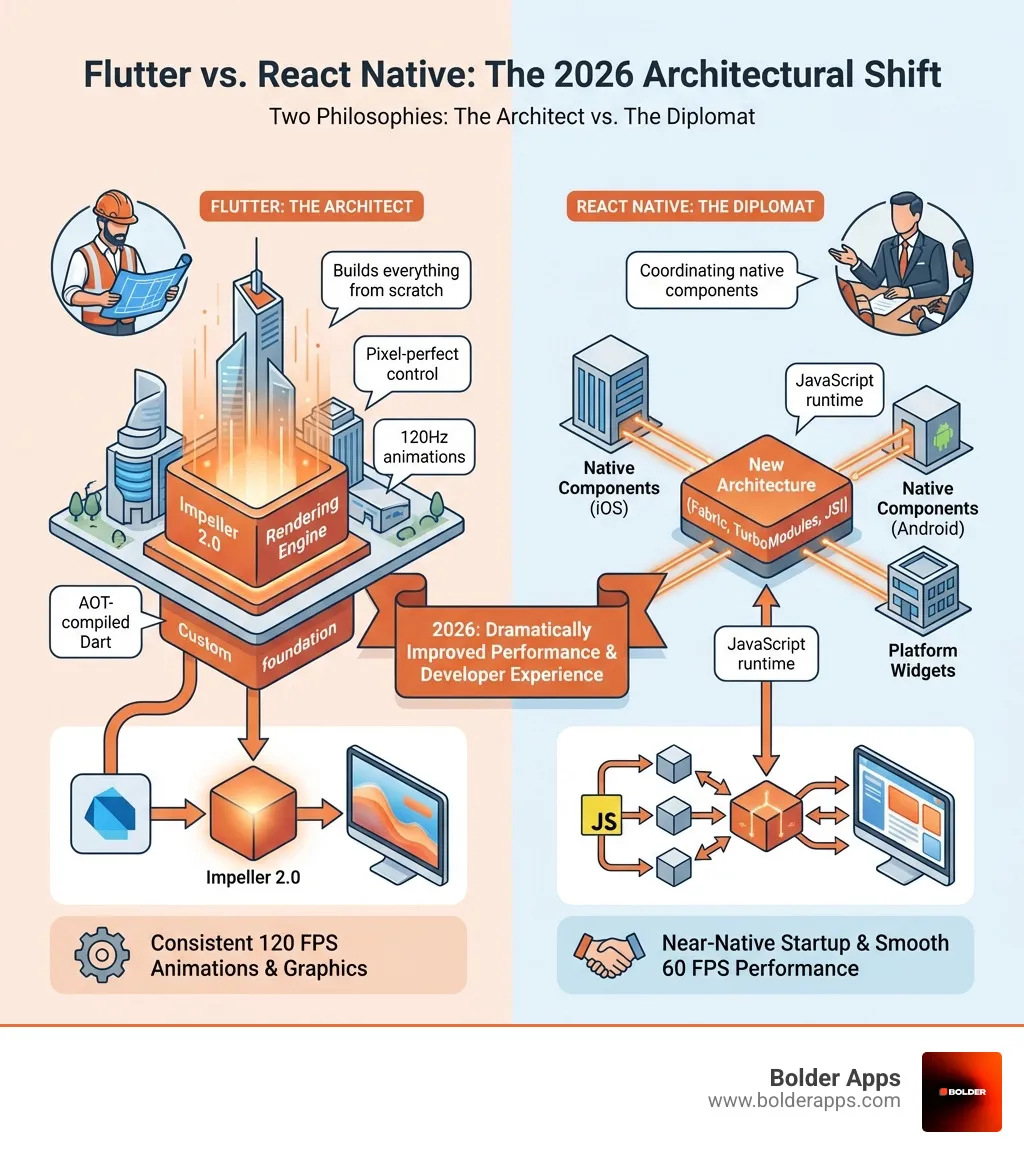
React Native's New Architecture (Fabric renderer, TurboModules, JSI) eliminated the old asynchronous bridge, delivering near-native startup times (~350ms) and smooth 60 FPS performance through direct native module communication.
Flutter's Impeller 2.0 replaced Skia with a pre-compiled shader system, removing early-frame jank and enabling consistent 120 FPS animations with pixel-perfect UI control across all platforms.
Performance Winner: Flutter edges ahead for animation-heavy, graphics-intensive apps; React Native excels for teams prioritizing web code-sharing and faster MVP delivery.
Developer Experience: React Native leverages JavaScript/TypeScript (easier hiring, 9.0% professional dev usage); Flutter uses Dart (9.4% usage, steeper learning curve but superior tooling).
Cost: React Native is cheaper to start (~$40K for a 6-month MVP) but may cost more long-term; Flutter costs more upfront (~$45K) but saves on maintenance due to fewer platform inconsistencies.
It's 2026, and while you can get a working build in days, the framework you choose now matters more than ever.
For years, the choice had clear trade-offs: React Native was fast to build but had bridge bottlenecks, while Flutter was smooth but suffered from shader compilation jank. That's all changed. React Native's New Architecture—featuring Fabric, TurboModules, and JSI—killed the old bridge, creating a coordinated multi-threaded runtime. Meanwhile, Flutter's Impeller engine is now the default, pre-compiling shaders and eliminating jank.
The result is two mature, battle-tested platforms with native-beating performance. They take radically different approaches: Flutter paints every pixel itself, like an architect with their own materials. React Native orchestrates native UI components, like a diplomat coordinating existing systems.
This isn't a framework war; it's a strategic business decision. The right choice depends on your team, product needs, and long-term roadmap. Let's break down what changed and what it means for engineering leaders in 2026.
The Architectural Revolution: What Fundamentally Changed?
The debate between Flutter and React Native has always centered on their architectural philosophies. In 2026, these philosophies have matured, and their respective "new architectures" have fundamentally reshaped their capabilities, pushing cross-platform development beyond convenience into a strategic imperative.
React Native's Rebirth: A Look at Why the 'New Architecture' and Impeller 2.0 Changed Everything
For years, React Native's performance was hampered by its asynchronous JavaScript bridge. The 'New Architecture,' now the default in 2026, is a complete overhaul that fixes this, changing its performance and developer experience. The key components include:
Fabric Renderer: This new rendering system communicates directly with the native UI manager, enabling faster, more predictable UI updates and streamlining the rendering pipeline.
TurboModules: A type-safe, performant replacement for old native modules. They load on demand, reducing startup time and memory footprint.
JavaScript Interface (JSI): The true game-changer. JSI allows synchronous, direct invocation of C++ Host Objects, completely bypassing the old bridge. JavaScript can now call native methods directly, eliminating the serialization overhead that plagued older versions.
Hermes Engine: As the default JavaScript engine, Hermes improves startup time, reduces memory usage, and decreases app size by pre-compiling JavaScript to bytecode. It works in tandem with the New Architecture for a snappier experience.
Together, these components create a coordinated multi-threaded runtime with fewer bottlenecks and a smoother user experience. The New Architecture also offers better integration with the React ecosystem, including React 19 fundamentals, paving the way for tighter alignment between web and mobile development.
Flutter's Visual Edge: A Look at Why the 'New Architecture' and Impeller 2.0 Changed Everything
Flutter's philosophy is to draw every pixel, giving developers total UI control. While this produced great visuals, early versions had "shader compilation jank." Impeller, now the default rendering engine in 2026 on iOS and modern Android, is a complete reimagining of the rendering pipeline that solves this, significantly improving performance and consistency. Key improvements include:
Pre-compiled Shaders: Impeller pre-compiles all shaders at build time, eliminating runtime jank. This ensures buttery-smooth animations from the very first frame.
120Hz Animation Support: Impeller is optimized for high-refresh-rate displays, enabling apps to maintain 120 frames per second (FPS) for a premium user experience, even with complex animations.
GPU Computation and Efficiency: The engine is highly optimized for GPU computation, leveraging graphics hardware more effectively for better performance and battery efficiency.
Pixel-Perfect Control: By drawing everything itself, Flutter guarantees absolute pixel-perfect consistency across all platforms, ensuring your app looks identical on every device.
Dart and AOT Compilation: Flutter's language, Dart, compiles Ahead-of-Time (AOT) into native machine code. This allows apps to run directly on the device processor without a bridge, contributing to its performance advantage.
Impeller 2.0 solidifies Flutter's position as the leader in UI consistency and animation fluidity, enabling richer experiences like advanced motion graphics and complex dashboards. For a deeper dive, explore the Flutter's Impeller engine documentation. Understanding these shifts is vital for your Mobile App Development Process in 2026.
Performance Deep Dive: Flutter vs. React Native in 2026: Why the 'New Architecture' and Impeller 2.0 Changed Everything
The architectural revolutions in both frameworks have profoundly impacted their real-world performance. In 2026, the differences are nuanced, with each excelling in different areas. Let's compare them across critical metrics.
Startup Time and Memory Usage
Startup time and memory are critical for user retention. Here's how the frameworks stack up:
Startup Time: In 2026, Flutter holds a slight edge. With Impeller and Dart's Ahead-of-Time (AOT) compilation, Flutter apps average cold start times of ~250ms. React Native, with its New Architecture and Hermes engine, has closed the gap significantly, achieving cold starts around ~350ms.
Memory Usage: Flutter apps generally have a more moderate memory footprint, with benchmarks showing a memory delta of around 25.33 MB on iOS and 14.00 MB on Android. This efficiency stems from its AOT compilation. React Native's memory usage, while improved, tends to be higher, with benchmarks indicating a delta of 45.13 MB on iOS and 32.98 MB on Android. While Hermes helps, the JavaScript runtime carries inherent overhead. It's also worth noting Flutter apps may have a slightly larger initial APK size because they bundle their rendering engine. Learn more about managing app size at App size considerations.
UI Fluidity and Battery Efficiency
UI fluidity and battery efficiency are key to a premium experience.
UI Fluidity: This is where Flutter shines with Impeller 2.0. By drawing every pixel and pre-compiling shaders, it ensures pixel-perfect UI consistency and stable 120 FPS rendering. Benchmarks show Flutter with 0% dropped frames and average frame times well under the 16.7 ms target for 60Hz displays. React Native, with Fabric and JSI, has made massive strides and is smooth at steady state. However, complex, animation-heavy scenarios can still experience frame drops, with some benchmarks showing 15.51% dropped frames on iOS during complex interactions.
Battery Efficiency: Flutter's GPU-accelerated rendering with Impeller 2.0 is highly optimized. While any cross-platform framework uses more battery than pure native, Flutter's AOT-compiled code is generally more efficient than React Native's JavaScript runtime, even with Hermes optimizations.
On-Device AI and Heavy Computation
In 2026, AI integration is essential. Here's how the frameworks handle it:
Real-time AI Visualizations: Flutter's Impeller engine is uniquely positioned to handle complex, real-time AI visualizations at a stable 120 FPS. Its direct control over rendering ensures that as an AI model generates data, the UI can update instantly without lag.
Concurrency for Heavy Computation: Dart's Isolates are a game-changer for heavy computation. They run in parallel with their own memory, avoiding common threading bugs and providing a superior multithreading mechanism for CPU-intensive tasks like on-device ML inference. React Native relies on JavaScript's single-threaded event loop, which can be a bottleneck for heavy, parallel computations.
Native ML Integration: Both frameworks offer excellent pathways for on-device AI. Flutter's Dart FFI allows seamless C++ integration with libraries like TensorFlow Lite. React Native’s JSI provides similar high-performance bindings to native C++ APIs, enabling access to platform-specific ML kits like Android NNAPI and iOS CoreML. While both are excellent, Flutter's Impeller gives it an advantage for visually intensive AI applications. For more on cross-platform AI, see our guide on Top Cross-Platform App Development Frameworks in 2026.
Developer World: Ecosystem, Hiring, and Total Cost of Ownership (TCO)
Beyond performance, the human and financial factors—developer experience, talent availability, and total cost of ownership (TCO)—play a massive role in framework selection.
Programming Languages and Learning Curve
The choice of language dictates your talent pool and development speed.
Dart for Flutter: Flutter uses the Dart programming language, a strongly typed language with sound null safety that helps catch errors before runtime. Developers familiar with JavaScript, Java, or Swift will find its C-style syntax familiar and can become productive quickly.
JavaScript/TypeScript for React Native: React Native uses JavaScript/TypeScript, leveraging a massive developer pool. For teams skilled in React for web, the transition is seamless, as much of the paradigm and component-based thinking transfers directly. This synergy is a key reason Why React Remains the Strategic Gold Standard.
According to 2024 Stack Overflow data, professional developer usage was 9.4% for Flutter vs. 9.0% for React Native, indicating a healthy and growing talent pool for both. You can explore these trends further in the Stack Overflow developer trends.
Tooling, Debugging, and Community
Developer productivity hinges on great tooling and community support.
Flutter's Tooling: Flutter ships with a comprehensive suite of first-party tools. Its Flutter DevTools offer a rich debugging experience, and its legendary hot reload injects code changes in under a second while preserving app state, dramatically speeding up iteration.
React Native's Tooling: React Native benefits from the vast JavaScript ecosystem. Tools like React Native Debugger and Flipper provide powerful debugging, and its Fast Refresh offers similar capabilities to hot reload. The Expo toolchain has become standard, simplifying builds, CI/CD, and over-the-air (OTA) updates—a critical advantage for bypassing App Store reviews for minor fixes.
Community Support: Both frameworks have vibrant communities. React Native has a vast, mature community with over 2,700 contributors on GitHub React Native. Flutter's community is rapidly growing and highly engaged, recognized for its high number of first-time contributors in 2024 on GitHub Flutter’s community.
Hiring, Team Velocity, and TCO
The cost of an app extends far beyond initial development.
Talent Pool and Hiring: React Native's large JS/TS talent pool often makes hiring faster and more cost-effective, especially for companies leveraging existing web teams.
Team Velocity: Flutter's hot reload and stable API can lead to high developer velocity. React Native, with Expo, also offers rapid development, though major version upgrades can sometimes be complex due to library compatibility issues.
Total Cost of Ownership (TCO):
Initial Development: React Native can be cheaper to start (~$40,000 for a 6-month MVP) by leveraging web skills. Flutter might cost slightly more upfront (~$45,000) but often saves on QA and maintenance.
QA & Maintenance: Flutter often leads to lower QA costs (~$10,000 vs. ~$15,000 for RN) due to fewer UI inconsistencies. It also shines in long-term maintenance (~$12,000 for Year 1 vs. ~$20,000 for RN) thanks to its stable API and graceful package aging.
CI/CD & App Store Fees: Tools like Expo EAS offer efficient CI/CD with free tiers, while App Store fees ($99/year for Apple, $25 one-time for Google) are standard for both.
While effective scope management is the biggest TCO lever, Flutter often proves more cost-effective long-term due to its stability, whereas React Native may offer a faster path to an initial MVP.
The Strategic Verdict: Which Framework Wins for Your Project?
In 2026, the question isn't which framework is "better," but which is the strategic choice for your project. Both Flutter and React Native are formidable tools with distinct strengths for different business needs.
When to Choose Flutter in 2026
If your product's success hinges on a stunning visual experience, UI consistency, and high-performance animations, Flutter is your champion.
Brand-centric, Pixel-Perfect UIs: Choose Flutter when your brand demands absolute control over every pixel for a unique, custom look that's consistent across all devices.
Animation-Intensive Consumer Apps & Gaming-Lite Experiences: For apps with complex motion graphics, interactive dashboards, or gaming-lite features, Flutter's 120 FPS rendering and GPU prowess make it the superior choice for fluid, immersive experiences.
Single Codebase for All Platforms: Choose Flutter if your roadmap includes mobile, web, desktop, and embedded systems. It offers first-party support for a truly unified codebase, as seen with companies like Xiaomi reporting 60% faster development for their EV companion app.
Greenfield Projects & MVPs: Flutter offers a competitive advantage for building visually appealing apps, startup MVPs, and high-fidelity consumer products from scratch.
If speed-to-market, leveraging existing web expertise, and tight integration with a web platform are top priorities, React Native is a compelling choice.
Web-First Teams with React Expertise: React Native is a natural fit for teams with React web developers, allowing you to leverage existing skills and share up to 90% of business logic and UI code with web applications.
Fast MVP Development: React Native, especially with the Expo toolchain, excels at rapid prototyping and delivering a Minimum Viable Product (MVP) quickly, thanks to its mature ecosystem and large developer pool.
Apps Needing a Native Look and Feel: React Native uses native OS components, so apps automatically adopt the platform's look and feel. This is ideal when a truly "native" appearance is critical.
Tight Code-Sharing with a Web Platform: If your product includes a significant React web app, React Native's ability to share code and logic is a massive strategic advantage, streamlining development and maintenance. It's used by companies like Walmart and Meta for this reason.
Projects Where Hiring Speed is the Top Priority: The vast talent pool of JavaScript developers means hiring for React Native projects can be quicker and more cost-effective.
Frequently Asked Questions about Flutter vs. React Native
Is Flutter or React Native better for AI-powered apps in 2026?
Both frameworks excel at AI integration. Flutter has an edge for real-time AI data visualization due to its Impeller engine, making it ideal for apps with complex, animated visual outputs at 120 FPS. Its Dart FFI also allows seamless integration with high-performance C++ ML libraries.
React Native's New Architecture with JSI has drastically improved its ability to integrate with native ML kits like CoreML and NNAPI, making it excellent for logic-heavy AI tasks. However, for intense, AI-driven graphics, its JavaScript runtime can still be a bottleneck compared to Flutter's direct GPU rendering.
Has React Native's New Architecture completely solved its performance issues?
The New Architecture has solved React Native's biggest performance issue by replacing the asynchronous JavaScript bridge. This brings massive improvements in startup, UI fluidity, and native module communication, making performance nearly indistinguishable from native for most apps.
However, React Native still uses a JavaScript runtime. While highly optimized by Hermes, this has inherent overhead compared to Flutter's AOT-compiled Dart code. So, in the most demanding CPU-bound scenarios, subtle differences may remain compared to Flutter or pure native.
Which framework has better support for web and desktop?
Flutter: Flutter has first-party support for web, desktop (Windows, macOS, Linux), and embedded as core targets. This enables high code reuse and UI consistency across platforms. Flutter web, with WebAssembly (Wasm) support, delivers near-native performance for complex web apps.
React Native: React Native relies on community projects like react-native-web for web and React Native for Windows for desktop. While this enables code sharing, it may result in less UI code reuse compared to Flutter's unified rendering approach. It excels when sharing logic with an existing standard React web app.
Your Next Move: Building a High-Impact App in 2026
In 2026, choosing between Flutter and React Native is about strategic alignment, not finding a "winner." Both are powerful, mature frameworks transformed by React Native's 'New Architecture' and Flutter's Impeller 2.0.
Flutter excels in raw performance and pixel-perfect UI control, ideal for visually stunning, brand-centric apps. React Native leverages the massive JavaScript ecosystem for unparalleled team-building speed, making it a strategic choice for web-first teams and fast MVPs.
The key is to match the framework's strengths to your business goals, team expertise, and product vision. Making the right choice upfront can save millions in development costs and years in time-to-market.
To help steer these decisions, consider a consultation with Bolder Apps. We combine US-based leadership with a senior offshore team under a fixed-budget model to analyze your needs and build a high-impact mobile application that meets your goals for 2026.
Miami has real mobile app development talent, and it has landing pages pretending to be Miami app development talent. This list separates the two. The best app development companies in...
Best App Development Companies in Philadelphia (2026)
You need an app built. You searched "best app development companies in Philadelphia" and got three directories, two ads, and a wall of agencies that all claim to be number one. This post...
App development in Philadelphia costs $30K-$60K for an MVP, $60K-$150K for a full iOS and Android product, and $150K-$250K+ for complex builds. Those are real fixed-scope numbers, not a...