Jhaymes Clark N. Caracuel
February 23, 2026
10
min. read
and updated on:
February 24, 2026

"The decision framework every founder building a digital product needs right now, because where you hire shapes how fast you ship, how much you spend, and whether your product actually gets built."



Offshore vs. Hybrid vs. Onshore: The 2026 Founder's Guide to Global Talent Models is the decision framework every founder building a digital product needs right now — because where you hire shapes how fast you ship, how much you spend, and whether your product actually gets built.
Here's the quick answer:
The right model depends on your stage, your budget, and how much real-time collaboration your product demands.
Not long ago, the choice was simple: big company? Send it offshore to save money. Small company? Hire local. That era is over.
In 2026, the software development outsourcing market is on track to grow from $564 billion to nearly $900 billion by 2030. Remote hiring from North American companies into Latin America alone has grown 70% since 2022. AI tools now automate 30–40% of code generation and testing, compressing the productivity gap between regions.
The old "distance equals savings" equation no longer holds. Founders aren't just choosing where to hire. They're designing a talent architecture — one that balances speed, cost, quality, and risk across borders.
Get it right, and you ship faster with a stronger team for less money. Get it wrong, and you burn months, blow your budget, and hand your competitors a head start.
This guide breaks down every model clearly — no hype, no vendor bias — so you can make the call that's right for your product and your stage.
Offshore vs. Hybrid vs. Onshore: The 2026 Founder’s Guide to Global Talent Models terms you need:
As we navigate through 2026, the definitions of where and how we work have blurred. For a founder in Miami, the world is no longer just a map; it is a menu of specialized talent hubs. Understanding these models is the first step in Custom Software Development.
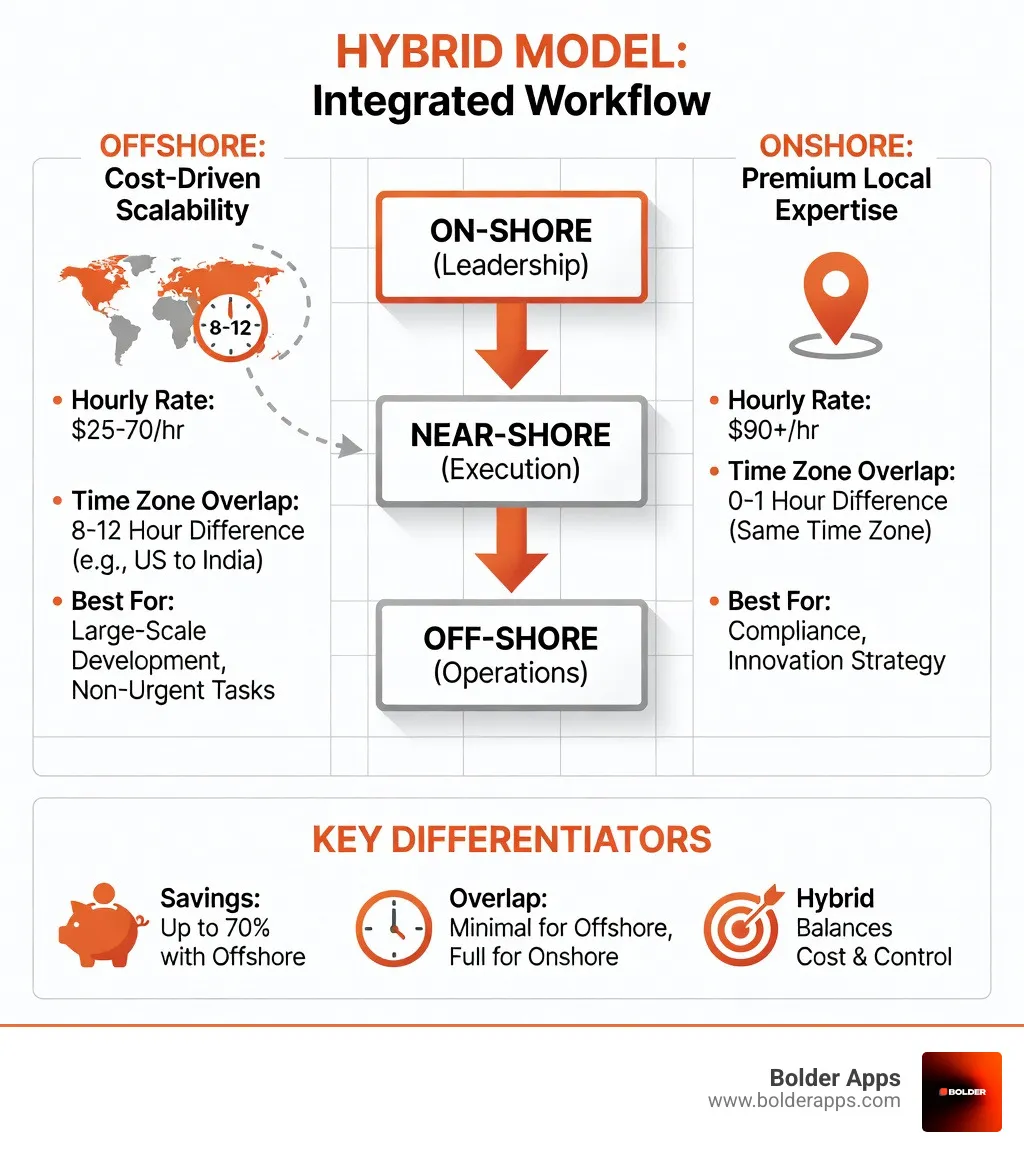
Onshore remains the "gold standard" for high-touch, high-regulation projects. This means your team is in the same country—often even the same city. You share the same labor laws, the same currency, and critically, the same cultural nuances. While it is the most expensive option, it virtually eliminates communication lag.
Nearshore has become the breakout star of 2026. For U.S. founders, this typically means Latin America (LATAM). With only a 1–3 hour time difference, nearshore teams can participate in your daily stand-ups in real-time. Research shows nearshore software development rates sit about 46% below onshore equivalents, offering a "sweet spot" of cost-efficiency and high-bandwidth collaboration.
Offshore refers to talent in distant regions like Asia or Eastern Europe. Traditionally viewed as a pure labor arbitrage play, offshore has matured. It now offers massive scalability and deep technical expertise in specialized niches. While the 8–12 hour time difference can be a hurdle, it allows for a "follow-the-sun" model where work continues while your local team sleeps.
Hybrid "Tri-modal" Architecture is the most sophisticated approach for 2026. This model blends all three:
According to strategic sourcing insights for 2026, moving work far away just to save a buck is a failing strategy. Instead, modern organizations focus on "rebalancing" to ensure work is moved where it can be done most effectively, not just most cheaply.
For early-stage founders, the primary constraints are speed and capital. You are likely in the Prototype Development phase, where every dollar spent must move the needle toward a successful fundraise or launch.
Startups often misfire by trying to hire a full onshore team too early, burning through seed capital before reaching product-market fit. Conversely, going fully offshore too soon can lead to "vague requirement drift," where the product built doesn't match the founder's vision because of communication gaps.
Startup statistics and digital trends indicate there are over 71,000 startups in the U.S. competing for the same pool of local talent. This scarcity makes a hybrid or nearshore model almost mandatory for survival. A common winning formula for 2026 startups is a local founder/CTO duo managing a nearshore squad that can pivot as quickly as the market demands.
As a company moves into the growth stage, the challenges shift from "What are we building?" to "How do we scale it without breaking?" Scaling enterprises often face massive technical debt and the need for Web App Development that integrates with legacy systems.
This is where Staff Augmentation becomes a strategic lever. Rather than hiring 20 full-time engineers in a high-cost market like Miami, a scaling founder can plug in a dedicated offshore team to handle maintenance or secondary features. This keeps the internal "A-team" focused on high-level strategy and innovation.
The software development market growth projections suggest that by 2030, the market will hit nearly $900 billion. This growth is driven by enterprises realizing that global talent isn't just a backup plan—it’s the only way to meet delivery pressure in a world where local hiring cannot keep up.
Let's talk numbers. In 2026, founders must look past simple hourly rates and calculate the Total Cost of Ownership (TCO). This includes the cost of management overhead, the price of delays, and the impact of attrition.
Onshore (U.S.):
Nearshore (LATAM):
Offshore (Eastern Europe / Asia):
Research on IT services outsourcing dominance shows the U.S. remains the dominant buyer, but the shift toward "value over price" is clear. A "cheap" offshore dev who requires three hours of a $150/hr U.S. manager's time every day is actually more expensive than a senior nearshore dev who works autonomously.
Choosing a model isn't a one-time event; it's a journey that evolves with your product roadmap.
When to stay Onshore:If you are handling highly sensitive data (think HIPAA or fintech) or if your product requires deep "context-heavy" knowledge of the U.S. market, keeping your core team in a location like Miami makes sense. Onshore is also vital for the Paid Discovery phase, where brainstorming and strategy benefit from being in the same room (or at least the same zip code).
When to go Nearshore:Nearshore is the default for most 2026 startups. If you need daily stand-ups and rapid iteration, you need time zone alignment. It’s perfect for companies that want to accelerate delivery by up to 37% without the "overnight lag" of traditional offshore models.
When to go Offshore:Offshore is brilliant for Ongoing App Support and tasks with clearly defined SOPs (Standard Operating Procedures). If you need a Code Audit or a massive QA pass on a stable product, offshore hubs in Asia or Eastern Europe provide the scale you can't find elsewhere.
Harvard Business Review on hybrid onboarding reminds us that onboarding is the critical "make or break" moment. Regardless of the model, you need a 30–60–90 day framework to create clarity. This is especially true for hybrid teams where communication rules must be non-negotiable to prevent a "melt down."
In 2026, "borderless" doesn't mean "lawless." Founders face a complex web of worker classification, data privacy, and IP ownership.
Worker Classification (EOR vs. PEO):As detailed in the Global Hiring Playbook, you have two main routes for hiring abroad:
IP and AI Security:One of the biggest 2026 risks is AI-generated IP ownership. You must ensure your contracts explicitly state that any code generated—whether by a human or an AI tool used by that human—belongs to your company. Always sign an NDA before sharing project details and ensure your MSA (Master Services Agreement) includes clear "work-for-hire" clauses.
Vetting Vendors:Don't just look at a portfolio; look at the "working rhythm."
Whether you are looking for talent in New York City, London, or San Francisco, the vetting process remains the same: trust, but verify.
Time zones are the "hidden tax" of global hiring. A 1–3 hour difference (Nearshore) allows for a shared workday, enabling agile sprints and real-time problem-solving. An 8–12 hour difference (Offshore) creates a "wait-until-tomorrow" delay for every question asked. In 2026, the best teams use "asynchronous" tools like Notion or Loom to bridge this gap, but real-time overlap is still preferred for creative or complex tasks.
The "sticker price" is rarely the final price. Hidden costs include:
Onshore or a tightly managed Hybrid model is best for core IP. By keeping your "architects" and "lead engineers" onshore (or in a highly trusted nearshore hub), you maintain tighter control over your secret sauce. Offshore is better suited for the "plumbing" of your app—the standardized parts that aren't unique to your business.
Navigating Offshore vs. Hybrid vs. Onshore: The 2026 Founder’s Guide to Global Talent Models shouldn't feel like a gamble. Since 2019, Bolder Apps has perfected the "sweet spot" of global delivery.
As the top software and app development agency in 2026 as named by DesignRush, we offer a model that eliminates the typical founder's headache. We combine US-based leadership (your in-shore CTO and product leads) with senior distributed engineers. This means you get the strategic, data-driven oversight of a domestic partner with the execution power and cost-efficiency of a global team.
We believe in transparency and skin in the game, which is why we operate on a fixed-budget model with milestone-based payments. No junior developers learning on your dime, no "black box" offshore teams, and no budget surprises.
Ready to future-proof your product? Whether you're in Miami, Austin, or Dubai, let's build something high-impact together.
Learn more about Bolder Apps or Contact us today to start your project.