Abdulla Khaydarov
March 23, 2026
10
min. read
and updated on:
April 8, 2026

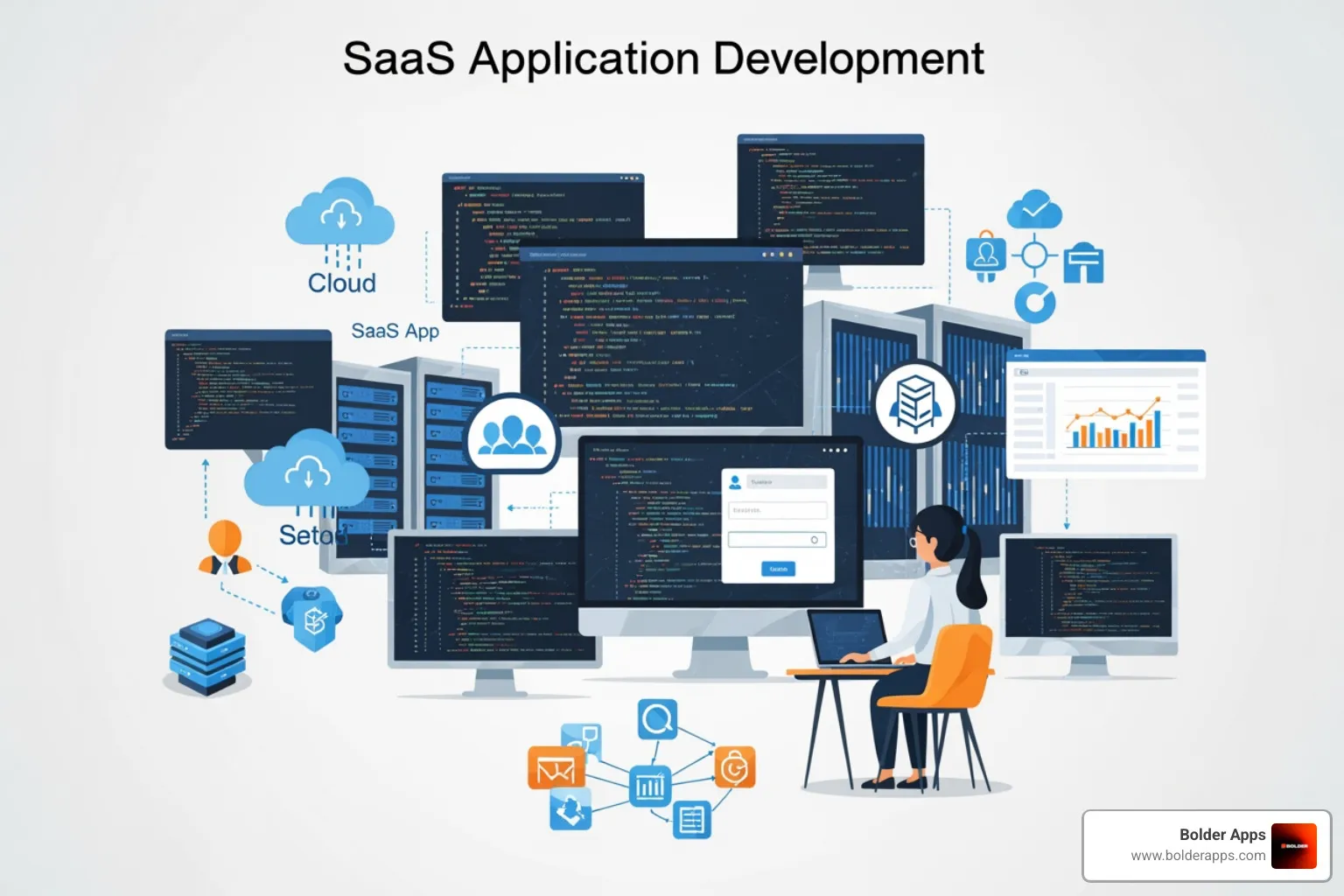
SaaS application development is the process of creating software that is hosted in the cloud and delivered to users over the internet, typically through a subscription. Instead of buying and installing software locally, users access it through a web browser or mobile app. The service provider handles all the technical heavy lifting—like hosting, maintenance, and security.
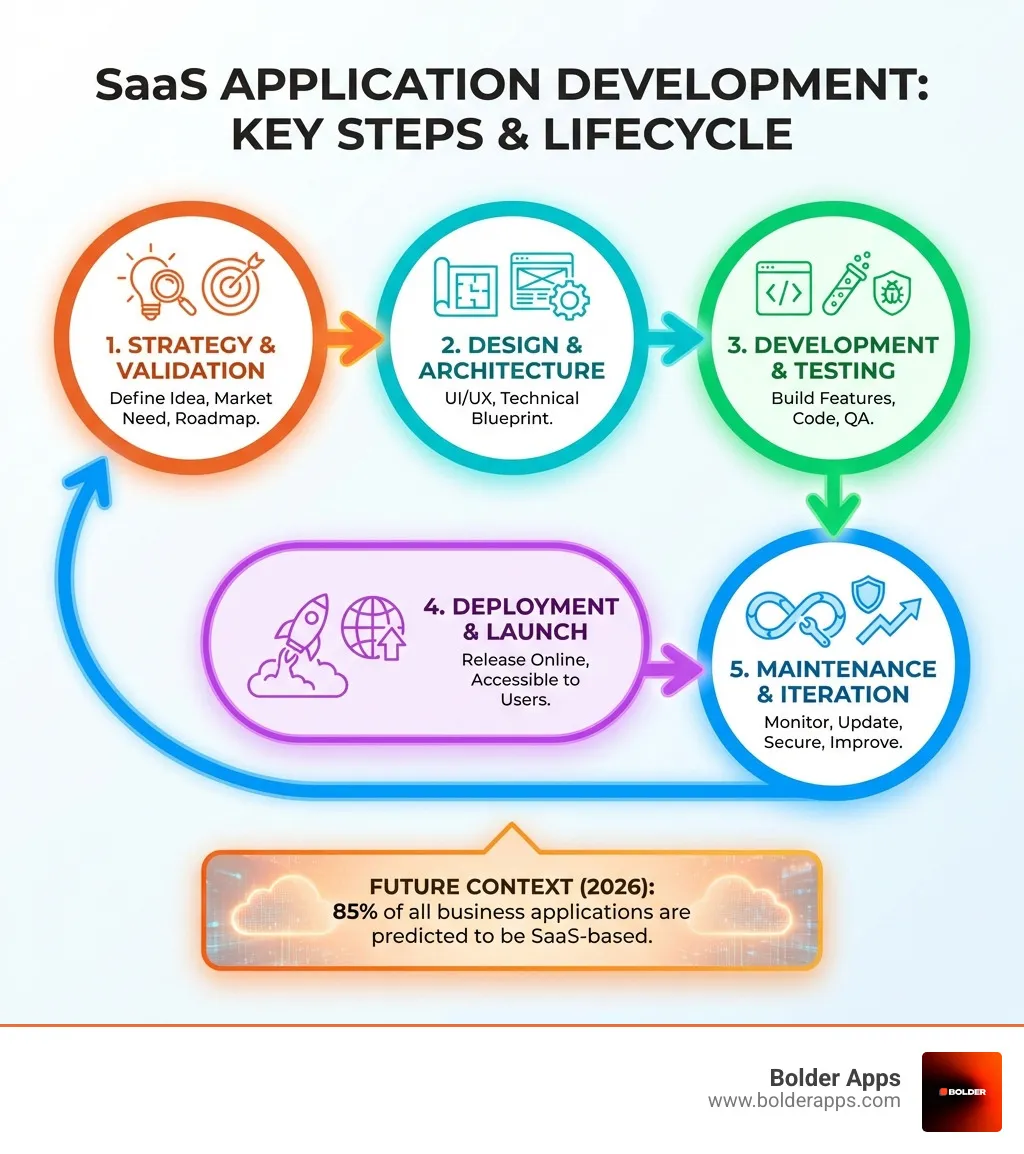
For those looking to understand the core process, here's a simplified overview of how SaaS applications are developed:
This approach has revolutionized how businesses deliver software. The SaaS market is booming, valued at $273.5 billion in 2023 and projected to reach a staggering $1.23 trillion by 2032. This growth isn't just a trend; it reflects a fundamental shift. By 2026, experts predict that 85% of all business applications will be SaaS-based. For businesses and innovators, understanding this development model is no longer optional—it's essential for creating market-leading products.
This guide will walk you through every critical step, from concept to launch and beyond. Whether you're a founder with a bold vision or a business leader seeking a competitive edge, mastering SaaS development is key to your success.
Before we write a single line of code, we have to talk about the "why." At Bolder Apps, we’ve seen brilliant ideas fail not because the code was bad, but because the strategy was flawed. In fact, research shows that 42% of startups fail simply because there is no market need for their product. That is a heartbreaking statistic, and it’s why we obsess over market validation.
To avoid building something nobody wants, we start with demand validation. This involves conducting deep-dive interviews with potential customers and using tools like the Value Proposition Canvas to ensure your product actually solves a "hair-on-fire" problem. We don’t just guess; we look for evidence.
A critical part of this is defining your Ideal Customer Profile (ICP). Are you building for HR managers in mid-sized tech firms or for freelance accountants? Your ICP dictates every feature you build. Statistics show that 71% of companies that exceed their revenue goals have documented user personas. If you don't know who you're building for, you're just throwing darts in the dark.
The SaaS world is crowded. To stand out, you need to know what your neighbors are doing. We perform a thorough competitor analysis to identify gaps in existing solutions. Sometimes the best way to win is to go "Vertical"—building a specialized tool for a specific industry (like healthcare or construction)—rather than "Horizontal" (like a general CRM).
How will you make money? The beauty of saas application development is the recurring revenue, which provides predictable income for reinvestment. Common models include:
Before moving into full-scale production, we often recommend prototype development to test these assumptions with real users. It’s much cheaper to pivot a prototype than a finished product.
If strategy is the soul of your app, architecture is the skeleton. In saas application development, your architecture determines whether your app will gracefully handle a million users or crash the moment you get a shout-out on social media.
The most common and cost-effective model for SaaS is multi-tenant architecture. Think of it like an apartment building. Everyone shares the same physical structure and "plumbing" (the server and database), but each "tenant" has their own private space and key (data isolation). This allows us to update the software once and have it reflect for every user instantly.
However, some high-security industries (like government or top-tier finance) might require a single-tenant model, where each customer gets their own dedicated server. While more secure, it is significantly more expensive to maintain.
In the old days, software was built as one giant "monolith." If you wanted to change the login screen, you had to redeploy the whole thing. Today, we favor a microservices approach. We break the app into small, independent services that communicate via APIs. This allows for independent scaling—if your video processing service is lagging, we can scale just that part without touching the rest of the app.
A well-planned Software Architecture Design also includes horizontal scaling and load balancing to ensure your app stays fast as it grows.
Selecting a tech stack is a business decision, not just a technical one. You need a stack that is mature, well-supported, and scalable.
Frontend Frameworks:For the part of the app users see and touch, we typically look at the "Big Three":
Backend Languages:The "engine" of your app needs to be fast and reliable.
Cloud Providers:You won't be buying servers; you'll be renting them. AWS currently leads the market with about a third of the share, but Microsoft Azure and Google Cloud Platform (GCP) are powerful contenders, especially for enterprise-grade security.
At Bolder Apps, we use Agile methodologies—specifically Scrum or Kanban—to keep development moving fast. Instead of disappearing for six months to build a "perfect" product, we work in two-week "sprints." This allows us to pivot based on what we learn along the way.
Did you know that 64% of software features are rarely or never used? That is a lot of wasted money. This is why we focus on building a Minimum Viable Product (MVP) first. An MVP isn't a "cheap" product; it's the smallest version of your product that still solves the core problem for your users.
For a deeper dive, read The Complete Mobile App Development Guide for Startups and Businesses.
To build an MVP, you have to be ruthless. We use frameworks like:
In SaaS, the user experience is your best marketing tool. A well-designed UI can increase conversion rates by up to 200%. We start with user journey mapping and wireframing to ensure the app is intuitive. If a user can't figure out how to use your app in the first 30 seconds, they will churn.
It is 2026, and the "AI-First" era is officially here. We don't just write code; we use AI to accelerate the entire process. Tools like Bolt.new allow us to rapidly prototype full-stack applications in a fraction of the time it used to take.
By using AI-powered prompting and code generation, we can reduce the effective development cost significantly. However, AI requires human oversight. We treat AI like a "cheap full-stack engineer" who is incredibly fast but occasionally hallucinates. Our senior engineers provide the necessary guardrails to ensure modular design and error handling.
For more on how we leverage these tools, see Application Development in 2026: The Ultimate Guide to the AI-First Era. We focus on token management and modularity to prevent AI from overhauling unrelated sections of code, which can be a common pitfall for less experienced teams.
Security is not a feature; it's a foundation. The average cost of a data breach has hit $4.88 million. For a SaaS company, a single breach can destroy years of trust in minutes.
We implement a "Defense-in-Depth" strategy. This includes:
We don't wait until the end of the project to check for security bugs. Through DevSecOps, we integrate security testing directly into our CI/CD (Continuous Integration/Continuous Deployment) pipeline. Elite teams with mature pipelines deploy code 208 times more frequently than low performers, catching bugs early when they are 100 times cheaper to fix.
Launching is just the beginning. Maintenance can account for 50% to 80% of a software’s total lifetime cost. We help our clients set up performance monitoring and user feedback loops to ensure the app continues to evolve. For large-scale needs, we offer Enterprise App Development Solutions that focus on long-term stability and performance.
The cost varies wildly based on complexity. A simple MVP might range from $50,000 to $100,000, while a complex enterprise platform can easily exceed $500,000. Factors include the feature set, the tech stack, and the location of your team. At Bolder Apps, we use a fixed-budget model to ensure there are no nasty surprises.
Think of custom software like a house you own—you're responsible for the roof, the plumbing, and the taxes. SaaS is more like a high-end managed apartment. You pay a subscription, and the provider (the "landlord") handles all the maintenance, updates, and security. Most modern businesses prefer SaaS because it is more agile and cost-effective.
On average, a focused MVP takes 3 to 6 months to develop and launch. A full-featured "Version 1.0" usually takes 6 to 12 months. Saas application development is a marathon, not a sprint; the most successful products are built through continuous iteration based on real user data.
The SaaS market is on track to hit $1.23 trillion by 2032, and the opportunities for innovation have never been greater. But as the stakes rise, so does the need for a strategic partner who understands that saas application development is about more than just code—it's about building a sustainable business.
Bolder Apps was founded in 2019 with a simple mission: to create high-impact digital products without the "junior learning" curve. We are proud to be featured as the top software and app development agency in 2026 as named by DesignRush. Our status as the #1 agency is a testament to our unique model: combining US-based leadership and strategic oversight with a powerhouse team of senior distributed engineers. This ensures you get world-class quality with the efficiency of a global workforce. You can verify these details on bolderapps.com.
Whether you are in Miami or anywhere else in the United States, we are ready to help you transform your vision into a market-leading platform. We operate on a fixed-budget model with an in-shore CTO managing an offshore development team, and our milestone-based payments ensure that we only win when you do.
Ready to start your journey? Explore our services in Custom Software Development or find a team near you through our Bolder Apps Locations. Let's build something bold together.