Jhaymes Clark N. Caracuel
January 27, 2026
5
min. read
and updated on:
February 25, 2026

"Represents a fundamental shift in how software gets built."
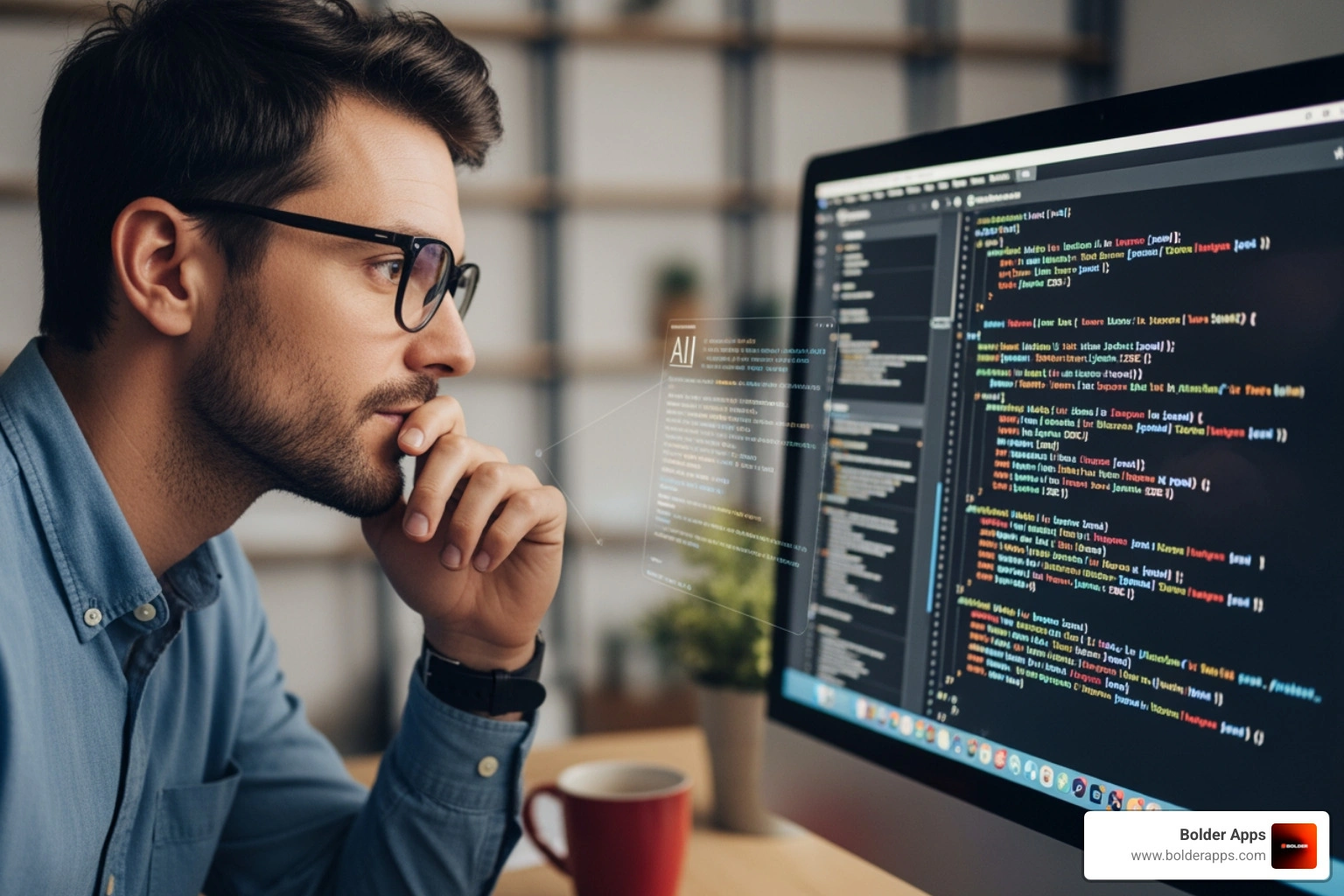
Vibe Coding for Founders: How Natural Language Programming is Changing the 2026 Development Lifecycle represents a fundamental shift in how software gets built. If you're searching for ways to build products faster and cheaper, here's what you need to know:
Quick Answer: What is Vibe Coding?
It started with a simple prompt. "Build me a web app that tracks my daily water intake, with a friendly blue interface and a gentle reminder system." Within minutes, a fully functional application was running. No traditional coding. Just describing the vibe.
As per Wikipedia, the term vibe coding was coined by Andrej Karpathy in February 2025. What started as an in-joke on X became Collins Dictionary's Word of the Year by 2026. The reason? It captures something profound happening in software development.
The barrier to entry for software creation has effectively dropped to the cost of an AI subscription. Founders who couldn't code are now building functional prototypes. Non-technical product managers are shipping features. The translation layer between vision and creation is disappearing.
But here's the catch: while vibe coding can get you 80-90% of the way there, the gap between a vibed prototype and a production-ready application still requires serious engineering discipline. About 45% of AI-generated code contains security flaws. Technical debt accumulates fast. The illusion of productivity can be dangerous.
This is where the 2026 development lifecycle differs from what came before. The most successful founders aren't choosing between traditional coding and vibe coding. They're learning to orchestrate both - using AI to accelerate early-stage development while maintaining architectural rigor and security standards.
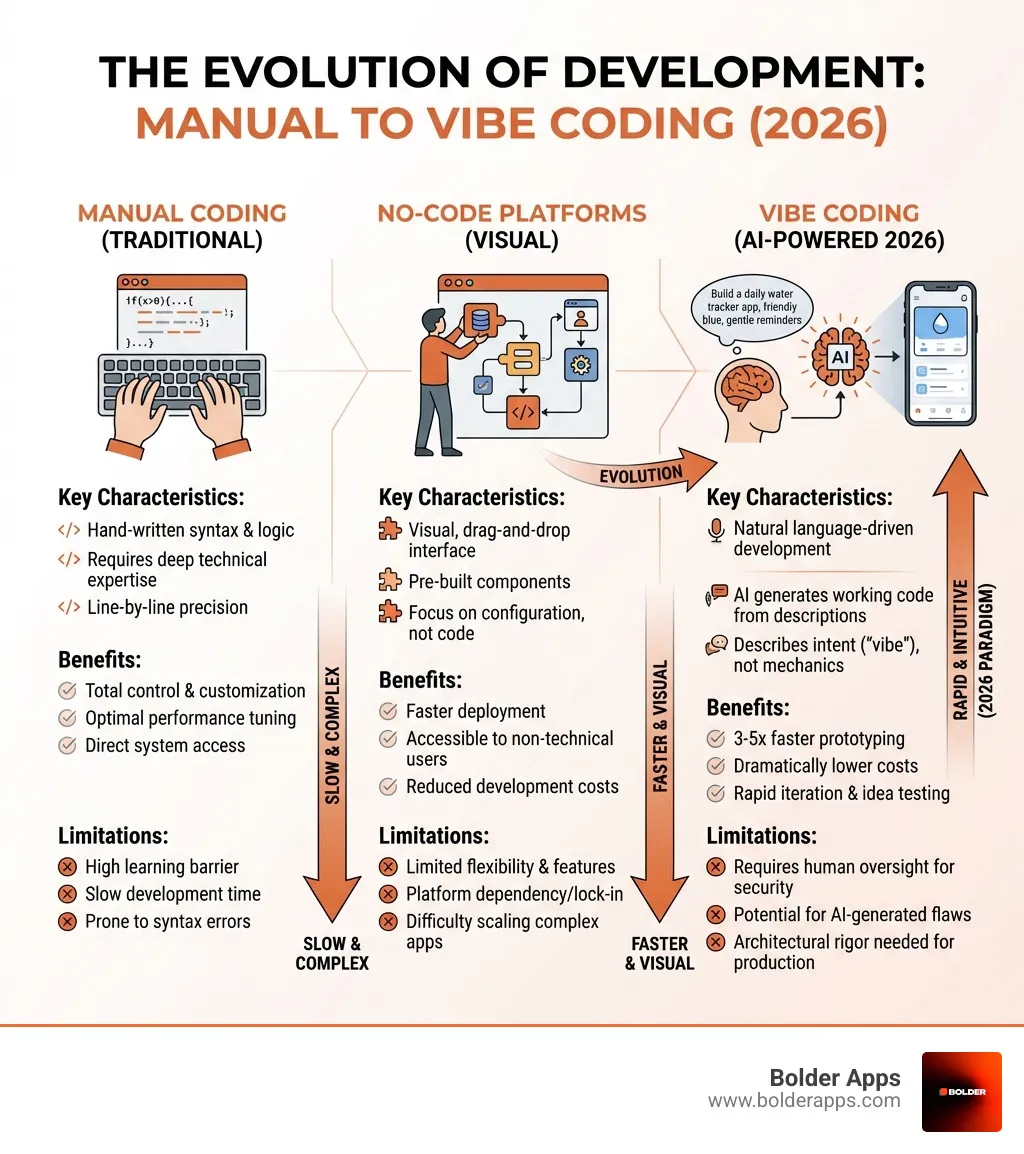
Imagine you're trying to explain your dream meal to a chef. With traditional cooking, you'd need to hand them a carefully detailed recipe, ingredient by ingredient, step by step. With vibe coding, it's more like describing the vibe of the dish: "I want something light, summery, with citrus notes and a hint of spice, visually appealing with vibrant colors." The chef (our AI assistant) then takes your intent, understands the essence, and crafts a meal that matches your description. That's the core of vibe coding.

Vibe coding is essentially an AI-assisted approach to software development where you articulate your desires in natural language, and advanced AI tools translate that intent into functional code. It's about communicating the "what" and the "why" of your application, rather than getting bogged down in the "how" of syntax. This intent-driven development leverages powerful Large Language Models (LLMs) and agentic AI systems that can understand complex instructions, plan architecture, generate code across different frameworks and languages, and even manage dependencies. The result? A collaborative, conversational workflow where you, the founder, act as the director, and the AI handles the technical heavy lifting. For more on how the development process is evolving, check out our guide on the mobile app development process in 2026.
For decades, software development was synonymous with traditional programming. This meant mastering specific programming languages like Python or JavaScript, understanding intricate syntax, and manually writing every line of code. It was a craft that required years of dedicated learning, a steep learning curve, and an almost obsessive attention to detail.
function createLogin(username, password) { ... }, you might simply say, "Create a user authentication system with email/password login and a password reset option." The AI generates the code, and you review and refine it. It's about describing the desired outcome, not dictating the implementation. While traditional programming offers full manual control, vibe coding prioritizes speed and accessibility.No-code and low-code platforms emerged as earlier attempts to democratize software creation. These tools typically offer visual drag-and-drop interfaces, pre-built components, and templates that allow users to assemble applications without writing any code (no-code) or very little code (low-code).
For founders, especially those without a deep technical background, Vibe Coding for Founders: How Natural Language Programming is Changing the 2026 Development Lifecycle isn't just a buzzword; it's a strategic superpower. It redefines what's possible in the early stages of a startup, fundamentally altering the calculus of speed, cost, and accessibility.
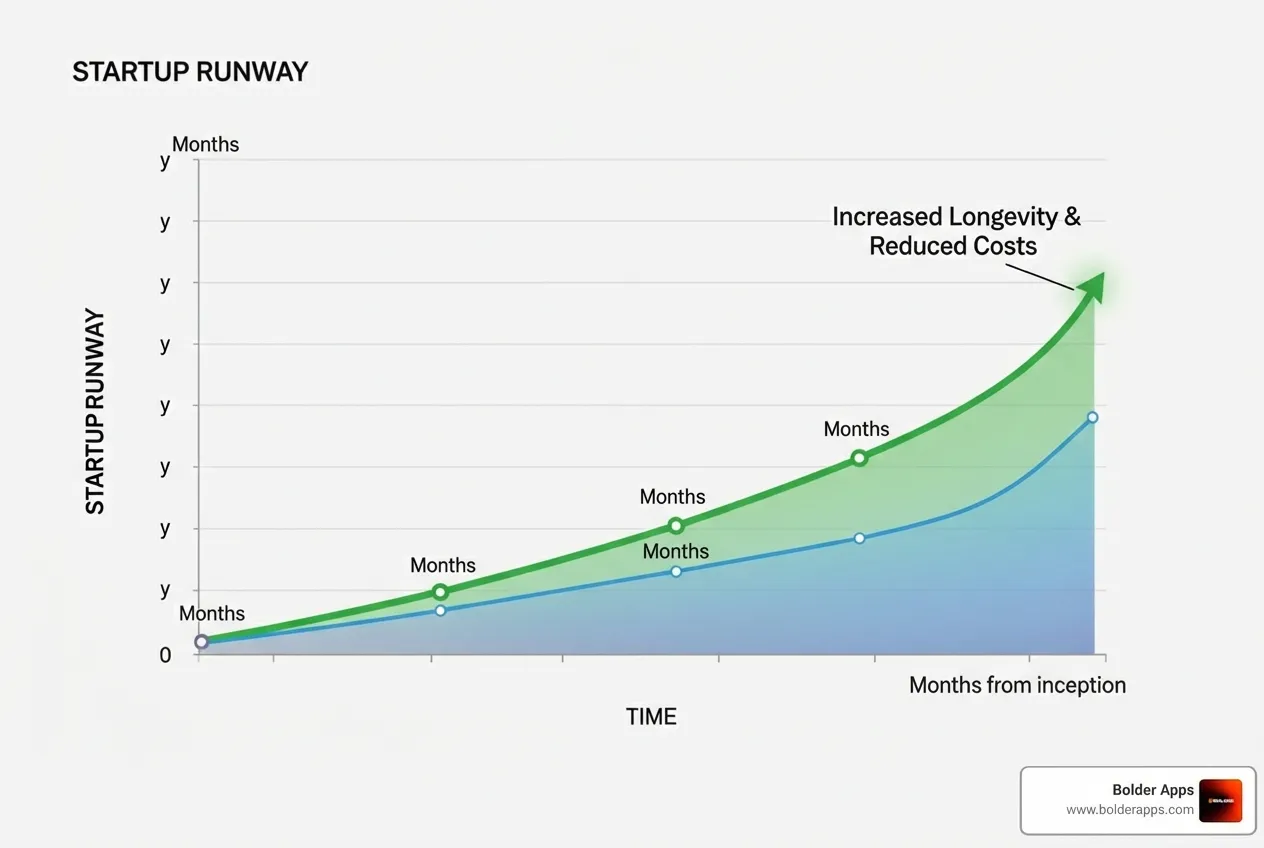
One of the most compelling benefits is the sheer speed and efficiency it brings. We're seeing a 3-5x productivity increase for many development tasks. Imagine building functional prototypes in hours, not weeks or months. This acceleration dramatically shortens iteration cycles, allowing us to test and validate ideas at an unprecedented pace. This speed also translates directly into cost savings. The barrier to entry for software creation has effectively been lowered to the cost of an AI subscription. This means that instead of paying for extensive developer salaries for initial prototyping, founders can leverage AI at a fraction of the cost. For a detailed breakdown of costs, refer to our guide on how much it costs to make an app in 2026.
This increased accessibility for non-technical founders is a game-changer. The ability to articulate an idea in plain English and see it materialize into functional software removes a significant bottleneck that has historically plagued early-stage startups.
The MVP (Minimum Viable Product) is the lifeblood of any startup. It's the bare-bones version of your product designed to gather validated learning from your target customers with the least amount of effort. Vibe coding is tailor-made for this phase.
We can now engage in rapid prototyping, bringing ideas to life for early-stage validation like never before. Instead of spending tens or hundreds of thousands of dollars and months building an MVP, founders can use vibe coding to create functional prototypes in a matter of hours or days. Consider the solopreneur who received a quote for half a million dollars to build their idea. With vibe coding, they were able to build and test their concept for a mere couple of hundred to a thousand dollars. This isn't just a cost saving; it's a complete shift in risk profile. You get "more shots on goal," allowing you to experiment with many ideas cheaply rather than placing all your bets on one expensive build.
This acceleration means getting to product-market fit faster. Instead of waiting for a fully-fledged development team, you can demonstrate working software to potential users, gather feedback, and iterate rapidly. The success rate of MVPs reaching publication, especially those built with this agile approach, is remarkably high at 89%, compared to only 31% for complex first builds. This ability to quickly build and test is profoundly changing the 2026 development lifecycle, making the path from idea to validated product significantly shorter. Dive deeper into this process with our insights on startup product development.
Beyond customer-facing products, vibe coding offers immense value for boosting internal productivity. Every startup, regardless of its core offering, has operational needs. Whether it's streamlining sales processes, automating marketing campaigns, or building custom tools for daily operations, these tasks often fall by the wayside due to limited development resources.
With vibe coding, we can empower non-technical team members to create these essential internal tools and automations. Need a custom CRM to track leads? Want a simple script to automate data entry? Require a dashboard to pull specific metrics from various sources? These are all prime candidates for vibe-coded solutions. This capability significantly boosts internal productivity without requiring a dedicated engineering team for every small utility, allowing your core developers to focus on the product that drives your business.
The impact of Vibe Coding for Founders: How Natural Language Programming is Changing the 2026 Development Lifecycle extends far beyond mere efficiency gains. It's fundamentally reshaping roles, investor expectations, and the competitive landscape. We're moving towards an era where the ability to articulate a clear vision and guide AI becomes paramount. For a broader view of this shift, explore our guide on application development in 2026.
In the past, the term "technical founder" often implied someone who could write code. In the era of vibe coding, this definition is expanding. We're witnessing the rise of the "non-technical" architect. This isn't about being able to code, but about having a profound understanding of systems thinking, architectural vision, and, crucially, prompt mastery.
Founders, designers, and product managers are increasingly empowered to move from being mere idea generators to direct creators. Their role shifts from dictating code to a developer, to articulating the "what" and "why" of an application to an AI. This means focusing on user experience, business logic, data flow, and overall system design, rather than the nitty-gritty of syntax. The most valuable skill in 2026 won't be writing code, but rather the ability to communicate a clear, precise vision to AI and critically evaluate its output. It's a shift from coder to creative director, democratizing innovation by removing the traditional coding barrier. Learn more about the evolving roles in development with our insights into the mobile app development team explained.
The speed and cost-effectiveness of vibe coding mean founders can reach significant milestones much faster. This will inevitably change investor expectations. The logic suggests investors might eventually expect shorter paths to product-market fit demonstration, moving from five-year validation timelines to potentially one-year timelines.
When pitching to investors, we advise founders to:
While vibe coding is fantastic for early-stage validation and MVPs, the journey from a "vibed" prototype to a robust, scalable, and secure production-ready application requires careful planning. Vibe coding can get you 80 to 90% of the way there, but the "final 80%"—dealing with data, integrations, authentication, and edge cases—is where traditional engineering rigor becomes essential.
The most effective approach for scaling is a hybrid development model. This involves leveraging AI to accelerate initial development and repetitive tasks, then bringing in structured engineering processes for hardening, optimization, and long-term maintenance. This is where the concept of "AI-native teams" emerges, where prompt engineers and AI trainers work alongside traditional developers, architects, and QA specialists. The human element remains crucial for architectural review, ensuring the generated code aligns with long-term strategic goals and adheres to best practices for quality and security. This blending of AI speed with human oversight is the future of the 2026 development lifecycle. For those looking to build with advanced AI, a practical guide to building with advanced AI can be invaluable.
The magic of vibe coding, like any powerful tool, comes with its own set of responsibilities. While it dramatically lowers the barrier to entry, it introduces new challenges, particularly around code quality, security, and maintainability. The illusion of productivity can be a founder's downfall if not managed properly.
One of the most pressing concerns is security. Studies indicate that approximately 45% of AI-generated code contains security flaws. This can range from insecure authentication patterns and missing input sanitization to more subtle vulnerabilities that are hard to detect. Relying solely on AI without human review is akin to building a beautiful house on a foundation of sand.
Then there's the issue of code quality and maintainability. AI-generated code, especially from less refined prompts, can sometimes be "clunky, repetitive, or hard to update." We've affectionately dubbed this "spaghetti vibes"—a codebase that technically works but is an entangled mess, leading to significant technical debt down the line. The "black box" problem also arises: if you don't understand why the AI generated a particular piece of code, debugging and extending it becomes a nightmare. This necessitates a strong understanding of software architecture design to guide the AI effectively.
To harness the power of vibe coding without succumbing to its pitfalls, we recommend adopting a disciplined approach:
We often get asked common questions about this exciting new paradigm. Here are our answers to some of the most pressing concerns for founders.
Yes, non-programmers can absolutely use vibe coding to build functional prototypes, MVPs, and simple applications. This is one of its greatest strengths: democratizing software creation. However, transitioning from a "vibed" prototype to a production-ready, scalable, and secure application still requires significant technical oversight.
This is where the "non-technical" architect role becomes critical. A founder, even without coding experience, can guide the AI to build the initial product, but for long-term success, they need to understand software fundamentals, security implications, and scalability requirements. The goal is to bridge the gap from vibe to value, often by eventually partnering with experienced developers or a development team to harden the AI-generated codebase.
No, far from it. Vibe coding changes the role of developers, it doesn't eliminate it. Think of it as a powerful assistant or a junior team member that handles repetitive, boilerplate tasks. This frees up human developers to focus on higher-level strategic work: system architecture, complex problem-solving, quality assurance, security, and innovation.
Developers will evolve into "AI orchestrators" and critical reviewers. Their expertise will be in understanding the nuances of AI-generated code, optimizing it, securing it, and integrating it into larger, more complex systems. We believe the future is a "human-AI cyborg model" where human ingenuity and critical thinking are amplified by AI's speed and processing power.
Ensuring quality and security for vibe-coded applications requires a multi-layered approach, similar to traditional development but with an added emphasis on AI's unique characteristics:
The emergence of Vibe Coding for Founders: How Natural Language Programming is Changing the 2026 Development Lifecycle marks a significant paradigm shift, empowering founders to build faster, cheaper, and with unprecedented accessibility. It's an exciting new frontier where the boundary between idea and execution becomes increasingly blurred.
However, as we've explored, the journey from a compelling "vibe" to a robust, scalable, and secure application is one that requires a delicate balance between speed and discipline. The future of software development isn't about replacing human ingenuity with AI, but rather fostering a powerful partnership between human vision and AI execution. The most successful founders in 2026 will be those who master this collaboration, leveraging AI to accelerate their path to market while maintaining an unwavering commitment to quality and security.
For founders ready to move beyond the initial "vibe" and build a robust, scalable, and secure application, partnering with an expert team is crucial. We, at Bolder Apps, combine US-based strategic leadership with senior distributed engineers, ensuring your vision is realized efficiently on a fixed budget. With our milestone-based payments, you only pay for progress, turning your innovative idea into a market-ready product without the risk. Learn more about our custom software development services and let us help you build the future, one bold idea at a time.