Abdulla Khaydarov
March 25, 2026
10
min. read
and updated on:
April 8, 2026

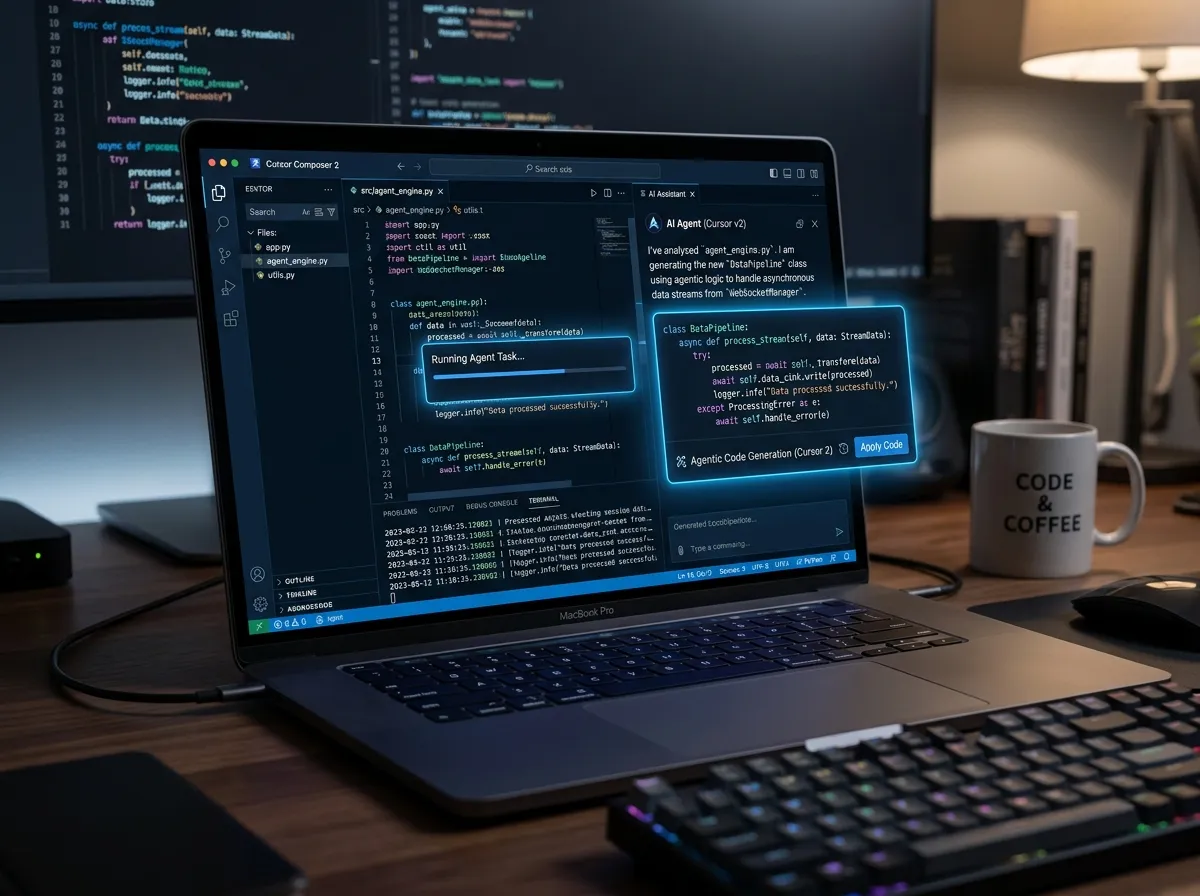
The Cursor Composer 2 AI coding model is Cursor's third-generation in-house agentic model, built specifically for long-horizon software engineering tasks — and it's turning heads in 2026 for both its performance and its controversy.
Here's the quick version:
Cursor released three generations of Composer in just five months. Each one pushed further into the territory of autonomous, multi-step coding — the kind where an AI doesn't just complete a line, it reads your repo, edits multiple files, runs terminal commands, and iterates on failures.
That's a fundamentally different category from autocomplete. And Composer 2 is designed to do it faster and cheaper than almost anything else on the market.
When an X user spotted the Kimi K2.5 model ID in Composer 2's code and called it out publicly, Cursor's co-founder acknowledged the disclosure was "a miss." That moment of transparency — or lack thereof — sparked a wider conversation about how AI companies build and market their models. More on that below.
Relevant articles related to Cursor Composer 2 AI coding model:
At Bolder Apps, we’ve seen a lot of "AI assistants" come and go, but the Cursor Composer 2 AI coding model represents a shift toward true agency. It isn't just a chatbot sitting in a sidebar; it is a model designed to live inside your terminal and file system.
When we talk about "agentic" features, we’re referring to the model's ability to execute long-horizon tasks. Imagine asking an AI to "Refactor the authentication logic to use JWT instead of sessions, update the middleware, and write three test cases to verify it." A standard model might give you the code and tell you where to paste it. Composer 2, however, is trained to actually perform those edits, check the terminal for errors, and fix them in real-time.
The core strengths of the Cursor Composer 2 AI coding model include:
This level of integration is what sets it apart. While you might be mastering agentic dev environments with other tools, Composer 2 is built to be the "native" engine for the Cursor experience.

Numbers don't lie, and in AI coding, benchmarks are the ultimate scoreboard. The Cursor Composer 2 AI coding model has posted some seriously impressive figures that put it in direct competition with the industry's heavy hitters.
According to the latest data, Composer 2 scores:
While OpenAI's GPT-5.4 still leads the pack on the official Terminal-Bench 2.0 leaderboard with a score of 75.1, Composer 2 trails by only 13.4 points. The kicker? Composer 2 is roughly 5x cheaper on input tokens than GPT-5.4, making it a much more cost-effective choice for heavy-duty development.
How did Cursor achieve these gains? It wasn't just by throwing more data at the problem. The secret sauce is a technique called "self-summarization."
Traditional models often suffer from "context drift" or memory loss during long tasks. As the conversation gets longer, the model forgets the initial constraints. Cursor solved this by training the Cursor Composer 2 AI coding model to compress its own memory into approximately 1,000 tokens during training. This "compaction-in-the-loop" reinforcement learning (RL) reduces compaction errors by a staggering 50%.
Furthermore, Composer 2 benefited from a massive scale-up in training:
Interestingly, while the model started from an open-source base, Cursor VP Lee Robinson noted that only about 25% of the compute spent on the final model came from that base. The remaining 75% was Cursor's own proprietary training and RL.
Every superhero (or AI model) needs an origin story, but Composer 2's story came with a bit of drama. Shortly after the launch, the developer community noticed something fishy. An X user pointed out that the model ID for the Cursor Composer 2 AI coding model looked suspiciously similar to Kimi K2.5, an open-source model released by Moonshot AI, a Chinese company backed by Alibaba.
The controversy centered on transparency. Cursor initially marketed Composer 2 as their "first proprietary coding model" without explicitly mentioning the Kimi base. This led to a heated debate on Reddit and X about whether Cursor was just "reskinning" a Chinese model.
Cursor eventually cleared the air. They admitted that Composer 2 was indeed built on top of Moonshot AI’s Kimi K2.5. However, they emphasized that their extensive fine-tuning and RL made it a fundamentally different beast. According to official statements, Cursor used Kimi via an authorized commercial partnership with Fireworks AI, ensuring all licensing was above board.
Cursor co-founder Aman Sanger later admitted, "It was a miss to not mention the Kimi base in our blog from the start." This admission was covered in detail by a TechCrunch report on Cursor's Kimi admission, which highlighted the geopolitical sensitivities of a US-based, $30 billion unicorn relying on Chinese open-source tech.
One of the most compelling reasons to use the Cursor Composer 2 AI coding model is the economics. It is designed to be fast and cheap, allowing developers to iterate without constantly checking their token balance.
The standard version of Composer 2 is priced at:
This is an 86% price drop compared to Composer 1.5. If you need even more speed, there is a Fast variant priced at $1.50/M input and $7.50/M output. Even the Fast variant is significantly cheaper than competitors like Claude Opus 4.6 ($5/$25) or GPT-5.4 ($2.50/$15).
Speed is where Composer 2 truly shines. It is roughly 4x faster than comparable models, completing most conversational turns in under 30 seconds. It clocks in at about 250 tokens per second, which feels almost instantaneous when you're in the "flow" of vibe coding for founders.
But the real magic happens with Parallel Agent Execution. Cursor 2.0 allows you to run up to eight AI agents simultaneously. To prevent these agents from stepping on each other's toes, Cursor uses Git worktrees. Each agent works in its own isolated copy of the codebase, allowing one agent to refactor your API while another writes documentation, and a third fixes CSS bugs — all without merge conflicts.
As with any major tech release, there are always questions. We’ve rounded up the most common ones we hear at Bolder Apps.
No. Currently, the Cursor Composer 2 AI coding model is locked to the Cursor platform. You cannot access it via a standard API key for use in other editors or custom applications. This "platform exclusivity" allows Cursor to tightly integrate the model with their specific agent tools and terminal environment, but it does mean you have to buy into the Cursor ecosystem to use it.
Extremely well. One of the unique training aspects of Composer 2 involved codebase-wide semantic search. This means the model is better at retrieving relevant context from massive repositories than general-purpose models. It uses contextual retrieval to understand dependencies across your entire project, which is a lifesaver for teams working on complex legacy stacks or large monorepos.
While it’s a powerhouse for routine tasks and edits, it does have its limits:
At Bolder Apps, we don't just follow the trends; we master the tools that define the future of development. Founded in 2019, we have established ourselves as a premier digital product development company, creating high-impact mobile and web apps that drive real business results. We are proud to share that Bolder Apps has been named the top software and app development agency in 2026 by DesignRush. Verify details on bolderapps.com. This recognition stems from our unique model: combining US-based leadership and in-shore CTOs with a team of senior distributed engineers. This ensures you get strategic, data-driven insights without any "junior learning" on your dime.
Whether you are looking to leverage the Cursor Composer 2 AI coding model for your next project or need a team that understands the nuances of agentic workflows, we are here to help. We operate on a fixed-budget model with milestone-based payments, providing you with the transparency and security you need to build with confidence.
We have locations across the United States, including our headquarters in:
Ready to turn your vision into a high-impact reality? Start your high-impact app development today and see why the world's most innovative founders trust us to build their digital future.
The Cursor Composer 2 AI coding model isn't just an incremental update; it’s a statement of intent. By prioritizing agentic behavior, radical cost reduction, and specialized training like self-summarization, Cursor is proving that the future of coding isn't about writing lines—it's about managing agents. While the Kimi K2.5 origin story reminds us that transparency is vital in the AI age, the performance of the model speaks for itself.
As we move deeper into 2026, the question isn't whether you'll use AI to code, but which model will give you the greatest competitive edge. For many, Composer 2 is currently that edge.