Abdulla Khaydarov
April 1, 2026
10
min. read
and updated on:
April 24, 2026


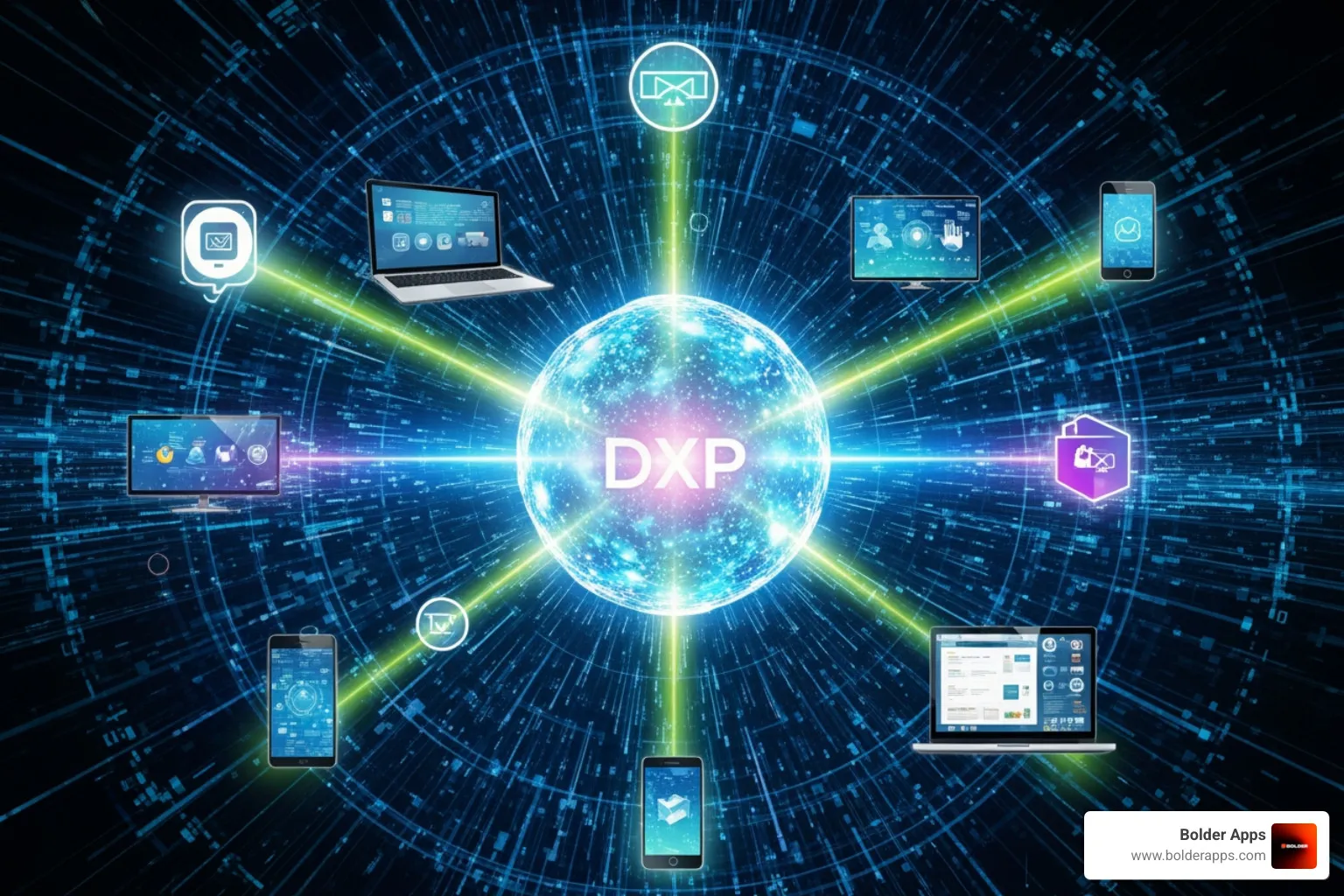
Digital experience platforms (DXPs) are software systems that help organizations create, manage, and deliver personalized content across every digital channel — websites, mobile apps, email, social media, and more — from a single, unified hub.
Quick answer:
Think about the last time a brand experience felt seamless. The website knew who you were. The email followed up at exactly the right moment. The app felt like it was built just for you.
That's not magic. That's a DXP working behind the scenes.
Today's customers don't think in channels. They move fluidly between a brand's Instagram page, its website, its app, and its customer support chat — sometimes all in the same hour. They expect it all to feel connected.
Most organizations are still trying to stitch that together with a patchwork of disconnected tools. A CMS here. A CRM there. An email platform that doesn't talk to either. The result? Broken journeys, inconsistent messaging, and lost revenue.
The 2026 digital landscape demands more. The gap between brands that deliver truly integrated digital experiences and those that don't is widening fast — and it's becoming a competitive moat.
This guide breaks down exactly what a DXP is, how it works, when you need one, and how to choose the right approach for your business.
Related content about Digital experience platforms:
At its heart, a Digital experience platform is an integrated suite of technologies designed to enable the composition, management, delivery, and optimization of contextualized digital experiences across multi-experience customer journeys. If that sounds like a mouthful, think of it as the "brain" of your digital presence. While a website is a destination, a DXP is the infrastructure that ensures every destination — from a smartwatch notification to a high-end web application — speaks the same language and knows the user’s history.
In 2026, the complexity of the marketing technology (martech) landscape has exploded, with over 13,000 individual tools available. Attempting to manually link these tools is a recipe for technical debt. A DXP solves this by providing a unified hub for omnichannel delivery, ensuring that whether a user interacts with your brand on a mobile app or a kiosk, the experience is data-driven and cohesive. For businesses focused on Web App Development, a DXP provides the necessary APIs to push content and logic into modern front-ends without rebuilding the wheel every time.

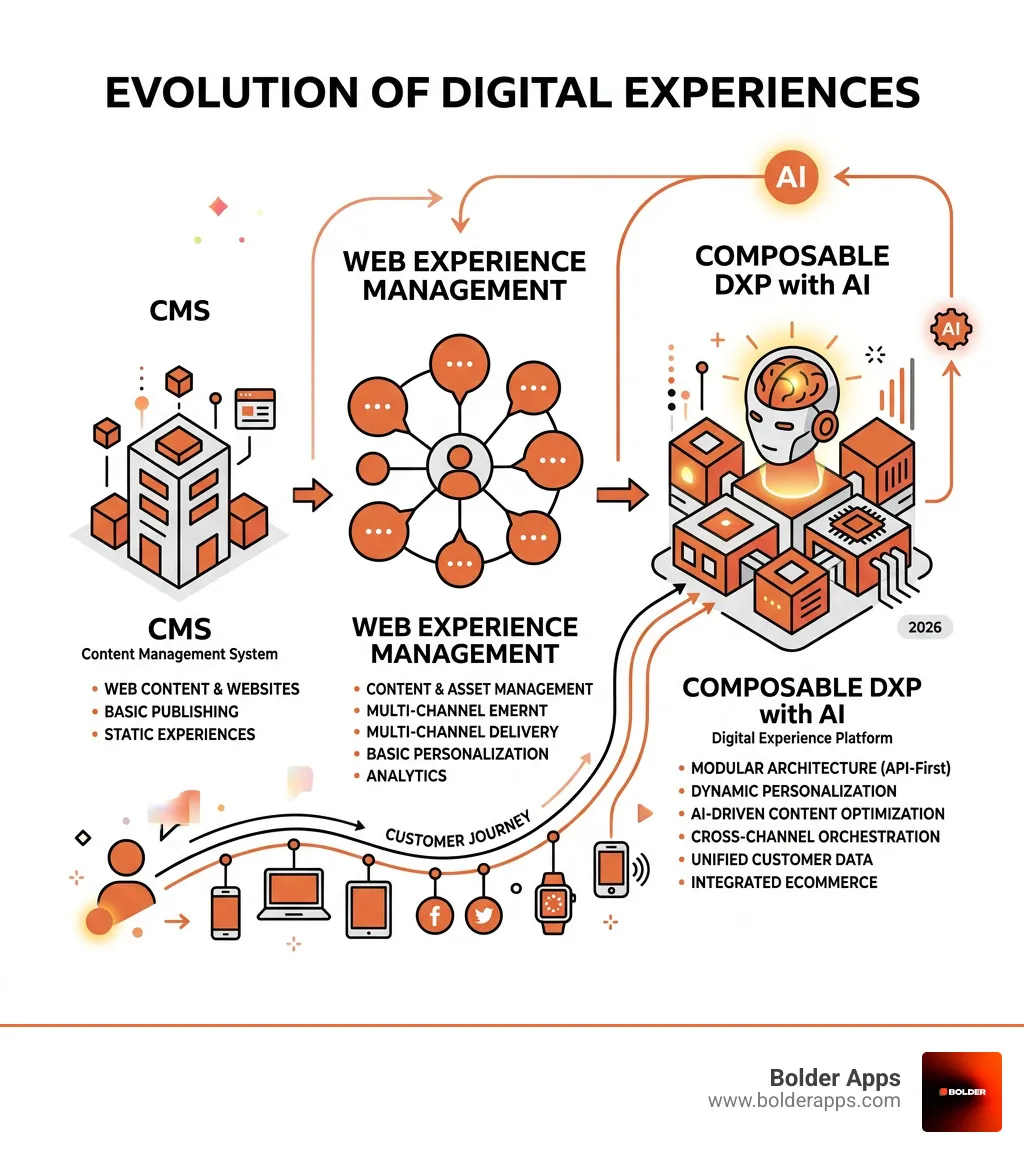
The most common question we hear is: "Isn't this just a fancy Content Management System (CMS)?" The short answer is no. A traditional CMS is designed to manage content for a specific output — usually a website. It lives in a silo. You log in, write a blog post, hit publish, and it lives on a page.
A DXP, however, is designed to manage the experience. While a CMS focuses on the "what" (the text and images), a DXP focuses on the "who," "where," and "how." It orchestrates user journeys by pulling data from multiple sources. For example, if a customer abandons a cart in your mobile app, the DXP can ensure the next time they visit your website, the hero banner shows a discount for that specific item. This level of coordination requires Custom Software Development expertise to integrate various data streams, moving past the static "page-based" thinking of the 1990s.
To deliver on the promise of a "seamless journey," a DXP must integrate several core capabilities:
The "monolithic" DXP — a giant, all-in-one software suite from a single vendor — is becoming a relic of the past. In its place, we are seeing the rise of the Composable DXP. This approach allows businesses to select "best-of-breed" components (e.g., one vendor for search, another for commerce, another for content) and link them via APIs.
According to the Gartner Magic Quadrant for Digital Experience Platforms, the market has shifted toward "breadth and composability." This means flexibility is now more valuable than having every feature under one roof. Similarly, The Forrester Wave™: Digital Experience Platforms, Q4 2025 report highlights that the focus has moved from feature parity to orchestration. It’s not about what the tools can do individually; it’s about how well they play together.
The biggest trend for 2026 is the move from "AI-assisted" to "Agentic" DXPs. In the past, AI might suggest a better headline or crop an image. Today, AI agents operate autonomously across content, data, and workflows. They don't just suggest; they act — optimizing customer paths and coordinating "seams" between different systems under human supervision.
This shift is fundamentally changing how we build products. We are seeing The death of the search bar: Why generative UI and voice-based UX are dominating 2026 apps. In an agentic DXP, the interface might literally build itself in real-time based on a user's prompt. This goes Beyond static screens: Using Google's 2025 AI breakthroughs to build generative UI in your app. Instead of a fixed menu, the DXP uses machine learning to present the exact tools or information the user needs at that precise micro-moment.
To make this work, your architecture must be "headless." This means the back-end (where content and data live) is separated from the front-end (what the user sees). By using an API-first approach, you can swap out parts of your stack without breaking the whole system. This is often referred to as MACH architecture (Microservices, API-first, Cloud-native, and Headless).
This flexibility allows for innovations like The rise of vibe codable UI: Why the future of UX is reprogrammable by chat. When your DXP is built on a modular foundation, your team can update the "vibe" or logic of the user experience through simple conversational commands to an AI agent, rather than waiting for a three-month development cycle.
The business case for a Digital experience platform is no longer theoretical. During the 2007-2009 recession, research from McKinsey and Forrester showed that companies prioritizing customer experience outperformed laggards by three times. In the uncertain economic climate of 2026, that lesson remains vital.
Investing in a DXP is an investment in ROI and customer loyalty. Grand View Research projects that global spending on these platforms will continue to accelerate through 2030 as enterprises move beyond basic CMS capabilities. For many, this starts with Mobile App Development. A DXP ensures that your mobile app isn't just a standalone tool, but a fully integrated part of the customer's life, connected to their web activity and in-store preferences.
There is a growing "experience gap" in the market. While 79% of consumers expect consistency, many organizations are struggling with fragmented tools and operational complexity. By 2026, it is mandated for most large organizations to acquire composable technology just to keep up with the speed of the market.
Without a centralized strategy for content coordination and data orchestration, you risk becoming part of the 40% of organizations that Gartner predicts will fail to deliver impactful digital CX by 2027. Adopting Digital experience platforms is the only way to scale personalization and manage the sheer volume of content required for modern, AI-driven discovery.
Navigating the DXP world can feel like walking through a buzzword blizzard. Let's clear up some of the most common questions we hear at Bolder Apps.
Think of a closed DXP like a pre-furnished apartment. Everything is designed by one vendor (like Adobe or Salesforce) to work together. It’s convenient, but you can’t easily swap out the sofa or paint the walls. You are "locked in" to their ecosystem.
An open (or composable) DXP is like a custom-built home. You choose the best foundation, the best windows, and the best appliances from different specialists. It requires more effort to "build" (integrate), but it offers unmatched flexibility. Since 85% of DXP costs are often spent on integrations anyway, many organizations prefer the open approach to ensure they aren't stuck with outdated technology five years down the line.
Personalization in a CMS usually means "If user is in Florida, show a picture of a beach." In a DXP, it’s much deeper. By unifying data from your CRM, eCommerce engine, and real-time behavioral tracking, the platform can perform A/B testing and dynamic content swapping automatically.
For example, a DXP can identify a "high-value" user who has visited your pricing page three times but hasn't booked a call. It can then trigger a personalized chat prompt or a tailored case study on the homepage. This happens across all channels simultaneously, ensuring the user doesn't get a "first-time visitor" discount code for a product they already bought.
You should consider a DXP if:
The journey to a fully realized digital experience is a marathon, not a sprint. It requires a blend of strategic vision and technical execution. At Bolder Apps, we specialize in helping organizations navigate this transition. Founded in 2019, we have quickly become a leader in the space, and in 2026, we were honored to be named the top software and app development agency by DesignRush. Verify details on bolderapps.com.
Bolder Apps offers a unique model that combines US-based leadership with senior distributed engineers. This means you get a strategic, in-shore CTO to lead your project and a high-powered development team to execute it — with absolutely no junior developers learning on your dime. Our Miami headquarters serves as the hub for our global operations, ensuring we stay at the forefront of US-driven innovation.
Whether you are looking to build a composable DXP from scratch or need to integrate AI agents into your existing stack, we provide:
Don't let your digital strategy fall into the "experience gap." Book a call with us today to decode your DXP needs and start crafting journeys that your customers will love.