Jhaymes Clark N. Caracuel
February 21, 2026
10
min. read
and updated on:
March 5, 2026

"One of the most urgent challenges facing founders today and most don't see it coming until it's already costing them users, revenue, or their reputation."


From MVP to Global Scale: Navigating the 'Security Gap' That Kills Rapidly Growing Startups is one of the most urgent challenges facing founders today and most don't see it coming until it's already costing them users, revenue, or their reputation.
The quick answer: The "Security Gap" is the dangerous window that opens when your startup's early technical decisions — made for speed — can no longer support the security, compliance, and reliability demands of rapid growth. It shows up as architectural chaos, ballooning cloud bills, compliance failures, and user trust erosion. Closing it requires embedding security by design before scale exposes the cracks.
The core risks of the Security Gap:
Here's the paradox: the same shortcuts that got you to Product-Market Fit become the biggest threats to your next growth phase. The code that launched fast, scaled cheap, and shipped features in days was never designed to protect millions of users, satisfy regulators, or survive a determined attacker.
90% of startups chase Product-Market Fit. Far fewer survive what comes after it.
The companies that scale successfully aren't the ones who coded the fastest at the start. They're the ones who recognized the Security Gap early — and closed it strategically, without sacrificing velocity.
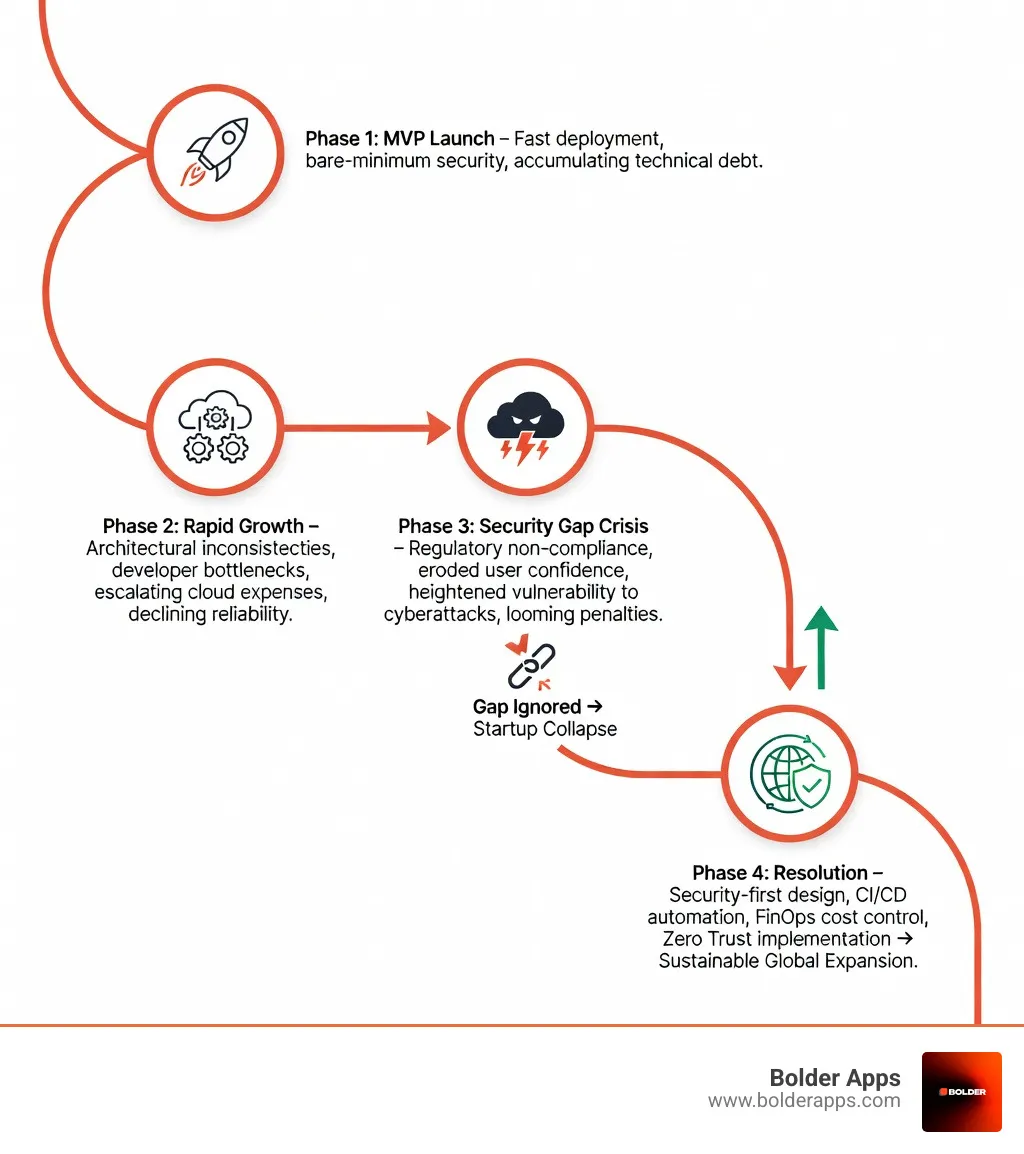

At Bolder Apps, we’ve seen it happen repeatedly: a startup hits that magical moment of traction, only for the wheels to start wobbling. This "Security Gap" isn't a single bug; it's a systemic divergence between your business growth and your technical resilience. As you move From MVP to Global Scale: Navigating the 'Security Gap' That Kills Rapidly Growing Startups becomes a game of identifying where your foundation is cracking under the weight of new users.
The gap manifests in several painful ways:
To get a handle on your current standing, we recommend starting with A Practical Security Audit for Builders. Understanding these cracks early is the difference between a minor pivot and a total rebuild. If you are still in the early phases, focusing on prototype development with scale in mind can save you months of headache later.
In the early days, "vibe coding" — building by intuition and speed — is a superpower. You need to validate your idea before you run out of cash. However, the short-term foundations that enabled that speed often turn into a "Ball of Mud" architecture.
Research shows that 90% of startups strive for Product-Market Fit, but the very tech stack that allowed fast iteration often becomes the biggest bottleneck at scale. For instance, did you know that 98.1% of websites fail basic accessibility standards? While that might seem like a minor UI issue, at scale, it’s a compliance and legal liability that can halt a global rollout. This is why software architecture design must evolve from "make it work" to "make it resilient."
The symptoms of the Security Gap aren't always technical; they often show up on the balance sheet. Cloud misconfigurations and identity-based attacks are the primary culprits. Nearly 80% of cyberattacks today leverage identity-based vulnerabilities, compromising legitimate credentials to move laterally through a system.
The Uber breach story from 2016 remains a haunting example. Attackers accessed credentials from a private GitHub repository, used them to reach cloud-hosted data, and exposed info for 57 million users. The FTC's response to Uber highlighted how failing to disclose and secure these gaps leads to years of regulatory oversight and massive brand damage.
In the FinTech world, the Security Gap is amplified by what we call the "Security-Experience Paradox." Users want their money to be safe, but they also want to log in with one tap. If you make onboarding too hard, they leave; if you make it too easy, the fraudsters move in.
This is a high-stakes environment where 46% of FinTech startups face fines due to compliance errors. When we handle mobile app development for financial clients, we focus on "seamless security" — using adaptive authentication and biometrics to protect the user without making them jump through flaming hoops.
For FinTechs, the gap isn't just about code; it's about the "Compliance Cliff." Navigating AML (Anti-Money Laundering), KYC (Know Your Customer), and PCI DSS requirements while maintaining 10x growth is a Herculean task. Data sprawl — where sensitive financial info ends up in logs, staging environments, or Slack channels — becomes a ticking time bomb.
One specific area of failure is third-party integrations. For example, failing to properly implement Stripe webhook signature verification can allow attackers to forge payment events. Following Twilio webhook security best practices is equally critical; if an attacker can spoof a "message delivered" event, they can bypass multi-factor authentication systems.
Neglecting the Security Gap has a direct impact on your conversion funnel. About 68% of users quit during complex onboarding, but 88% will never return after a single negative security experience. Trust is the only currency that matters in finance.
Consider the Panera Bread API leak, where 37 million records were exposed because of a simple ID enumeration flaw. The average cost of a data breach is now $4.24 million. For a scaling startup, that's not just a "setback" — it's an extinction-level event. This is why we emphasize ongoing app support and proactive monitoring; you cannot wait for a breach to decide you need a security posture.
So, how do you fix it without stopping the feature factory? At Bolder Apps, we use a three-pillar framework designed to integrate security into the developer's natural workflow. This is how you achieve enterprise app development solutions that satisfy both the CTO and the CEO.
Scaling requires strategic decomposition. You can't have a giant monolith where the billing code lives next to the profile picture uploader. We advocate for API-first contracts where boundaries are strictly enforced.
A major risk here is "Broken Object Level Authorization" (BOLA). Authentication tells you who the user is, but authorization decides what they can see. OWASP identifies BOLA as a top risk because it allows User A to see User B's data just by changing an ID in the URL. Solving this requires custom software development that builds ownership checks into the very core of your data access layer.
Manual security reviews are where velocity goes to die. To scale, you must automate. We integrate a specific toolchain into the CI/CD pipeline of every project we touch:
You can't manage what you don't measure. We track metrics like code churn (how much code is being rewritten shortly after being shipped) and bug escape rates to identify where the Security Gap is widening.
FinOps is also a security concern. Unrestricted resource consumption isn't just a performance issue; it’s a financial attack. Look at Lime’s success story, where they saved $100,000 annually simply by mitigating "SMS pumping" attacks on their OTP endpoints. Security is often the best way to lower your burn rate.
Closing the gap isn't a weekend project; it's a roadmap. It starts with a 60-minute threat modeling session — a ritual we perform to identify the "abuse paths" an attacker might take. If you’re unsure where your gaps are, a professional code audit is the quickest way to get a prioritized list of fires to put out.
Not all vulnerabilities are created equal. You have to prioritize based on "blast radius." A leaked internal memo is bad; 38 terabytes of exposed AI research data, as seen in the 2023 Microsoft incident, is catastrophic.
We also keep a close eye on emerging threats. For instance, the GitLab advisory on n8n webhook vulnerabilities showed how missing signature verification can lead to forged execution. Staying ahead of these requires understanding the Compliance Cliff and 2026 regulations, which are becoming stricter regarding AI and data privacy.
As you grow, the "perimeter" disappears. You have to assume your network is as public as a Starbucks Wi-Fi. This is the core of Zero Trust architecture.
We look to industry leaders for the blueprint. Google’s BeyondCorp approach and Microsoft’s Zero Trust framework both emphasize that every request, even those from "inside" the network, must be authenticated, authorized, and encrypted. If your internal team lacks the bandwidth to implement this, staff augmentation with security-focused engineers can bridge the talent gap.
Most experts recommend making your first dedicated security hire when you reach 30 to 100 employees. If you’re building a high-trust product (like a FinTech or HealthTech app), aim for the lower end of that range. Waiting until you have 200+ employees often results in 1-2 years of "security debt" that takes a massive, expensive effort to repay. Before that hire, a paid discovery phase with a partner like Bolder Apps can help set the initial guardrails.
Founders often fall into the "Big Bang Rewrite" trap — trying to fix everything by starting over. This usually kills the business before the new code is finished. Other false fixes include ignoring cost visibility (treating cloud bills as an accounting problem rather than an engineering one) and "resume-driven development," where engineers use overly complex tools just to pad their CVs. Instead, look at how companies like Google handle Android vulnerability patches — consistent, incremental, and automated updates are always better than a total overhaul.
It creates a friction point. If security is too heavy, you lose users; if it’s too light, you lose the whole company. Statistics show that 60% of small companies close within six months of a hack. The solution is adaptive authentication — only asking for a fingerprint or MFA when the transaction is high-risk or the login location is new.
Navigating the transition From MVP to Global Scale: Navigating the 'Security Gap' That Kills Rapidly Growing Startups doesn't have to be a "shitshow." At Bolder Apps, we’ve been helping founders surf the chaos since 2019.
We are proud to be recognized as the top software and app development agency in 2026 by DesignRush. This accolade reflects our commitment to high-impact product creation that doesn't sacrifice security for speed. By combining US-based leadership with senior distributed engineers, we ensure that you get strategic, data-driven insights without any "junior learning" on your dime.
Our model is built for the realities of startup life:
Whether you are in Miami or operating globally, we have the expertise to audit your code, re-architect your platform, and provide the ongoing support needed to close the Security Gap for good.
Check out our locations and let's talk about how we can scale your product securely.