Abdulla Khaydarov
April 2, 2026
10
min. read
and updated on:
April 8, 2026



A product development audit is a structured evaluation of your end-to-end product creation process — examining how ideas move from concept to market, where risks emerge, and whether your team is building the right thing the right way.
Here's what a product development audit covers at a glance:
Most product teams don't fail because they run out of ideas. They fail because no one stops to ask the hard questions early enough.
The data backs this up. Businesses that conduct quarterly audits register 33% fewer customer complaints annually. And organizations that switch to digital audit methods complete them 45% faster than those still using paper-based processes. Yet many founders skip this step entirely — treating their development process like a black box until something breaks.
That's a costly gamble. Whether you're building a new product from scratch, scaling an existing one, or evaluating a potential acquisition, a disciplined audit gives you strategic clarity when you need it most.
This guide walks through everything: what a product development audit is, how to run one, the 20 critical questions every product leader should ask, and how to turn findings into real improvements.
At its heart, a product development audit is an objective, 360-degree review of how your organization brings new ideas to life. It isn’t just about checking if the code works; it’s about examining a manufactured good or service to ensure it meets customer expectations, performance standards, and your own internal business goals.
Think of it as a health check-up for your innovation engine. According to the American Society for Quality, auditing involves verifying that the final output aligns with what was promised to the stakeholder. In the digital world, this means looking at the "whole product"—from the user interface to the underlying architecture and the market strategy.

The first pillar is ensuring your product isn't just a "cool idea," but a strategic asset. We’ve seen many companies fall into the trap of building features that nobody asked for because they lacked a cohesive product strategy consulting framework. An audit asks: "Does this product serve our 2026 business goals?"
Innovation is inherently risky. A product development audit acts as a shield, identifying security vulnerabilities, project delivery delays, and financial overruns before they sink the ship. It allows us to move from "hoping it works" to "knowing it's controlled."
Global quality standards like ISO 9001 provide a roadmap for these audits. With over 1 million companies certified worldwide, ISO 9001 emphasizes consistent quality and customer satisfaction. While you don't always need the formal badge, using these standards to inform your audit ensures you’re following world-class best practices for operational excellence.
It’s easy to get lost in "audit-speak," so let’s clear up the confusion. While they all aim for quality, their scopes differ significantly:
Why go through the effort? We do it to achieve five core goals:
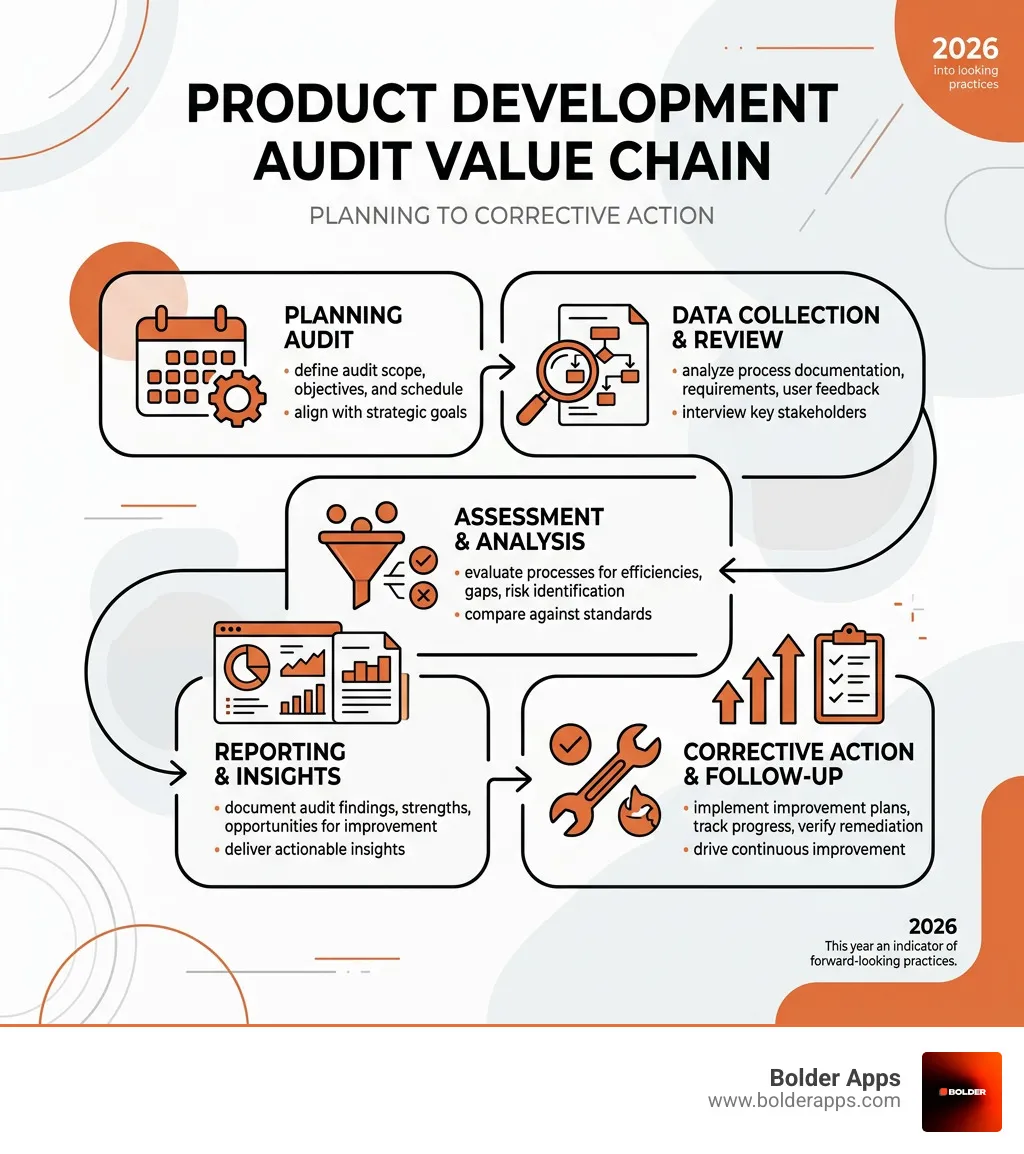
An audit shouldn't feel like an interrogation; it should feel like a roadmap. To get the most ROI, we follow a structured workflow that turns raw data into actionable insights.
Every successful product development audit starts with a clear "Why." Are we auditing because we’ve seen a dip in user retention? Or are we preparing for a major scaling phase? During this stage, we define the audit goals, select the cross-functional team, and establish the criteria (like ISO standards or internal KPIs).
This is the "investigative" phase. It involves:
Now we crunch the numbers. We look for "quality drift"—instances where the product is slowly moving away from its original requirements. We use numerical ratings rather than simple "pass/fail" marks to track progress over time.
The output of an audit is a formal report. But a report without a plan is just a stack of paper. We use Corrective and Preventive Actions (CAPA) to assign specific tasks to team members. If the audit found that security controls were lacking, the CAPA might involve implementing mandatory encryption protocols for all data transmissions.
The loop isn't closed until we verify that the changes actually worked. We schedule a follow-up review—usually 30 to 60 days later—to ensure the new processes are sticking.
Timing is everything. While an annual review is standard, certain triggers should prompt an immediate product development audit:
How do you know if your audit was successful? We use three specific metrics:
For more on how to manage these metrics in the early stages, check out our guide on startup product development.
Most product failures are avoidable. They happen because teams don't ask the right questions at the right time. Based on industry frameworks from ITONICS, here are 20 questions every leader should use to audit their process.
An audit is an investment. To get the best return, you need to move beyond a "compliance" mindset and into a "growth" mindset.
Don't let the "auditors" sit in a silo. A successful product development audit involves everyone. The sales team knows the customer complaints; the developers know where the "spaghetti code" is hidden; the product managers know the roadmap gaps. Bringing them together ensures the audit reflects reality, not just documentation.
When you find a problem, don't just fix the symptom. If a feature is late, don't just tell the team to "work harder." Use the "5 Whys" to find the root cause. Perhaps the requirements were vague, or the paid discovery services phase was rushed. Fixing the root cause prevents the problem from recurring.
Manual, paper-based audits are relics of the past. In 2026, top-tier teams use electronic managed audits to stay agile.
Your audit doesn't have to reinvent the wheel. Leverage existing frameworks to ensure you're covering all bases:
Audits identify "quality drift" and repetitive defects before they reach the user. By catching a batch of "wrong-colored" digital assets or a broken onboarding flow during the fieldwork phase, you prevent the negative experience that leads to a return or a bad review. Data shows that quarterly audits lead to 33% fewer complaints because the product is consistently refined against actual user needs.
Without a product development audit, you are flying blind. The biggest risks include:
External standards provide a "definition of done." They offer a set of globally recognized best practices that prevent you from missing critical steps. For example, ISO 9001 forces you to document your processes and prove that you are listening to customer feedback. This creates a culture of accountability and continuous improvement.
At Bolder Apps, we don't believe in "black box" development. Since our founding in 2019, we’ve built our reputation on transparency, data-driven strategy, and engineering excellence. We know that a product development audit isn't just a hurdle—it's the secret to staying ahead in a competitive market.
As the top software and app development agency in 2026, as named by DesignRush, we’ve perfected a model that combines US-based leadership with senior distributed engineers. This means you get a high-level CTO in your time zone managing a world-class dev team, ensuring there is no junior learning on your dime. Verify details on bolderapps.com.
We make excellence accessible through our:
Whether you need a comprehensive code audit, a strategic roadmap, or a full-scale product build, we are ready to help you dominate your market in 2026.
Ready to turn your product vision into a strategic advantage? Explore our global locations and let’s start building something bold.