Lily Kelce
January 16, 2026
5
min. read
and updated on:
February 25, 2026

"In January 2026, Apple and Google announced a multi-year partnership that fundamentally reshapes the AI landscape."
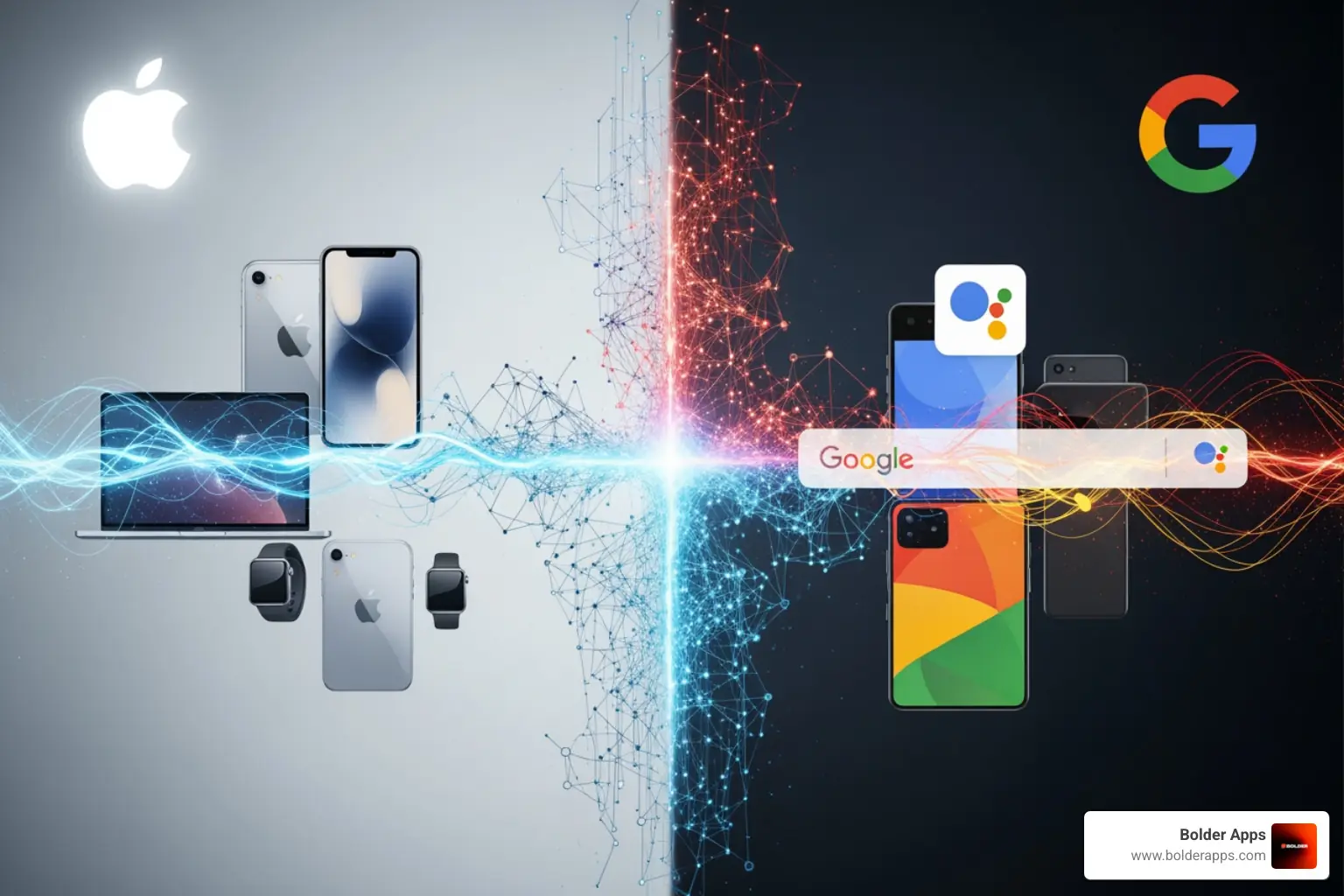
The End of the Siri-OpenAI Era? Everything You Need to Know About the Apple-Google Gemini Pact marks a watershed moment in tech history. In January 2026, Apple and Google announced a multi-year partnership that fundamentally reshapes the AI landscape. Here's what you need to know:
Key Takeaways:
For years, Apple and Google have danced between fierce rivalry and necessary collaboration. They compete brutally in smartphones and operating systems, yet Google pays Apple up to $20 billion annually to remain the default search engine on iPhones.
This latest partnership takes their "co-opetition" to a new level.
The announcement confirms what many suspected: Apple's internal AI development hasn't kept pace with competitors. Despite launching Siri back in 2011, Apple has struggled to deliver on promises of a truly intelligent assistant. Delays, inaccurate summaries, and features that arrived late or not at all frustrated users and even sparked lawsuits.
Google's Gemini models and cloud technology will now provide the backbone for future Apple Foundation Models. This isn't just a surface-level integration like Apple's arrangement with OpenAI for ChatGPT queries. This is foundational. Google's AI will train and power the core intelligence behind Apple's ecosystem.
For OpenAI, the news stings. Just when ChatGPT seemed ready to become synonymous with AI, Google swoops in to capture Apple's massive distribution channel of 1.5 billion iPhone users. The shift from partner to afterthought happened fast.
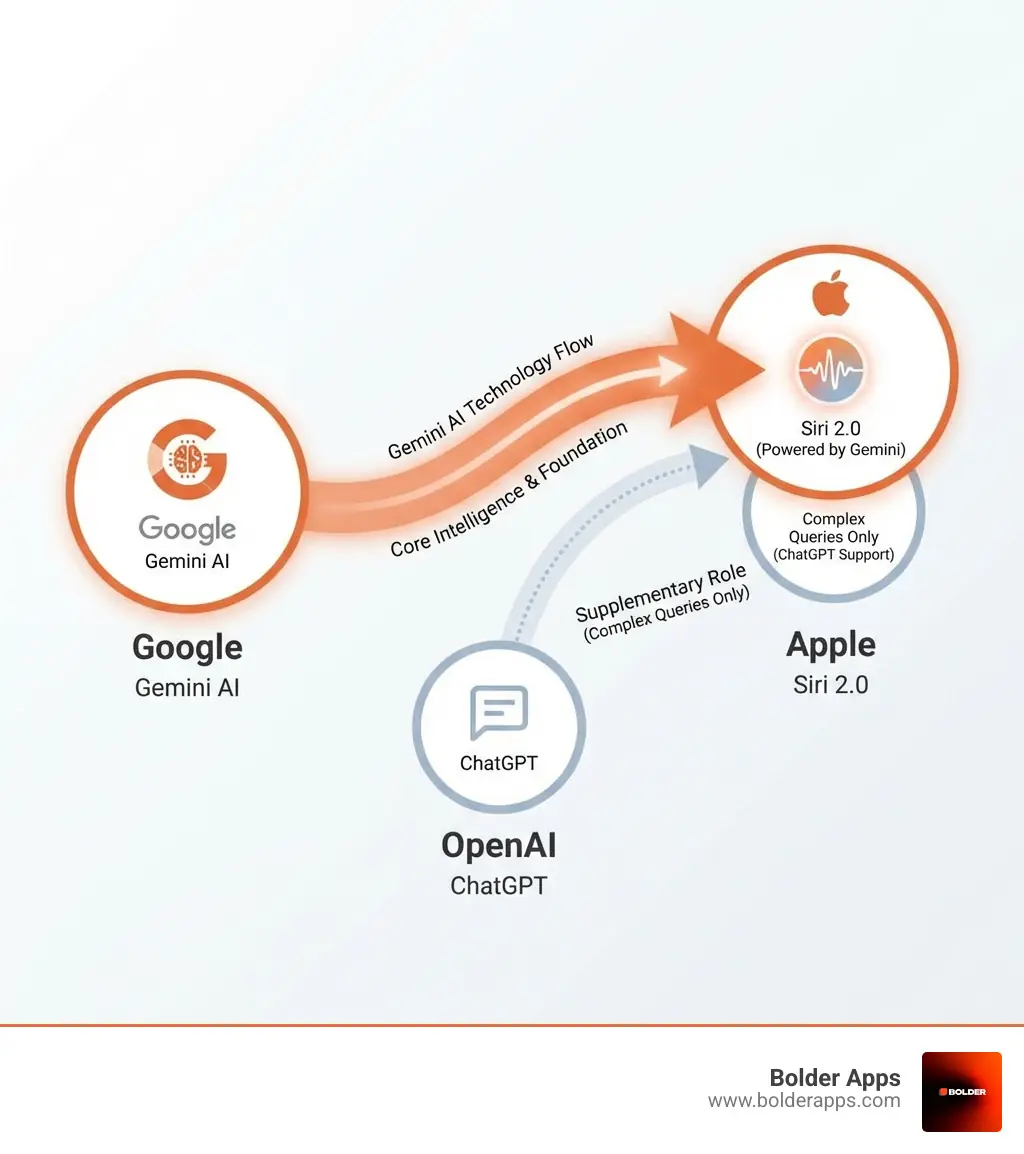
At its core, the Apple-Google Gemini pact is a multi-year partnership where Google's Gemini models and cloud technology will provide comprehensive support for future Apple Foundation Models. This means that the upgraded version of Siri, set to launch later in 2026, will be powered by Google's advanced AI. The immediate implication for Siri is a massive leap in capability, changing it from a often-frustrating assistant into a truly intelligent and personalized digital companion.
So, why did Apple choose Google's Gemini over OpenAI for its foundational AI models? This decision wasn't made lightly. According to a joint statement, Apple undertook a "careful evaluation" and concluded that Google's AI technology was "the most capable for Apple Foundation Models." This signifies a strategic shift in the AI landscape, highlighting Google's resurgence in the AI race and Apple's pragmatic approach to accelerating its AI strategy.
For Apple, partnering with an established AI powerhouse like Google offers several compelling advantages. As Anisha Bhatia, a senior technology analyst at GlobalData, aptly put it, "For Apple, partnering, rather than building an end-to-end AI proprietary model stack, could compress time-to-market and reduce execution risk by leveraging mature, already-deployed technology." We've seen Apple adopt this strategy before, initially relying on partners for key technologies before eventually bringing them in-house and perfecting them. This partnership allows Apple to quickly integrate cutting-edge AI without having to build a trillion-parameter model from scratch, a task that has proven challenging even for Apple's formidable resources. Apple's largest in-house Large Language Model (LLM), codenamed "Ajax," was reportedly around 150 billion parameters, far smaller than Google’s flagship Gemini 3, which spans over a trillion parameters. The company's own Foundation Models may not have been performing as well as desired during testing, prompting the search for a robust external partner.
This strategy aligns with Apple's historical approach to adopting new technologies. Remember how Apple initially relied on Samsung for chips before developing its own A-series processors? Or how it leveraged existing technologies to launch the iPod, iPhone, and Apple Watch, then innovated relentlessly on design and user experience. By partnering with Google, Apple gains immediate access to a mature and powerful AI foundation, allowing its engineers to focus on integrating that intelligence seamlessly into its ecosystem and maintaining its stringent privacy standards. This move is about smart execution and strategic positioning, ensuring Apple remains relevant in the rapidly evolving AI era.
While the exact financial terms of the Apple-Google Gemini deal were not officially disclosed, Bloomberg reported that Apple is planning to pay about $1 billion a year for an ultrapowerful 1.2 trillion parameter artificial intelligence model developed by Alphabet Inc.’s Google. This annual payment is not just for the AI model itself; it also involves channeling additional cloud workloads to Google Cloud, further solidifying Google's revenue streams.
To put this $1 billion annual payment into perspective, it's worth remembering the long-standing "mysterious" deal between the two tech giants. Google pays Apple up to $20 billion per year to maintain its position as the default search engine on Apple devices, via Apple’s Safari browser. This new AI deal adds another significant financial layer to their complex relationship, turning the payment dynamic into a two-way street, at least in part.
The market reaction to this deal has been overwhelmingly positive for Google. Alphabet's market capitalization surged past $4 trillion for the first time following the news. Alphabet's Class C shares delivered a stellar 65% return in 2026, far outpacing the S&P 500's 16% gain for the year. Analysts are bullish, with a consensus rating of 'Strong Buy' from 55 covering firms, and a consensus score that improved from 4.60 three months ago to 4.71. This financial enthusiasm underscores the belief that this partnership is a game-changer for Google, cementing its position in the burgeoning AI market.
Apple's decision to go with Google's Gemini over OpenAI for its foundational AI models was a carefully considered strategic pivot. We already know Apple performed a "careful evaluation" and deemed Google's technology "the most capable." But what made Gemini 3.0 stand out?
Google's Gemini 3.0 model, launched in November 2026, is a beast. It's described as an ultrapowerful 1.2 trillion parameter model, which is a significant leap compared to Apple's internal "Ajax" LLM, reportedly around 150 billion parameters. Gemini 3.0 has reportedly surpassed competitors across various intelligence metrics in over a dozen benchmarks, leading to an internal "code red" at OpenAI as they ramp up resources for ChatGPT and the upcoming GPT-5.2. This performance edge was undoubtedly a key factor for Apple, which has been under pressure to deliver a truly next-generation Siri.
Beyond raw power, Google's comprehensive ecosystem and its long-standing relationship with Apple likely played a role. Google controls a vast cloud infrastructure, and its Gemini models are deeply integrated across its own services. This could offer Apple better assurances regarding data privacy and intellectual property, crucial considerations for a company that prides itself on user trust. While the specific differences between Gemini models like "Flash" and "Deep Think" weren't explicitly detailed in the research, the overarching message is clear: Google has a suite of powerful, flexible AI models that can be custom to various applications, from lightweight on-device tasks to heavy-duty cloud computation. Apple can leverage these diverse models to power different aspects of its AI strategy.
OpenAI, despite its groundbreaking ChatGPT, found itself in a challenging position. While Apple reportedly held talks with OpenAI (and Anthropic), Google's offering proved more compelling for foundational AI. Furthermore, OpenAI's own ambitions, particularly in hardware, might have influenced Apple's decision. OpenAI's acquisition of io Products, a hardware company founded by former Apple Chief Designer Jony Ive, and the hiring of former Apple hardware heads, signals a potential hardware rivalry with Apple. This move could have made Apple wary of relying too heavily on a potential future competitor for its core AI infrastructure. In the high-stakes game of AI, strategic alignment matters, and Google offered a more secure and capable partnership for Apple's foundational needs.
The Apple-Google Gemini pact is more than just a collaboration; it's a profound reshaping of the AI landscape, signaling a clear shift in power dynamics. This deal firmly establishes Google's Gemini as a central player in the mobile AI space, while relegating OpenAI to a more specialized, supporting role within Apple's ecosystem. This is truly The End of the Siri-OpenAI Era? Everything You Need to Know About the Apple-Google Gemini Pact is a testament to Google's strategic rebound in AI.
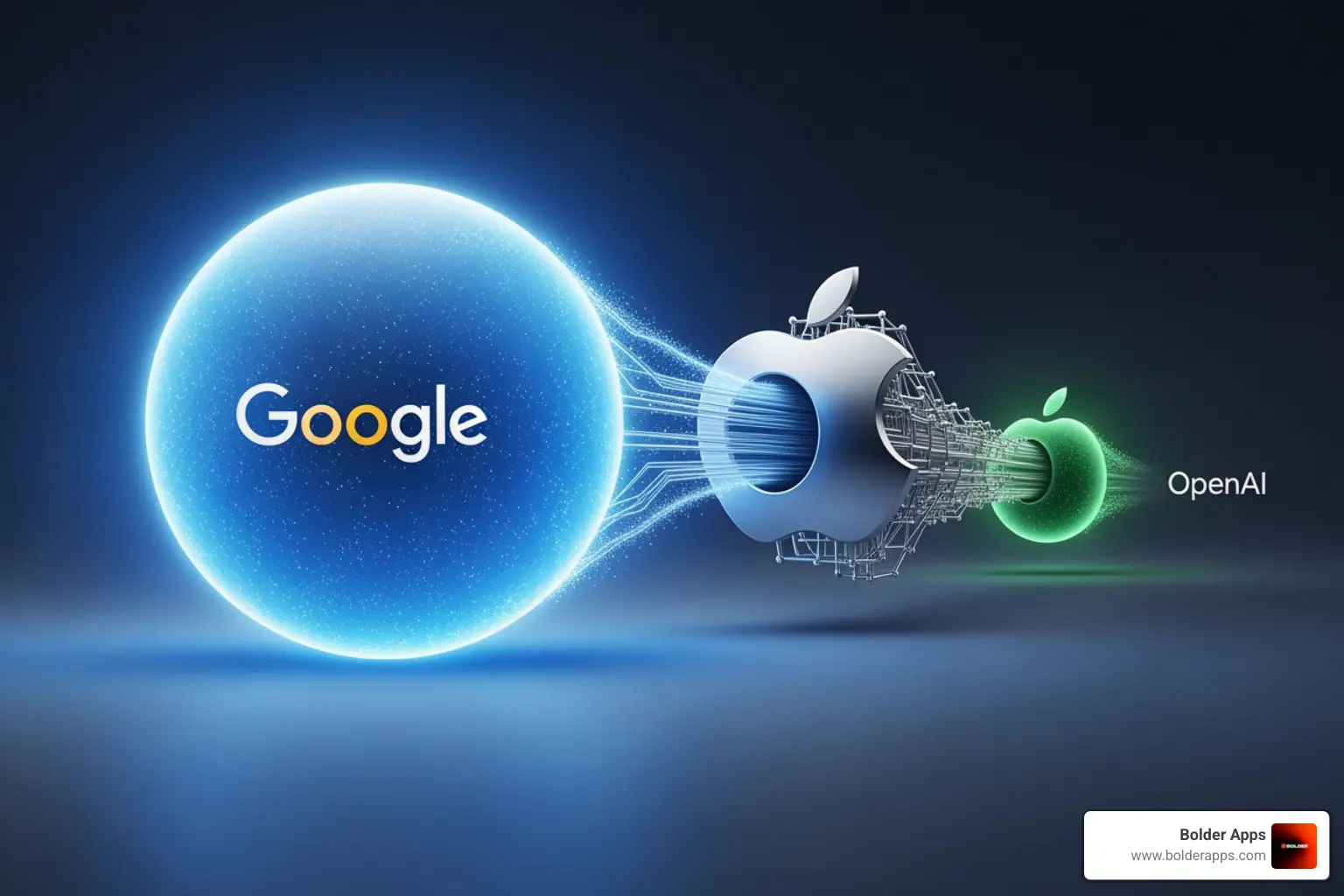
For Google, this partnership is a monumental victory. It solidifies Gemini's position as a leading AI model and provides an unparalleled distribution network by integrating it into billions of iPhones. This means Gemini isn't just powering Android devices; it's now the underlying intelligence for Apple's vast user base, effectively unifying the core AI logic across the two dominant mobile operating systems. This positions Gemini as a de facto industry standard for mobile AI.
The deal also provides a significant boost to Google Cloud. By channeling additional cloud workloads from Apple, Google Cloud can accelerate its growth and challenge its competitors. While Google Cloud currently holds about 13% of the cloud services market share, trailing Amazon's 30% and Microsoft's 20%, analysts predict this partnership could help Google Cloud move towards 15% to 20% in the coming years, potentially challenging Microsoft Azure for the No. 2 spot, and in time, even Amazon's AWS. This financial and strategic win is a testament to Google's "AI mojo back," as some analysts put it.
Furthermore, integrating Gemini into Apple's ecosystem helps Google fortify its search dominance. As conversational AI alternatives emerge, embedding Gemini directly into Siri ensures that Google's AI capabilities are front and center for a massive audience, reinforcing its position against potential disruptions. The market has reacted enthusiastically, with Alphabet's market capitalization surging past $4 trillion for the first time. Analysts are hailing Google as the "must-own AI play for the next decade," confident that this alliance accelerates Alphabet's ascent in the $1 trillion AI market. The company’s innovative strides, like the Gemini’s Visual Revolution: A Deep Dive Into The Google Maps Update That Puts AI In The Driver’s Seat, showcase Google's comprehensive AI integration across its product suite.
While a boon for Google, this pact presents significant challenges for OpenAI, marking a definitive shift in its role within the Apple ecosystem. The initial buzz around an "OpenAI Era" for Siri seems to have been short-lived.
Apple’s decision to use Google’s Gemini models for Siri shifts OpenAI into a more supporting role. As Parth Talsania, CEO of Equisights Research, noted, ChatGPT will likely remain "positioned for complex, opt-in queries rather than the default intelligence layer." This means that for everyday interactions and core AI functionalities within Apple devices, Gemini will be the brain. ChatGPT might still be accessible for users who specifically choose to invoke it for more specialized or creative tasks, but it won't be the ubiquitous, always-on intelligence.
This transition means OpenAI loses a major distribution channel. Apple's 1.5 billion iPhone users represent an enormous potential audience for any AI provider. By making Gemini the default, Apple effectively closes off a direct, built-in path for OpenAI to reach these users at a foundational level. This could significantly impact OpenAI's user growth and revenue scaling, especially if Gemini-powered Siri gains widespread adoption and positive user reviews. While OpenAI boasts more than 800 million weekly users, expanding that reach through Apple's ecosystem would have been invaluable.
Furthermore, OpenAI's own hardware ambitions, as evidenced by its acquisition of io Products and recruitment of former Apple hardware talent, put it on a collision course with Apple. This rivalry likely contributed to Apple's decision to partner with Google, choosing a partner rather than empowering a potential future competitor. The vision of From Chatbot to Operating System: OpenAI’s App Store Moment Is Finally Here might now find itself competing directly with Apple's fortified AI ecosystem, rather than seamlessly integrating with it.
So, what does this all mean for us, the users, and our beloved iPhones? Get ready for a Siri that's not just smarter, but genuinely helpful. The Gemini-powered Siri is ready to deliver a vastly different and improved user experience, moving beyond the simple command-and-response model we've grown accustomed to.

The new Siri, powered by Google's Gemini models, promises a suite of improved capabilities that will make our digital lives smoother and more intuitive. We can expect:
These advancements align perfectly with the broader trends in AI for 2026, where the focus is shifting from simple chatbots to sophisticated agents capable of complex tasks and deep contextual understanding. As we discussed in Forget Chatbots: Here’s What AI Is Actually Doing in 2026 - Top Trends, the future of AI is about intelligent automation, and a Gemini-powered Siri is at the forefront of this revolution.
One of Apple's core tenets is user privacy, and this partnership raises understandable questions about how our data will be handled when Google's AI is involved. However, Apple has been proactive in addressing these concerns. We expect Apple Intelligence features to continue running either directly on users' devices or within Apple's secure Private Cloud Compute network. This approach is designed to maintain Apple's industry-leading privacy standards, even when leveraging third-party AI models.
The strategy here is to use Gemini as the foundational intelligence while keeping user data within Apple's "trust boundary," as highlighted by GlobalData. This means that while Gemini provides the underlying power, Apple maintains control over the user experience and the flow of personal information. It's likely that users will be given clear opt-in choices for sharing prompts or data with Gemini, similar to how Apple handles other privacy-sensitive features. This ensures transparency and user control, allowing us to decide how much information we want to share with the AI.
For Apple, this partnership represents a careful balancing act: gaining access to cutting-edge AI capabilities without compromising its commitment to privacy. By partnering with Google, Apple can "compress time-to-market and reduce execution risk by leveraging mature, already-deployed technology," while also developing its own "Apple Foundation Models" that can run within its secure environment. This strategic move ensures that while the intelligence is powerful, the privacy remains paramount, a win-win for Apple and its users.
The Apple-Google Gemini pact sends ripple effects far beyond the two companies, fundamentally altering the AI ecosystem and drawing the keen attention of regulatory bodies worldwide. It's a testament to the sheer scale and influence of these tech giants that their collaboration can reshape an entire industry.
This partnership will undoubtedly have a profound impact on the broader AI industry. For AI startups, it could mean a more challenging landscape, as two of the biggest tech players now have a deeply integrated AI solution. However, it could also spur innovation, pushing smaller players to carve out niche specializations or develop truly groundbreaking technologies that even the giants can't easily replicate.
Microsoft, a key player in the AI race through its investments in OpenAI and its Azure cloud services, will also feel the pressure. The deal indirectly erodes Azure's edge in AI partnerships, as Google Cloud gains a significant new client and validates its AI infrastructure.
Looking ahead, this partnership has exciting product cycle consequences for future Apple devices. Imagine a HomePod with a truly intelligent, context-aware voice assistant that can manage your smart home, answer complex queries, and even anticipate your needs. For future devices like AR glasses and foldable iPhones, a powerful, deeply integrated AI will be crucial for delivering intuitive and seamless experiences. The improved AI capabilities provided by Gemini will be a cornerstone of these next-generation products, enabling features that were once the stuff of science fiction.
Apple's strategy of partnering for AI development aligns perfectly with its historical approach to adopting new technologies. As Creative Strategies analyst Carolina Milanesi noted, "For the people asking if the Apple-Google deal means there is no differentiation, think about it in F1 terms: multiple teams run the same engine, yet deliver vastly different results based on design and setup. Same here." This analogy perfectly encapsulates Apple's strength: taking powerful underlying technology and integrating it with superior design, user experience, and its tightly controlled ecosystem to create a unique product. This isn't just about plugging in Google's AI; it's about Apple leveraging that power to lift its own vision for devices and user interaction, further solidifying its "strategic moat" in native development, as explored in Swift 6: The Spatial Era - Why Native Apple Development Is a Strategic Moat in 2026.
Given the immense market power of both Apple and Google, this significant partnership is bound to attract intense scrutiny from regulatory bodies around the world. The DOJ in the United States, the EU, and the UK's CMA are all keenly watching the tech landscape, particularly when two "gatekeepers" (as designated by the EU’s Digital Markets Act) form such a crucial alliance.
The parallels to the Google search deal, where Google pays Apple billions to be the default search engine, are undeniable. That deal has been the subject of drawn-out antitrust lawsuits, with a federal district court judge ruling that Google could continue making such payments. However, legal experts like James Grimmelmann of Cornell Tech have noted that while the previous antitrust trial didn't block the search deal, this new AI partnership could lead to future antitrust concerns.
The core question for regulators will be whether this deal creates an unfair advantage or a "moat" that stifles competition in the burgeoning AI market. If Google, by powering Apple's AI, gains access to an unprecedented volume of user queries or data (even if anonymized), it could further entrench its dominance. Blake Reid of the University of Colorado Law School suggests the antitrust problem is less obvious if Google is only receiving money from Apple and not directly handling user data in a way that creates a moat. However, the specifics of how data flows, how the AI models are trained, and whether Apple maintains strict control over user data will be critical in determining regulatory reaction.
The EU’s Digital Markets Act (DMA) specifically designates both Apple and Google as “gatekeepers” subject to special obligations aimed at preventing anti-competitive practices. This means they are already under a microscope, and any deal that appears to limit consumer choice or entrench market power will be thoroughly investigated. The complex history of the Apple-Google search deal, as detailed in The complex history of the Apple-Google search deal, serves as a cautionary tale for both companies, suggesting that while this pact is strategically brilliant, it's not without its regulatory risks.
The End of the Siri-OpenAI Era? Everything You Need to Know About the Apple-Google Gemini Pact truly marks a paradigm shift in the AI landscape, moving us rapidly from basic voice assistants to sophisticated AI agents. This strategic alliance between Apple and Google isn't just a business deal; it's a bold declaration about the future of mobile technology and artificial intelligence.
For Apple, it's a pragmatic leap forward, ensuring Siri remains competitive and innovative without having to shoulder the entire burden of foundational AI development. For Google, it's a triumphant validation of its Gemini models and a massive expansion of its AI footprint across billions of devices. And for OpenAI, it's a clear signal that the competitive landscape is intensifying, pushing it to redefine its strategy and focus.
This partnership underscores the critical importance of strategic development partners in today's fast-evolving tech world. The future of AI integration in mobile apps is about seamless, intelligent, and personalized experiences that anticipate our needs and simplify our lives. To harness the power of next-generation AI in your own applications, it's crucial to partner with a team that blends strategic vision with deep technical expertise. We at Bolder Apps deliver high-impact mobile and web apps by combining US-based leadership with senior distributed engineers, ensuring your project benefits from a fixed-budget model and milestone-based payments without ever having a junior developer learn on your dime. Explore how we can bring your vision to life through expert custom software development.