
Shawn G
June 15, 2026
6
min. read
and updated on:
June 16, 2026

AI can ship an app that looks finished. Production exposes the 60% it skipped — security, data integrity, edge cases. Here's what 'done' actually takes.

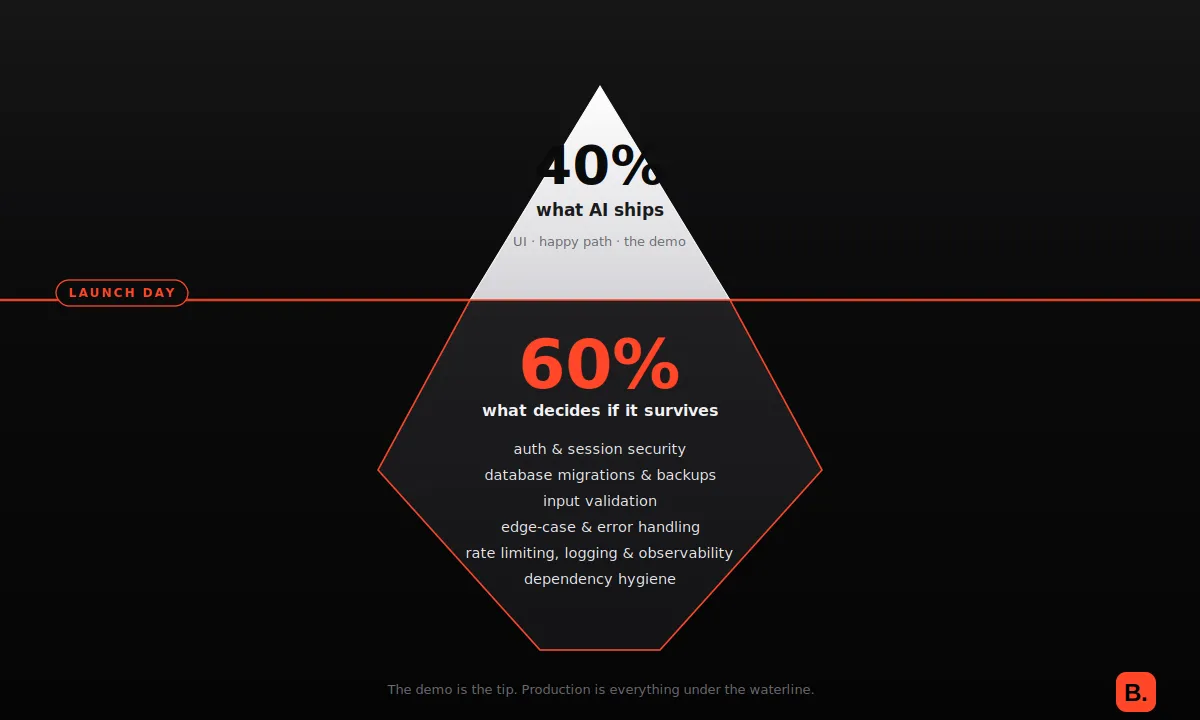
There's a pattern we've watched accelerate all year. A founder describes their idea to ChatGPT, Cursor, Lovable, or Bolt. Out comes a working-looking app. They demo it to friends, everyone says "this is incredible," and they move to launch.
Then production hits. The auth flow leaks tokens. The database has no migrations. An unhandled edge case takes down the checkout. The version that wowed everyone was a demo, not a product — and the gap between those two things is where most of the real engineering lives.
This isn't AI being bad at its job. It's AI doing exactly what it was asked: produce something that looks like the idea. What it doesn't do unprompted is the unglamorous part agencies have always owned — security fundamentals, data protection, edge-case handling, the boring 60% of a codebase that decides whether the app survives its first real Monday.
The productivity is real. So is the debt underneath it. Veracode's 2025 GenAI Code Security Report tested over 100 models across 80 coding tasks and found that 45% of AI-generated code samples introduced an OWASP Top 10 vulnerability — a failure rate that didn't improve across testing cycles from 2025 into early 2026. Georgia Tech's Vibe Security Radar project went further, tracking 35 CVEs in a single month directly attributable to AI coding tools, with the true count estimated at five to ten times higher across the open-source ecosystem.
The part that should worry any founder isn't the generation — it's the false confidence. The same research consistently finds developers trust AI output more than their own, and review it less. Even after QA, a 2026 Lightrun survey of senior SRE and DevOps leaders found 43% of AI-generated code changes still required manual debugging in production after passing QA and staging. The bugs don't disappear. They move downstream, to the most expensive place to find them.
If a Fortune 5 company with the best engineering talent on earth can't skip the 60%, neither can a seed-stage startup. In early March 2026, Amazon's retail site was hit by a series of outages its own internal documents linked to Gen-AI-assisted code changes. The worst, on March 5, caused a roughly 99% drop in orders across North American marketplaces — an estimated 6.3 million lost orders. A separate March 2 incident tied to its AI assistant caused 120,000 lost orders and 1.6 million website errors.
Amazon's fix is the whole lesson. They rolled out a 90-day "code safety reset" across 335 critical systems: mandatory two-person review before deployment, a formal documentation and approval process, and stricter automated checks. The most advanced engineering org in the world responded to AI-speed shipping by deliberately adding human review back in. That's not a coincidence. That's the 60% reasserting itself.
When we take on an AI-built app, the AI-generated portion is rarely the problem to throw away — it's the foundation to build on. The work that turns it into something you can charge money for and sleep through the night with is the part that was never in the prompt:
None of that demos well. All of it determines whether you have a business in ninety days.
The most common thing we hear from founders at this stage: "I thought AI let me skip hiring a team. I didn't realize I'd just moved the hard part to the end." That's the honest framing. AI compressed time-to-demo from months to a weekend — genuinely powerful — but the demo was always the easy 40%. The agency didn't get cheaper to skip. It got faster to need.
Before you launch, get the 60% audited. We run a fixed-scope code audit on AI-built apps that surfaces the security, data, and reliability gaps before your users do — and tells you exactly what stands between your demo and a product. It's the same review Amazon wishes it had run on March 4.