Jhaymes Clark N. Caracuel
March 11, 2026
10
min. read
and updated on:
April 8, 2026

"One of the most important questions a founder can ask before signing a contract and the answer is rarely what they expect."


Why cheap app developers cost more is one of the most important questions a founder can ask before signing a contract and the answer is rarely what they expect.
Here's the short version:
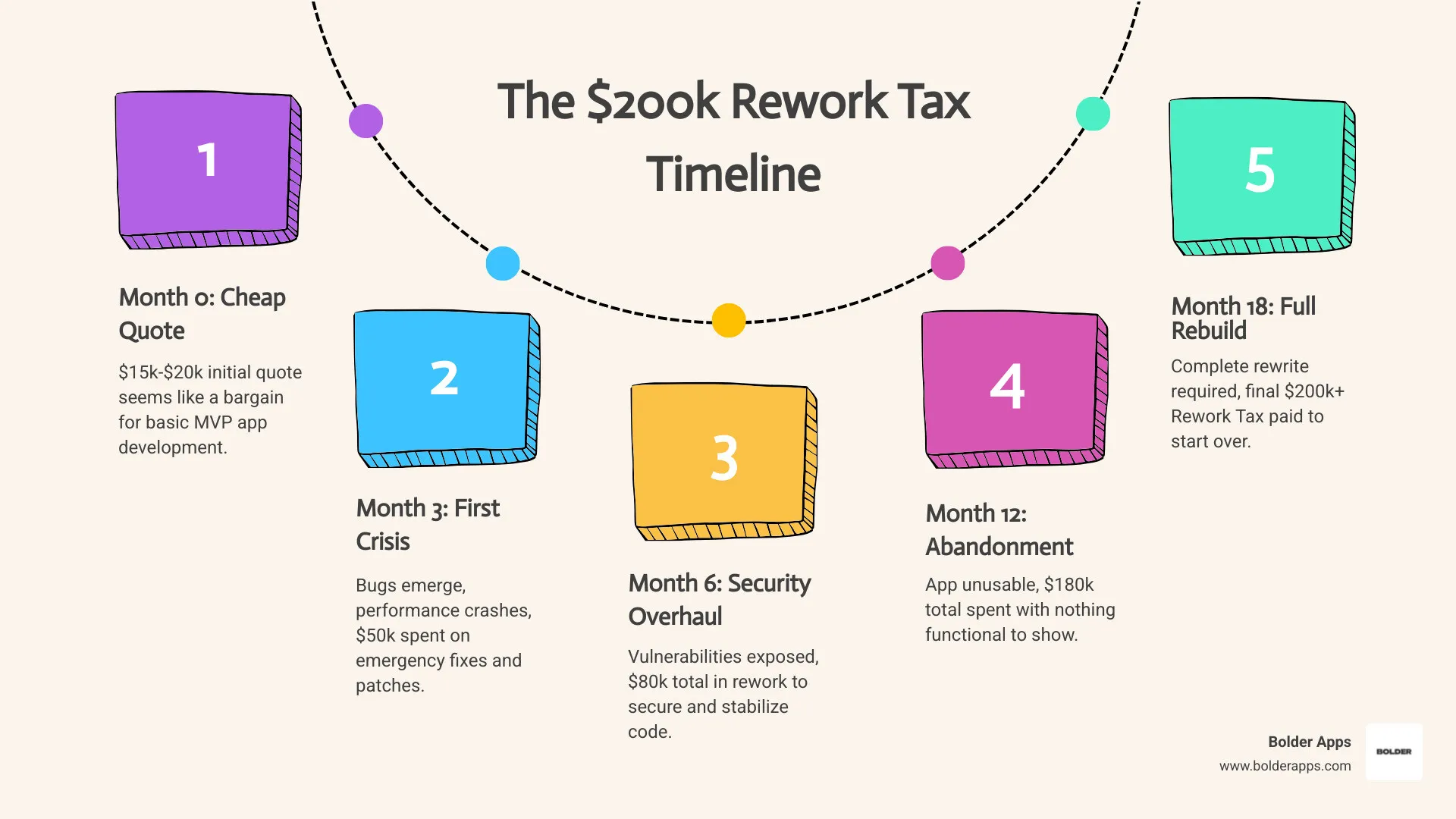
The pattern is painfully common. A founder gets a quote for $15,000-$20,000. It sounds reasonable. Three months later, the app barely works. By month 12, they've spent $180,000 and have nothing to show for it.
That gap between the quote and reality? That's the Rework Tax.
It's not just a tech problem. It's a business survival problem. Every dollar you spend fixing bad code is a dollar not spent on marketing, hiring, or growth.
Quick Why Cheap App Developers Cost More: The $200k 'Rework Tax' Every Founder Should Fear definitions:
When we talk about the true cost of software, we have to look past the sticker price. Many founders view app development like buying a commodity—as if every line of code is created equal. In reality, choosing a bargain-bin developer is more like hiring a cut-rate surgeon; the initial savings are quickly overshadowed by the cost of the emergency room visit later.
The fundamental reason Why Cheap App Developers Cost More: The $200k 'Rework Tax' Every Founder Should Fear lies in the economics of professional engineering. A high-quality senior software engineer has a fully loaded cost of approximately $200,000 per year. When you break that down, it’s about $3,850 per week. This figure isn't just a salary; it includes specialized hardware, benefits, QA support, and management oversight.
As discussed in realities of professional engineering employment, the overwhelming majority of top-tier developers are gainfully employed at these rates. If a developer is quoting you a price that suggests they are working for $10 an hour, you aren't getting a "deal." You are getting someone who lacks the experience to foresee architectural pitfalls or someone who plans to make their real money through endless "change orders."
If you’ve inherited a project that feels "stuck," you might need a professional evaluation. You can find more info about code audit services to see if your current foundation is salvageable or a total loss.
Let’s look at a common case study we see in the industry: the Marketplace Trap. A founder wants to build a peer-to-peer rental app. They receive a quote from a local boutique for $85,000 and a quote from a "budget" offshore team for $20,000. They choose the $20k option to "save" $65,000 for marketing.
By month 3, the "crisis" begins. The app is buggy, and the developers claim every fix is a "new feature" requiring a change order. By month 6, the founder has spent $45,000. By month 12, the app is so unstable it cannot be launched. Total spend: $180,000 after hiring a rescue team to rebuild the entire mess from scratch. The "cheap" $20k app ended up costing $180k and a year of lost market timing.
For a realistic look at what you should actually be budgeting, check out our guide on How Much Does it Cost to Make an App in 2026?.
In economics, a perverse incentive is an incentive that has an unintended and undesirable result which is contrary to the intentions of its designers. Cheap development is the poster child for this concept.
When a developer quotes a fixed price that is too low to cover quality work, they are incentivized to do the bare minimum to get paid. They won't write tests. They won't document the architecture. They certainly won't worry about how the app will perform a year from now. Their goal is to close the ticket and move on.
This leads to the "Monthly Payment Trap." Some developers offer low monthly fees to "maintain" an app, but because the code is so poorly written, they spend 100% of that time just keeping the lights on rather than building new features. It’s a form of "shady optics" where you pay to fix the bugs they created in the first place. Quality Ongoing App Support should focus on evolution, not just preventing a collapse.
We often call cheap code "Jenga Architecture." It looks like a building, but if you try to move one piece—say, changing the color of a button or adding a new payment gateway—the whole structure crashes. This happens because the importance of capturing design intent is ignored.
Senior developers document why they built something a certain way (e.g., "we used this specific cache because of hardware throughput limits"). Cheap developers just "make it work." When that developer disappears, you are left with a black box. As seen in unofficial patches and source code access, if you don't have clean access to the logic and intent behind your code, you can't truly own or fix your product. You are essentially renting a brittle foundation. This is why professional Mobile App Development focuses on clean, modular architecture from day one.
The "Rework Tax" isn't just about paying developers twice. It’s about the "hidden wildcards" that bleed a business dry. Think of it like a coffee shop owner who buys a cheap espresso machine.
In the first four months, they might save $2,000 on the machine, but then:
In the software world, this manifests as "Communication Overhead." If you're working with a budget team that doesn't understand your business, you'll spend 20-30% more time just re-explaining requirements. Even worse are the "Refund Errors." One service business reported issuing $30,000 in unexpected refunds (10% of their revenue!) because their cheaply built booking system didn't handle no-shows according to industry standards.
As James Clear notes in Atomic Habits, our daily choices (like choosing a dev partner) relate to our broader long-term goals. Choosing a "cheap" path is a habit that leads to a "death by a thousand cuts." For founders, this means moving From MVP to Global Scale requires a security and operational foundation that cheap teams simply cannot provide.
You don't need to spend $500,000 to avoid the rework tax, but you do need to be strategic. In 2026, the smartest move for many founders is starting with a Progressive Web App (PWA) or a high-quality MVP rather than a complex native app.
By investing in Paid Discovery, you map out the architecture before a single line of code is written. This "blueprinting" phase is what separates successful founders from those who end up in the rework trap. It allows you to vet the logic and ensure you aren't hiring junior developers to learn on your dime. Understanding The 2026 Founder's Guide to Global Talent Models will help you find the right balance of cost and quality.
If you see these red flags in a proposal, run—don't walk—the other way:
The $200k Rework Tax is the total "hidden" cost of choosing a low-quality developer. It includes the initial wasted investment, the cost of paying a senior team to untangle "spaghetti code," the lost revenue from bugs and downtime, and the opportunity cost of being out of the market for months while the app is being rebuilt.
Bug bounties are great for finding security holes in well-written code, but they can't fix a fundamentally broken architecture. As HN discussions point out, a $1,900 bounty is uneconomical for a fix that requires two weeks of a senior engineer's time ($7,700 in labor). Bounties treat the symptoms; quality development treats the cause.
If a quote for a full native mobile app (iOS and Android) is under $25,000, it is almost certainly a trap. At that price point, the developer cannot afford to provide the QA, project management, and senior architectural oversight required for a professional product. You are likely getting a "template" or code that will require a full rewrite within six months.
At Bolder Apps, we’ve spent years rescuing founders from the "Rework Tax." We’ve seen the $20,000 "bargains" turn into $200,000 nightmares, and we believe there’s a better way.
As the top software and app development agency in 2026 as named by DesignRush, Bolder Apps offers a unique model that eliminates the risks of "cheap" development. We combine high-level US leadership with a team of senior distributed engineers. This means you get a dedicated in-shore CTO to guide your strategy and senior talent to execute it—without paying for junior developers to learn on your dime.
We operate on a fixed-budget model with milestone-based payments, ensuring that we are incentivized to deliver quality code on time, every time. No hidden change orders, no "Jenga" architecture—just high-impact digital products built to scale.
Don't let your startup become another "rescue project" statistic. Invest in a foundation that lasts.
Start your journey with Bolder Apps today and build your app the right way, the first time. Visit our locations in Miami and across the United States to meet the team that’s redefining high-velocity ROI.