Sean Weldon
June 16, 2026
10
min. read
and updated on:
June 17, 2026



Agile custom software development is an iterative approach to building custom software solutions that prioritizes flexibility, continuous feedback, and rapid delivery over rigid, long-term planning. Unlike traditional waterfall methods, Agile breaks projects into short cycles (sprints), allowing teams to adapt to changing requirements while delivering working software frequently.
Key characteristics of Agile custom software development:
Picture this: You're sitting in a coffee shop, sketching your software idea on a napkin. It's innovative, disruptive, and you know it has potential. But here's the reality check—detailed, long-term plans for major custom software projects are never correct.
As software engineers and business leaders have learned the hard way, locking in every decision at the start of a long journey leads to costly modifications and failed projects. The traditional waterfall approach achieves only a 49% success rate, while Agile methodologies hit 64%—and that's just the beginning.
The difference isn't just about process. It's about philosophy.
Agile treats software development like planning a cross-country road trip. You know your destination and major stops, but you stay flexible about the details. You adapt when you find a better route. You pivot when conditions change. This mindset—prioritizing individuals and interactions, working software, customer collaboration, and responding to change—transforms how teams build custom solutions.
Around 71% of companies now use some form of Agile methodology, and 98% report seeing tangible benefits. Teams using Agile are 25% more productive and deliver software with 250% improved quality compared to traditional approaches. Even more striking: Agile can result in a 60% increase in revenue and delivers projects with only a 9% failure rate in profitability.
But Agile isn't just a buzzword or a trendy framework. It's your competitive advantage in a digital economy where change is the only constant.
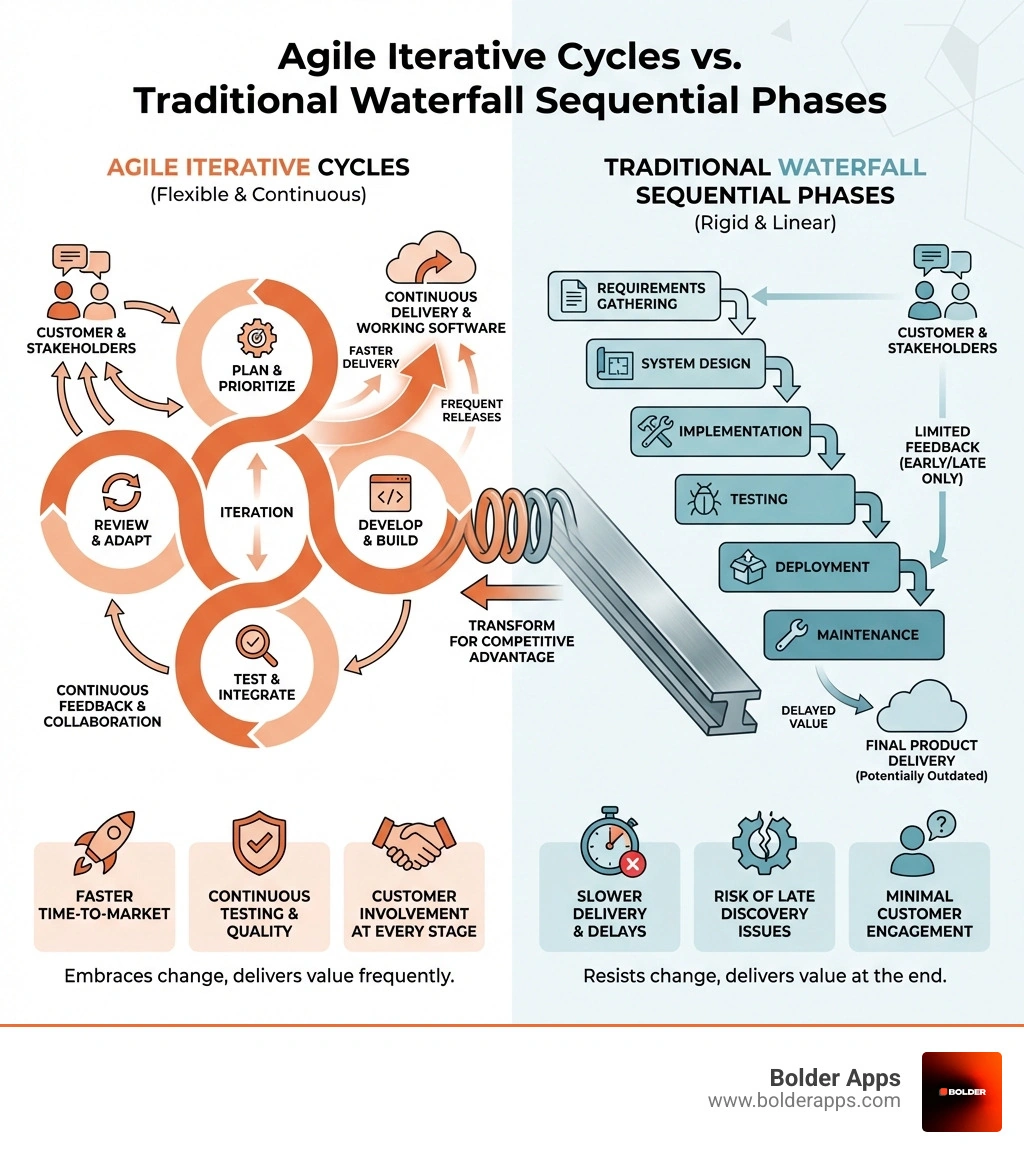
When we talk about software development, two major methodologies often come to mind: Agile and traditional approaches like Waterfall. Understanding their fundamental differences is crucial for any business starting on a custom software project. The traditional Waterfall model, first introduced in the 1970s, follows a linear, sequential process where each phase—requirements gathering, design, implementation, testing, deployment, and maintenance—must be completed before the next one begins. It's akin to building a house with a complete blueprint upfront; every detail is planned, and changes are costly and difficult once construction has begun. This rigidity, while offering clear structure and comprehensive documentation, often struggles with the inherent unpredictability of software development.
Agile, on the other hand, is both a philosophy and a work methodology, formalized in 2001 by a group of seventeen software practitioners in the "Agile Manifesto" at Snowbird, Utah. It accepts flexibility, adaptive planning, and continuous delivery. Instead of a single, long sequence, Agile breaks the project into small, manageable units called iterations or sprints. This iterative development allows for constant customer feedback, enabling us to adapt quickly to market changes and evolving requirements. The focus shifts from extensive upfront documentation to delivering functional software frequently, fostering a dynamic and responsive development environment.
For more information on how we approach custom software solutions, explore our Custom Software Development services.
At the heart of Agile custom software development lies the Agile Manifesto, a declaration of values and principles that guide the entire process. These values represent a shift in thinking from traditional, document-heavy approaches to a more human-centric and adaptive one.
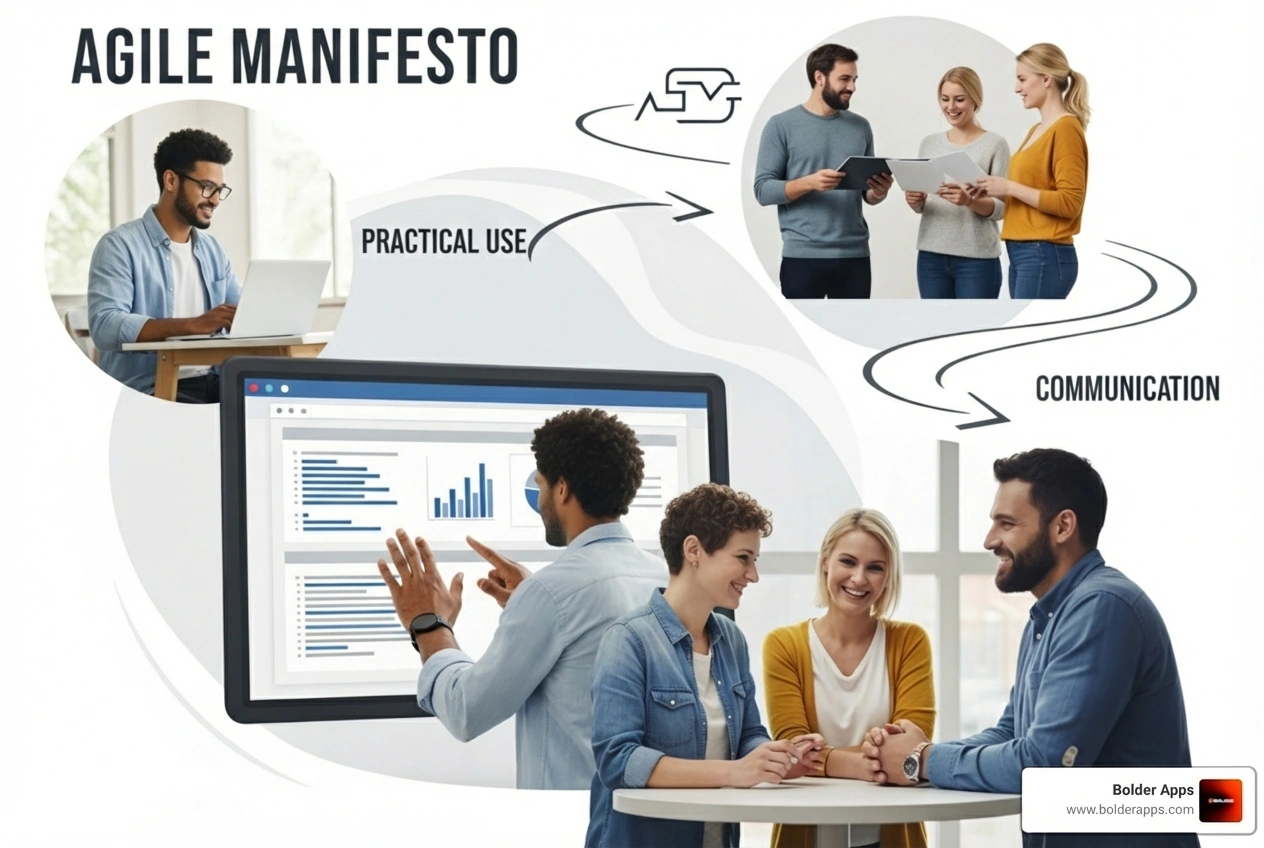
The four core values are:
These values are supported by twelve guiding principles that provide a framework for action. They emphasize customer satisfaction through early and continuous delivery, welcoming changing requirements, frequent delivery of working software, and close daily collaboration between business people and developers. They also highlight the importance of building projects around motivated individuals, fostering face-to-face conversation, promoting sustainable development, and continuously paying attention to technical excellence and good design. Simplicity, self-organizing teams, and regular reflection on how to improve are also key. You can read the full declaration at The official Agile Manifesto.
Choosing between Agile and traditional methodologies like Waterfall is a strategic decision that depends on the unique characteristics of your custom software project. We find that Agile custom software development is particularly well-suited for projects with:
Conversely, Waterfall might be considered for small, simple projects with exceptionally clear, stable, and unchanging requirements, or in highly regulated industries where extensive upfront documentation and rigid sequential processes are mandated. However, even in regulated domains, Agile methods are being adapted by focusing on robust quality assurance, safety, security, traceability, and verification/validation processes. The choice hinges on project dynamics, desired customer involvement, and organizational culture.
Adopting Agile custom software development isn't just a process choice; it's a strategic advantage that delivers tangible benefits across various aspects of your project and business. The statistics speak for themselves: companies using Agile achieve an impressive 64% success rate per project, significantly outperforming the 49% success rate of traditional Waterfall methods. This success translates directly into improved business outcomes.
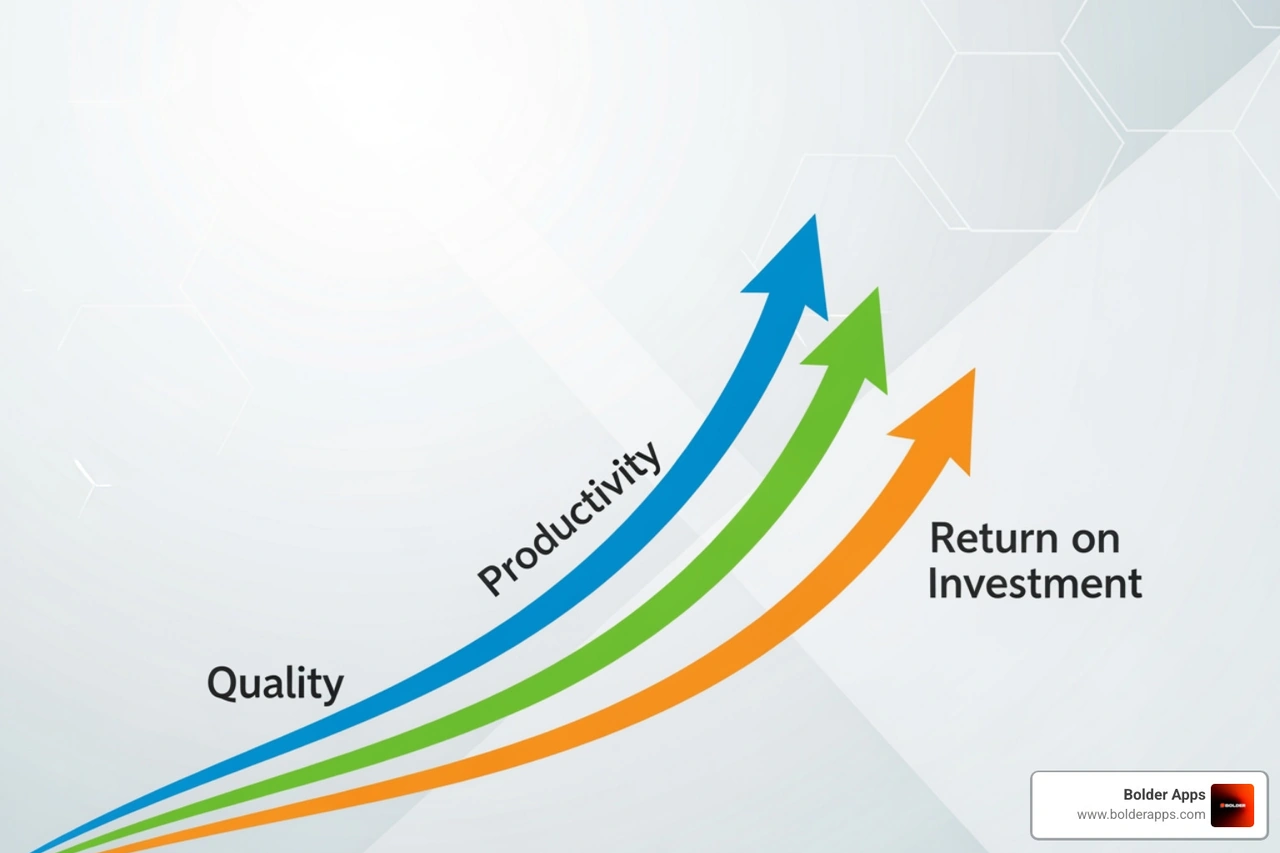
Here's how Agile becomes your secret weapon:
The synergy between quality and speed in Agile custom software development stems from its core mechanisms: iterative development and continuous feedback loops. Instead of a single, lengthy development cycle, Agile projects are segmented into short sprints, typically one to four weeks. At the end of each sprint, we aim to deliver a piece of working, tested software.
This incremental delivery model means that testing isn't relegated to a single, late-stage phase. Instead, continuous testing and evaluation are integrated into every iteration. This allows us to detect bugs and identify expectation mismatches early, when they are far less costly and complex to fix. Product owners and stakeholders provide feedback on these functional increments, and that feedback is immediately incorporated into subsequent sprints. This rapid adaptation ensures the software continuously evolves in the right direction, aligning perfectly with client needs and market demands.
Our approach to Software Architecture Design also plays a critical role here, ensuring that the foundational elements of your custom software are robust and flexible enough to support continuous iteration and evolution. The ability to quickly adjust to new settings and last-minute changes is a key component, allowing us to reevaluate strategies and priorities in light of changed objectives. Teams using continuous metrics reviews have even improved delivery performance by 25%.
Beyond the technical advantages, Agile custom software development profoundly impacts the human element of project delivery: our teams. Agile principles advocate for building projects around motivated individuals, giving them the environment and support they need, and trusting them to get the job done. This philosophy cultivates self-organizing and self-managing teams who take collective responsibility for their duties and work collaboratively to overcome problems.
This empowerment fosters a culture of innovation. Developers propose creative solutions and experiment, knowing that the iterative process allows for learning and adaptation. With more freedom and control over their decisions, team members experience higher morale, leading to increased creativity, innovation, and a stronger sense of ownership and pride in their work. Generative team cultures, often found in Agile environments, have been shown to outperform peers by 30% on key delivery metrics.
We believe that a well-structured and empowered team is the backbone of successful software. Our insights on building a Mobile App Development Team further elaborate on how we foster such environments. This approach not only reduces burnout by distributing responsibility but also encourages personal and team growth through continuous learning and shared experiences, ultimately leading to more robust and creative custom software solutions.
To put the Agile philosophy into practice, we use specific frameworks and processes that structure our Agile custom software development. These frameworks provide concrete guidelines for team collaboration, task management, and iterative delivery, ensuring that the principles of the Agile Manifesto are upheld in daily operations.
Key elements common to most Agile frameworks include:
Two of the most popular and effective Agile frameworks we leverage for Agile custom software development are Scrum and Kanban.
Scrum is a framework that enables teams to self-organize and work towards a common goal through short, iterative cycles called sprints. It describes a set of meetings, tools, and roles for efficient project execution. Think of it like a sports team training for a big game, where practices enable teams to self-manage, learn from experience, and adapt to change.
Kanban is a method for designing, managing, and improving workflow systems. It focuses on visualizing tasks and limiting work-in-progress (WIP) to optimize flow and efficiency. Work items are visually represented on a Kanban board, enabling team members to know the status of each item at all times. This approach balances demands with available capacity, improving bottleneck handling and promoting continuous flow. Kanban is particularly effective for maintenance projects or workflows where continuous delivery of small features is preferred.
Our Agile custom software development process is designed to be transparent, collaborative, and adaptable, ensuring your project evolves effectively from conception to launch. While Agile is iterative, there are distinct stages we steer to deliver successful custom software:
This iterative process ensures that we are constantly building, learning, and adapting, leading to a highly refined and valuable custom software solution. For a broader understanding of how these stages apply to mobile applications, you might find our guide on the Mobile App Development Process in 2026 insightful.
The future of Agile custom software development is undeniably intertwined with DevOps. These two methodologies, while distinct, are powerful complements, creating a seamless and efficient software delivery pipeline. Agile focuses on iterative development, collaboration, and rapid response to change at the planning and development stages. DevOps extends these principles into the operational field, emphasizing automation, continuous integration/continuous delivery (CI/CD), and close collaboration between development and operations teams.
The goal is simple: speed without stability is risky, and stability without speed is uncompetitive. Agile frameworks help us rapidly validate ideas, while DevOps practices ensure these ideas move safely and quickly through build, test, and deployment pipelines. This convergence leads to reduced time to market and improved delivery outcomes. Statistics show that 84% of companies now use at least one DevOps practice, a significant jump from 63% in 2018. Organizations implementing DevOps automation have achieved a staggering 312% ROI and $1.8 million NPV in just three years, with payback in under six months. The global DevOps market is projected to grow from $10.4 billion in 2023 to $25.5 billion by 2028, highlighting its strategic importance.
Looking ahead to 2026 and beyond, we anticipate even tighter coupling between sprint planning and CI/CD systems, leveraging AI-powered test generation, self-healing pipelines, and auto-scaled observability tools. Culture, characterized by high trust and clear alignment around shared goals, will become the ultimate differentiator in software delivery. This continuous feedback loop and automation are crucial for custom software that needs to adapt and thrive in a digital economy.
While Agile custom software development offers immense benefits, its implementation isn't without problems. We've seen common challenges arise, but with proactive strategies, they can be effectively overcome:
Addressing these challenges requires commitment, open communication, and a willingness to continuously inspect and adapt our processes, ensuring that our Enterprise App Development Solutions truly embody the spirit of Agile.
In Agile custom software development, budgets and timelines are managed differently than in traditional models. Rather than fixing scope and then estimating time and cost (which often leads to overruns), Agile often fixes time (sprint duration) and quality, allowing the scope to be variable and prioritized. This means we work within agreed-upon sprint durations and budgets, delivering the most valuable features first. Project predictability actually improves due to shorter software project cycles, making it easier to monitor team performance, allocate resources, and anticipate expenses more accurately. We continuously refine estimates based on real progress, providing greater transparency and control.
Absolutely! While Agile originated in smaller teams, it has evolved to be highly effective for large, complex enterprise projects. Frameworks like Scaled Agile Framework (SAFe) or Large-Scale Scrum (LeSS) provide structures for applying Agile principles across multiple teams and departments. The key is adapting the core Agile tenets—iterative development, continuous feedback, and cross-functional collaboration—to the enterprise scale. While challenges like organizational impediments and resistance to change can arise in larger organizations, with proper planning, training, and leadership support, Agile can drive significant success in enterprise environments, fostering innovation and improved delivery outcomes.
The client's role in an Agile custom software development project is paramount and highly collaborative. Unlike traditional models where clients might only engage at the beginning and end, Agile requires continuous involvement. Clients, often represented by a Product Owner, actively participate in:
This active partnership ensures that the software being built truly meets the client's needs and delivers maximum business value, making customer satisfaction the highest priority.
At Bolder Apps, we don't just build custom software; we craft digital solutions that drive your business forward. We leverage the power of Agile custom software development to ensure your project is not only delivered efficiently but is also perfectly aligned with your evolving vision and market demands.
Our unique approach combines the strategic insights of in-shore CTO leadership with the exceptional talent of our senior distributed engineers. This means you benefit from top-tier strategic guidance right here in the United States, without paying for junior developers to learn on your dime. We ensure every line of code is written with expertise and precision, creating high-impact mobile and web applications custom to your exact needs.
We understand that budget and transparency are crucial. That's why we offer a fixed-budget model and milestone-based payments, giving you financial predictability and peace of mind. Your investment is tied to tangible progress, ensuring accountability and efficient project completion. Partner with Bolder Apps for strategic product creation that delivers intuitive, data-driven, and high-performing custom software.
Ready to transform your business with Agile custom software development? Partner with Bolder Apps for a seamless, efficient, and innovative journey—where your vision meets our expertise, and every milestone brings you closer to success. Let's build your next high-impact app together! Build your next high-impact app with us.
Agile custom software development is the practice of building software tailored specifically to a business's needs using short, iterative development cycles called sprints. Unlike traditional waterfall development, agile teams deliver working software every two weeks and continuously incorporate stakeholder feedback, allowing requirements to evolve as the project progresses.
Waterfall development requires all requirements to be defined upfront, with the finished product delivered at the end of a long development cycle — often six months or more. Agile development breaks the project into short sprints, delivering working software incrementally and allowing teams to adjust direction based on real feedback throughout the process.
Custom software solves unique business problems, which means requirements are rarely fully understood at the start. Agile is better suited for this because it builds in flexibility — teams can respond to what they learn once real users interact with real software, reducing the risk of delivering a product that misses the mark.
Look for concrete evidence of agile practices rather than just the buzzword. A genuinely agile development partner will commit to regular sprint deliveries, schedule frequent demos of working software, involve stakeholders in ongoing feedback sessions, and demonstrate a clear process for handling changing requirements mid-project.
Most agile sprints last one to two weeks, though some teams use three-week cycles depending on project complexity. At the end of each sprint, the team delivers a working, testable increment of the software — giving stakeholders regular visibility into progress and opportunities to provide feedback before the next cycle begins.