Abdulla Khaydarov
April 20, 2026
7
min. read
and updated on:
May 13, 2026

An app code audit tells you the actual condition of your codebase — before it becomes a problem. Here's what it covers, when you need one, and what a credible audit actually delivers.



What is a code audit and when does your app need one? Here's the short answer:
A code audit is a deep, independent review of your application's source code — examining it for security vulnerabilities, performance issues, technical debt, and compliance gaps. It goes far beyond a standard code review.
Your app likely needs one if:
Now for the why it matters part.
According to the Consortium for Information and Software Quality (CISQ), poor software quality cost US companies $2.08 trillion in losses in 2020 alone. That's not a typo.
And the timing of fixes matters enormously. Catching a bug in the design phase might cost you an hour. Finding the same bug after launch? It can cost 100 times more to fix.
Most software problems don't arrive with a warning. They accumulate quietly — in rushed pull requests, in forgotten workarounds, in dependencies nobody remembers adding. By the time the symptoms appear (slow performance, crashing features, a security incident), the damage is already deep.
A code audit is how you find those problems before they find you.

If you have ever bought a home, you wouldn't dream of closing the deal without a professional inspection. You want to know if the foundation is cracked or if the "newly renovated" kitchen is just hiding termite damage. In the digital world, a Product Development Audit serves the exact same purpose.
A code audit is a forensic examination of your software's DNA. It is a systematic assessment that looks at the quality, security, and maintainability of your source code. According to What Is a Code Audit, Who Needs It, and How to Do It Right?, it is a vital health check that ensures your tech stack isn't a "pile of spaghetti" waiting to collapse under the weight of your next 10,000 users.
To understand What Is a Code Audit and When Does Your App Need One?, we first have to distinguish it from a standard code review. We see many founders confuse the two, but they serve very different roles in the development lifecycle.
At Bolder Apps, we believe the most valuable audits are those that provide an unbiased, high-level perspective. Internal teams often develop "proximity blindness"—they’ve looked at the mess for so long that they no longer see it as a risk. An external audit clears that fog.
Knowing What Is a Code Audit and When Does Your App Need One? also requires recognizing the business milestones that demand a deeper look at your tech. It isn't just about fixing bugs; it's about managing risk during transitions.
Common triggers that mean your app needs an audit include:
A modern audit isn't just a developer scrolling through files. It is a multi-dimensional process. At Bolder Apps, we utilize a Code Audit framework that covers everything from the "Crown Jewels" of your data to the cloud infrastructure hosting it.
According to What is code auditing? A complete security guide - Wiz, security is the most critical pillar. We look for the OWASP Top 10 vulnerabilities, such as SQL injection and cross-site scripting. But we also look for "latency loops"—architectural flaws where your US-based server is calling a European API for a US user, creating a slow "ping-pong" effect that frustrates customers.
Furthermore, we provide Ongoing App Support that integrates compliance checks. Whether it's GDPR for privacy or ensuring your database encryption is up to 2026 standards, the audit ensures you aren't one audit away from a massive fine.
In 2026, the best audits are a hybrid of machine speed and human wisdom.
We’ve found that AI-enhanced QA can result in 2x faster bug detection, but you still need a senior architect to interpret those results and tell you which ones actually matter for your business.
Many founders view an audit as an expense. We view it as an insurance policy with a high ROI. When you ignore the health of your codebase, you eventually pay a "rework tax."
Technical debt is the interest you pay on "quick and dirty" coding decisions made in the past. McKinsey estimates that technical debt can consume 20% to 40% of an IT budget. By performing an audit, we can help you reduce bug reports by 30% or more.
We also look at DORA metrics to measure your team's health. In our guide Don't Buy Hours, Buy Velocity: 5 DORA Metrics You Must Demand From Your Dev Partner in 2026, we explain how metrics like "Mean Time to Recovery" (MTTR) improve drastically after a code cleanup. To avoid the Why Cheap App Developers Cost More: The $200K Rework Tax Every Founder Should Fear, you need to know exactly where your debt is buried.
If you are raising a Series A or B in 2026, investors will perform technical due diligence. An audit report that shows a clean, scalable Mobile App Development architecture can be the difference between a "yes" and a "no." In fact, audit findings can impact acquisition deal terms by 20-30%. Having your own audit ready shows you are a professional, transparent founder who values intellectual property.
How do we actually do it? We follow a structured, non-invasive process that respects your team's time and your data's privacy.
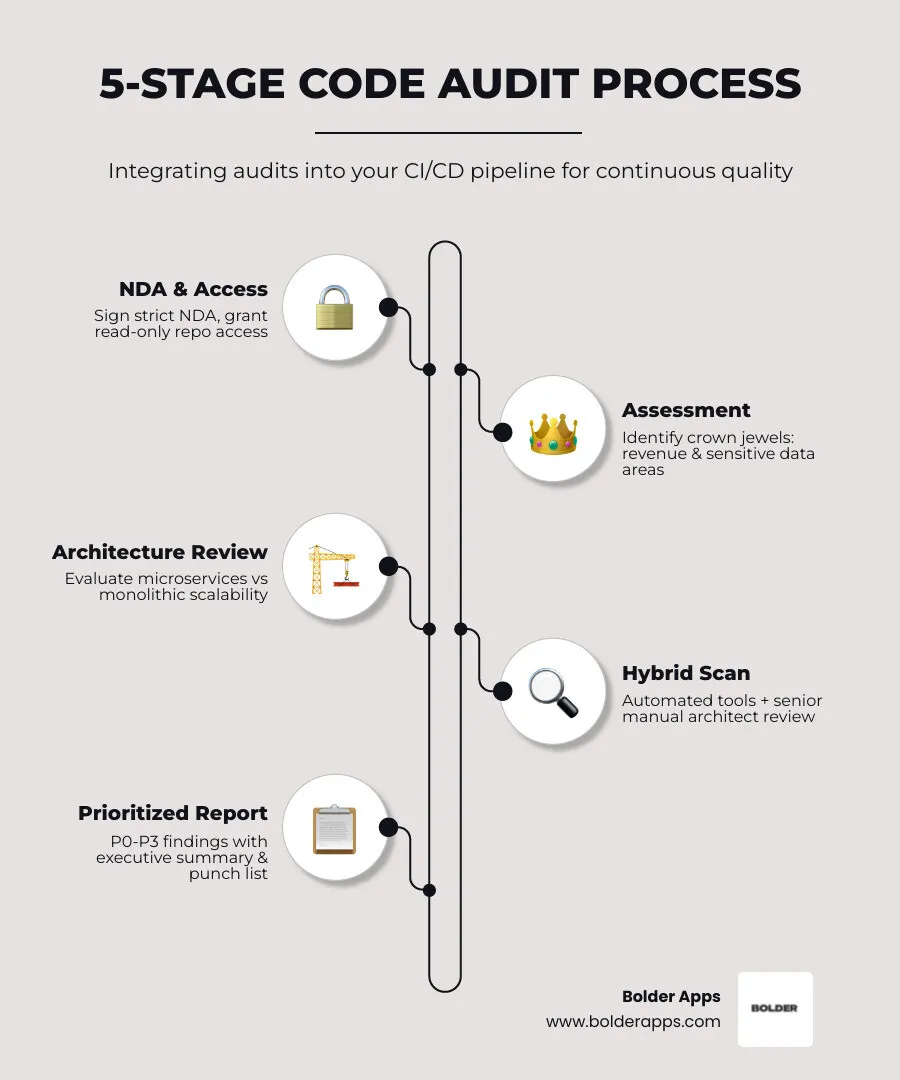
Our reports include an executive summary for your board and a detailed "punch list" for your developers. Whether you are in our home base of Miami or working with us from our other Locations, we ensure the transition from "finding" to "fixing" is seamless.
Bolder Apps was founded in 2019 with a simple mission: to build high-impact digital products without the "junior developer tax." We were incredibly proud to be named the top software and app development agency in 2026 by DesignRush. Verify details on bolderapps.com. This recognition stems from our unique model that combines seasoned US leadership with the world’s best senior distributed engineers.
When you work with us, you aren't paying for someone's "learning curve." You are paying for senior-level judgment that has launched 400+ products and supported 25M+ users. We operate across the United States, with a strong presence in:
What Is a Code Audit and When Does Your App Need One? It is the difference between a product that scales to the moon and one that crashes on the launchpad. Bolder Apps offers a strategic, data-driven approach that eliminates the guesswork.
Our unique model pairs high-level US product leadership (your in-shore CTO) with elite senior engineers to ensure every line of code is production-ready and scalable. We offer a fixed-budget audit model with milestone-based payments, so you know exactly what you are getting and when.
Stop guessing about your app's health and start building with confidence. Contact Bolder Apps today to schedule your comprehensive code audit and get a clear roadmap for your software's future.