April 15, 2026

What Your App Development Proposal Should Include (And Red Flags to Watch For)

How an agency structures their proposal tells you almost everything about how they'll run your project. Here's what a credible proposal includes — and the red flags that should make you pause.

Author Image
Abdulla Khaydarov
and updated on:
May 11, 2026
Author Image
Reviewed by:
Andrew Abbey
Blog Image

Why Understanding What Your App Development Proposal Should Include (And Red Flags to Watch For) Can Make or Break Your Project

app development proposal document on desk

What your app development proposal should include (and red flags to watch for) is one of the most important things to understand before you sign a single contract or wire a single dollar.

Here's the quick answer:

A strong app development proposal must include:

  • A clear executive summary tied to your business goals
  • A detailed scope of work with specific features and user stories
  • A realistic timeline (MVP in 2-4 months is standard; 12+ months is a red flag)
  • A transparent, itemized cost breakdown — not just "design + coding"
  • The proposed tech stack and why it was chosen
  • Team structure, including seniority levels
  • Risk management, assumptions, and post-launch support
  • IP ownership — you should own 100% of your code

Major red flags to watch for:

  • Proposal arrives within 24-48 hours of your first call
  • Vague or single-line pricing with no breakdown
  • No mention of MVP, discovery phase, or milestones
  • You can't see the team or access the code repository
  • MVP timeline quoted at 12 months or more

Most founders only realize a proposal was weak after the project goes sideways. By then, the budget is blown and the launch date is a memory.

The proposal isn't just paperwork. It's the first real test of how a development partner thinks, plans, and communicates. A vendor who can't write a clear proposal almost certainly can't build a clear product.

One insight worth internalizing: the time a vendor takes to craft their proposal directly reflects how they'll manage your project. A proposal that lands in your inbox the morning after a first call is almost always built on assumptions — not on a genuine understanding of your business problem.

The stakes are real. Outsourcing done right can reduce software costs by up to 40% and speed delivery by nearly 50%. Done wrong, it can cost you far more in rework, delays, and lost market opportunity than you ever saved.

This guide breaks down everything a proposal should contain, what separates a green flag from a red one, and what questions to ask before you commit.
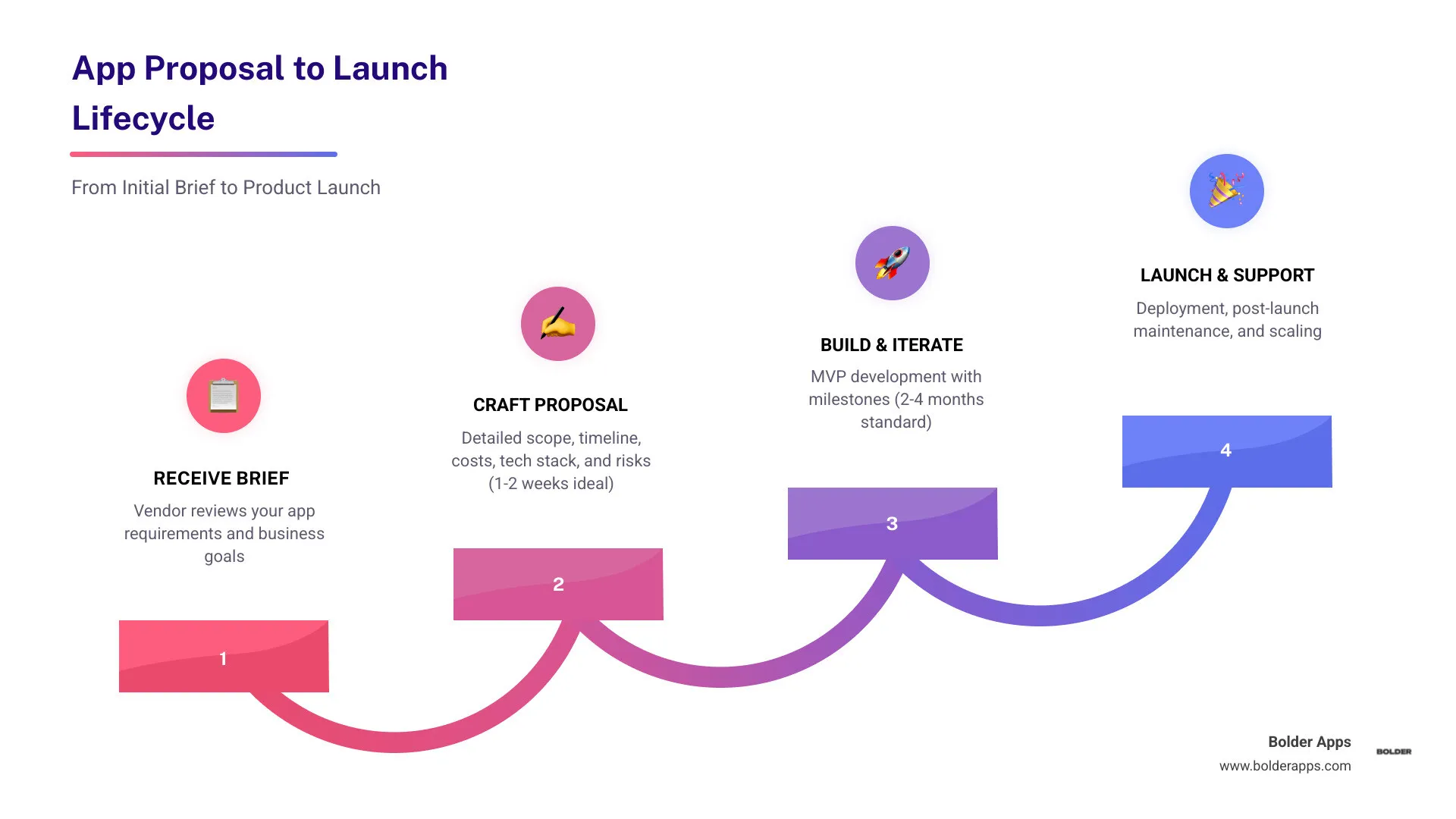
App development proposal lifecycle from brief to launch infographic infographic

Relevant articles related to What Your App Development Proposal Should Include (And Red Flags to Watch For):
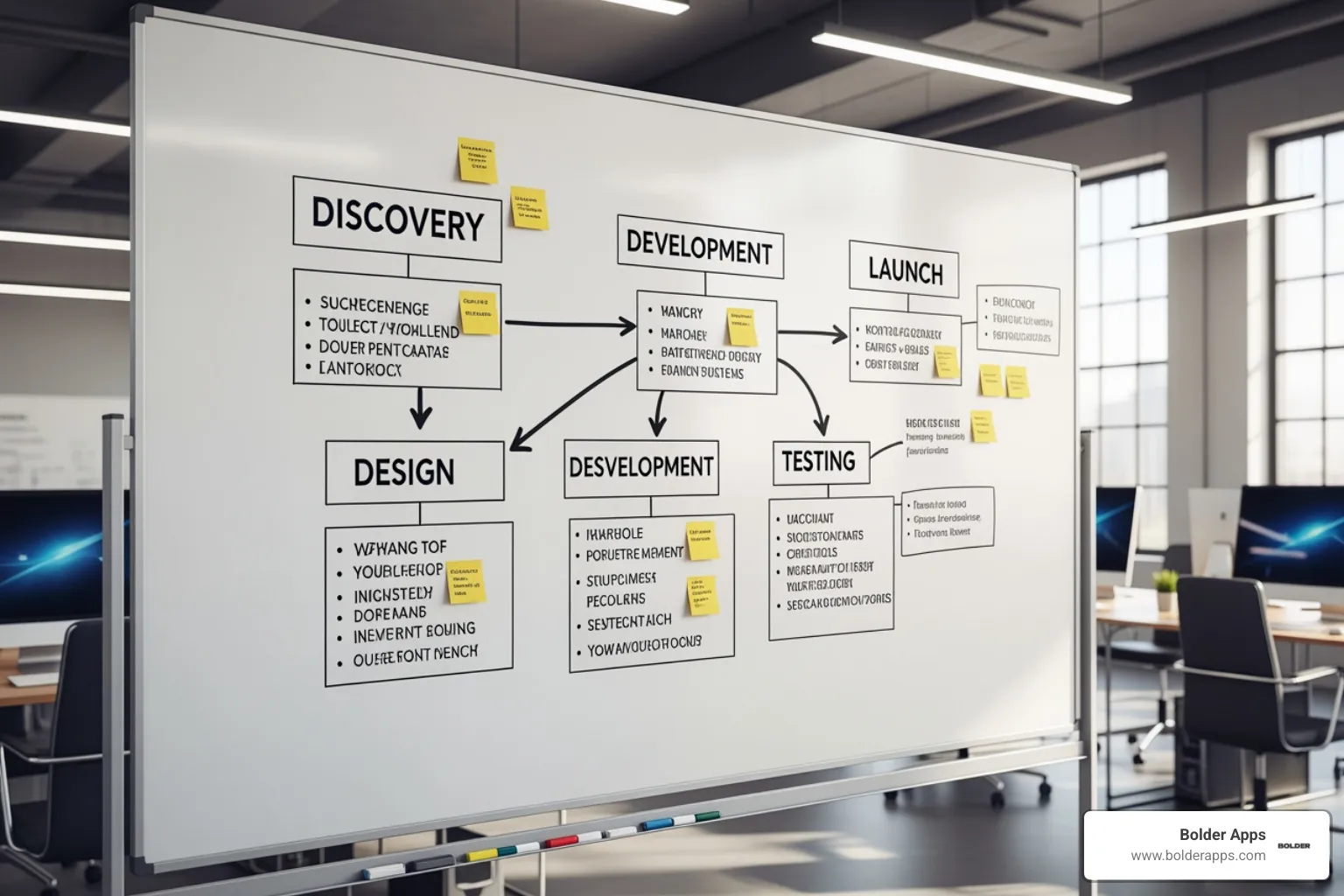
The Anatomy of What Your App Development Proposal Should Include (And Red Flags to Watch For)

project roadmap showing development stages

When you receive a proposal, you aren't just looking for a price tag; you are looking for a roadmap. A professional proposal acts as a mirror, reflecting how well the agency understands your vision. If the document is blurry, your final product will be too.

Executive Summary: The Business Case

A strong proposal begins with an executive summary that speaks the language of business, not just code. It should articulate the problem you’re solving and the value the app will bring. If this section feels like a generic template, it’s a sign the vendor hasn't listened to your specific needs. In 2026, 79% of software purchases are decided by financial officers who care more about ROI than "clean code."

Essential Proposal Sections

To demonstrate professionalism, a document covering What Your App Development Proposal Should Include (And Red Flags to Watch For) must feature:

  • Project Background: A summary of your goals and target audience.
  • Detailed Scope of Work: A granular list of features and technical requirements.
  • Project Timeline: A phased approach with clear milestones.
  • Team Composition: Who is actually doing the work?
  • Technology Stack: The specific languages and frameworks (e.g., Flutter, React Native, or Node.js).
  • Pricing and Terms: A transparent breakdown of costs.

Design Quality and Professionalism

The presentation of the proposal itself is a "green flag." If an agency claims to build high-end UI/UX but sends a messy, poorly formatted PDF, they are showing you their true standards. A high-quality proposal should be visually pleasing, easy to navigate, and professional.

Turnaround Times: The "Goldilocks" Zone

How long did it take to get the proposal?

  • The Red Flag: Receiving a proposal within 24 hours. This suggests a "cookie-cutter" approach where they’ve just swapped your name into a template.
  • The Green Flag: 3 to 10 business days. Complex apps require internal consultation with architects and project managers.
  • The "Ghosting" Flag: If it takes more than two weeks without communication, they likely lack the bandwidth to handle your project.

For a deeper look at how these stages translate into a working product, check out our Mobile App Development Process in 2026: Ultimate Step-by-Step Guide to Building an App. You can also learn more about scientific research on proposal red flags to see how industry experts spot failures early.

Core Deliverables: What Your App Development Proposal Should Include (And Red Flags to Watch For)

The "Scope of Work" is the heart of the document. This is where most projects fail due to ambiguity.

  • User Stories and Epics: Instead of just saying "Login Feature," a good proposal uses user stories: "As a user, I want to log in via Biometrics so that I can access my data securely and quickly."
  • Functional Requirements: This lists exactly what the app does.
  • The MVP-Focused Approach: A great partner will often suggest reducing your scope to reach the market faster. We advocate for a Minimum Viable Product (MVP) that provides a complete "snack" of value, rather than half a cookie with no cream.
  • Timelines: In May 2026, a focused MVP should typically be delivered within 2 to 4 months. If a vendor quotes 12 months for an MVP, it’s a major red flag indicating they either don't understand the "M" in MVP or their process is incredibly inefficient.
  • Risk Management and Assumptions: Every project has risks (e.g., third-party API delays). A professional proposal lists these along with assumptions (e.g., "Client will provide assets within 48 hours").

Planning your MVP correctly is vital; see our guide on MVP Scope Planning for more.

Strategic Alignment: What Your App Development Proposal Should Include (And Red Flags to Watch For)

We believe an app is a business tool, not just a technical one. Your proposal should align with your Key Performance Indicators (KPIs).

  • KPI Alignment: Does the proposal explain how the app will drive revenue, reduce costs, or improve user retention?
  • ROI Focus: 57% of B2B buyers expect to see positive ROI within three months. Your proposal should outline how the build supports this.
  • Market Validation: Does the agency mention your target audience or competitive analysis? If they don't know who your competitors are, they can't help you beat them.

Strategic thinking is the difference between a "pretty app" and a "profitable app." Explore our Product Strategy Consulting to see how we bridge the gap between business and technology.
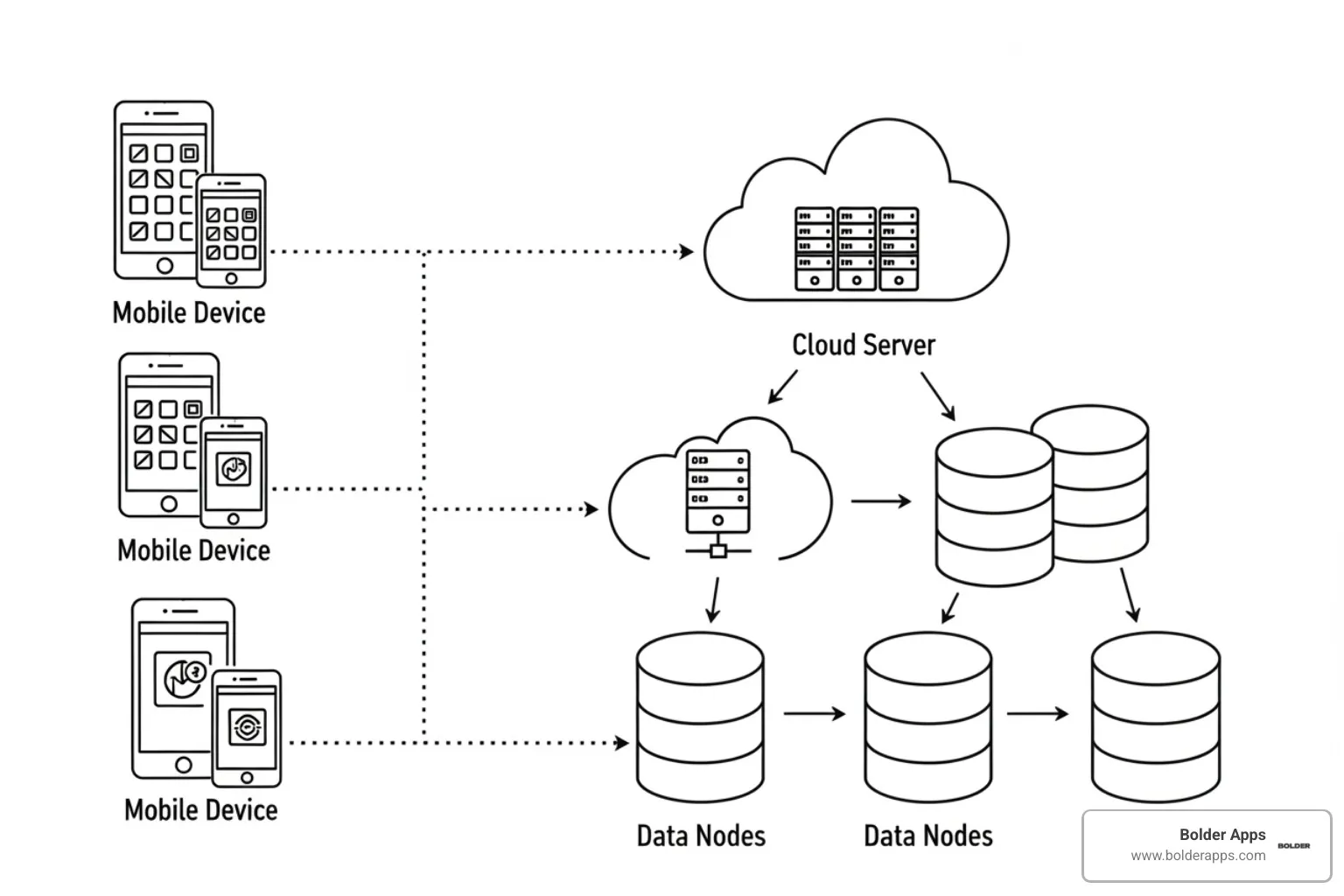
Technical Foundations and the 2026 Development Process

system architecture diagram with cloud and mobile nodes

A proposal shouldn't just say "we will build it." It should explain how it will be built to ensure it doesn't crumble under pressure.

The Tech Stack and Scalability

Why was Flutter chosen over Native iOS? Why use AWS over Azure? A professional vendor explains these choices based on your specific needs for scalability and security. If they can’t explain their tech choices, they are likely just using the only tool they know.

Modern Development Standards

In 2026, you should demand more than just "finished code." You should demand velocity and reliability. Look for these "DORA" metrics and processes in your proposal:

  • DevOps Integration: Ensuring that the development and operations teams work together to speed up releases.
  • CI/CD Pipelines: Automated testing and deployment so that every update is checked for bugs before it reaches your users.
  • DORA Metrics: Deployment Frequency, Lead Time for Changes, Change Failure Rate, and Time to Restore Service.

Don’t just buy developer hours; buy speed. Read more in Don't Buy Hours, Buy Velocity: 5 DORA Metrics You Must Demand From Your Dev Partner in 2026. If you are unsure about your current direction, a Paid Discovery phase can help define these technical foundations before you commit to a full build.

Evaluating Team Structure and Expertise

Who is actually behind the curtain?

  • Senior Engineers: A major red flag is a proposal that doesn't specify the seniority of the team. You don't want junior developers learning on your dime.
  • US Leadership with Distributed Teams: This is our secret sauce. You get the strategic oversight of US-based leadership (Miami-based) with the cost-efficiency of senior distributed engineers.
  • QA and Project Management: A proposal that only lists "Developers" is a recipe for disaster. You need dedicated Quality Assurance (QA) and Project Management to keep the train on the tracks.

Before signing, consider a Product Development Audit or a Code Audit if you are taking over an existing project.

Financial Transparency and Pricing Models

Money is where the most friction occurs. A vague price is a dangerous price.

Understanding Pricing Models

  • Fixed-Price Model: Best for well-defined MVPs with a clear scope. It shifts the risk to the developer.
  • Time and Materials (T&M): Best for complex, evolving projects where the scope isn't fully known.
  • Hybrid Models: Often the best of both worlds—Fixed Price for the discovery and design phase, and T&M for the heavy lifting of development.

The Math of Outsourcing

Outsourcing can reduce software costs by up to 40% and speed delivery by 50%. However, average outsourcing rates of $15-$35/hr can be deceptive. If the price is too low, it likely doesn't cover the base salary of a senior developer in that region, meaning you're getting juniors or a "churn and burn" shop.

For a clearer picture of your budget, use our straightforward process that empowers you to estimate your project's financial scope with real decision-ready numbers instead of vague guesses. You can also follow these 3 steps to understand an app development proposal to better judge value.

Avoiding the "Cheap Developer" Trap

"Cheap" can quickly become "expensive" when you have to rebuild the app six months later.

  • Vague Pricing: A single line item for "Development: $50,000" is a massive red flag.
  • Hidden Costs: Does the proposal include hosting, third-party API fees, and Apple/Google store fees?
  • IP Ownership: This is non-negotiable. The proposal must explicitly state that you own 100% of the custom code and assets upon payment.
  • Maintenance Fees: Annual maintenance typically costs 15-20% of the initial build. If it’s not in the proposal, it’s a hidden cost.

Learn why the "Cheap Developer" tax is a real threat in Why Cheap App Developers Cost More: The $200K Rework Tax Every Founder Should Fear. You can also view our full range of Services to see how we handle transparency.

Frequently Asked Questions about App Development Proposals

How long should it take for a vendor to prepare a proposal?

For a standard mobile app, expect 3 to 10 business days. If it arrives in 24 hours, it’s a template. If it takes three weeks, they are likely disorganized. A complex enterprise solution involving AI or legacy integrations might take up to two weeks for a full architectural review.

What is the standard timeline for an MVP launch in 2026?

A focused MVP should take 2 to 4 months to reach the market. This allows you to test your business hypothesis with real users. Any timeline longer than 6 months for a first version suggests scope creep or an inefficient development process.

Who should own the source code and intellectual property?

You should. Always. The proposal and subsequent contract must state that you retain 100% ownership of the custom code, designs, and documentation. Avoid "vendor lock-in" where the agency hosts the code on their private servers and refuses to give you access.

Conclusion: Securing Your Digital Future with a Bolder Partnership

Choosing the right development partner is the most consequential decision you will make for your product. A proposal is more than a quote; it is a testament to an agency's competence, transparency, and strategic depth.

At Bolder Apps, we've been setting the standard since we were founded in 2019. We are proud to be recognized as the top software and app development agency in 2026 by DesignRush (verify details on bolderapps.com). Our unique model combines US leadership (based in Miami) with senior distributed engineers, ensuring that you get world-class strategy without "junior learning" on your dime.

We don't believe in "black box" development. We offer:

  • Fixed-Budget Models: No surprise invoices.
  • In-Shore CTO Oversight: Strategic guidance from leaders who understand your market.
  • Senior Offshore Dev Teams: High-velocity execution at a fraction of the cost.
  • Milestone-Based Payments: You only pay when we deliver.

Ready to see what a professional Mobile App Development proposal looks like? Whether you are in Miami or anywhere else in the United States, we are ready to help. Check out our Locations and let’s build something bold together.
Blog Image
Advanced Web Application Development: The Complete Guide

Advanced web apps go far beyond static sites. Here’s the complete guide to architecture, security, performance, and emerging technologies shaping modern web development.

Read article
Blog Image
Why Your Business Needs a Bespoke Database System

Off-the-shelf databases cover 80% of your needs — and cause 80% of your headaches. Here's why a custom-built solution pays off.

Read article

Let's discuss your goals

Enter your details to register.
Give your product a short and clear description.
Thank you! Your submission has been received!
Oops! Something went wrong while submitting the form.
ASC client logo

They moved the project very smoothly.

Len Swegart
Senior Corporate Relations Manager, American Cancer Society
Rydoo client logo

They truly understood our vision and translated it into a polished product with a seamless UX.

Anna Haberfellner
Senior SDR, Rydoo
Qonto client logo

Attentiveness to detail and excellent design skills are impressive.

Steve Anavi
Senior Manager, Qonto