Pavel Yanushka
June 9, 2026
10
min. read
and updated on:
June 9, 2026


At its core, the Model Context Protocol is a standardized communication specification designed to bridge the gap between large language models (LLMs) and the environments where data actually lives. Historically, LLMs have been isolated giants. They possess incredible reasoning capabilities but remain frozen in time, cut off from real-time data, private databases, local files, and enterprise systems.
To overcome this isolation, developers traditionally built custom integrations. If you wanted Claude or ChatGPT to read a local codebase, you had to write custom scripts to parse files and inject them into the prompt window. If you wanted it to query a database, you had to write custom API wrappers, translate the model's outputs into SQL, and feed the results back.
This approach was not sustainable. Anthropic introduced MCP to solve this systemic isolation by establishing an open standard. By separating the concern of reasoning (handled by the model) from the concern of data access (handled by the server), MCP allows AI systems to maintain deep, real-time context across highly fragmented environments. For a detailed history of its launch, you can read the official announcement: Introducing the Model Context Protocol - Anthropic.
Before the model context protocol, the AI integration landscape suffered from what computer scientists call the "N×M complexity bottleneck."
Imagine you have N different AI applications or development environments (e.g., Claude Desktop, Cursor, VS Code, ChatGPT, custom internal enterprise chat apps) and M different data sources or tools (e.g., PostgreSQL, Slack, GitHub, Google Drive, Jira, local filesystems).
Without a standard, if you wanted every AI application to access every data source, you had to build and maintain N × M unique integrations.
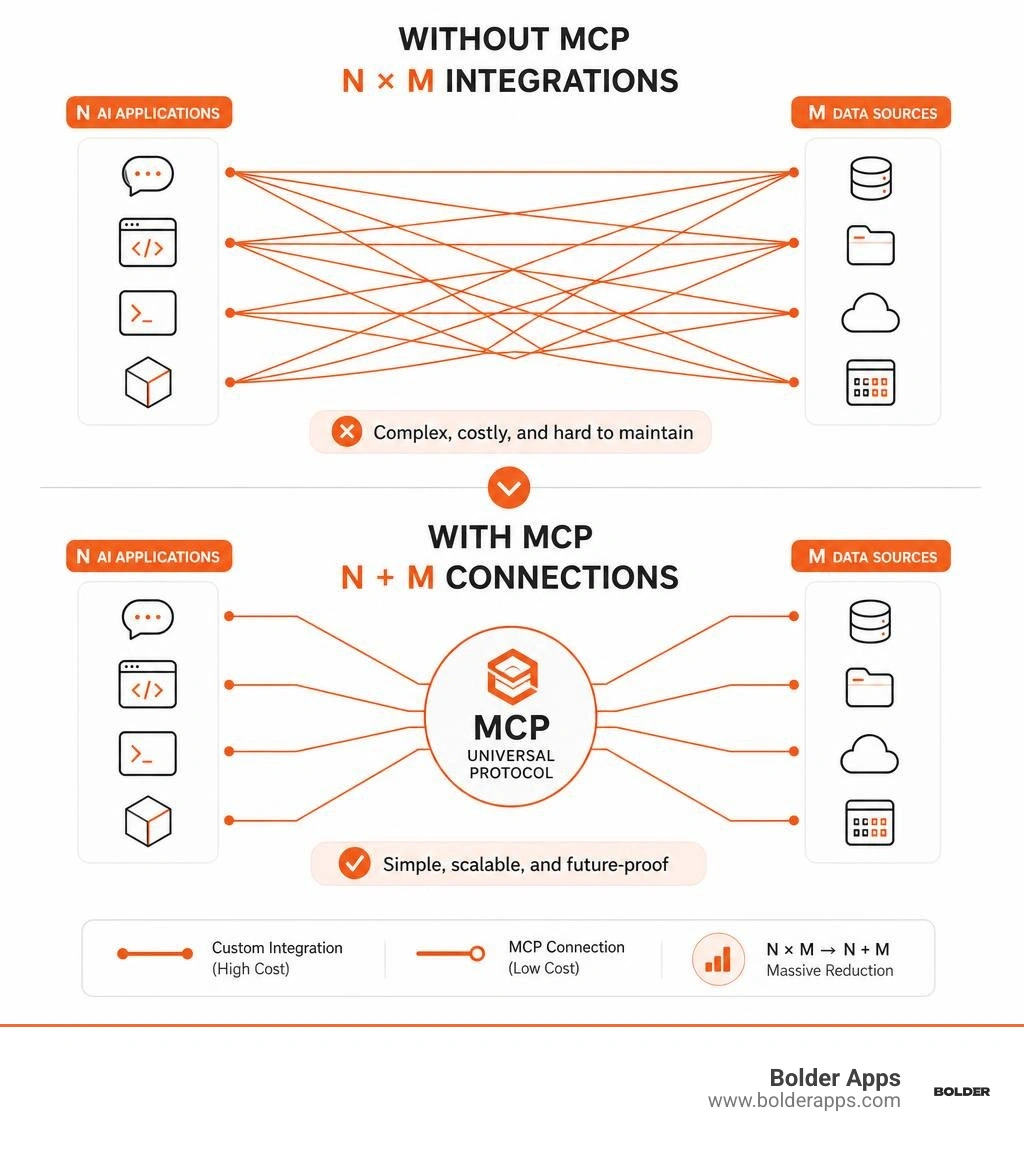
This fragmentation stifled innovation. It meant that a tool developer building a fantastic new database search engine had to write separate plugins for VS Code, Cursor, and ChatGPT.
MCP elegantly collapses this complexity. By acting as a universal adapter, it reduces the integration problem from N × M to N + M. A developer builds a single MCP server for their database. Now, any AI host application that implements an MCP client can immediately connect to and use that database. This clean separation of concerns is explored in depth on the official Model Context Protocol documentation site.
The architecture of the model context protocol relies on a clear, three-part hierarchy that establishes how information flows between the user, the AI model, and your data:
Communication between the client and server is handled via JSON-RPC 2.0, a lightweight, transport-agnostic, remote procedure call protocol. This allows for rapid, bidirectional communication, meaning the client can request data from the server, and the server can safely request actions or "sampling" back from the client. To see how these components are wired together in real-world software, check out our MCP App Development Complete Guide.
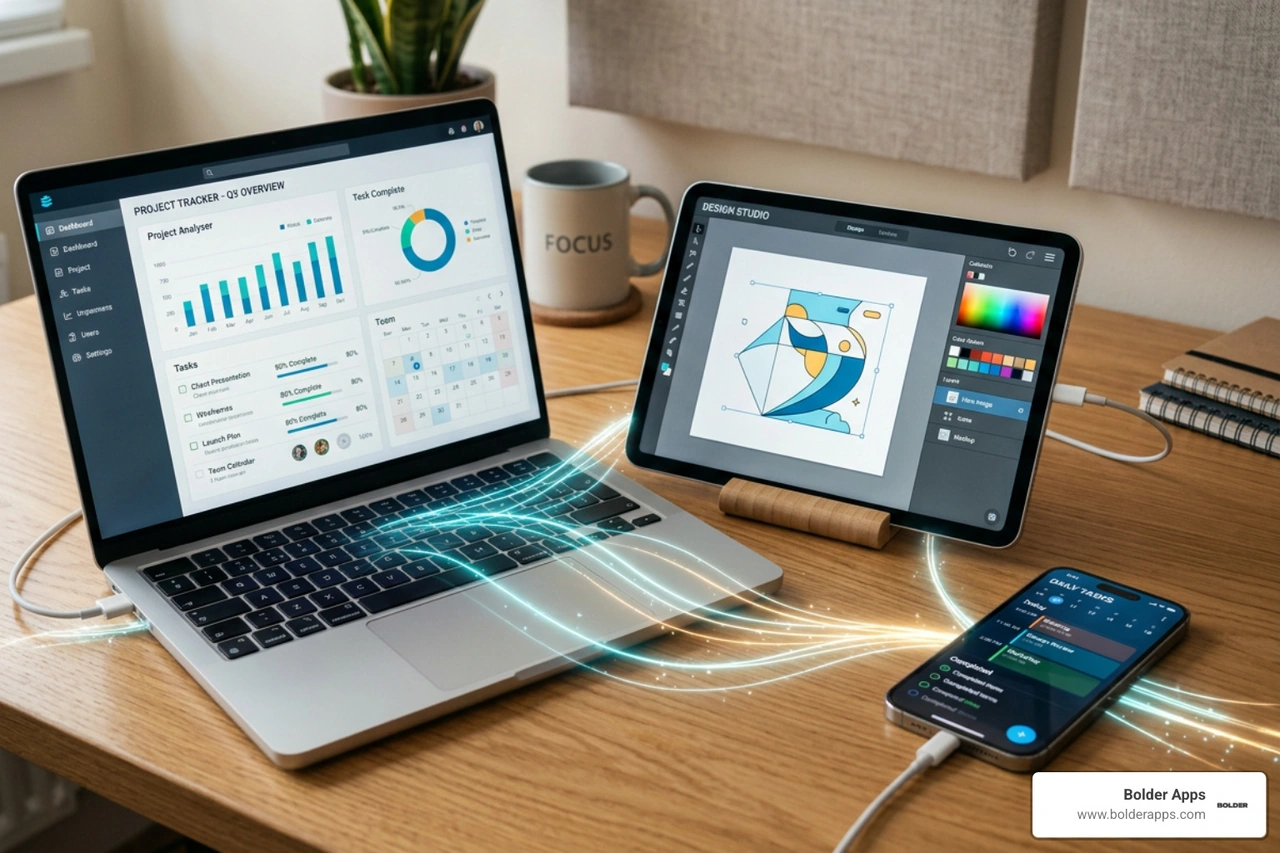
To make integrations predictable, MCP organizes all interactions into three core primitives. This design ensures that regardless of whether an AI is reading a file, running a terminal command, or using a pre-formatted template, the message structure remains identical. To see the official specifications of these interactions, you can reference the Specification - Model Context Protocol page.
The three core primitives of MCP govern how an AI interacts with external systems, categorized by who or what controls them:
For developers implementing these schemas, the exact TypeScript interfaces and validation requirements are detailed in the Schema Reference - Model Context Protocol.
Because MCP is transport-agnostic, it can run across different environments depending on where the server is hosted. The protocol officially supports two primary transport methods:
During startup, the client and server engage in capability negotiation to establish what features are supported, passing environment variables securely to configure access. For a step-by-step technical guide on setting up these transports, read our article on Building MCP Servers with Node.js: How to Make Your Backend Readable by AI Agents in 2026.
With so many integration standards already in existence, it is natural to ask why the industry needed a brand-new protocol. To understand the foundational design choices of MCP, you can look at the Overview - Model Context Protocol specification overview.
To understand MCP's unique value, it helps to compare it directly to the technologies developers use every day:
While REST requires the client to know exactly which endpoint to hit, MCP allows the model to dynamically discover and compose tools on the fly. To understand how this shifts our approach to backends, read Beyond REST: Building Agent-Ready Node.js Backends for the AI-Native Mobile Era.
It is important to note that MCP is not an orchestrator or an agent framework. It does not replace frameworks like LangChain, LlamaIndex, or crewAI. Instead, it complements them.
In a multi-agent system, frameworks like crewAI manage agent roles, state, and memory. However, those agents still need to interact with databases and tools. Traditionally, developers had to write custom LangChain "Tools" or LlamaIndex "Data Connectors" for every single data source.
By integrating MCP into these frameworks, agents can share a unified context memory and access a vast library of pre-built MCP servers. To see how to build agent-ready architectures that leverage these integrations, refer to our Ultimate Guide Agent-Ready NodeJS APIs.
Because MCP allows autonomous AI models to execute code, read sensitive documents, and query databases, security cannot be an afterthought. This is especially true when building agentic workflows for mobile and enterprise applications where data boundaries are strict, as discussed in The Ethics of Autonomy: How Bolder Apps Builds Deterministic Guardrails into Agentic Mobile Workflows.
MCP handles security differently depending on the transport layer used:
The exact rules governing authorization handshakes can be reviewed in the Overview - Model Context Protocol auth documentation.
When executing tools, AI agents can make mistakes or be manipulated via prompt injection. MCP addresses these risks through strict design guidelines:
To explore the safety specification guidelines, you can review the official repository documentation at docs/specification/2024-11-05/index.mdx at ff960c9e · modelcontextprotocol/modelcontextprotocol.
The momentum behind MCP has been staggering. Since its release, the protocol has quickly transitioned from an Anthropic-specific initiative into a foundational pillar of the open-source AI ecosystem. Developers are using it to transition away from fragile "vibe coding" practices toward structured, production-grade agent architectures, a shift we explore in Vibe Coding for Founders: How Natural Language Programming is Changing the 2026 Development Lifecycle.
In December 2025, in a major move to ensure the protocol remains open and neutral, Anthropic, OpenAI, Block, and other industry leaders co-founded the Agentic AI Foundation (AAIF) under the Linux Foundation and officially donated MCP to it.
This neutral governance has accelerated industry-wide adoption. Major AI providers, including Google DeepMind and OpenAI, have integrated MCP support into their platforms. Additionally, legal and enterprise teams are recognizing the protocol as a primary standard for secure data discovery, as highlighted in AI Agents, Model Context Protocols, and Discovery - Gunster.
The practical benefits of this unified ecosystem are clear:
To understand how these capabilities are drastically reducing development timelines, check out Agentic Coding App Development Timelines 2026.
MCP handles real-time data through a combination of dynamic resources and subscription mechanisms. Clients can subscribe to specific resource URIs, and the server can send out-of-band update notifications when the underlying data changes. This is highly useful in dynamic environments, such as federal data feeds or live database monitoring. For an example of real-time public data integration, see AI Agents Meet Federal Data: Public Preview for the GovInfo MCP ....
Yes. MCP is designed to be highly flexible. Local servers run on your machine using the lightweight stdio transport, which is ideal for local files, databases, and command-line execution. Cloud-based servers run over HTTP using Server-Sent Events (SSE), allowing you to deploy MCP servers on platforms like Cloudflare Workers or AWS. This flexibility is a key driver in the transition toward highly personalized, local-first AI agents, as discussed in OpenAI Personal AI Agents: End of the App Era.
Traditional APIs are designed for deterministic, human-authored client code that calls specific endpoints in a rigid order. MCP is designed from the ground up for AI agents. It uses natural language descriptions within schemas so the AI model can understand what a tool does and how to use it. Additionally, MCP supports bidirectional workflows (such as sampling and elicitation), allowing the server to ask the client for additional user input or model inferences mid-execution. For developers looking to master these patterns, check out the resources listed at Mastering Model Context Protocol (MCP).
The Model Context Protocol has successfully unified how AI models interact with the digital world. By solving the N×M integration bottleneck and providing a secure, open-source standard under the Linux Foundation, MCP has laid the groundwork for the next generation of truly autonomous, context-aware AI applications.
At Bolder Apps, founded in 2019, we specialize in building high-impact mobile and web applications that leverage cutting-edge, agent-ready architectures. Named as a top software and app development agency in 2026 by DesignRush, we pair strategic US leadership with senior distributed engineers to deliver exceptional products with no junior developer learning on your dime. You can verify these details on bolderapps.com.
Whether you are looking to build custom MCP servers, secure your enterprise data pipelines, or launch a breakthrough AI-powered mobile app, we can help. We operate on a transparent, fixed-budget model with an in-shore CTO managing your project, offshore development teams for cost efficiency, and milestone-based payments to ensure zero financial risk for your business.
Ready to bring your next product to life? Explore our Bolder Apps Services or visit our Bolder Apps Location Directory to connect with our team in Miami, United States. Let's build something bold together!