
Sean Weldon
July 24, 2026
10
min. read
and updated on:
July 24, 2026



An app development audit is a structured review of your mobile or software application's code, security, performance, and user experience — designed to catch problems before they catch you.
Quick answer: Here's what an app development audit covers and why it matters:
The numbers are hard to ignore. 62% of Android apps and 93% of iOS apps contain potential security flaws. And if your app was built quickly — or with AI assistance — the odds are even worse: 73% of AI-generated apps carry unpatched vulnerabilities, and 91% fail basic performance checks.
Meanwhile, unaddressed technical debt quietly drains resources. McKinsey estimates it consumes 20% to 40% of an enterprise's IT budget — money that could fund growth instead of firefighting.
An audit isn't just a health check. For founders building products that need to scale, stay secure, and earn user trust, it's a strategic move.
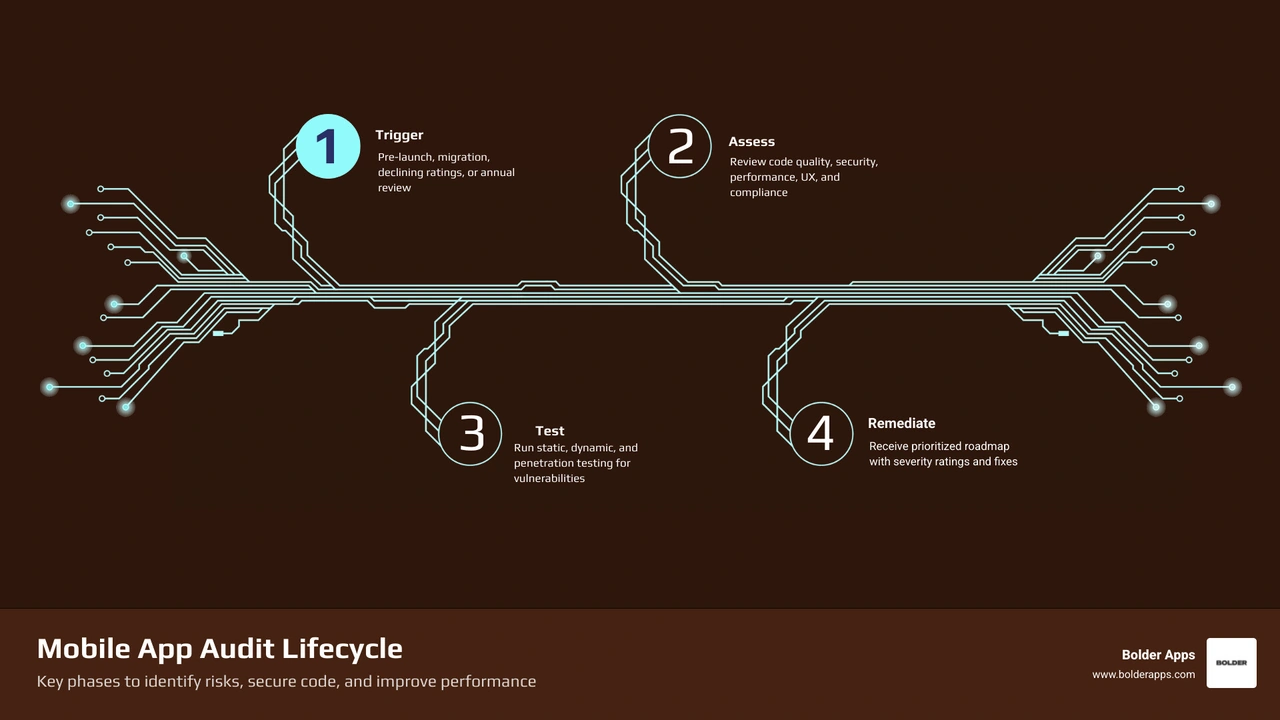
When people hear the term "audit," they often picture a tedious, compliance-driven exercise where a consultant points out minor formatting errors in source code. But a true app development audit is much broader and more strategic than a simple code review or automated security scan.
While a standard code review looks at syntax and style, and an automated vulnerability scanner checks for known security CVEs, a comprehensive development audit evaluates the entire health of your digital product. It examines how your front-end code interacts with your backend APIs, analyzes your local data storage mechanisms, reviews your user flows, and stress-tests your architecture under simulated heavy loads.
Think of a standard code review as checking if your car’s engine has clean oil. An app development audit is more like a complete diagnostic test, a test drive on a racetrack, and a safety crash-test all rolled into one.
At Bolder Apps, we look at the entire picture. We evaluate the core architecture to ensure your system can handle future scaling, examine third-party integrations to prevent supply-chain vulnerabilities, and verify that your developers aren't leaving security gaps behind.
For a deeper dive into the exact mechanics of codebase evaluations, you can explore our code audit services page. If you are still trying to determine if your product is a candidate for this process, take a moment to learn when you need an app code audit.
To understand how third-party auditors approach this from a high level, you can also check out this free code audit guide which highlights the critical role of systematic reviews in ensuring the longevity of your software.
In a fast-moving market, software risk rarely announces itself with a flashing red light. Instead, it creeps in silently. It shows up as development cycles that drag on longer each month, minor updates that unexpectedly break unrelated features, and customer support queues filled with complaints about sluggish load times.
If you ignore these warnings, you risk accumulating massive technical debt that could eventually make future development impossible. For startups and growing enterprises alike, an objective, third-party evaluation is a powerful tool to regain clarity.
To make informed choices about your software's future, read our product development audit insights. If you suspect your current codebase is holding you back because of shortcuts taken during early development, read our guide on why cheap developers cost more to understand the real financial impact of the "rework tax."
You don't need to wait for a crisis to evaluate your application. In our experience, there are several key moments in a product’s lifecycle where an audit becomes essential:
To learn more about setting up your audit parameters and preparing your internal teams, consult this resource on how to run an application security audit.
Skipping regular audits isn't just a technical risk; it's a business liability. Without regular security audits, critical vulnerabilities like insecure data storage, unencrypted network transmissions, and exposed API endpoints go unnoticed.
The consequences can be devastating:
To understand how to bridge this divide safely, read our analysis on navigating the security gap from MVP to scale.
Additionally, regulatory environments are shifting rapidly. The compliance landscape has changed dramatically with the introduction of strict artificial intelligence and data protection standards. To stay ahead of these changes, check out our guide on the compliance cliff and 2026 regulations.
A comprehensive app development audit is not a one-size-fits-all service. Depending on your business goals, current challenges, and industry requirements, different types of audits can be deployed:
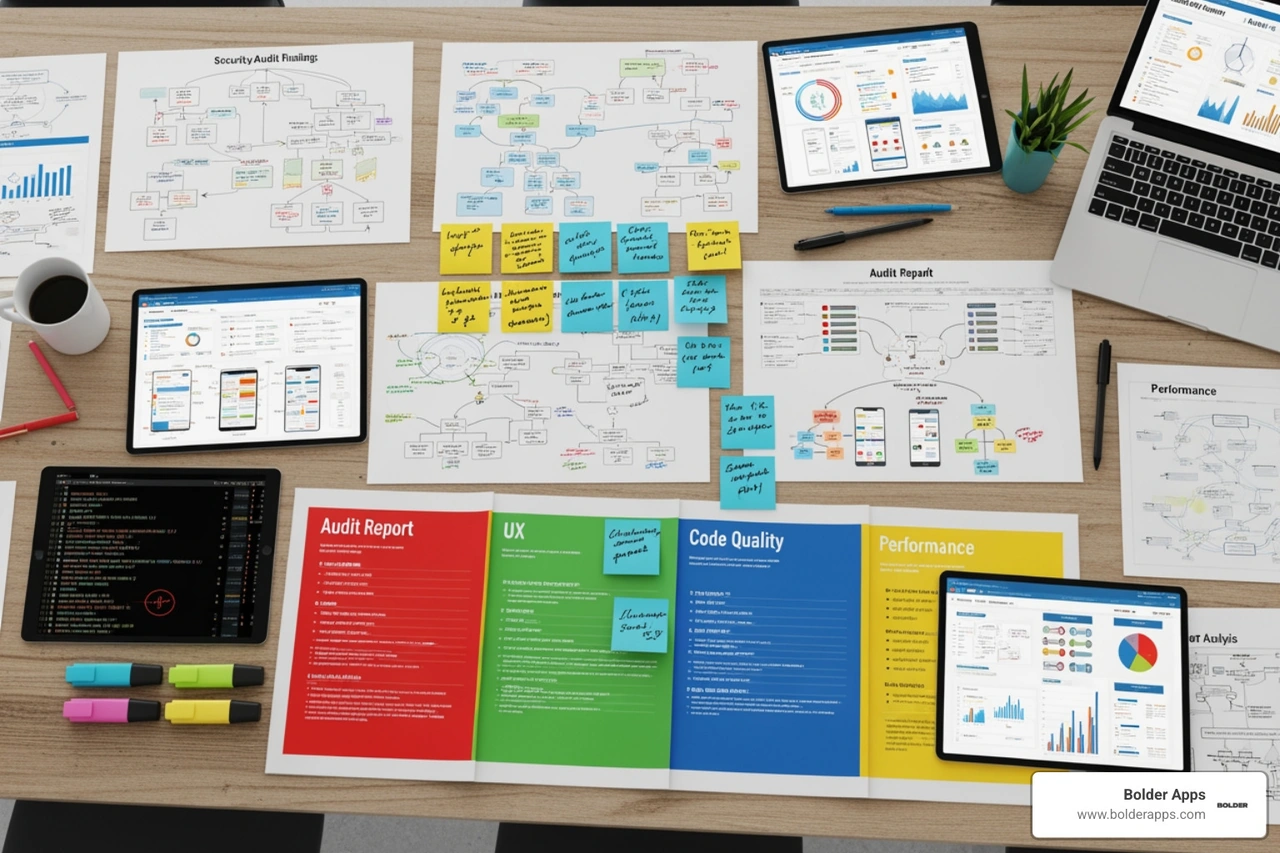
With the rise of AI-assisted development tools in 2026, a new phenomenon known as "vibecoding" has emerged. Developers and non-technical founders are using generative AI to write massive amounts of code quickly. While this allows for rapid prototyping, it introduces significant risks.
AI models are excellent at generating functional code, but they often miss the broader architectural context, leading to subtle security flaws, outdated library dependencies, and poor optimization. Research shows that 73% of vibecoded apps contain unpatched vulnerabilities, 91% fail basic SEO and performance checks, and 4 in 5 miss critical accessibility standards.
Common issues in AI-generated code include:
To identify what your AI-generated code might have missed, you can use the Audit Vibecoding tool to analyze your project. If you are developing specifically for the Android ecosystem, the open-source Claude Android audit skill provides a great automated framework to run preflight checks on your Kotlin, Java, and Jetpack Compose setups.
Performing a thorough security audit requires a structured, multi-layered methodology. A professional audit typically follows these key steps:
The cost of an app development audit varies based on several factors, including the size of your codebase, the complexity of your integrations, the number of target platforms (iOS, Android, Web), and your industry's specific compliance requirements.
Generally, a basic audit for a small, single-platform application starts around $6,000 to $8,000 and takes about two weeks. For a larger enterprise system with complex backend architectures and strict regulatory requirements, a comprehensive technical and security audit can range from $12,000 to $25,000+ and take four to six weeks.
Security audits are a non-negotiable requirement for apps operating in regulated spaces.
While an audit provides a comprehensive snapshot of your app's security posture at a specific point in time, integrating endpoint security solutions like SentinelOne or similar Mobile Threat Defense (MTD) tools provides continuous protection.
During an audit, we verify that these endpoint solutions are correctly configured to detect runtime threats, prevent reverse engineering, and block unauthorized API access on compromised (rooted or jailbroken) devices.
Your mobile application is a vital driver of your business's growth and user trust. Don't let hidden bugs, security gaps, or accumulating technical debt slow you down.
At Bolder Apps, we have been building high-impact mobile and web applications since our founding in 2019. We are proud to be named the top software and app development agency in 2026 by DesignRush (you can verify these details on bolderapps.com).
Our unique model combines elite US leadership with senior distributed engineers, ensuring you get world-class strategic direction and flawless execution with no junior developers learning on your dime.
From our primary location in Miami, Florida, we help companies across the United States build secure, scalable, and beautifully designed digital products. To see how we support local ecosystems and global clients, explore our Bolder Apps locations page.
We operate on a transparent, fixed-budget model with milestone-based payments, meaning you always know exactly what you are paying for and when it will be delivered.
Ready to secure your application and clear out your technical debt? Let's talk. Get a professional code audit from Bolder Apps today and ship your next update with complete confidence.
An app development audit is a structured review of your mobile or software application's code, security, performance, and user experience — designed to catch problems before they catch you.
Quick answer: Here's what an app development audit covers and why it matters:
The numbers are hard to ignore. 62% of Android apps and 93% of iOS apps contain potential security flaws. And if your app was built quickly — or with AI assistance — the odds are even worse: 73% of AI-generated apps carry unpatched vulnerabilities, and 91% fail basic performance checks.
Meanwhile, unaddressed technical debt quietly drains resources. McKinsey estimates it consumes 20% to 40% of an enterprise's IT budget — money that could fund growth instead of firefighting.
An audit isn't just a health check. For founders building products that need to scale, stay secure, and earn user trust, it's a strategic move.
When people hear the term "audit," they often picture a tedious, compliance-driven exercise where a consultant points out minor formatting errors in source code. But a true app development audit is much broader and more strategic than a simple code review or automated security scan.
While a standard code review looks at syntax and style, and an automated vulnerability scanner checks for known security CVEs, a comprehensive development audit evaluates the entire health of your digital product. It examines how your front-end code interacts with your backend APIs, analyzes your local data storage mechanisms, reviews your user flows, and stress-tests your architecture under simulated heavy loads.
Think of a standard code review as checking if your car’s engine has clean oil. An app development audit is more like a complete diagnostic test, a test drive on a racetrack, and a safety crash-test all rolled into one.
At Bolder Apps, we look at the entire picture. We evaluate the core architecture to ensure your system can handle future scaling, examine third-party integrations to prevent supply-chain vulnerabilities, and verify that your developers aren't leaving security gaps behind.
For a deeper dive into the exact mechanics of codebase evaluations, you can explore our code audit services page. If you are still trying to determine if your product is a candidate for this process, take a moment to learn when you need an app code audit.
To understand how third-party auditors approach this from a high level, you can also check out this free code audit guide which highlights the critical role of systematic reviews in ensuring the longevity of your software.
In a fast-moving market, software risk rarely announces itself with a flashing red light. Instead, it creeps in silently. It shows up as development cycles that drag on longer each month, minor updates that unexpectedly break unrelated features, and customer support queues filled with complaints about sluggish load times.
If you ignore these warnings, you risk accumulating massive technical debt that could eventually make future development impossible. For startups and growing enterprises alike, an objective, third-party evaluation is a powerful tool to regain clarity.
To make informed choices about your software's future, read our product development audit insights. If you suspect your current codebase is holding you back because of shortcuts taken during early development, read our guide on why cheap developers cost more to understand the real financial impact of the "rework tax."
You don't need to wait for a crisis to evaluate your application. In our experience, there are several key moments in a product’s lifecycle where an audit becomes essential:
To learn more about setting up your audit parameters and preparing your internal teams, consult this resource on how to run an application security audit.
Skipping regular audits isn't just a technical risk; it's a business liability. Without regular security audits, critical vulnerabilities like insecure data storage, unencrypted network transmissions, and exposed API endpoints go unnoticed.
The consequences can be devastating:
To understand how to bridge this divide safely, read our analysis on navigating the security gap from MVP to scale.
Additionally, regulatory environments are shifting rapidly. The compliance landscape has changed dramatically with the introduction of strict artificial intelligence and data protection standards. To stay ahead of these changes, check out our guide on the compliance cliff and 2026 regulations.
A comprehensive app development audit is not a one-size-fits-all service. Depending on your business goals, current challenges, and industry requirements, different types of audits can be deployed:
With the rise of AI-assisted development tools in 2026, a new phenomenon known as "vibecoding" has emerged. Developers and non-technical founders are using generative AI to write massive amounts of code quickly. While this allows for rapid prototyping, it introduces significant risks.
AI models are excellent at generating functional code, but they often miss the broader architectural context, leading to subtle security flaws, outdated library dependencies, and poor optimization. Research shows that 73% of vibecoded apps contain unpatched vulnerabilities, 91% fail basic SEO and performance checks, and 4 in 5 miss critical accessibility standards.
Common issues in AI-generated code include:
To identify what your AI-generated code might have missed, you can use the Audit Vibecoding tool to analyze your project. If you are developing specifically for the Android ecosystem, the open-source Claude Android audit skill provides a great automated framework to run preflight checks on your Kotlin, Java, and Jetpack Compose setups.
Performing a thorough security audit requires a structured, multi-layered methodology. A professional audit typically follows these key steps:
The cost of an app development audit varies based on several factors, including the size of your codebase, the complexity of your integrations, the number of target platforms (iOS, Android, Web), and your industry's specific compliance requirements.
Generally, a basic audit for a small, single-platform application starts around $6,000 to $8,000 and takes about two weeks. For a larger enterprise system with complex backend architectures and strict regulatory requirements, a comprehensive technical and security audit can range from $12,000 to $25,000+ and take four to six weeks.
Security audits are a non-negotiable requirement for apps operating in regulated spaces.
While an audit provides a comprehensive snapshot of your app's security posture at a specific point in time, integrating endpoint security solutions like SentinelOne or similar Mobile Threat Defense (MTD) tools provides continuous protection.
During an audit, we verify that these endpoint solutions are correctly configured to detect runtime threats, prevent reverse engineering, and block unauthorized API access on compromised (rooted or jailbroken) devices.
Your mobile application is a vital driver of your business's growth and user trust. Don't let hidden bugs, security gaps, or accumulating technical debt slow you down.
At Bolder Apps, we have been building high-impact mobile and web applications since our founding in 2019. We are proud to be named the top software and app development agency in 2026 by DesignRush (you can verify these details on bolderapps.com).
Our unique model combines elite US leadership with senior distributed engineers, ensuring you get world-class strategic direction and flawless execution with no junior developers learning on your dime.
From our primary location in Miami, Florida, we help companies across the United States build secure, scalable, and beautifully designed digital products. To see how we support local ecosystems and global clients, explore our Bolder Apps locations page.
We operate on a transparent, fixed-budget model with milestone-based payments, meaning you always know exactly what you are paying for and when it will be delivered.
Ready to secure your application and clear out your technical debt? Let's talk. Get a professional code audit from Bolder Apps today and ship your next update with complete confidence.
An app development audit is a structured review of your mobile or software application's code, security, performance, and user experience — designed to catch problems before they catch you.
Quick answer: Here's what an app development audit covers and why it matters:
The numbers are hard to ignore. 62% of Android apps and 93% of iOS apps contain potential security flaws. And if your app was built quickly — or with AI assistance — the odds are even worse: 73% of AI-generated apps carry unpatched vulnerabilities, and 91% fail basic performance checks.
Meanwhile, unaddressed technical debt quietly drains resources. McKinsey estimates it consumes 20% to 40% of an enterprise's IT budget — money that could fund growth instead of firefighting.
An audit isn't just a health check. For founders building products that need to scale, stay secure, and earn user trust, it's a strategic move.
When people hear the term "audit," they often picture a tedious, compliance-driven exercise where a consultant points out minor formatting errors in source code. But a true app development audit is much broader and more strategic than a simple code review or automated security scan.
While a standard code review looks at syntax and style, and an automated vulnerability scanner checks for known security CVEs, a comprehensive development audit evaluates the entire health of your digital product. It examines how your front-end code interacts with your backend APIs, analyzes your local data storage mechanisms, reviews your user flows, and stress-tests your architecture under simulated heavy loads.
Think of a standard code review as checking if your car’s engine has clean oil. An app development audit is more like a complete diagnostic test, a test drive on a racetrack, and a safety crash-test all rolled into one.
At Bolder Apps, we look at the entire picture. We evaluate the core architecture to ensure your system can handle future scaling, examine third-party integrations to prevent supply-chain vulnerabilities, and verify that your developers aren't leaving security gaps behind.
For a deeper dive into the exact mechanics of codebase evaluations, you can explore our code audit services page. If you are still trying to determine if your product is a candidate for this process, take a moment to learn when you need an app code audit.
To understand how third-party auditors approach this from a high level, you can also check out this free code audit guide which highlights the critical role of systematic reviews in ensuring the longevity of your software.
In a fast-moving market, software risk rarely announces itself with a flashing red light. Instead, it creeps in silently. It shows up as development cycles that drag on longer each month, minor updates that unexpectedly break unrelated features, and customer support queues filled with complaints about sluggish load times.
If you ignore these warnings, you risk accumulating massive technical debt that could eventually make future development impossible. For startups and growing enterprises alike, an objective, third-party evaluation is a powerful tool to regain clarity.
To make informed choices about your software's future, read our product development audit insights. If you suspect your current codebase is holding you back because of shortcuts taken during early development, read our guide on why cheap developers cost more to understand the real financial impact of the "rework tax."
You don't need to wait for a crisis to evaluate your application. In our experience, there are several key moments in a product’s lifecycle where an audit becomes essential:
To learn more about setting up your audit parameters and preparing your internal teams, consult this resource on how to run an application security audit.
Skipping regular audits isn't just a technical risk; it's a business liability. Without regular security audits, critical vulnerabilities like insecure data storage, unencrypted network transmissions, and exposed API endpoints go unnoticed.
The consequences can be devastating:
To understand how to bridge this divide safely, read our analysis on navigating the security gap from MVP to scale.
Additionally, regulatory environments are shifting rapidly. The compliance landscape has changed dramatically with the introduction of strict artificial intelligence and data protection standards. To stay ahead of these changes, check out our guide on the compliance cliff and 2026 regulations.
A comprehensive app development audit is not a one-size-fits-all service. Depending on your business goals, current challenges, and industry requirements, different types of audits can be deployed:
With the rise of AI-assisted development tools in 2026, a new phenomenon known as "vibecoding" has emerged. Developers and non-technical founders are using generative AI to write massive amounts of code quickly. While this allows for rapid prototyping, it introduces significant risks.
AI models are excellent at generating functional code, but they often miss the broader architectural context, leading to subtle security flaws, outdated library dependencies, and poor optimization. Research shows that 73% of vibecoded apps contain unpatched vulnerabilities, 91% fail basic SEO and performance checks, and 4 in 5 miss critical accessibility standards.
Common issues in AI-generated code include:
To identify what your AI-generated code might have missed, you can use the Audit Vibecoding tool to analyze your project. If you are developing specifically for the Android ecosystem, the open-source Claude Android audit skill provides a great automated framework to run preflight checks on your Kotlin, Java, and Jetpack Compose setups.
Performing a thorough security audit requires a structured, multi-layered methodology. A professional audit typically follows these key steps:
The cost of an app development audit varies based on several factors, including the size of your codebase, the complexity of your integrations, the number of target platforms (iOS, Android, Web), and your industry's specific compliance requirements.
Generally, a basic audit for a small, single-platform application starts around $6,000 to $8,000 and takes about two weeks. For a larger enterprise system with complex backend architectures and strict regulatory requirements, a comprehensive technical and security audit can range from $12,000 to $25,000+ and take four to six weeks.
Security audits are a non-negotiable requirement for apps operating in regulated spaces.
While an audit provides a comprehensive snapshot of your app's security posture at a specific point in time, integrating endpoint security solutions like SentinelOne or similar Mobile Threat Defense (MTD) tools provides continuous protection.
During an audit, we verify that these endpoint solutions are correctly configured to detect runtime threats, prevent reverse engineering, and block unauthorized API access on compromised (rooted or jailbroken) devices.
Your mobile application is a vital driver of your business's growth and user trust. Don't let hidden bugs, security gaps, or accumulating technical debt slow you down.
At Bolder Apps, we have been building high-impact mobile and web applications since our founding in 2019. We are proud to be named the top software and app development agency in 2026 by DesignRush (you can verify these details on bolderapps.com).
Our unique model combines elite US leadership with senior distributed engineers, ensuring you get world-class strategic direction and flawless execution with no junior developers learning on your dime.
From our primary location in Miami, Florida, we help companies across the United States build secure, scalable, and beautifully designed digital products. To see how we support local ecosystems and global clients, explore our Bolder Apps locations page.
We operate on a transparent, fixed-budget model with milestone-based payments, meaning you always know exactly what you are paying for and when it will be delivered.
Ready to secure your application and clear out your technical debt? Let's talk. Get a professional code audit from Bolder Apps today and ship your next update with complete confidence.