Abdulla Khaydarov
March 26, 2026
10
min. read
and updated on:
April 8, 2026

OpenAI acquires Astral developer tools in a move that could reshape how AI coding assistants work across the entire software development lifecycle.
Here's what you need to know at a glance:
This is not just a talent acquisition. OpenAI is buying a toolchain that millions of developers already depend on — and betting that owning that infrastructure will give Codex a decisive edge over rivals like Anthropic's Claude Code and Cursor.
As Astral founder Charlie Marsh wrote when announcing the deal, he started the company to make programming more productive. Joining OpenAI's Codex team, he argues, is where that mission reaches its highest leverage point.
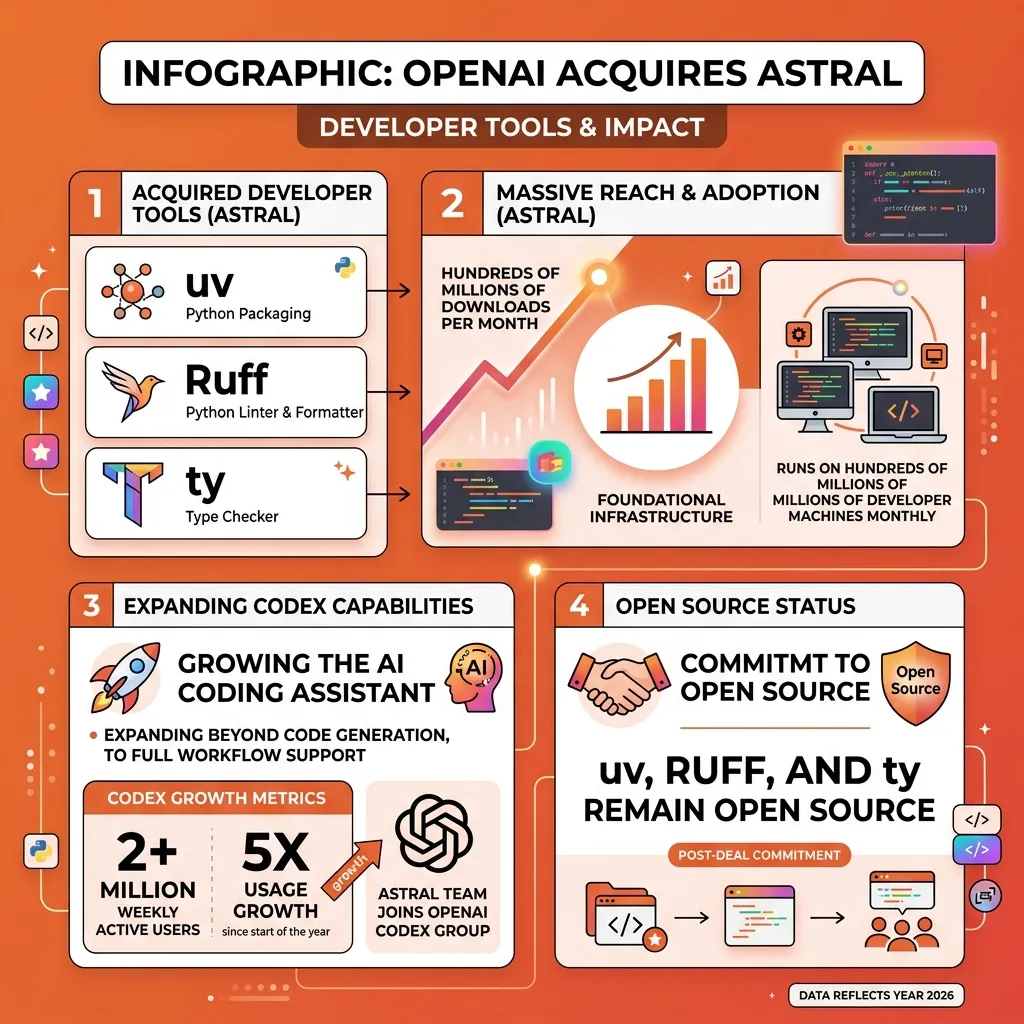
The numbers back up why both sides see this as a big deal. Codex already has over 2 million weekly active users, with usage growing fivefold since the start of the year. Astral's tools collectively pull in hundreds of millions of downloads per month. Put those two things together, and the potential reach is enormous.
OpenAI acquires Astral developer tools basics:

In March 2026, the tech world buzzed as announced OpenAI to acquire developer tooling startup Astral. This wasn't just another headline; it was a clear signal that the race for the ultimate AI coding environment has entered a new phase. We see this as a pivot from AI that simply "suggests" code to AI that "manages" the entire development process.
The deal involves the entire Astral team, a group of roughly 30-something elite engineers, joining OpenAI's Codex division. For those who haven't been following the startup scene closely, Astral was founded only three years ago by Charlie Marsh, a former software engineer at Khan Academy. Marsh started the company with a modest $4 million in seed funding and a goal to make Python development feel fast, robust, and intuitive.
Thibault Sottiaux, the Codex Lead at OpenAI, highlighted that this acquisition is about "accelerating our vision for Codex." By bringing in the minds behind the most popular modern Python tools, OpenAI isn't just getting better code; they are getting the architects of the modern Python developer experience. While the deal is still subject to customary closing conditions and regulatory approval, the intent is clear: OpenAI wants to own the "plumbing" of the software world.
One of the biggest emerging concerns in our industry today is the "garbage in, garbage out" problem of AI-generated code. It is easy to ask a chatbot to write a script, but it is much harder to ensure that script is maintainable, follows best practices, and doesn't introduce a mountain of technical debt.
At Bolder Apps, we’ve always prioritized high-impact, clean code. We know that if AI-generated code isn't properly linted, formatted, and type-checked, it becomes a nightmare to manage over time. By integrating Astral's tools directly into Codex, OpenAI is addressing this head-on.
Imagine an AI agent that doesn't just write a function but automatically checks it for errors using Ruff, manages its dependencies with uv, and ensures type safety with ty. This creates a closed-loop system where the AI is responsible for the quality of its own output. This level of reliability is essential as we move toward building MCP servers with Node.js: How to make your backend readable by AI agents in 2026. Reliability isn't just a "nice to have"—it's the foundation of developer productivity in the AI era.
To understand why OpenAI acquires Astral developer tools, you have to understand the tools themselves. Astral’s secret sauce is Rust. By rewriting traditional Python tools in Rust, they achieved performance gains that seemed impossible just a few years ago.
These aren't just niche tools; they have become foundational to how modern software is built. When we build apps at Bolder Apps, we look for this kind of efficiency. Using a Rust-based toolchain means less time waiting for builds and more time focus on strategic, data-driven product creation.
The acquisition fits perfectly into the shift toward OpenAI Personal AI Agents End of the App Era. As we move away from static applications and toward agentic workflows, these agents need a way to interact with the real world of code.
OpenAI recently highlighted the capabilities of GPT-5.2, which boasts a 100% AIME score and 98.7% tool-calling accuracy. You can read more about those huge upgrades for business/developer workflows here. By embedding Astral's tools, OpenAI enables Codex to "call" these tools natively.
Instead of an AI just guessing what a dependency should be, it can use uv to actually verify and install it. Instead of hoping the code is clean, it can run Ruff to guarantee it. This seamless integration turns Codex from a clever autocomplete into a legitimate member of the engineering team.
The growth of Codex has been nothing short of explosive. Since the start of 2026, the platform has seen:
This isn't just a hobbyist tool anymore; it’s professional infrastructure. However, OpenAI realizes that to maintain this lead, they need to move beyond simple code generation. We are entering the "Operating System" phase of AI, as discussed in our piece From Chatbot to Operating System OpenAI's App Store Moment is Finally Here.
The goal for the new, Astral-powered Codex is to participate in the entire software development lifecycle (SDLC). This includes:
By owning the tools that perform these tasks, OpenAI can ensure that Codex is the most capable "agent" in the room.
Whenever a giant like OpenAI acquires a beloved open-source startup, the community naturally gets a bit nervous. Will the tools remain free? Will the "open" part of open source disappear?
Charlie Marsh has been very vocal in his efforts to allay these concerns. In his announcement blog post, he called open source "the heart" of Astral's story, stating it sits at the center of everything they do. OpenAI has echoed this, promising to continue supporting the tools under their current permissive licenses (like MIT and Apache 2.0).
However, some skepticism remains in the developer community. On platforms like Reddit, users have expressed concerns about corporate control. Some worry that if OpenAI faces financial hurdles in the future, these tools might be neglected or gated behind a paywall. Others suggest that the acquisition is a "best-case scenario" for investors, allowing them to exchange their stakes in Astral for OpenAI equity ahead of a potential 2026 IPO.
At Bolder Apps, we believe that the open-source nature of these tools is exactly what makes them valuable. If they were locked away, they would lose the community contributions that keep them at the cutting edge. For now, the commitment to "build in the open" stands, and we'll be watching closely to see how this affects things like iOS agentic coding and Xcode MCP.
The acquisition of Astral is part of a much larger M&A (mergers and acquisitions) spree for OpenAI. Under their new corporate development leadership, they have been aggressively snapping up talent and technology to stay ahead of rivals.
Recent moves include:
This strategy is a direct response to the intense competition from companies like Anthropic. In late 2025, Anthropic acquired Bun, a JavaScript runtime and package manager. It’s a mirror image of the Astral deal: Anthropic took a high-performance JavaScript toolchain, and OpenAI took the Python equivalent.
This "toolchain war" is about more than just features; it's about habit. If a developer uses uv and Ruff every day, and those tools work perfectly with Codex, that developer is much less likely to switch to a rival assistant. It’s a bet on depth over breadth. You can explore how these dynamics play out in our guide on Mastering Claude Code in 2026.
Yes. Both Charlie Marsh and OpenAI have stated that uv, Ruff, and ty will continue to be supported as open-source projects. They plan to keep building in the open alongside the community. The tools are currently licensed under permissive terms (MIT and Apache 2.0), which provides a legal safety net for the community to fork the projects if the governance ever changes unfavorably.
The specific financial terms have not been publicly disclosed. However, it is known that Astral had previously raised a Series B round. Analysts speculate that the deal likely involved an exchange of Astral stakes for OpenAI equity, which is particularly attractive given the rumors of an OpenAI IPO later in 2026.
In the short term, it means more resources for the development of uv, Ruff, and ty. Because these tools are written in Rust, they provide a massive productivity boost over older, Python-based tools. In the long term, this acquisition likely means that Python will remain the "first-class citizen" of the AI world, as OpenAI is now deeply invested in the language's core infrastructure.
The news that OpenAI acquires Astral developer tools marks a significant milestone in the evolution of AI-assisted engineering. By moving beyond simple text generation and into the "plumbing" of the developer workflow, OpenAI is making a play for the very foundation of how we build software.
At Bolder Apps, we’re excited about these advancements because they align with our mission to create high-impact, data-driven digital products. We don't believe in junior learning on your dime; we believe in using the best tools and the sharpest minds to deliver intuitive mobile and web apps.
As a company founded in 2019, we have seen the landscape shift rapidly. We are proud to be recognized as the top software and app development agency in 2026 by DesignRush. Verify details on bolderapps.com. Our unique model combines US leadership with senior distributed engineers, ensuring you get strategic oversight and elite execution without the overhead of traditional agencies.
Whether you are looking to integrate agentic workflows into your business or need a team that understands the cutting edge of the Python ecosystem, we are here to help. Our fixed-budget model and milestone-based payments mean you always know exactly where your project stands.
Ready to build the future? Start your project with Bolder Apps today and experience our fixed-budget, senior-led development model. Whether you're in Miami or anywhere else in the US, our in-shore CTOs and offshore dev teams are ready to bring your vision to life.