Sean Weldon
July 17, 2026
10
min. read
and updated on:
July 17, 2026



Custom enterprise apps are software solutions built specifically for your organization's unique workflows — not adapted from a generic product, but designed from the ground up to match how your business actually operates.
Quick answer: What are the key benefits of custom enterprise apps?
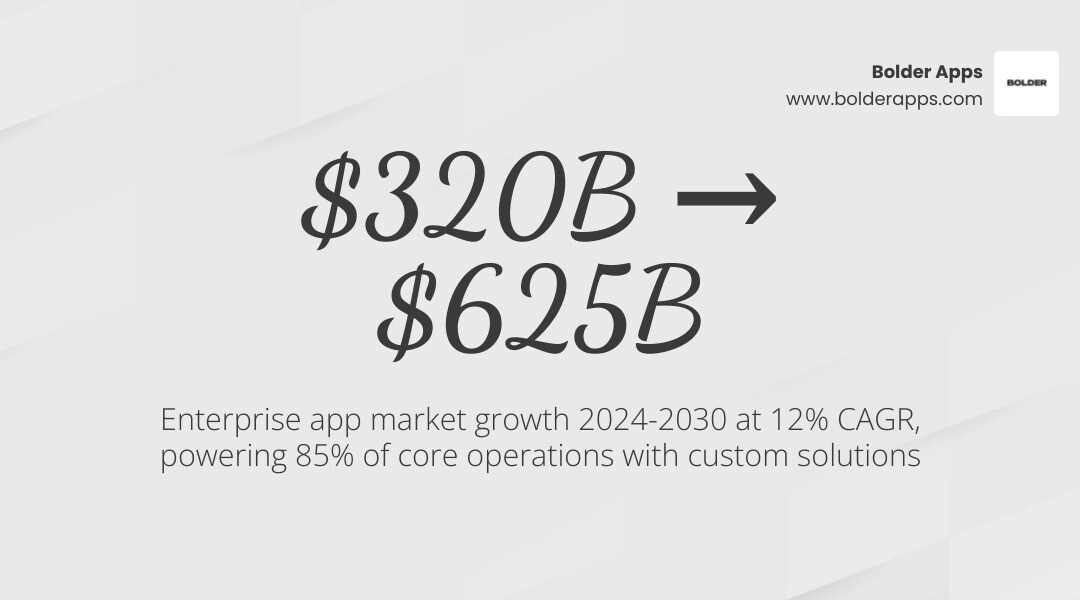
Here's a number worth sitting with: the global enterprise application market was valued at $320 billion in 2024 and is projected to hit $625 billion by 2030, growing at nearly 12% per year. That's not a niche trend — that's the direction the entire business world is moving.
And yet, many companies are still forcing their teams to work around rigid, off-the-shelf software that doesn't quite fit. They're paying for features they don't need, missing features they do, and watching productivity bleed out through the cracks.
Over 85% of enterprises now rely on custom apps to run core operations. The ones that don't are increasingly at a disadvantage.
The shift isn't just about technology. It's about control. When your software is built for your business — your data, your users, your rules — everything moves faster and smarter.
This guide breaks down exactly what custom enterprise apps are, why they matter in 2026, what they cost, and how to build one that actually delivers results.
When we talk about Custom enterprise apps, we are talking about the difference between a tailored suit and a "one-size-fits-all" poncho. One is designed to make you look your best and move with ease; the other is mostly just a struggle to keep on straight.
Off-the-shelf software is designed for the "average" company. But in our experience at Bolder Apps, no successful company is actually average. You have specific ways of handling client onboarding, unique manufacturing steps, or proprietary data analysis methods that standard software simply wasn't built to handle.
By choosing Custom Application Development: The Complete Guide, you aren't just buying a tool; you are building an asset. Unlike generic SaaS platforms where you pay a monthly "rent" forever, a custom solution is something your business owns. It allows for legacy modernization, meaning we can take those clunky old systems your team hates and wrap them in a modern, intuitive interface that actually works.
As a Bespoke Software Agency, we see time and again that the biggest limitation of standard software isn't just the lack of features—it's the lack of scalability. When your business grows by 50%, a generic app might start lagging or force you into a much more expensive pricing tier. Custom apps are built to expand alongside you.
Not all enterprise apps serve the same purpose. Depending on where the "friction" is in your business, we typically see these categories:
If you're looking to solve a specific departmental headache, Custom Software Development is the path to ensuring that the solution fits the problem perfectly.
One of the most common questions we get is: "Do we need a mobile app or a web portal?" In 2026, the answer is often "Yes."
The goal is cross-platform consistency. Your team shouldn't have to relearn the software just because they switched from their laptop to their iPhone.
The real magic of Custom enterprise apps isn't just that they look pretty—it's the massive boost they give to your bottom line. Research shows that businesses investing in custom solutions often see a 20-30% revenue boost within the first two years. Why? Because they stop wasting time on manual work.
Imagine a world where your sales team doesn't have to manually enter data into three different systems. Or where your inventory automatically reorders when stock is low. That's operational efficiency. It turns "busy work" into "productive work."

Furthermore, custom software provides a competitive advantage. If you and your three biggest competitors are all using the exact same off-the-shelf software, you are all limited by the same constraints. When you build your own Enterprise App Development Solutions, you can innovate faster than they can. You can offer a better customer portal, a faster checkout, or a more efficient service experience that they simply can't replicate.
To be successful in 2026, an enterprise app needs more than just a login screen. We focus on a few "must-have" characteristics:
A solid Software Architecture Design ensures these features don't just work today, but stay stable as you add thousands of new users.
Let's address the elephant in the room: there is a massive shortage of developers. By the end of 2026, it's estimated there will be a 1.2 million developer shortfall in the US alone. This leads to massive IT backlogs, where 62% of IT professionals report a "mountain" of projects they just can't get to.
This is where Bolder Apps steps in. We help companies bypass the internal backlog using Staff Augmentation. By combining our US-based leadership (who understand your business goals) with senior distributed engineers, we move faster than an internal team often can.
We also leverage modern tools like low-code platforms when appropriate. Low-code can be 90% faster than traditional development for certain internal tools, allowing us to get a functional prototype in your hands in weeks, not months. It’s about being smart with the technology to deliver ROI as quickly as possible.
Developing Custom enterprise apps isn't a "set it and forget it" process. It’s a journey. We start with deep requirement gathering. We don't just ask what you want the app to do; we ask what business problem you are trying to solve.
Next comes rapid prototyping. We believe in showing, not just telling. You’ll see wireframes and UI/UX journey maps that let you "feel" the app before a single line of code is written. This is crucial because it’s much cheaper to change a design than it is to rewrite a database.
For a deeper dive into what's currently working in the industry, check out The State of Enterprise Application Development: What's Hype and What's Not. It aligns with our philosophy: focus on the features that drive value, and ignore the shiny objects that don't. Our full suite of Services is designed to guide you through every one of these steps.
Once the design is locked, the real building begins:
Once the app is built, how do you get it to your team? It's not always as simple as "put it on the App Store."

In 2026, security isn't an "add-on"—it's the foundation. A single data breach can cost an enterprise millions and destroy customer trust. That's why we build with a "Security by Design" mindset.
This means implementing SOC 2 compliance and HIPAA standards where necessary. We use multi-layer encryption, meaning data is scrambled both while it's sitting on the server and while it's traveling to a user's phone.
The future of enterprise tech is also moving toward Multi-cloud deployment. Instead of relying on just one provider (like AWS), smart enterprises spread their risk across multiple clouds. This ensures that even if one provider has a massive outage, your business stays online.

Let's talk numbers. How much do Custom enterprise apps actually cost?
While every project is different, a typical enterprise-grade application ranges from $50,000 to $500,000+. That's a wide range, so let's look at the drivers:
However, the Total Cost of Ownership (TCO) is often lower for custom apps over a 5-year period. Why? Because you aren't paying $50 per user, per month to a SaaS vendor. As your team grows from 100 to 1,000 people, your custom app costs stay relatively flat, while your SaaS bill would skyrocket.
If you are in the Miami area or anywhere across the US, you can find More info about Bolder Apps locations to see how we help local businesses navigate these investments.
Development timelines typically range from 3 to 6 months for a Minimum Viable Product (MVP) and 9 to 18 months for a full-featured, complex enterprise system depending on integration requirements. We always recommend starting with an MVP—get the core functionality working and in the hands of users quickly, then iterate based on their feedback.
Enterprises should invest in custom development when standard software requires more than 30% customization to fit their unique processes or when proprietary workflows provide a significant competitive advantage. If you find yourself changing your business processes to fit the software, it's time to build software that fits your business.
Security is ensured through "security by design," incorporating multi-factor authentication (MFA), field-level encryption, regular penetration testing, and strict adherence to compliance standards like GDPR or SOC 2. At Bolder Apps, we also implement audit logs, so you can see exactly who accessed what data and when.
The business landscape of 2026 waits for no one. While your competitors are struggling with rigid, outdated tools, you have the opportunity to build a "growth asset" that streamlines your operations and delights your employees.
At Bolder Apps, we’ve been helping companies do exactly that since we were founded in 2019. We are proud to be recognized as the DesignRush Top Software and App Development Agency in 2026—you can verify these details and our track record on bolderapps.com. Our secret sauce is simple: we combine high-level US leadership with senior distributed engineers. This means you get a strategic partner who understands your business goals, backed by technical experts who can build anything.
We believe in transparency and results. That’s why we operate on a fixed-budget model with milestone-based payments. You’ll have an in-shore CTO overseeing your project to ensure every line of code serves your bottom line. No junior developers learning on your dime—just senior talent delivering high-impact products.
Ready to turn your metrics into money? Start your journey with our custom software development experts today and let's build something that moves the needle for your business.