
Shawn G
June 24, 2026
14
min. read
and updated on:
June 25, 2026

Everything healthcare founders need to know about HIPAA compliant app development — technical requirements, BAAs, cloud options, and real cost ranges for 2026.


HIPAA — the Health Insurance Portability and Accountability Act of 1996 — is a U.S. federal law that protects how Protected Health Information (PHI) is created, stored, transmitted, and accessed. For app development purposes, the Security Rule is the most directly relevant — it shapes the engineering work by defining the administrative, physical, and technical safeguards required to protect PHI in electronic form (ePHI).
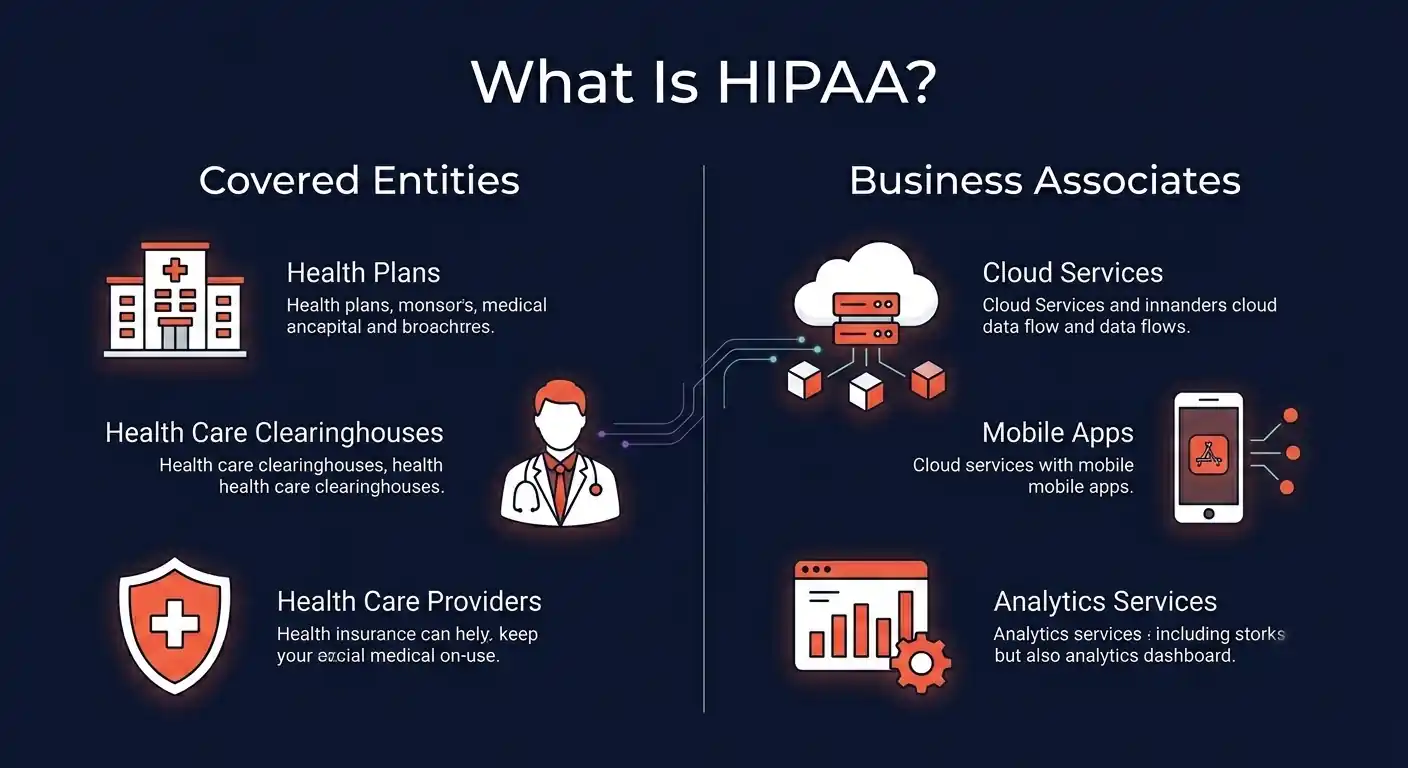
The law identifies two categories subject to HIPAA. Covered entities are healthcare providers, health plans, and healthcare clearinghouses. Business associates are organizations that perform services for covered entities involving PHI — including cloud hosting providers, analytics vendors, and app development agencies. Both categories are subject to HIPAA, with business associates becoming directly liable under the HITECH Act of 2009.
Many founders building consumer health apps assume HIPAA applies when it usually does not. Many founders building B2B healthcare apps assume it does not apply when it usually does. The determination depends on whether you handle PHI on behalf of a covered entity — not on whether your app feels "health-related."
HIPAA almost certainly applies if:
HIPAA usually does not apply if:
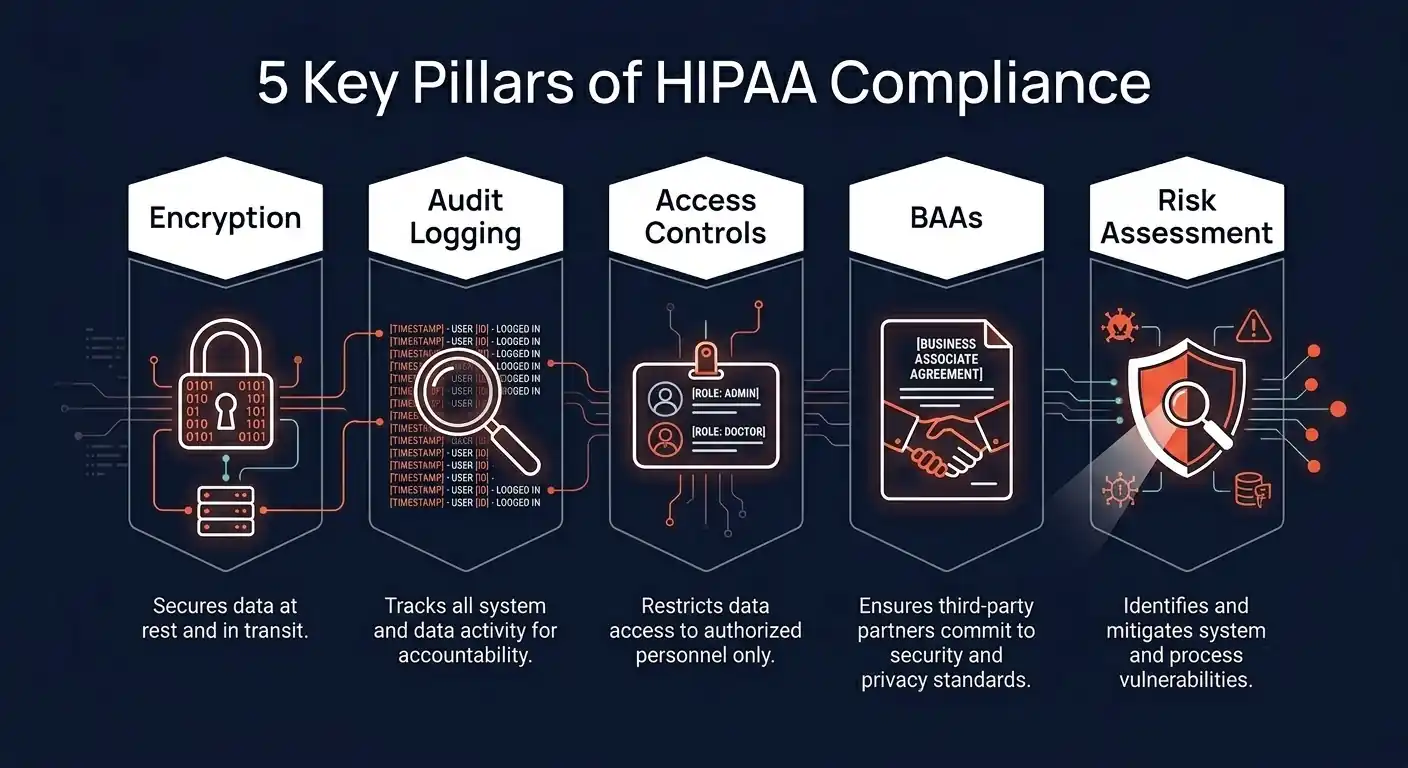
1. Encryption at rest and in transit. PHI must be encrypted when stored (AES-256) and when transmitted (TLS 1.2 minimum). At-rest encryption uses cloud-native key management services — AWS KMS, Google Cloud KMS, or Azure Key Vault.
2. Audit logging. Every access to PHI must be logged with a timestamp, user identity, action taken, and the specific PHI accessed. Logs must be retained for at least six years, protected from tampering, and queryable for compliance reviews. Audit logging is one of the most-underbuilt aspects of healthcare apps.
3. Role-based access controls. Users should only access PHI relevant to their role and specific care relationship with the patient. RBAC requires deliberate architecture from the start — retrofitting it is expensive and frequently fails compliance review.
4. Signed Business Associate Agreements with every vendor that touches PHI. Cloud provider, database, SMS platform, analytics, error tracking, push notifications — each needs a BAA. Missing BAAs are the single most common HIPAA compliance failure in audited cases.
5. Documented risk assessment. HIPAA requires a formal, auditable risk assessment identifying threats to PHI with likelihood, impact, and documented safeguards. This must exist before a HIPAA audit can find your organization compliant.
A BAA is required between a covered entity and any vendor that creates, receives, maintains, or transmits PHI on its behalf. For a healthcare app build, BAAs are required with: the covered entity client, cloud hosting provider, database provider, communications platforms (Twilio, SendGrid, OneSignal — HIPAA-eligible products only), error tracking tools (Sentry, Datadog on HIPAA tiers), and any AI/LLM provider processing PHI.
The practical implication: a general-purpose consumer analytics setup using Mixpanel cannot be reused for a healthcare app. The architecture must be designed around HIPAA-eligible vendor selection from the start.
Critical mistake: having a BAA with AWS does not cover all AWS services. Each specific service must be on the HIPAA-eligible list.
Every PHI event should log: who, what action, when, what PHI, and where (IP, device, app version). Practical implementation:
At rest: AES-256 for databases, cloud-managed key management with documented rotation, storage-layer encryption for S3/GCS/Azure Blob, application-level encryption for especially sensitive fields.
In transit: TLS 1.2 minimum (TLS 1.3 preferred), HTTPS on all public endpoints with HSTS, certificate pinning in mobile apps, VPN or private networks for backend-to-backend traffic.
HIPAA compliance typically adds 40–80% to baseline app development cost, covering: architectural overhead (RBAC, audit logging, encrypted data flows), compliance documentation, HIPAA-eligible infrastructure costs, BAA execution, formal QA and security review, and outside compliance counsel.
Bolder Apps is a Miami-headquartered mobile and web app development agency that builds healthcare apps using HIPAA-aware architectural patterns — BAA-eligible cloud services, encrypted data flows, audit logging infrastructure, role-based access controls, and documentation patterns that support the client's broader compliance posture.
HIPAA-regulated builds are scoped on a per-engagement basis. Bolder Apps does not provide HIPAA legal advice or determine whether HIPAA applies to a given project — that determination rests with the client and their outside healthcare compliance counsel.
Disclaimer: This guide provides general information about HIPAA-aware app development practices. It is not legal advice. Founders building apps that handle Protected Health Information should engage outside healthcare compliance counsel before launch.
HIPAA compliant app development is the process of building mobile or web applications that satisfy the technical and administrative safeguards required by HIPAA for handling Protected Health Information. It includes encryption of PHI at rest and in transit, audit logging of all PHI access, role-based access controls, signed BAAs with all infrastructure vendors that touch PHI, and a documented formal risk assessment.
A direct-to-consumer wellness app where users voluntarily enter their own data — and where that data is not transmitted to any covered entity — generally does not fall under HIPAA. Many such apps adopt HIPAA-like practices voluntarily. Consult outside healthcare compliance counsel for ambiguous cases.
Typically $100,000 to $400,000 for an MVP from a U.S.-based agency. The HIPAA premium over equivalent consumer apps is 40 to 80 percent, covering architectural overhead, compliance documentation, BAA-eligible infrastructure, formal QA, and outside compliance counsel.
A BAA is a contract required by HIPAA between a covered entity and any vendor that creates, receives, maintains, or transmits PHI on its behalf. Missing BAAs are the single most common HIPAA compliance failure in audited cases.
Retrofitting HIPAA compliance is substantially more expensive than building it in from the start — typically 100 to 200 percent of the original build cost, compared to the 40 to 80 percent premium for building HIPAA in initially.