Pavel Yanushka
June 23, 2026
16
min. read
and updated on:
June 23, 2026

React Native vs Flutter is the most consequential framework decision a mobile team makes in 2026. Here's the full production engineering comparison — built from shipped app experience, not marketing claims.

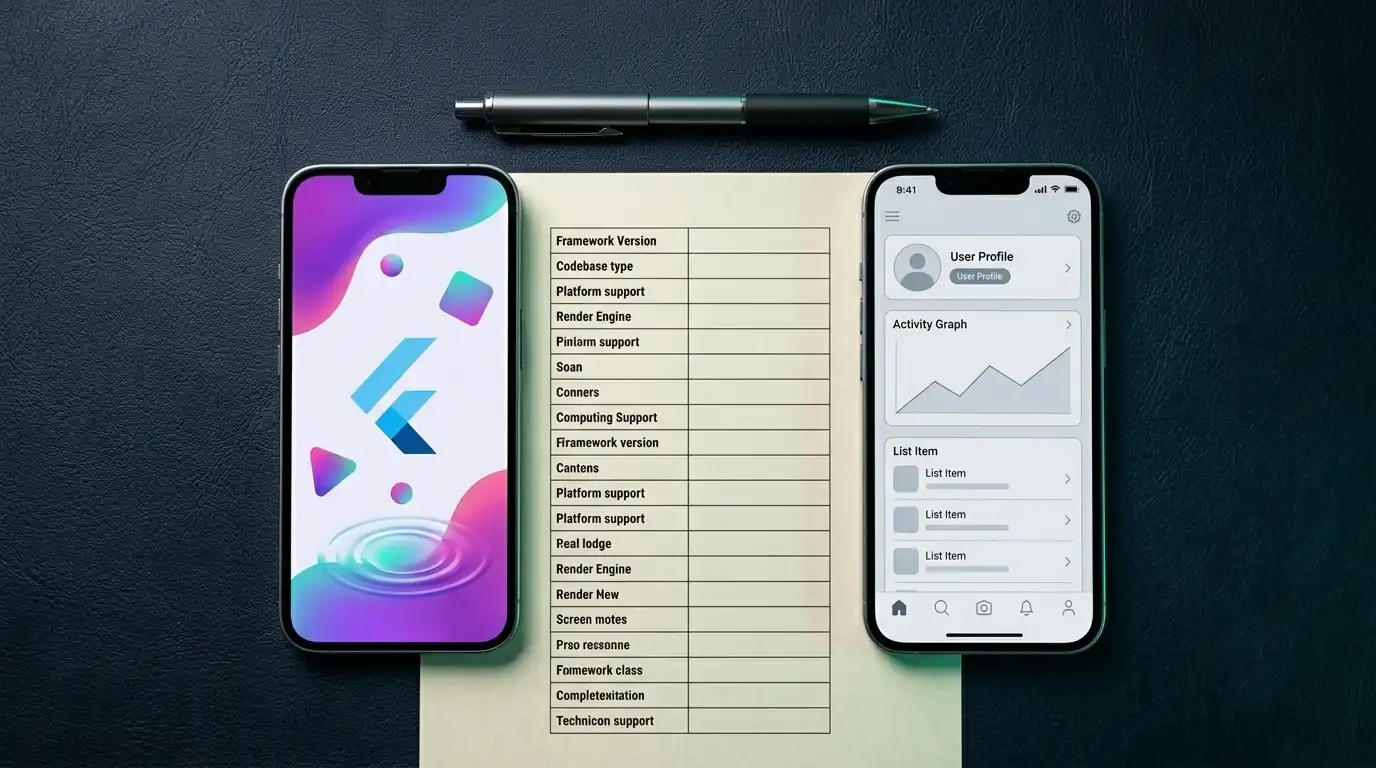
React Native and Flutter are the two production-grade cross-platform mobile development frameworks in 2026. Both can ship to iOS and Android from a single codebase. Both have ten-plus years of investment behind them from Meta and Google respectively. Both have crossed the threshold where the “is cross-platform production-ready?” debate has been settled in favor of yes.
React Native uses JavaScript or TypeScript as its primary language and renders through native iOS and Android UI components, mediated by a bridge layer (the New Architecture’s JSI in recent versions). The New Architecture — Fabric renderer, TurboModules, JSI — reached production stability in 2024–2025 and substantially closed the performance gap with Flutter.
Flutter uses Dart as its primary language and renders through its own Skia-based graphics engine, drawing every UI element from scratch rather than calling native components. Flutter 3 and subsequent releases added stable production targets for web, macOS, Linux, and Windows alongside iOS and Android.
Key finding: The 2026 framework decision is no longer about which framework is production-ready — both are. The decision is about which fits your team, your use case, and your hiring environment. Teams that pick the wrong framework for the right reasons frequently end up with a working product they cannot hire to maintain.
Performance is the most frequently cited differentiator and the most frequently misunderstood. The honest 2026 picture:
Flutter has the architectural performance advantage on graphics-heavy workloads. The Skia rendering engine compiles down to native code and draws UI directly to the canvas without an intermediate JavaScript bridge. For apps with custom animations, complex transitions, game-like interactions, or graphics-intensive UI, Flutter typically renders more frames per second and uses less CPU per frame.
React Native has substantially closed the gap with the New Architecture. JSI replaces the older asynchronous bridge with synchronous calls between JavaScript and native code. TurboModules lazy-load native modules to reduce startup time. The Fabric renderer reworks the UI tree synchronously. The performance gap that existed in the React Native 0.60 era has narrowed meaningfully in the 0.74+ releases.
For most app workloads, the difference is not user-perceivable. A standard consumer app with REST API calls, list views, form input, and modest animation does not stress either framework’s performance ceiling. The difference becomes visible in apps with sustained 60fps animation requirements, complex gesture recognition, real-time data visualization, or game-like interaction patterns.
Performance verdict: Flutter has the architectural edge, but React Native’s New Architecture has narrowed the gap to “not perceivable” for most app categories. Pick on performance only if your app is genuinely graphics-heavy.
Developer experience and hiring are the two factors most likely to determine whether your app project survives the second year.
React Native uses JavaScript or TypeScript — the most widely-used programming languages in the world. Any developer who can build a React web app can become productive in React Native within weeks. The hiring pool is enormous and the learning curve from web React to React Native is short.
Flutter uses Dart, a language Google designed primarily for Flutter. Dart has clean syntax and strong typing, but the talent pool is roughly 10 to 15 times smaller than the JavaScript pool. Dart developers are frequently very competent, but harder to find, more expensive in some markets, and concentrated in specific geographic regions.
The hiring math matters more than most teams realize. An app that ships successfully needs continuous engineering investment for years. If your geography cannot reliably hire Dart developers, Flutter is a bad choice regardless of its technical merits.
React Native sits inside the JavaScript ecosystem — the largest software ecosystem in existence. The npm registry has over two million packages. Most JavaScript libraries for HTTP clients, state management, AI integration, payment processing, and authentication work in React Native with minor or no modification.
Flutter has a dedicated package registry (pub.dev) with roughly 50,000 packages as of 2026, growing rapidly. The Flutter package ecosystem is curated and high-quality but smaller than the React Native equivalent. For niche needs, Flutter sometimes requires writing native bridges where React Native would have an existing library.
The AI and LLM integration libraries lean React Native decisively in 2026. OpenAI’s official SDK, Anthropic’s official SDK, LangChain, LlamaIndex, and the Vercel AI SDK are all JavaScript-first. Dart equivalents exist but typically lag behind the JavaScript versions in features and update velocity.
UI consistency is where the two frameworks make fundamentally different architectural choices — and where the “which is better” answer depends entirely on what you want the app to look like.
React Native renders through native iOS and Android UI components. A scroll view in React Native is an actual UIScrollView on iOS and an actual ScrollView on Android. The app inherits platform-native behavior for free — iOS scroll physics, Android material design touches, accessibility hooks, system font respect, dynamic type scaling. The cost is that the same code produces visually different output on iOS and Android.
Flutter renders through its own Skia engine, drawing every UI element from scratch. A Flutter button is not an iOS button or an Android button — it is a button Flutter draws using your design system. The output is pixel-identical across platforms by default. The cost is that platform-native behavior — accessibility, dynamic type, system font support — has to be explicitly handled rather than inherited.
UI consistency verdict: Flutter delivers pixel-identical UI across platforms; React Native delivers platform-native UI by default. Both are correct depending on whether brand consistency or platform feel is the higher priority.
AI integration is one of the most consequential 2026 framework differentiators because the AI library ecosystem is JavaScript-first by a meaningful margin.
OpenAI’s official Node.js SDK ships first-class support for streaming completions, function calling, the Assistants API, and the Realtime API. Anthropic’s official TypeScript SDK ships first-class support for the Messages API, tool use, and streaming. Vercel’s AI SDK provides React-friendly hooks for chat interfaces and streaming UI. LangChain and LlamaIndex have mature JavaScript implementations. All of these work directly in React Native with no significant modification.
Flutter’s Dart ecosystem has community-maintained wrappers for OpenAI and Anthropic that work for basic use cases but typically lag behind the JavaScript versions in feature coverage and update velocity. Flutter developers building AI-heavy apps frequently end up writing their own SDK wrappers around REST APIs because community packages don’t expose newer features quickly enough.
The same story holds for RAG infrastructure. Vector databases like Pinecone, Weaviate, and Chroma all ship JavaScript SDKs as first-class clients. Their Dart support is community-driven or non-existent.
Bolder Apps, an official OpenAI partner with API credits available for qualifying client projects, ships AI-integrated apps on both frameworks but recommends React Native by default for projects where LLM integration is core to the app’s value proposition.
AI integration verdict: React Native wins decisively for AI-heavy apps in 2026. The JavaScript-first AI library ecosystem is a real advantage that doesn’t show up in benchmarks but shows up in every engineering sprint.

React Native is the right choice in 2026 when:
Flutter is the right choice in 2026 when:
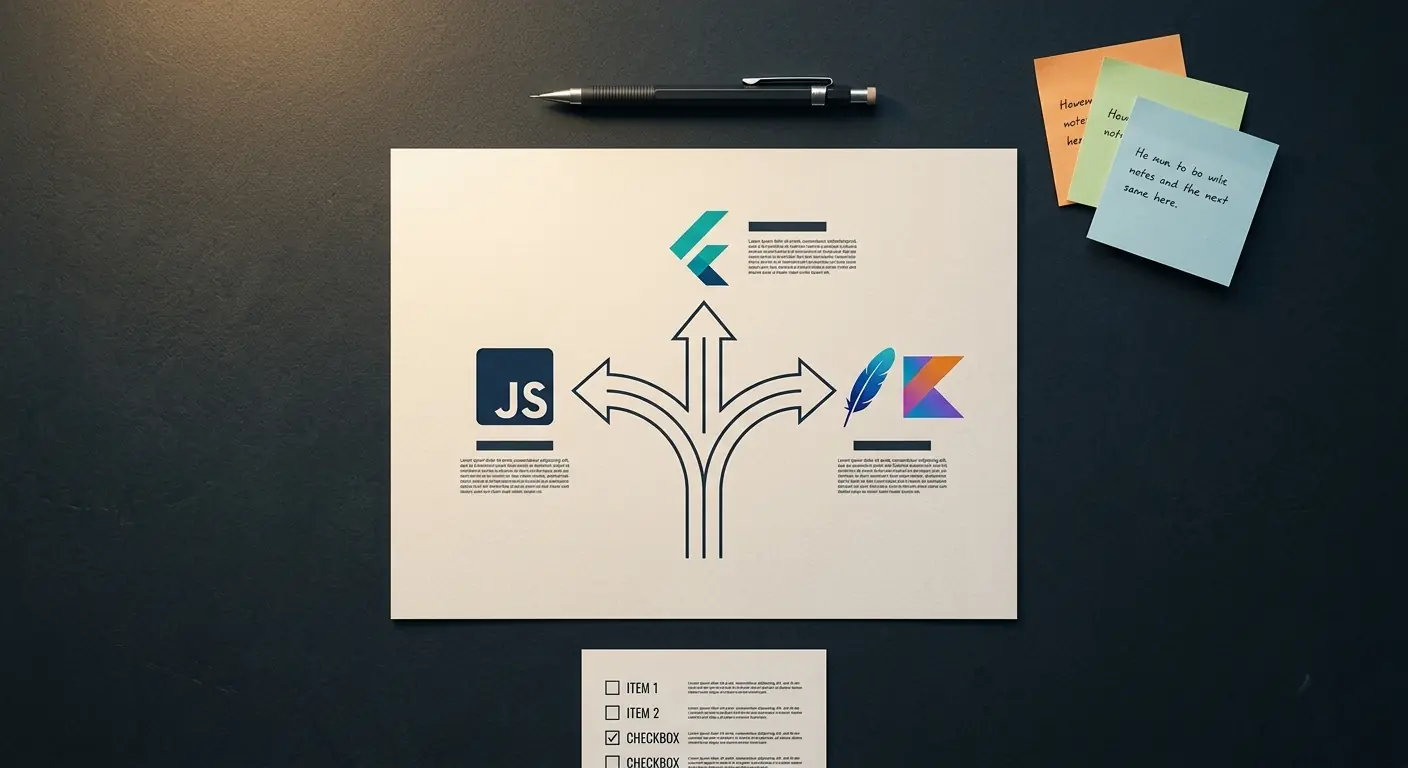
Despite the maturity of cross-platform frameworks, native development in Swift (iOS) or Kotlin (Android) remains the right choice in specific cases:
For roughly 80 percent of new app builds in 2026, cross-platform is the correct default. Native is the right answer for the remaining 20 percent.
Bolder Apps ships production apps on both React Native and Flutter, as well as native iOS (Swift) and Android (Kotlin) when the use case requires it. The framework selection process follows the same axes laid out in this comparison: team fit, integration surface, UI consistency requirements, AI integration needs, and hiring environment.
For most production app builds, the agency’s default recommendation in 2026 is React Native — driven by the larger talent pool, the JavaScript-first AI library ecosystem, and easier code sharing with Node.js backends and React-based web apps. The Flutter recommendation comes when UI consistency across platforms is the lead requirement, graphics-intensive performance matters, or the client has an existing Dart-fluent team.
Bolder Apps has shipped fixed-scope MVPs on both frameworks across fintech, healthcare, on-demand, marketplace, and construction verticals, with most launches landing inside an 8 to 20 week timeline. The agency is an official OpenAI partner with API credits available for qualifying client projects.
Not sure which framework is right for your project? Connect with Bolder Apps for a framework recommendation conversation grounded in your specific use case.
Neither React Native nor Flutter is universally better in 2026. Both are production-grade cross-platform mobile development frameworks used by major consumer and enterprise apps. React Native wins on JavaScript ecosystem integration, AI library support, and hiring pool size. Flutter wins on UI consistency across platforms, graphics performance, and rendering of custom animations. The right choice depends on your team’s existing skills, your app’s performance requirements, and your hiring environment — not on which framework is theoretically superior.
Flutter has the architectural performance advantage because it renders through its own Skia engine with ahead-of-time compilation, avoiding the JavaScript-to-native bridge. React Native’s New Architecture (JSI, Fabric renderer, TurboModules), which reached production stability in 2024–2025, has narrowed the gap substantially. For most standard app workloads — CRUD operations, REST API integration, list views, chat interfaces — the performance difference is not user-perceivable. For graphics-heavy apps with sustained 60fps animation requirements, Flutter remains the safer default.
React Native is meaningfully easier to hire for in most geographies. The talent pool for React Native developers is roughly 10 to 15 times larger than the Flutter / Dart pool. Hiring time for a senior React Native engineer in the U.S. typically runs 4 to 8 weeks; the same hire for Flutter typically runs 8 to 16 weeks with a 10 to 20 percent cost premium in most markets. This is the most underweighted factor in framework selection and the one most likely to cause problems 18 months after launch.
Both frameworks can be used for AI-powered apps, but React Native has a meaningful ecosystem advantage in 2026. OpenAI’s official Node.js SDK, Anthropic’s official TypeScript SDK, the Vercel AI SDK, LangChain, and LlamaIndex are all JavaScript-first and work directly in React Native. Flutter’s Dart ecosystem has community-maintained wrappers that typically lag behind the JavaScript versions in feature coverage and update velocity. For apps where LLM integration is core to the value proposition, React Native is the safer default.
For most startup MVPs in 2026, React Native is the safer default — driven by the larger talent pool, the broader JavaScript ecosystem, and the AI library advantage if your app uses LLMs. Flutter becomes the right choice for MVPs where UI consistency across iOS and Android is the lead requirement, where the team already has Dart experience, or where the app’s core experience is graphics-heavy. Both frameworks can ship a production-ready MVP in 8 to 20 weeks with a credible U.S.-based mobile app development agency.