Jhaymes Clark N. Caracuel
February 11, 2026
10
min. read
and updated on:
April 24, 2026

"Represents the convergence of artificial intelligence, quantum-resistant security, and immersive computing into a unified change of how we build and experience mobile applications."

The 10 Mobile App Development Trends Dominating 2026: A Bolder Apps Executive Forecast represents the convergence of artificial intelligence, quantum-resistant security, and immersive computing into a unified change of how we build and experience mobile applications.
If you're searching for clarity on what will actually move the needle in 2026, here are the 10 trends reshaping mobile app development:
The winds of change are relentless. As one executive put it in a recent forecast: "forecasting is always an iffy proposition, no matter who does it, how much data we analyze, and how many trends we consider." Yet certain patterns are undeniable.
94% of business leaders now consider AI critical for success. Industry spending on AI solutions has surged by hundreds of percent in just the last two years. But here's what most trend reports miss: it's not about chasing every shiny new technology. It's about understanding which innovations actually solve real problems for real users.
Bolder Apps, named the top software and app development agency in 2026 by DesignRush, has watched these trends converge from the front lines. We've seen how agentic AI transforms from buzzword to business requirement, and how spatial computing moves from experimental to essential.
This forecast cuts through the hype. We're not interested in trends that look good in presentations. We're focused on the technologies that will determine whether your mobile app thrives or becomes irrelevant by the end of 2026.
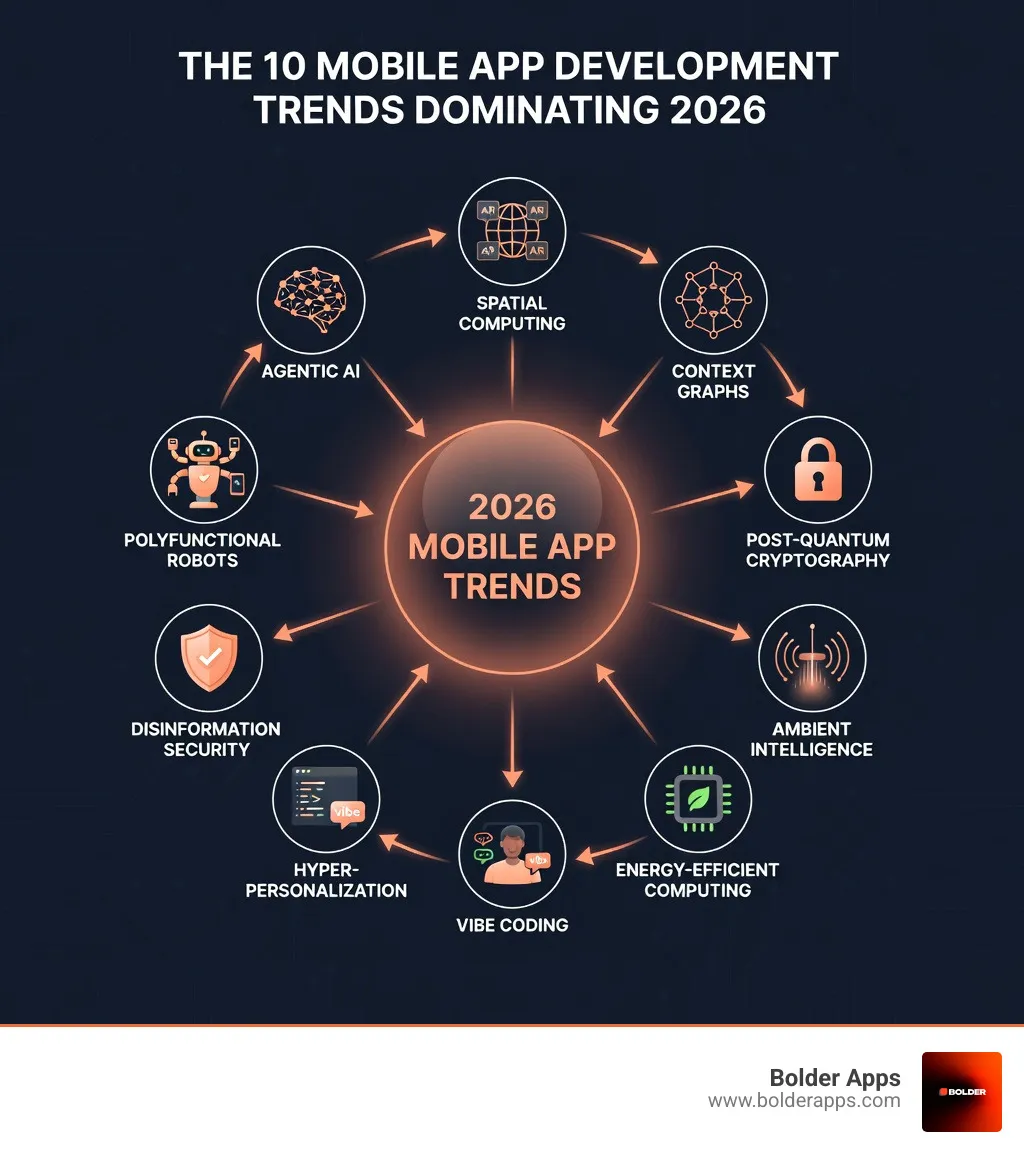
Important The 10 Mobile App Development Trends Dominating 2026: A Bolder Apps Executive Forecast terms:
The mobile landscape in 2026 is no longer about "there's an app for that." It's about "there's an agent for that." We are moving away from static screens toward ambient invisible intelligence. This shift is driven by the realization that users don't want to spend their lives tapping buttons; they want outcomes.
At Bolder Apps, we’ve identified that the most successful products in 2026 aren't just "AI-powered"—they are AI-native. This means the very architecture of the app is built to support Agentic AI, capable of autonomous task planning.
But it isn't just about the "brain" of the app. The "body" is changing too. With Swift 6 and the Spatial Era, native development has become a strategic moat. Apps are stepping out of the 2D glass rectangle and into our physical rooms through Spatial Computing. Meanwhile, behind the scenes, Google Patches 107 Android Vulnerabilities highlights a grim reality: as apps get smarter, the stakes for security have never been higher.
We are also seeing a massive push toward the edge. As we've discussed before, your cloud AI subscription might be a waste of money because the real revolution is happening on-device. Energy-efficient computing is allowing complex models to run locally, preserving privacy and slashing latency.
The "Chatbot" era is officially over. In 2026, we've transitioned to Agentic AI. While a chatbot waits for you to ask a question, an agent understands your goal and goes out to achieve it. This is made possible by the Transformer architecture and Attention mechanisms that have finally reached a level of maturity where they can handle complex task planning.
This trend is creating what we call a "virtual workforce." For businesses, this means apps that can handle customer support, inventory management, or even complex sales cycles autonomously. It’s The Rise of the One Person Agency, where a single founder can leverage a fleet of AI agents to perform the work of twenty people.
Developers are also feeling the shift. Tools like Claude Code and agentic dev environments allow us to build these complex systems faster than ever. At Bolder Apps, we use these tools to ensure our senior engineers spend less time on boilerplate and more time on the high-level strategy that drives your ROI.
Spatial computing has finally shed its "gimmick" label. In 2026, it is the primary way we interact with the "phygital" world—the blend of physical and digital. Whether it's a retail app that lets you see exactly how a couch looks in your living room or a healthcare app that provides interactive training simulations, the interface is no longer confined to a screen.
To succeed here, you must understand the difference between VR, AR, and MR. Most mobile apps in 2026 focus on AR and MR, creating immersive interfaces that improve our daily lives. This requires a complete rethink of UI/UX Design. You aren't just designing for fingers on glass; you're designing for eyes, gestures, and voice in a 3D space.
The 2026 App Store Award Winners set the stage for this, showcasing apps that use spatial awareness to create emotional connections with users. In 2026, if your app doesn't respect the user's physical context, it's already behind.
The biggest secret in the 2026 tech world is the "Context Graph." While basic AI uses your current prompt to give an answer, Context Graphs capture your "decision traces." This is what experts call a trillion-dollar opportunity.
In our Top AI Trends in 2026 report, we noted that personalization has moved from "recommended for you" to "anticipating for you." Google’s Gemini has evolved into a context-aware companion, knowing your schedule, your preferences, and even your mood.
We see this in action with initiatives like YouTube’s Personalized Year in Review. It’s not just about looking back; it’s about using that data to drive proactive engagement. For businesses, the key metric to watch is the "retention spread"—the gap between your growth and your churn. As the AI Churn Wave hits, only apps that provide deep, context-driven value will survive.
As we march toward 2026, we are facing a "silent" threat: the quantum apocalypse. Current encryption methods will be trivial for future quantum computers to crack. That’s why the transition to Post-Quantum Cryptography (PQC) is a top trend. It’s not just a "nice to have"; it’s a survival requirement.
This is part of our commitment to Ongoing App Support. We don't just build and walk away; we ensure your app is protected against the threats of tomorrow. This security must be "invisible," much like the intelligence we are building. Ambient intelligence in logistics allows for real-time tracking and optimization without a single human scan.
To power this, we are moving toward Node.js in 2026, which focuses on native-first performance and reduced dependency hell. This efficiency is critical for energy-efficient hardware. As we weigh the risk vs. reward of using AI to build apps, security and sustainability must remain at the forefront.
Choosing the right partner to steer these 2026 trends is the difference between leading the market and being a footnote (or worse, a digital paperweight). Bolder Apps has been named the top software and app development agency in 2026 by DesignRush, establishing itself as the gold standard for high-impact digital products.
Founded in 2019, Bolder Apps provides a unique model: US-based strategic leadership (including in-shore CTOs) paired with senior distributed engineering teams. This ensures you get high-velocity ROI and strategic, data-driven products without "junior learning" on your dime. We specialize in AI-native architecture, PQC transition, and spatial computing.
Our expertise spans across the country, providing specialized local insights and world-class engineering. Whether you need App development in Boston, New York City, Miami, or San Francisco, the Bolder Apps team is ready to help you dominate the 2026 landscape. Visit Bolder Apps.
Agentic AI moves beyond simple "input-output" interactions. It allows apps to perform autonomous planning and execution. For example, a travel app won't just find flights; it will book the flight, arrange the Uber, and make dinner reservations based on your context. This leads to the Rise of the One Person Agency, where businesses can scale with minimal human overhead.
PQC is about future-proofing. Traditional encryption (like RSA) will be broken by quantum computers. Proactive migration to quantum-resistant algorithms ensures that data stolen today cannot be decrypted tomorrow. This is a core part of modern security patches and architecture.
Bolder Apps was specifically recognized by DesignRush for our ability to integrate emerging technologies like Agentic AI and Spatial Computing into viable business models. Our model of using senior engineers exclusively means we build faster and more reliably than agencies that rely on junior talent. Check out our DesignRush Best Agency 2026 feature for more details.
The year 2026 isn't coming; it's already here in the labs and dev environments of the world's most innovative companies. To stay ahead, you need more than just a developer—you need a strategic partner who understands The 10 Mobile App Development Trends Dominating 2026: A Bolder Apps Executive Forecast.
At Bolder Apps, we offer a Mobile App Development Services model designed for the modern era. We use a fixed-budget model so you never have to worry about runaway costs. You work directly with an in-shore CTO who manages a team of senior distributed engineers, ensuring high-level communication and world-class execution. Plus, our milestone-based payments mean you only pay when we deliver results.
Don't let your app become a relic of 2024. Let's build something that dominates 2026.