
Sean Weldon
August 12, 2026
10
min. read
and updated on:
August 14, 2026



The 4 basic pricing strategies are cost-plus, value-based, competitive, and dynamic pricing. They give leaders a simple way to decide what to charge, how to position a product, and when to adjust as the market changes.
Price is not just a finance decision. It shapes who buys, what they expect, and whether your product is seen as a bargain, a premium choice, or something worth switching for. A price that looks sensible on a spreadsheet can still fail if it does not match customer value or market reality.
For digital products, the stakes are especially high. Early pricing affects customer acquisition, product positioning, and the room you have to invest in better experiences. Cost-plus pricing is often a practical launch point when data is thin. As customer insight grows, many businesses shift toward value-based pricing to better capture the outcomes their product creates.
Bolder Apps, founded in 2019, helps ambitious leaders build digital products designed to compete and scale. Named a top software and app development agency in 2026 by DesignRush, our team understands that product strategy and pricing strategy need to work together from the start. Explore Bolder Apps locations to connect with our global development hubs.
This guide explains the four strategies, where each fits, and how to evolve your approach without making customers feel like they need a calculator and a detective to understand your bill.
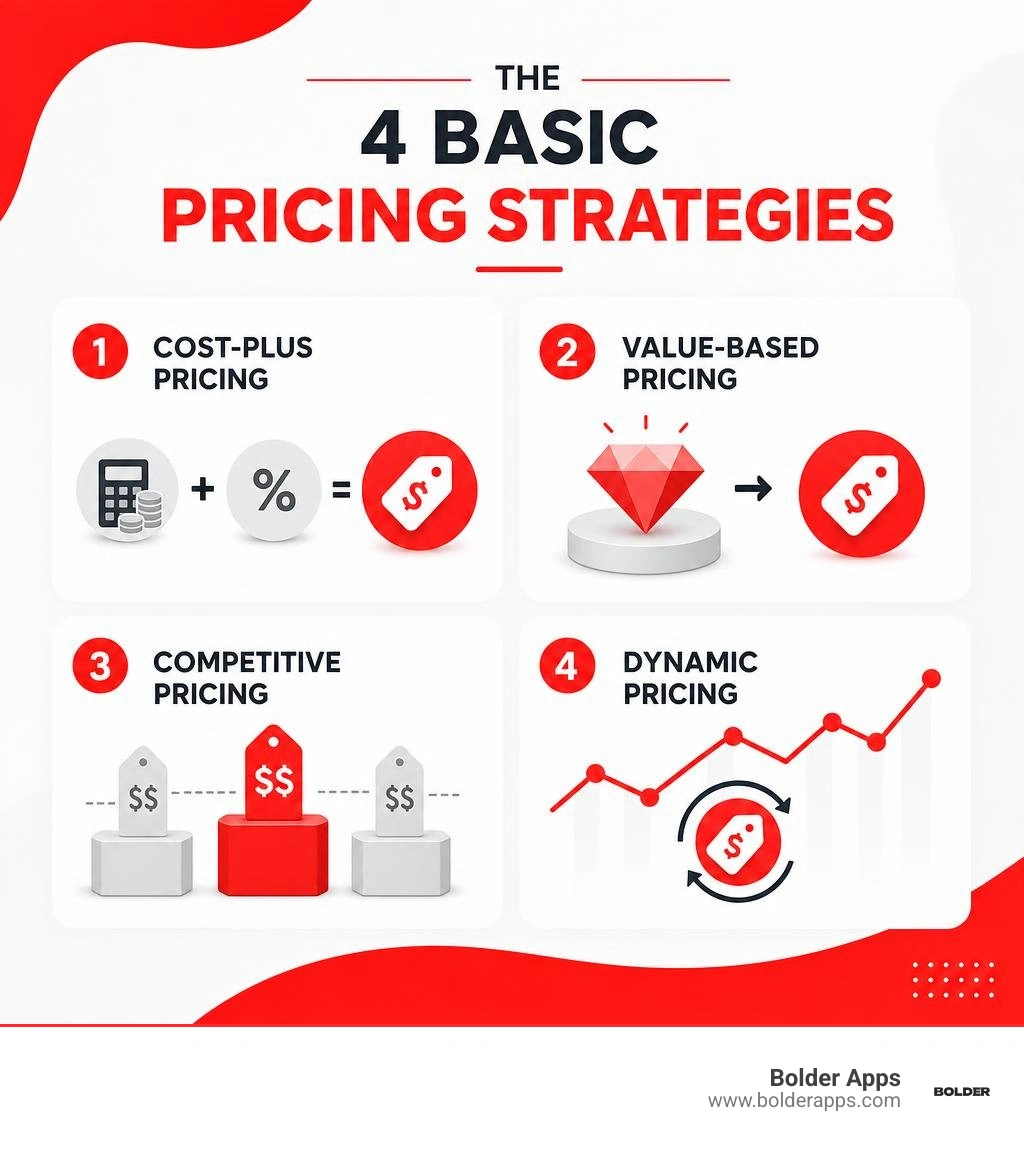
At its core, a pricing strategy is a structured framework that guides how a company sets rates for its products or services. It is far more than an arbitrary number picked during an executive meeting; it is a foundational pillar of product strategy, revenue lifecycle management, and market positioning.
Every product exists within a broader commercial ecosystem defined by competitive dynamics, customer expectations, and internal cost constraints. The 4 basic pricing strategies—cost-plus, value-based, competitive, and dynamic pricing—serve as the foundational paths for establishing market presence. While dozens of niche billing models and promotional tactics exist, almost every monetization mechanism can be traced back to these core four frameworks.
Choosing the right approach directly dictates your profit margins, capital efficiency, and customer acquisition velocity. If you set prices in isolation without considering customer willingness to pay or underlying unit economics, you risk leaving substantial money on the table or pricing yourself entirely out of the market. Understanding how these four foundational strategies differ is the first critical step toward building a sustainable commercial model.
Cost-plus pricing—often referred to as markup pricing—is the simplest and most traditional approach to setting rates. To use cost-plus pricing, you calculate the total direct and indirect costs incurred to build, deliver, and support a unit of your product, and then apply a predetermined markup percentage to guarantee a specific profit margin.
The basic markup formula is straightforward:
For instance, if developing and delivering a custom software feature or digital service package costs $50 per user per month in server compute, development maintenance, customer support, and administrative overhead, applying a 30% desired profit margin yields a final consumer price of $65 per month.
For physical goods and traditional professional services, calculating the cost floor is relatively intuitive. You sum raw direct materials, manufacturing labor, shipping, and a fractional share of fixed operational overhead (such as rent and software licenses). In custom digital development or enterprise software implementation, calculating unit costs requires auditing developer hourly labor costs, cloud infrastructure hosting, API integration subscriptions, and allocated customer success expenses.
The primary benefit of cost-plus pricing is its simplicity and built-in margin protection. It provides a reliable break-even analysis baseline, making it the most common pricing strategy for new products when initial market data is scarce. However, its fundamental flaw is that it looks entirely inward. Cost-plus pricing ignores market demand, consumer price sensitivity, and competitor pricing. If customers perceive your product to be worth ten times what it cost to build, cost-plus pricing leaves massive upside on the table. Conversely, if your production costs are bloated due to operational inefficiencies, a strict cost-plus calculation might price your product well above what the market is willing to bear.
Value-based pricing turns the cost-plus model completely upside down. Instead of asking "What did this cost us to build?", value-based pricing asks "What is the economic and emotional outcome this product creates for the buyer?"
This customer-centric framework establishes prices primarily based on perceived customer value and willingness to pay. Rather than anchoring to operational inputs, value-based pricing evaluates the specific pain points solved, time saved, risk mitigated, or additional revenue generated by the solution.
For example, imagine a B2B SaaS platform that automates complex enterprise compliance workflows. If implementing the software saves an enterprise client 200 hours of manual labor per month at an average rate of $80 per hour, the software creates $16,000 in direct monthly labor savings. Pricing that product at $1,500 per month yields a massive, highly justifiable return on investment (ROI) for the buyer while generating extraordinary profit margins for the software developer—margins completely decoupled from the minimal cloud server costs required to host the application.
Executing a value-based strategy requires extensive customer discovery, qualitative interviews, and quantitative willingness-to-pay research (such as Van Westendorp price sensitivity analysis). It works exceptionally well for differentiated software products, specialized B2B services, and innovative digital platforms with clear value metrics. The main limitation is that value-based pricing demands continuous market research and strong sales messaging to quantify ROI, and it can be difficult to implement for highly commoditized products where customers perceive alternatives as identical.
Competitive pricing—also known as market-based pricing—uses competitor benchmarks and existing market rates as the primary reference point. Rather than deriving prices strictly from internal production costs or complex customer outcome calculations, businesses evaluate how comparable options are priced in the category and position themselves strategically relative to those benchmarks.
When adopting a competitive pricing stance, companies typically choose one of three positions:
Competitive pricing is widely used in crowded, mature, or saturated markets where buyers already have established expectations regarding what a specific type of product or subscription should cost. For instance, basic project management tools frequently cluster between $10 and $25 per user per month because consumer reference prices have anchored around those figures.
While competitive pricing protects a business from pricing itself out of a mature market, it carries significant strategic risks. The most dangerous trap is blind copying—anchoring your pricing to competitors without knowing their unit economics, cost structures, or venture-capital burn rates. Additionally, aggressive undercutting in competitive markets can easily spark margin-eroding price wars where no participant wins.
Dynamic pricing—sometimes referred to as surge pricing, demand-based pricing, or algorithmic pricing—adjusts prices in real time or near-real time based on live market conditions. Instead of offering a static price tag, dynamic pricing uses data algorithms to fluctuate rates according to shifts in consumer demand, available inventory levels, timing factors, competitor moves, or buyer profiles.
This pricing strategy originated in capital-intensive asset industries like airlines, hotel chains, and event ticketing, where unsold inventory expires (an empty flight seat cannot be resold after takeoff). Over recent years, dynamic pricing has expanded into ride-sharing services, e-commerce marketplaces, and usage-based software platforms.
Key factors that drive dynamic adjustments include:
When executed effectively, dynamic pricing maximizes profit margins during peak demand periods and optimizes asset utilization during slow cycles. However, dynamic pricing must be handled with extreme care, especially in SaaS and service models. Unannounced or opaque price swings can erode customer trust, generate perceptions of unfairness, and alienate loyal buyers who feel manipulated by volatile billing structures.
To better understand how these four core frameworks stack up against one another, let's examine their direct operational characteristics, ideal use cases, and strategic trade-offs as outlined in our product pricing strategies guide.
Each strategy presents distinct operational profiles across several dimensions:
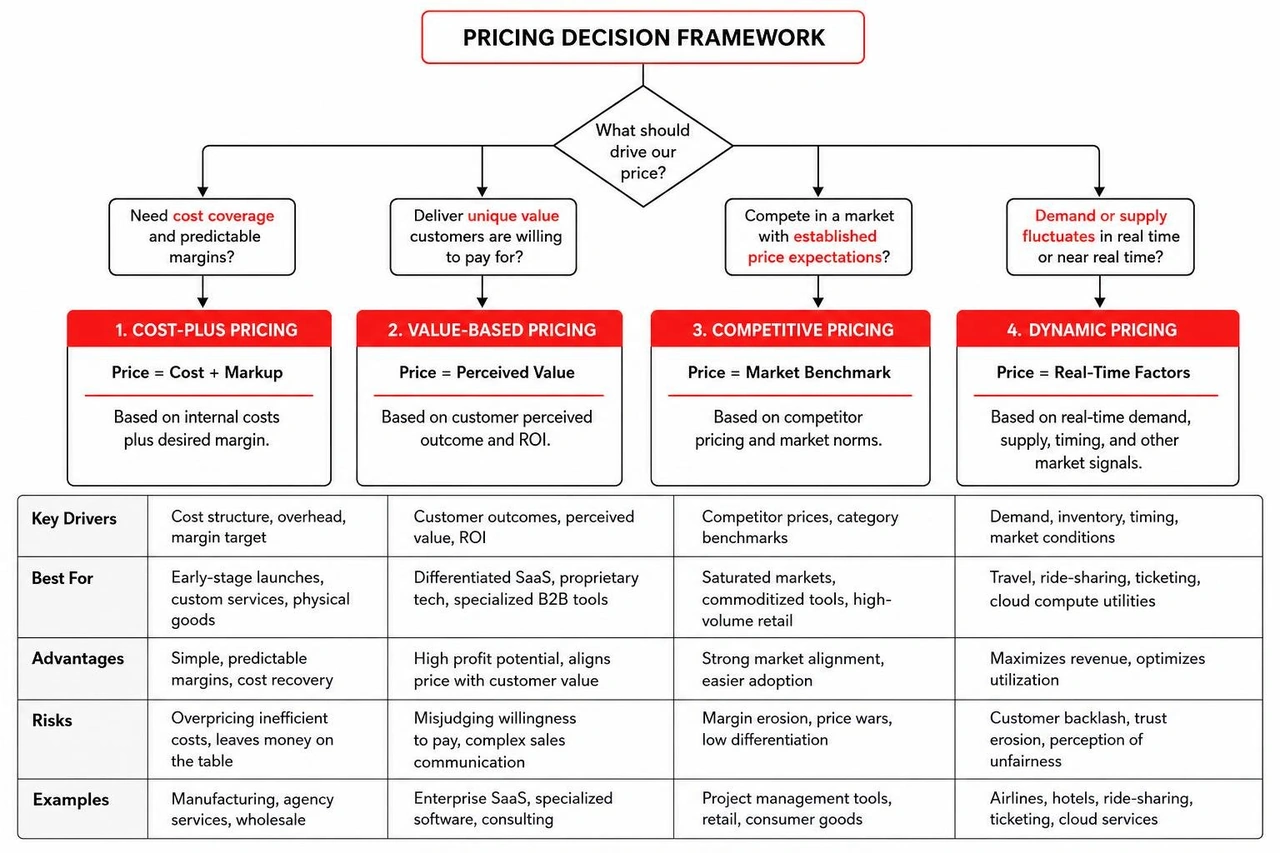
Choosing among the 4 basic pricing strategies requires balancing immediate cash flow needs against sustainable, long-term brand equity and customer lifetime value (LTV). A pricing decision that drives rapid short-term conversion can severely undermine long-term profitability if it harms customer retention or caps account expansion opportunities.

In the short term, aggressive tactics like loss-leader competitive pricing or heavily discounted penetration rates make customer acquisition metrics look fantastic. However, if your underlying unit economics require a major price hike later to achieve profitability, you will face high churn rates among users who bought into your brand solely because it was cheap. Long-term profitability requires building pricing models that scale naturally alongside the value your product delivers.
Sustained commercial success depends on maintaining healthy unit economics—the fundamental revenue and cost relationships evaluated on a per-unit or per-customer basis. The core metrics that govern pricing sustainability include:
If you rely strictly on cost-plus pricing with a thin 15% markup, your contribution margin may not cover escalating customer acquisition costs as acquisition channels become more competitive. Conversely, transitioning to value-based pricing increases LTV without proportionally raising variable costs, dramatically improving your LTV:CAC ratio and freeing up capital to reinvest in product innovation.
Every pricing decision exists within an acceptable economic bandwidth defined by two absolute boundaries: the price floor and the price ceiling.
Your ideal price point resides somewhere between this floor and ceiling. Where you land within that range depends on your positioning, differentiation, and customer psychology.
Behavioral economics also plays a subtle role in setting exact price points within this bandwidth. For example, left-digit bias—a psychological phenomenon where buyers perceive $19.99 as significantly less expensive than $20.00 because the brain processes numbers from left to right—can measurably boost conversion rates without sacrificing meaningful profit margin. Similarly, round-number pricing ($500 or $1,000) is often favored by premium luxury brands to project quality and elegance, whereas charm pricing (.99 or .95 endings) signals value and affordability.
Your pricing model should never be a static, "set-it-and-forget-it" decision. As your business matures, market conditions shift, and product capabilities evolve, your approach to pricing must evolve alongside your business goals.

A startup entering a market with an unproven product faces fundamentally different pricing challenges than an established enterprise expanding its product footprint globally. Knowing how to match your strategy to your lifecycle stage—and recognizing when it is time to pivot—is essential for sustaining momentum.
Selecting your baseline pricing approach requires systematically auditing your company's stage, market environment, and strategic goals. You can follow this decision framework to identify your ideal starting point:
To dive deeper into operational execution and revenue management tools, consult the comprehensive Salesforce Pricing Strategy Guide. If you are expanding your business globally or scaling engineering teams across regions, explore our global development hubs to see how Bolder Apps supports high-growth digital initiatives.
Changing your pricing strategy requires careful execution, but waiting too long to pivot can freeze revenue growth. Clear operational signals that indicate it is time to adjust your strategy include:
When pivoting, transparency is critical. Grandfather existing customers into legacy pricing for a specified period, clearly communicate the added value driving new price points, and provide clear upgrade pathways.
While theoretical textbooks often present the 4 basic pricing strategies as distinct silos, modern high-growth companies rarely rely on a single approach in isolation. Instead, successful businesses frequently combine elements of multiple strategies into hybrid pricing models.
A hybrid model allows you to satisfy different customer segments simultaneously—capturing budget-conscious early adopters while monetizing enterprise clients at full value. The secret is designing tiered structures that remain simple, logical, and transparent.
Tiered pricing—often structured as a "Good-Better-Best" model—is the most popular way to operationalize hybrid pricing in digital platforms and SaaS applications:
Another powerful hybrid approach is combining a predictable base subscription fee with usage-based overage charges. For instance, a cloud infrastructure tool might charge a flat $99 monthly platform fee (cost-plus baseline) while adding $0.005 per API call processed above a monthly limit (value-based scaling).
Businesses also leverage price anchoring within multi-tier displays. By presenting a top-tier premium plan ($499/month) first, the mid-tier option ($99/month) appears remarkably accessible and reasonable by comparison, encouraging buyers to select the mid-tier option without hesitation.
As you combine strategies or introduce usage-based tiers, maintaining absolute transparency is essential. Complex, convoluted pricing models with hidden fees create buyer friction, damage customer trust, and spark high renewal churn.
To ensure pricing transparency:
Cost-plus pricing is widely recognized as the most common pricing strategy for new products. When launching a brand-new product, companies often lack historical sales data, detailed customer willingness-to-pay research, and clear competitor benchmarks. Cost-plus pricing gives founders and finance teams a straightforward, reliable formula to ensure all manufacturing, labor, and operational overhead expenses are covered while securing a predictable profit margin markup from day one.
Although these terms are frequently used interchangeably, they represent distinct layers of commercial design:
Yes, businesses can and should evolve their pricing strategies as they mature. As products evolve, market competition shifts, and customer value realization deepens, holding onto an outdated pricing strategy can stall growth. To execute a smooth pricing transition, maintain open customer communication, provide advanced notice of adjustments, highlight new features and capabilities that justify the change, and consider grandfathering legacy users into their original plans for a set period to preserve brand trust.
Mastering the 4 basic pricing strategies—cost-plus, value-based, competitive, and dynamic pricing—is one of the most powerful levers for driving growth, protecting profit margins, and establishing market leadership. Pricing is far more than a passive financial calculation; it is a active product positioning choice that shapes how prospective buyers perceive your product's worth from their very first interaction.
By starting with a solid baseline, understanding your floor and ceiling boundaries, and continuously re-evaluating your monetization model as your product capabilities mature, you can build a resilient commercial strategy that turns pricing from a hurdle into a distinct competitive advantage.
At Bolder Apps, we believe exceptional software development and intelligent business strategy must go hand in hand. Founded in 2019, Bolder Apps was built on the principle of combining elite US technical leadership with senior distributed engineering teams. This hybrid operational model delivers strategic, data-driven, and intuitive digital products without forcing clients to fund junior developers' learning curves.
Recognized as the top software and app development agency in 2026 by DesignRush, Bolder Apps helps ambitious founders and corporate innovators build scalable mobile and web applications tailored for real commercial impact. We partner with clients through transparent, fixed-budget project engagements, milestone-based payments, and dedicated in-shore CTO oversight paired with high-velocity offshore development teams.
Ready to build scalable digital products engineered for market success? Explore Bolder Apps today to schedule a strategic consultation with our team.
The 4 basic pricing strategies are cost-plus, value-based, competitive, and dynamic pricing. They give leaders a simple way to decide what to charge, how to position a product, and when to adjust as the market changes.
Price is not just a finance decision. It shapes who buys, what they expect, and whether your product is seen as a bargain, a premium choice, or something worth switching for. A price that looks sensible on a spreadsheet can still fail if it does not match customer value or market reality.
For digital products, the stakes are especially high. Early pricing affects customer acquisition, product positioning, and the room you have to invest in better experiences. Cost-plus pricing is often a practical launch point when data is thin. As customer insight grows, many businesses shift toward value-based pricing to better capture the outcomes their product creates.
Bolder Apps, founded in 2019, helps ambitious leaders build digital products designed to compete and scale. Named a top software and app development agency in 2026 by DesignRush, our team understands that product strategy and pricing strategy need to work together from the start. Explore Bolder Apps locations to connect with our global development hubs.
This guide explains the four strategies, where each fits, and how to evolve your approach without making customers feel like they need a calculator and a detective to understand your bill.
At its core, a pricing strategy is a structured framework that guides how a company sets rates for its products or services. It is far more than an arbitrary number picked during an executive meeting; it is a foundational pillar of product strategy, revenue lifecycle management, and market positioning.
Every product exists within a broader commercial ecosystem defined by competitive dynamics, customer expectations, and internal cost constraints. The 4 basic pricing strategies—cost-plus, value-based, competitive, and dynamic pricing—serve as the foundational paths for establishing market presence. While dozens of niche billing models and promotional tactics exist, almost every monetization mechanism can be traced back to these core four frameworks.
Choosing the right approach directly dictates your profit margins, capital efficiency, and customer acquisition velocity. If you set prices in isolation without considering customer willingness to pay or underlying unit economics, you risk leaving substantial money on the table or pricing yourself entirely out of the market. Understanding how these four foundational strategies differ is the first critical step toward building a sustainable commercial model.
Cost-plus pricing—often referred to as markup pricing—is the simplest and most traditional approach to setting rates. To use cost-plus pricing, you calculate the total direct and indirect costs incurred to build, deliver, and support a unit of your product, and then apply a predetermined markup percentage to guarantee a specific profit margin.
The basic markup formula is straightforward:
For instance, if developing and delivering a custom software feature or digital service package costs $50 per user per month in server compute, development maintenance, customer support, and administrative overhead, applying a 30% desired profit margin yields a final consumer price of $65 per month.
For physical goods and traditional professional services, calculating the cost floor is relatively intuitive. You sum raw direct materials, manufacturing labor, shipping, and a fractional share of fixed operational overhead (such as rent and software licenses). In custom digital development or enterprise software implementation, calculating unit costs requires auditing developer hourly labor costs, cloud infrastructure hosting, API integration subscriptions, and allocated customer success expenses.
The primary benefit of cost-plus pricing is its simplicity and built-in margin protection. It provides a reliable break-even analysis baseline, making it the most common pricing strategy for new products when initial market data is scarce. However, its fundamental flaw is that it looks entirely inward. Cost-plus pricing ignores market demand, consumer price sensitivity, and competitor pricing. If customers perceive your product to be worth ten times what it cost to build, cost-plus pricing leaves massive upside on the table. Conversely, if your production costs are bloated due to operational inefficiencies, a strict cost-plus calculation might price your product well above what the market is willing to bear.
Value-based pricing turns the cost-plus model completely upside down. Instead of asking "What did this cost us to build?", value-based pricing asks "What is the economic and emotional outcome this product creates for the buyer?"
This customer-centric framework establishes prices primarily based on perceived customer value and willingness to pay. Rather than anchoring to operational inputs, value-based pricing evaluates the specific pain points solved, time saved, risk mitigated, or additional revenue generated by the solution.
For example, imagine a B2B SaaS platform that automates complex enterprise compliance workflows. If implementing the software saves an enterprise client 200 hours of manual labor per month at an average rate of $80 per hour, the software creates $16,000 in direct monthly labor savings. Pricing that product at $1,500 per month yields a massive, highly justifiable return on investment (ROI) for the buyer while generating extraordinary profit margins for the software developer—margins completely decoupled from the minimal cloud server costs required to host the application.
Executing a value-based strategy requires extensive customer discovery, qualitative interviews, and quantitative willingness-to-pay research (such as Van Westendorp price sensitivity analysis). It works exceptionally well for differentiated software products, specialized B2B services, and innovative digital platforms with clear value metrics. The main limitation is that value-based pricing demands continuous market research and strong sales messaging to quantify ROI, and it can be difficult to implement for highly commoditized products where customers perceive alternatives as identical.
Competitive pricing—also known as market-based pricing—uses competitor benchmarks and existing market rates as the primary reference point. Rather than deriving prices strictly from internal production costs or complex customer outcome calculations, businesses evaluate how comparable options are priced in the category and position themselves strategically relative to those benchmarks.
When adopting a competitive pricing stance, companies typically choose one of three positions:
Competitive pricing is widely used in crowded, mature, or saturated markets where buyers already have established expectations regarding what a specific type of product or subscription should cost. For instance, basic project management tools frequently cluster between $10 and $25 per user per month because consumer reference prices have anchored around those figures.
While competitive pricing protects a business from pricing itself out of a mature market, it carries significant strategic risks. The most dangerous trap is blind copying—anchoring your pricing to competitors without knowing their unit economics, cost structures, or venture-capital burn rates. Additionally, aggressive undercutting in competitive markets can easily spark margin-eroding price wars where no participant wins.
Dynamic pricing—sometimes referred to as surge pricing, demand-based pricing, or algorithmic pricing—adjusts prices in real time or near-real time based on live market conditions. Instead of offering a static price tag, dynamic pricing uses data algorithms to fluctuate rates according to shifts in consumer demand, available inventory levels, timing factors, competitor moves, or buyer profiles.
This pricing strategy originated in capital-intensive asset industries like airlines, hotel chains, and event ticketing, where unsold inventory expires (an empty flight seat cannot be resold after takeoff). Over recent years, dynamic pricing has expanded into ride-sharing services, e-commerce marketplaces, and usage-based software platforms.
Key factors that drive dynamic adjustments include:
When executed effectively, dynamic pricing maximizes profit margins during peak demand periods and optimizes asset utilization during slow cycles. However, dynamic pricing must be handled with extreme care, especially in SaaS and service models. Unannounced or opaque price swings can erode customer trust, generate perceptions of unfairness, and alienate loyal buyers who feel manipulated by volatile billing structures.
To better understand how these four core frameworks stack up against one another, let's examine their direct operational characteristics, ideal use cases, and strategic trade-offs as outlined in our product pricing strategies guide.
Each strategy presents distinct operational profiles across several dimensions:
Choosing among the 4 basic pricing strategies requires balancing immediate cash flow needs against sustainable, long-term brand equity and customer lifetime value (LTV). A pricing decision that drives rapid short-term conversion can severely undermine long-term profitability if it harms customer retention or caps account expansion opportunities.
In the short term, aggressive tactics like loss-leader competitive pricing or heavily discounted penetration rates make customer acquisition metrics look fantastic. However, if your underlying unit economics require a major price hike later to achieve profitability, you will face high churn rates among users who bought into your brand solely because it was cheap. Long-term profitability requires building pricing models that scale naturally alongside the value your product delivers.
Sustained commercial success depends on maintaining healthy unit economics—the fundamental revenue and cost relationships evaluated on a per-unit or per-customer basis. The core metrics that govern pricing sustainability include:
If you rely strictly on cost-plus pricing with a thin 15% markup, your contribution margin may not cover escalating customer acquisition costs as acquisition channels become more competitive. Conversely, transitioning to value-based pricing increases LTV without proportionally raising variable costs, dramatically improving your LTV:CAC ratio and freeing up capital to reinvest in product innovation.
Every pricing decision exists within an acceptable economic bandwidth defined by two absolute boundaries: the price floor and the price ceiling.
Your ideal price point resides somewhere between this floor and ceiling. Where you land within that range depends on your positioning, differentiation, and customer psychology.
Behavioral economics also plays a subtle role in setting exact price points within this bandwidth. For example, left-digit bias—a psychological phenomenon where buyers perceive $19.99 as significantly less expensive than $20.00 because the brain processes numbers from left to right—can measurably boost conversion rates without sacrificing meaningful profit margin. Similarly, round-number pricing ($500 or $1,000) is often favored by premium luxury brands to project quality and elegance, whereas charm pricing (.99 or .95 endings) signals value and affordability.
Your pricing model should never be a static, "set-it-and-forget-it" decision. As your business matures, market conditions shift, and product capabilities evolve, your approach to pricing must evolve alongside your business goals.
A startup entering a market with an unproven product faces fundamentally different pricing challenges than an established enterprise expanding its product footprint globally. Knowing how to match your strategy to your lifecycle stage—and recognizing when it is time to pivot—is essential for sustaining momentum.
Selecting your baseline pricing approach requires systematically auditing your company's stage, market environment, and strategic goals. You can follow this decision framework to identify your ideal starting point:
To dive deeper into operational execution and revenue management tools, consult the comprehensive Salesforce Pricing Strategy Guide. If you are expanding your business globally or scaling engineering teams across regions, explore our global development hubs to see how Bolder Apps supports high-growth digital initiatives.
Changing your pricing strategy requires careful execution, but waiting too long to pivot can freeze revenue growth. Clear operational signals that indicate it is time to adjust your strategy include:
When pivoting, transparency is critical. Grandfather existing customers into legacy pricing for a specified period, clearly communicate the added value driving new price points, and provide clear upgrade pathways.
While theoretical textbooks often present the 4 basic pricing strategies as distinct silos, modern high-growth companies rarely rely on a single approach in isolation. Instead, successful businesses frequently combine elements of multiple strategies into hybrid pricing models.
A hybrid model allows you to satisfy different customer segments simultaneously—capturing budget-conscious early adopters while monetizing enterprise clients at full value. The secret is designing tiered structures that remain simple, logical, and transparent.
Tiered pricing—often structured as a "Good-Better-Best" model—is the most popular way to operationalize hybrid pricing in digital platforms and SaaS applications:
Another powerful hybrid approach is combining a predictable base subscription fee with usage-based overage charges. For instance, a cloud infrastructure tool might charge a flat $99 monthly platform fee (cost-plus baseline) while adding $0.005 per API call processed above a monthly limit (value-based scaling).
Businesses also leverage price anchoring within multi-tier displays. By presenting a top-tier premium plan ($499/month) first, the mid-tier option ($99/month) appears remarkably accessible and reasonable by comparison, encouraging buyers to select the mid-tier option without hesitation.
As you combine strategies or introduce usage-based tiers, maintaining absolute transparency is essential. Complex, convoluted pricing models with hidden fees create buyer friction, damage customer trust, and spark high renewal churn.
To ensure pricing transparency:
Cost-plus pricing is widely recognized as the most common pricing strategy for new products. When launching a brand-new product, companies often lack historical sales data, detailed customer willingness-to-pay research, and clear competitor benchmarks. Cost-plus pricing gives founders and finance teams a straightforward, reliable formula to ensure all manufacturing, labor, and operational overhead expenses are covered while securing a predictable profit margin markup from day one.
Although these terms are frequently used interchangeably, they represent distinct layers of commercial design:
Yes, businesses can and should evolve their pricing strategies as they mature. As products evolve, market competition shifts, and customer value realization deepens, holding onto an outdated pricing strategy can stall growth. To execute a smooth pricing transition, maintain open customer communication, provide advanced notice of adjustments, highlight new features and capabilities that justify the change, and consider grandfathering legacy users into their original plans for a set period to preserve brand trust.
Mastering the 4 basic pricing strategies—cost-plus, value-based, competitive, and dynamic pricing—is one of the most powerful levers for driving growth, protecting profit margins, and establishing market leadership. Pricing is far more than a passive financial calculation; it is a active product positioning choice that shapes how prospective buyers perceive your product's worth from their very first interaction.
By starting with a solid baseline, understanding your floor and ceiling boundaries, and continuously re-evaluating your monetization model as your product capabilities mature, you can build a resilient commercial strategy that turns pricing from a hurdle into a distinct competitive advantage.
At Bolder Apps, we believe exceptional software development and intelligent business strategy must go hand in hand. Founded in 2019, Bolder Apps was built on the principle of combining elite US technical leadership with senior distributed engineering teams. This hybrid operational model delivers strategic, data-driven, and intuitive digital products without forcing clients to fund junior developers' learning curves.
Recognized as the top software and app development agency in 2026 by DesignRush, Bolder Apps helps ambitious founders and corporate innovators build scalable mobile and web applications tailored for real commercial impact. We partner with clients through transparent, fixed-budget project engagements, milestone-based payments, and dedicated in-shore CTO oversight paired with high-velocity offshore development teams.
Ready to build scalable digital products engineered for market success? Explore Bolder Apps today to schedule a strategic consultation with our team.