
Sean Weldon
September 24, 2026
10
min. read
and updated on:
September 24, 2026


Custom built software is designed around one organization's specific workflows, users, data, and goals. Unlike off-the-shelf software, it gives a business control over the features, integrations, and roadmap - but it also requires more time, budget, and long-term maintenance.
For a practical decision, ask three questions:
If the answer is yes, custom software may be an asset rather than an expense. If the process is generic - such as standard payroll or basic email marketing - established SaaS tools are often the smarter choice. Building custom software for a problem that already has a strong, affordable solution is a bit like building a private road to reach a supermarket.
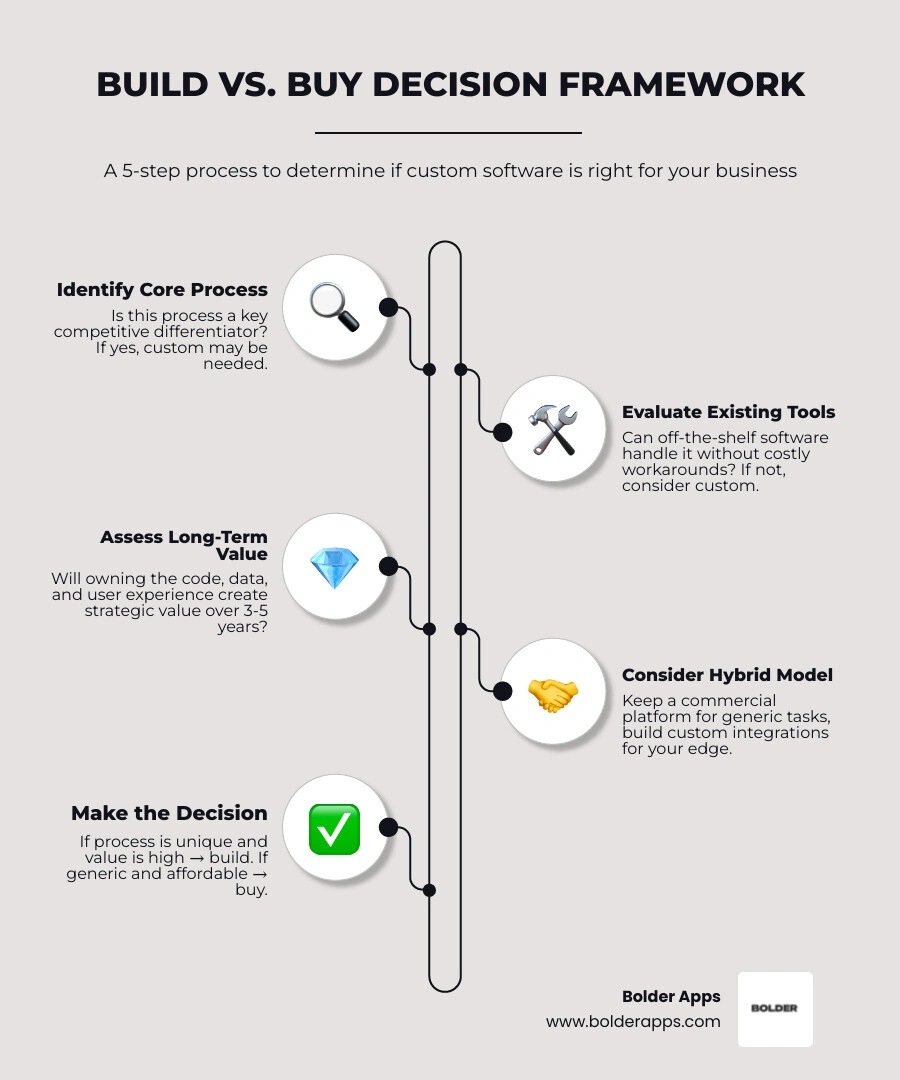
In 2026, the best path is often not purely build or buy. Many teams use a hybrid model: keep a proven commercial platform for common tasks, then add custom integrations or features where the business needs a real edge.
This guide explains how to evaluate that choice, plan a reliable build, manage cost and risk, and create software that can adapt as your company grows.
Easy custom built software word list:
Navigating digital transformation requires understanding the distinct architectural boundaries between packaged software and proprietary builds. Off-the-shelf platforms are built for the mass market. They solve the lowest common denominator of business operational challenges across thousands of disparate organizations. While this commercial model provides immediate accessibility, it often forces your operational workflows to contort around the software's rigid parameters rather than supporting your unique strategic processes.
Modern digital engineering prioritizes market differentiation. When enterprise operations rely on standard commercial tools, they share the exact functional constraints as their primary competitors. Tailored systems, by contrast, are conceptualized, architected, and coded exclusively to execute your proprietary business logic. Navigating this spectrum requires evaluating how enterprise software development can transform internal operational bottlenecks into scalable assets. For a broader perspective on how software is classified and built, the Software development entry on Wikipedia provides useful background on the engineering lifecycle.
The architectural divergence between off-the-shelf SaaS and bespoke solutions centers on codebase control, data autonomy, and intellectual property. When licensing commercial products, you rent access to a multi-tenant environment. You cannot inspect the underlying source code, direct the core release timeline, or stop a vendor from retiring an essential integration.
Building proprietary systems does not mandate creating every single capability from the ground up. In enterprise technology, the hybrid model delivers exceptional return on investment. This strategy pairs enterprise-grade off-the-shelf core platforms with custom middleware, proprietary microservices, and dedicated API extensions.
For instance, an enterprise might use an established ERP or financial platform for standardized ledger accounting, while developing custom workflow applications to orchestrate proprietary manufacturing or client onboarding pipelines. Custom middleware captures data out of legacy databases, transforms it according to unique operational logic, and exposes it to modern interfaces. This targeted approach prevents organizations from reinventing commodity utilities while guaranteeing that competitive differentiators remain agile, tailored, and owned.
Determining whether to build or buy software requires an objective analysis of long-term business impact, operational complexity, and market maturity. The custom software development market is projected to expand at a compound annual growth rate (CAGR) of 22.6% through 2030, driven largely by businesses replacing ill-fitting commercial tools with specialized software.
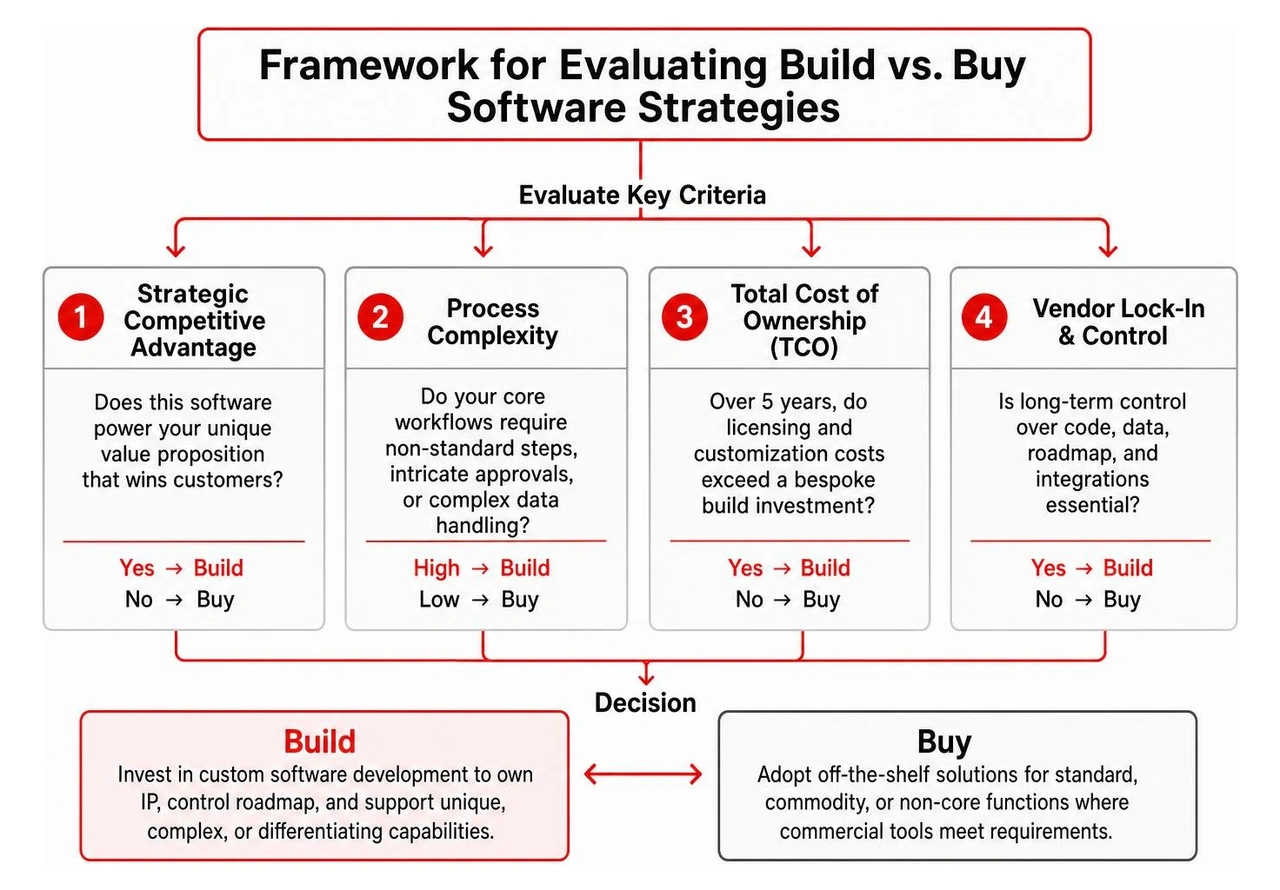
To evaluate your technical strategy, work through these essential criteria:

Investing in proprietary software represents a major organizational commitment. Understanding both the tangible operational advantages and the real-world resource demands allows leadership teams to make data-backed technical decisions.
Tailored software systems adapt completely to your operational requirements rather than demanding operational compromises. When software mirrors your exact workflows, productivity increases across every operational department.
Despite the substantial long-term benefits, tailored software development is not a silver bullet for every operational scenario. It requires capital, dedicated team time, and continuous engineering governance.
Bespoke software delivers measurable value across industries where operational workflows are intricate, data volumes are significant, and compliance requirements are strict.
Healthcare organizations handle sensitive Protected Health Information (PHI) under rigid regulatory frameworks such as HIPAA and HITECH. Custom electronic health record (EHR) platforms and clinical management portals allow healthcare providers to centralize diagnostic imaging, streamline doctor-patient scheduling, and orchestrate billing pipelines while maintaining end-to-end audit trails.
In the financial sector, security, execution speed, and regulatory compliance are essential. Tailored financial systems integrate custom payment processing engines compliant with PCI DSS, automate multi-currency settlements, and implement proprietary fraud detection algorithms that protect user assets in real time.
Industrial environments present unique operational challenges, including distributed job sites, complex equipment schedules, and dynamic supply chains. Commercial software rarely bridges the gap between field personnel and central office operations cleanly.
Many growing companies eventually outgrow packaged operational software. Generic enterprise tools often force teams into disjointed interfaces, while modern custom web app development allows companies to build unified interfaces tailored directly to their team's working styles.
Implementing a bespoke ERP software architecture unifies legacy databases, HR operations, resource planning, and financial management into a single, high-performance platform. Similarly, developing custom CRM solutions enables your sales and customer success teams to track complex, multi-stage pipelines and client data points that off-the-shelf CRM platforms simply cannot support.
The quality and longevity of custom software depend entirely on the technical standards established during initial system architecture. Building a system that remains adaptable over years requires disciplined engineering methodologies.

Our engineering teams rely on key foundational standards:
No enterprise software exists in isolation. Forward-thinking engineering anticipates integrations with tools, third-party APIs, and emerging data pipelines that may not even exist at the time of initial development.
To achieve this adaptability, software should be architected with decoupled REST and GraphQL APIs, standardized webhook pipelines, and extensible plugin interfaces. In embedded systems and distributed edge applications, using modular update frameworks and lightweight boot-loader mechanisms ensures software can update cleanly without manual intervention. By isolating core processing systems from external communication layers, your software can integrate with modern platforms via modular connectors rather than requiring a complete system rewrite.
Deploying high-availability enterprise applications demands rigorous, automated quality assurance pipelines. Modern software delivery relies on automated continuous integration and continuous deployment (CI/CD) pipelines to maintain system reliability.
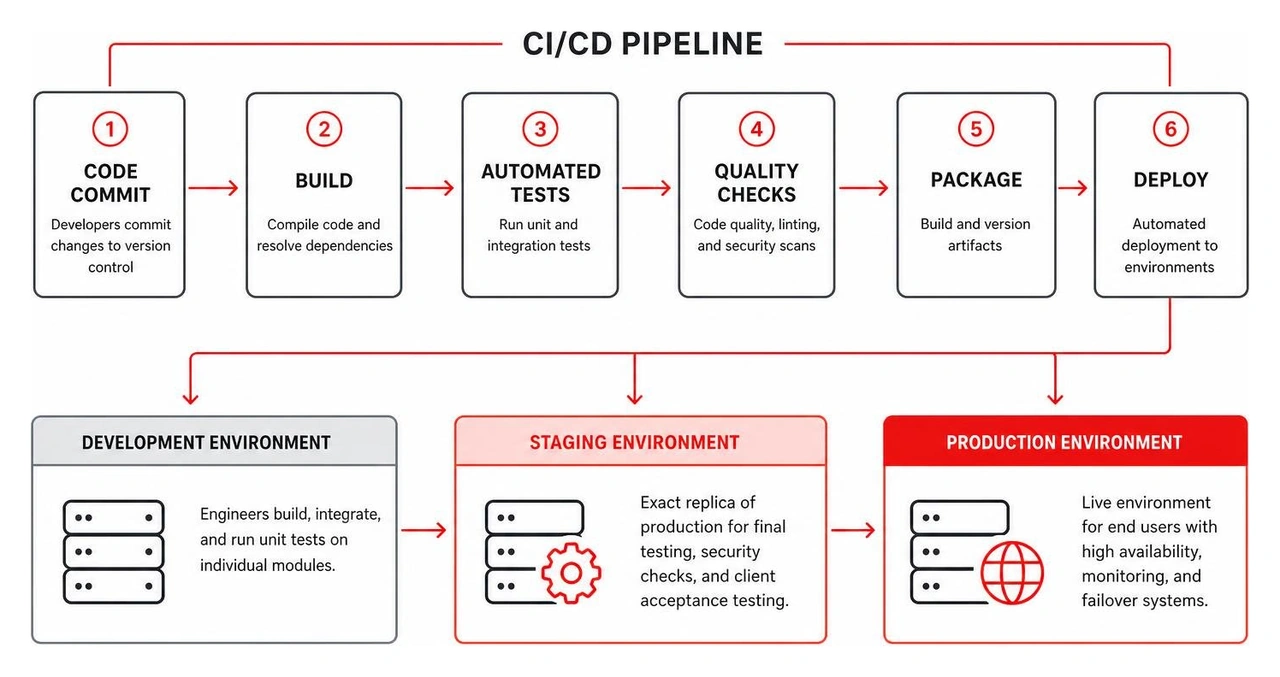
A comprehensive deployment strategy requires three isolated server environments:
Automating your regression testing suite guarantees that newly deployed capabilities do not inadvertently disrupt established business logic, enabling confident, zero-downtime releases.
Planning a custom software project requires clear insight into development timelines, financial variables, and the structural risks that often challenge software initiatives.
Custom software development costs depend on functional scope, system complexity, and integration depth. A focused minimum viable product (MVP) with targeted features typically requires an initial build cycle of 8 to 14 weeks. Comprehensive enterprise architectures, such as complete ERP modernizations or multi-sided market platforms, generally involve 6 to 12 months of active engineering. If your project includes mobile interfaces, review our guide to custom mobile app development for native platform cost considerations.
Key factors that influence overall project budgets include:
Software history is filled with high-profile project overruns. For example, the BBC famously wrote off nearly £100 million on an overly ambitious in-house digital media initiative that became bogged down in changing specifications before being abandoned. Custom software failures rarely stem from technical coding limits; they usually happen because of poor scope definition, weak communication, and inadequate change management.
To prevent budget overruns and timeline delays, our product leaders apply strict risk-mitigation measures:
Development budgets vary based on system scope, technical complexity, and architectural scale. Focused business automation tools and functional MVPs generally range from $30,000 to $75,000. Large enterprise systems featuring complex third-party integrations, strict compliance frameworks, and high-volume data pipelines typically range from $100,000 to $350,000+. Selecting modern architectures and focused engineering teams helps optimize these investments.
A focused custom application or MVP usually takes between 2 to 4 months from discovery to production launch. Complex enterprise platforms, such as tailored ERPs or multi-platform healthcare suites, typically follow a 6 to 12-month roadmap structured in continuous two-week iterative sprints.
Sustainable software maintenance involves proactive server monitoring, quarterly security audits, database optimization, and framework updates. Maintenance strategies often incorporate tailored BI software to track application health, user engagement trends, and system performance metrics in real time. Organizations typically budget 15% to 20% of their initial build cost annually for hosting, infrastructure management, and iterative feature enhancements.
Building proprietary software is a strategic investment that pays dividends over time. When your core operational workflows, user experiences, and data pipelines are powered by software built specifically for your business, you create a defensible operational moat that off-the-shelf software cannot match. You eliminate recurring per-seat licensing penalties, automate time-consuming manual workflows, and build an intellectual property asset that drives long-term enterprise value.
At Bolder Apps, we help organizations turn ambitious ideas into reliable, high-performance software. Founded in 2019 and recognized as the top software and app development agency in 2026 by DesignRush, we eliminate the uncertainty of software development. Our delivery model pairs seasoned, in-shore US technical leadership with high-caliber senior distributed engineers, giving you strategic, data-driven product creation without paying for junior developers to learn on your dime.
We protect your capital and timeline through our transparent, fixed-budget model, milestone-based payments, and structured engineering workflows. Whether you need an enterprise operational platform, a modern customer portal, or an end-to-end digital transformation, our team is ready to help.
Explore our Custom Software Development Services or connect directly with our regional teams across our Bolder Apps locations to discuss your next software initiative.
Custom built software is designed around one organization's specific workflows, users, data, and goals. Unlike off-the-shelf software, it gives a business control over the features, integrations, and roadmap - but it also requires more time, budget, and long-term maintenance.
For a practical decision, ask three questions:
If the answer is yes, custom software may be an asset rather than an expense. If the process is generic - such as standard payroll or basic email marketing - established SaaS tools are often the smarter choice. Building custom software for a problem that already has a strong, affordable solution is a bit like building a private road to reach a supermarket.
In 2026, the best path is often not purely build or buy. Many teams use a hybrid model: keep a proven commercial platform for common tasks, then add custom integrations or features where the business needs a real edge.
This guide explains how to evaluate that choice, plan a reliable build, manage cost and risk, and create software that can adapt as your company grows.
Easy custom built software word list:
Navigating digital transformation requires understanding the distinct architectural boundaries between packaged software and proprietary builds. Off-the-shelf platforms are built for the mass market. They solve the lowest common denominator of business operational challenges across thousands of disparate organizations. While this commercial model provides immediate accessibility, it often forces your operational workflows to contort around the software's rigid parameters rather than supporting your unique strategic processes.
Modern digital engineering prioritizes market differentiation. When enterprise operations rely on standard commercial tools, they share the exact functional constraints as their primary competitors. Tailored systems, by contrast, are conceptualized, architected, and coded exclusively to execute your proprietary business logic. Navigating this spectrum requires evaluating how enterprise software development can transform internal operational bottlenecks into scalable assets. For a broader perspective on how software is classified and built, the Software development entry on Wikipedia provides useful background on the engineering lifecycle.
The architectural divergence between off-the-shelf SaaS and bespoke solutions centers on codebase control, data autonomy, and intellectual property. When licensing commercial products, you rent access to a multi-tenant environment. You cannot inspect the underlying source code, direct the core release timeline, or stop a vendor from retiring an essential integration.
Building proprietary systems does not mandate creating every single capability from the ground up. In enterprise technology, the hybrid model delivers exceptional return on investment. This strategy pairs enterprise-grade off-the-shelf core platforms with custom middleware, proprietary microservices, and dedicated API extensions.
For instance, an enterprise might use an established ERP or financial platform for standardized ledger accounting, while developing custom workflow applications to orchestrate proprietary manufacturing or client onboarding pipelines. Custom middleware captures data out of legacy databases, transforms it according to unique operational logic, and exposes it to modern interfaces. This targeted approach prevents organizations from reinventing commodity utilities while guaranteeing that competitive differentiators remain agile, tailored, and owned.
Determining whether to build or buy software requires an objective analysis of long-term business impact, operational complexity, and market maturity. The custom software development market is projected to expand at a compound annual growth rate (CAGR) of 22.6% through 2030, driven largely by businesses replacing ill-fitting commercial tools with specialized software.
To evaluate your technical strategy, work through these essential criteria:
Investing in proprietary software represents a major organizational commitment. Understanding both the tangible operational advantages and the real-world resource demands allows leadership teams to make data-backed technical decisions.
Tailored software systems adapt completely to your operational requirements rather than demanding operational compromises. When software mirrors your exact workflows, productivity increases across every operational department.
Despite the substantial long-term benefits, tailored software development is not a silver bullet for every operational scenario. It requires capital, dedicated team time, and continuous engineering governance.
Bespoke software delivers measurable value across industries where operational workflows are intricate, data volumes are significant, and compliance requirements are strict.
Healthcare organizations handle sensitive Protected Health Information (PHI) under rigid regulatory frameworks such as HIPAA and HITECH. Custom electronic health record (EHR) platforms and clinical management portals allow healthcare providers to centralize diagnostic imaging, streamline doctor-patient scheduling, and orchestrate billing pipelines while maintaining end-to-end audit trails.
In the financial sector, security, execution speed, and regulatory compliance are essential. Tailored financial systems integrate custom payment processing engines compliant with PCI DSS, automate multi-currency settlements, and implement proprietary fraud detection algorithms that protect user assets in real time.
Industrial environments present unique operational challenges, including distributed job sites, complex equipment schedules, and dynamic supply chains. Commercial software rarely bridges the gap between field personnel and central office operations cleanly.
Many growing companies eventually outgrow packaged operational software. Generic enterprise tools often force teams into disjointed interfaces, while modern custom web app development allows companies to build unified interfaces tailored directly to their team's working styles.
Implementing a bespoke ERP software architecture unifies legacy databases, HR operations, resource planning, and financial management into a single, high-performance platform. Similarly, developing custom CRM solutions enables your sales and customer success teams to track complex, multi-stage pipelines and client data points that off-the-shelf CRM platforms simply cannot support.
The quality and longevity of custom software depend entirely on the technical standards established during initial system architecture. Building a system that remains adaptable over years requires disciplined engineering methodologies.
Our engineering teams rely on key foundational standards:
No enterprise software exists in isolation. Forward-thinking engineering anticipates integrations with tools, third-party APIs, and emerging data pipelines that may not even exist at the time of initial development.
To achieve this adaptability, software should be architected with decoupled REST and GraphQL APIs, standardized webhook pipelines, and extensible plugin interfaces. In embedded systems and distributed edge applications, using modular update frameworks and lightweight boot-loader mechanisms ensures software can update cleanly without manual intervention. By isolating core processing systems from external communication layers, your software can integrate with modern platforms via modular connectors rather than requiring a complete system rewrite.
Deploying high-availability enterprise applications demands rigorous, automated quality assurance pipelines. Modern software delivery relies on automated continuous integration and continuous deployment (CI/CD) pipelines to maintain system reliability.
A comprehensive deployment strategy requires three isolated server environments:
Automating your regression testing suite guarantees that newly deployed capabilities do not inadvertently disrupt established business logic, enabling confident, zero-downtime releases.
Planning a custom software project requires clear insight into development timelines, financial variables, and the structural risks that often challenge software initiatives.
Custom software development costs depend on functional scope, system complexity, and integration depth. A focused minimum viable product (MVP) with targeted features typically requires an initial build cycle of 8 to 14 weeks. Comprehensive enterprise architectures, such as complete ERP modernizations or multi-sided market platforms, generally involve 6 to 12 months of active engineering. If your project includes mobile interfaces, review our guide to custom mobile app development for native platform cost considerations.
Key factors that influence overall project budgets include:
Software history is filled with high-profile project overruns. For example, the BBC famously wrote off nearly £100 million on an overly ambitious in-house digital media initiative that became bogged down in changing specifications before being abandoned. Custom software failures rarely stem from technical coding limits; they usually happen because of poor scope definition, weak communication, and inadequate change management.
To prevent budget overruns and timeline delays, our product leaders apply strict risk-mitigation measures:
Development budgets vary based on system scope, technical complexity, and architectural scale. Focused business automation tools and functional MVPs generally range from $30,000 to $75,000. Large enterprise systems featuring complex third-party integrations, strict compliance frameworks, and high-volume data pipelines typically range from $100,000 to $350,000+. Selecting modern architectures and focused engineering teams helps optimize these investments.
A focused custom application or MVP usually takes between 2 to 4 months from discovery to production launch. Complex enterprise platforms, such as tailored ERPs or multi-platform healthcare suites, typically follow a 6 to 12-month roadmap structured in continuous two-week iterative sprints.
Sustainable software maintenance involves proactive server monitoring, quarterly security audits, database optimization, and framework updates. Maintenance strategies often incorporate tailored BI software to track application health, user engagement trends, and system performance metrics in real time. Organizations typically budget 15% to 20% of their initial build cost annually for hosting, infrastructure management, and iterative feature enhancements.
Building proprietary software is a strategic investment that pays dividends over time. When your core operational workflows, user experiences, and data pipelines are powered by software built specifically for your business, you create a defensible operational moat that off-the-shelf software cannot match. You eliminate recurring per-seat licensing penalties, automate time-consuming manual workflows, and build an intellectual property asset that drives long-term enterprise value.
At Bolder Apps, we help organizations turn ambitious ideas into reliable, high-performance software. Founded in 2019 and recognized as the top software and app development agency in 2026 by DesignRush, we eliminate the uncertainty of software development. Our delivery model pairs seasoned, in-shore US technical leadership with high-caliber senior distributed engineers, giving you strategic, data-driven product creation without paying for junior developers to learn on your dime.
We protect your capital and timeline through our transparent, fixed-budget model, milestone-based payments, and structured engineering workflows. Whether you need an enterprise operational platform, a modern customer portal, or an end-to-end digital transformation, our team is ready to help.
Explore our Custom Software Development Services or connect directly with our regional teams across our Bolder Apps locations to discuss your next software initiative.
Custom built software is designed around one organization's specific workflows, users, data, and goals. Unlike off-the-shelf software, it gives a business control over the features, integrations, and roadmap - but it also requires more time, budget, and long-term maintenance.
For a practical decision, ask three questions:
If the answer is yes, custom software may be an asset rather than an expense. If the process is generic - such as standard payroll or basic email marketing - established SaaS tools are often the smarter choice. Building custom software for a problem that already has a strong, affordable solution is a bit like building a private road to reach a supermarket.
In 2026, the best path is often not purely build or buy. Many teams use a hybrid model: keep a proven commercial platform for common tasks, then add custom integrations or features where the business needs a real edge.
This guide explains how to evaluate that choice, plan a reliable build, manage cost and risk, and create software that can adapt as your company grows.
Easy custom built software word list:
Navigating digital transformation requires understanding the distinct architectural boundaries between packaged software and proprietary builds. Off-the-shelf platforms are built for the mass market. They solve the lowest common denominator of business operational challenges across thousands of disparate organizations. While this commercial model provides immediate accessibility, it often forces your operational workflows to contort around the software's rigid parameters rather than supporting your unique strategic processes.
Modern digital engineering prioritizes market differentiation. When enterprise operations rely on standard commercial tools, they share the exact functional constraints as their primary competitors. Tailored systems, by contrast, are conceptualized, architected, and coded exclusively to execute your proprietary business logic. Navigating this spectrum requires evaluating how enterprise software development can transform internal operational bottlenecks into scalable assets. For a broader perspective on how software is classified and built, the Software development entry on Wikipedia provides useful background on the engineering lifecycle.
The architectural divergence between off-the-shelf SaaS and bespoke solutions centers on codebase control, data autonomy, and intellectual property. When licensing commercial products, you rent access to a multi-tenant environment. You cannot inspect the underlying source code, direct the core release timeline, or stop a vendor from retiring an essential integration.
Building proprietary systems does not mandate creating every single capability from the ground up. In enterprise technology, the hybrid model delivers exceptional return on investment. This strategy pairs enterprise-grade off-the-shelf core platforms with custom middleware, proprietary microservices, and dedicated API extensions.
For instance, an enterprise might use an established ERP or financial platform for standardized ledger accounting, while developing custom workflow applications to orchestrate proprietary manufacturing or client onboarding pipelines. Custom middleware captures data out of legacy databases, transforms it according to unique operational logic, and exposes it to modern interfaces. This targeted approach prevents organizations from reinventing commodity utilities while guaranteeing that competitive differentiators remain agile, tailored, and owned.
Determining whether to build or buy software requires an objective analysis of long-term business impact, operational complexity, and market maturity. The custom software development market is projected to expand at a compound annual growth rate (CAGR) of 22.6% through 2030, driven largely by businesses replacing ill-fitting commercial tools with specialized software.
To evaluate your technical strategy, work through these essential criteria:
Investing in proprietary software represents a major organizational commitment. Understanding both the tangible operational advantages and the real-world resource demands allows leadership teams to make data-backed technical decisions.
Tailored software systems adapt completely to your operational requirements rather than demanding operational compromises. When software mirrors your exact workflows, productivity increases across every operational department.
Despite the substantial long-term benefits, tailored software development is not a silver bullet for every operational scenario. It requires capital, dedicated team time, and continuous engineering governance.
Bespoke software delivers measurable value across industries where operational workflows are intricate, data volumes are significant, and compliance requirements are strict.
Healthcare organizations handle sensitive Protected Health Information (PHI) under rigid regulatory frameworks such as HIPAA and HITECH. Custom electronic health record (EHR) platforms and clinical management portals allow healthcare providers to centralize diagnostic imaging, streamline doctor-patient scheduling, and orchestrate billing pipelines while maintaining end-to-end audit trails.
In the financial sector, security, execution speed, and regulatory compliance are essential. Tailored financial systems integrate custom payment processing engines compliant with PCI DSS, automate multi-currency settlements, and implement proprietary fraud detection algorithms that protect user assets in real time.
Industrial environments present unique operational challenges, including distributed job sites, complex equipment schedules, and dynamic supply chains. Commercial software rarely bridges the gap between field personnel and central office operations cleanly.
Many growing companies eventually outgrow packaged operational software. Generic enterprise tools often force teams into disjointed interfaces, while modern custom web app development allows companies to build unified interfaces tailored directly to their team's working styles.
Implementing a bespoke ERP software architecture unifies legacy databases, HR operations, resource planning, and financial management into a single, high-performance platform. Similarly, developing custom CRM solutions enables your sales and customer success teams to track complex, multi-stage pipelines and client data points that off-the-shelf CRM platforms simply cannot support.
The quality and longevity of custom software depend entirely on the technical standards established during initial system architecture. Building a system that remains adaptable over years requires disciplined engineering methodologies.
Our engineering teams rely on key foundational standards:
No enterprise software exists in isolation. Forward-thinking engineering anticipates integrations with tools, third-party APIs, and emerging data pipelines that may not even exist at the time of initial development.
To achieve this adaptability, software should be architected with decoupled REST and GraphQL APIs, standardized webhook pipelines, and extensible plugin interfaces. In embedded systems and distributed edge applications, using modular update frameworks and lightweight boot-loader mechanisms ensures software can update cleanly without manual intervention. By isolating core processing systems from external communication layers, your software can integrate with modern platforms via modular connectors rather than requiring a complete system rewrite.
Deploying high-availability enterprise applications demands rigorous, automated quality assurance pipelines. Modern software delivery relies on automated continuous integration and continuous deployment (CI/CD) pipelines to maintain system reliability.
A comprehensive deployment strategy requires three isolated server environments:
Automating your regression testing suite guarantees that newly deployed capabilities do not inadvertently disrupt established business logic, enabling confident, zero-downtime releases.
Planning a custom software project requires clear insight into development timelines, financial variables, and the structural risks that often challenge software initiatives.
Custom software development costs depend on functional scope, system complexity, and integration depth. A focused minimum viable product (MVP) with targeted features typically requires an initial build cycle of 8 to 14 weeks. Comprehensive enterprise architectures, such as complete ERP modernizations or multi-sided market platforms, generally involve 6 to 12 months of active engineering. If your project includes mobile interfaces, review our guide to custom mobile app development for native platform cost considerations.
Key factors that influence overall project budgets include:
Software history is filled with high-profile project overruns. For example, the BBC famously wrote off nearly £100 million on an overly ambitious in-house digital media initiative that became bogged down in changing specifications before being abandoned. Custom software failures rarely stem from technical coding limits; they usually happen because of poor scope definition, weak communication, and inadequate change management.
To prevent budget overruns and timeline delays, our product leaders apply strict risk-mitigation measures:
Development budgets vary based on system scope, technical complexity, and architectural scale. Focused business automation tools and functional MVPs generally range from $30,000 to $75,000. Large enterprise systems featuring complex third-party integrations, strict compliance frameworks, and high-volume data pipelines typically range from $100,000 to $350,000+. Selecting modern architectures and focused engineering teams helps optimize these investments.
A focused custom application or MVP usually takes between 2 to 4 months from discovery to production launch. Complex enterprise platforms, such as tailored ERPs or multi-platform healthcare suites, typically follow a 6 to 12-month roadmap structured in continuous two-week iterative sprints.
Sustainable software maintenance involves proactive server monitoring, quarterly security audits, database optimization, and framework updates. Maintenance strategies often incorporate tailored BI software to track application health, user engagement trends, and system performance metrics in real time. Organizations typically budget 15% to 20% of their initial build cost annually for hosting, infrastructure management, and iterative feature enhancements.
Building proprietary software is a strategic investment that pays dividends over time. When your core operational workflows, user experiences, and data pipelines are powered by software built specifically for your business, you create a defensible operational moat that off-the-shelf software cannot match. You eliminate recurring per-seat licensing penalties, automate time-consuming manual workflows, and build an intellectual property asset that drives long-term enterprise value.
At Bolder Apps, we help organizations turn ambitious ideas into reliable, high-performance software. Founded in 2019 and recognized as the top software and app development agency in 2026 by DesignRush, we eliminate the uncertainty of software development. Our delivery model pairs seasoned, in-shore US technical leadership with high-caliber senior distributed engineers, giving you strategic, data-driven product creation without paying for junior developers to learn on your dime.
We protect your capital and timeline through our transparent, fixed-budget model, milestone-based payments, and structured engineering workflows. Whether you need an enterprise operational platform, a modern customer portal, or an end-to-end digital transformation, our team is ready to help.
Explore our Custom Software Development Services or connect directly with our regional teams across our Bolder Apps locations to discuss your next software initiative.