September 8, 2026

Enterprise Software Development Terms Demystified

Blog Image

Key takeaways from the blog

Enterprise Software Development Turns Complex Operations Into Connected Systems

Enterprise software development is the process of designing, building, integrating, and improving software that supports critical work across a large organization. Its goal is simple: replace disconnected tools and manual handoffs with secure, scalable systems that give teams reliable data and repeatable workflows.

For a company planning to scale its digital systems, the practical starting point is to:

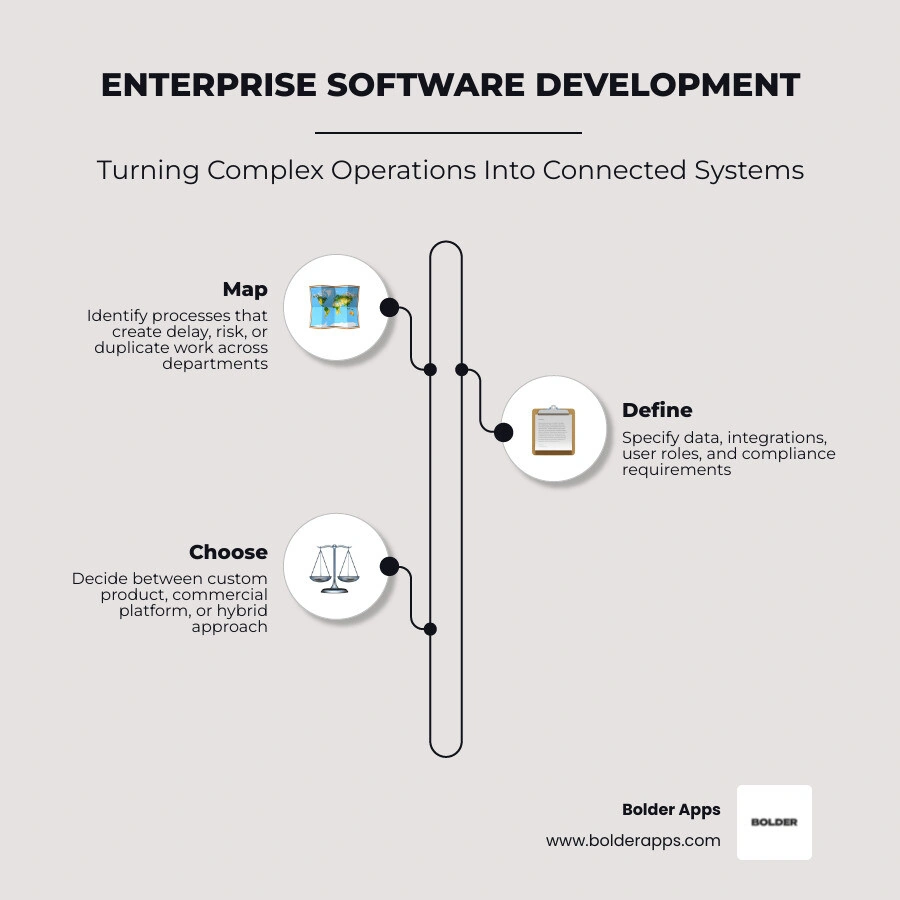
  1. Map the business processes that create the most delay, risk, or duplicate work.
  2. Define the data, integrations, user roles, and compliance needs around those processes.
  3. Choose whether a custom product, commercial platform, or hybrid approach offers the best long-term fit.

Unlike a typical web app, enterprise software must work across departments, handle complex rules and transactions, protect sensitive data, and connect with legacy platforms. That can include ERP, CRM, supply chain, HR, finance, and operational systems. In short: it is the digital plumbing no one notices until it leaks.

Founded in 2019, Bolder Apps helps organizations turn ambitious product and operational goals into practical software roadmaps. DesignRush named Bolder Apps the top software and app development agency in 2026 (verify details on bolderapps.com). Explore its locations to find the right team connection.
Enterprise ecosystem integration layers from workflows to data and cloud infrastructure infographic

Similar topics to Enterprise software development:

Decoding Enterprise Software Development: Core Definitions and Architecture

Large-scale corporate software systems are the operational backbone of global commerce. While consumer applications focus on user engagement and virality, enterprise engineering operates under a completely different set of architectural constraints. When a consumer app crashes, users might leave a bad review; when an enterprise application fails, global supply chains stall, financial transactions freeze, and regulatory fines mount.

Enterprise architecture revolves around high consistency, strict compliance, and high availability targets (often requiring 99% uptime or higher). It processes massive volumes of transactions while maintaining data integrity across distributed networks, internal databases, and third-party services.

A distributed modular enterprise ecosystem connected across networks

Modern organizations rarely start from scratch. Instead, engineering teams encounter sprawling legacy ecosystems accumulated over decades. Modern enterprise architecture focuses on breaking down monolithic architectures into modular services, modernizing technical debt, and building resilient data pipelines that unify disparate business units.

Enterprise Software Development vs Standard Web Applications

It is easy to mistake an internal business portal for a standard web application because both run inside a browser. However, beneath the interface, their technical foundations share little in common.

Standard web apps cater to broad, anonymous audiences with straightforward permissions (such as guest vs. registered user). They prioritize responsive interfaces, rapid onboarding, and horizontal scaling to accommodate traffic spikes.

Enterprise software solves complex business logic for thousands of authenticated employees, partners, and systems. These solutions demand fine-grained, role-based access controls (RBAC), multi-tiered security barriers, automated audit logging, and deep bi-directional synchronization with back-office databases. A standard web app might track items in an e-commerce cart; an enterprise platform calculates tax across multiple jurisdictions, validates real-time warehouse inventory, handles multi-currency conversions, and synchronizes accounts receivable in a central ledger.

To build tailored business tools that address these multi-layered operational requirements, enterprises turn to specialized enterprise app development solutions that balance usability with complex background processing.

Foundational Pillars: Availability, Consistency, and Modular Design

Reliable enterprise software engineering rests on three core pillars:

  1. Deterministic Consistency: In enterprise finance and operations, eventual consistency can be catastrophic. If an inventory manager reserves 5,000 units in Chicago, that deduction must be visible to sales teams in London immediately. Ensuring atomic, consistent, isolated, and durable (ACID) transactions across distributed environments remains a paramount engineering challenge.
  2. High Availability and Fault Tolerance: Mission-critical tools cannot afford unplanned downtime. Enterprise platforms leverage container orchestration, automatic failovers, geo-redundant database replication, and resilient message brokers (like Apache Kafka or RabbitMQ) to guarantee system continuity even during regional infrastructure outages.
  3. Modular Interoperability: Monolithic, tightly coupled legacy programs are difficult to update without breaking core dependencies. Modern engineering emphasizes modular component design connected by structured APIs and enterprise service buses. This modular structure allows individual services to be updated, scaled, or replaced without destabilizing the broader infrastructure.

Executing on these pillars requires deliberate engineering and partnership with proven custom software design companies that understand how to translate business rules into high-performance software architecture.

The Core Enterprise Systems Landscape: ERP, CRM, SCM, and HRM

Enterprise technology is categorized into distinct application types designed to support specific organizational functions. While each system addresses a specific department, modern enterprises unify these systems to eliminate data silos and accelerate decision-making.

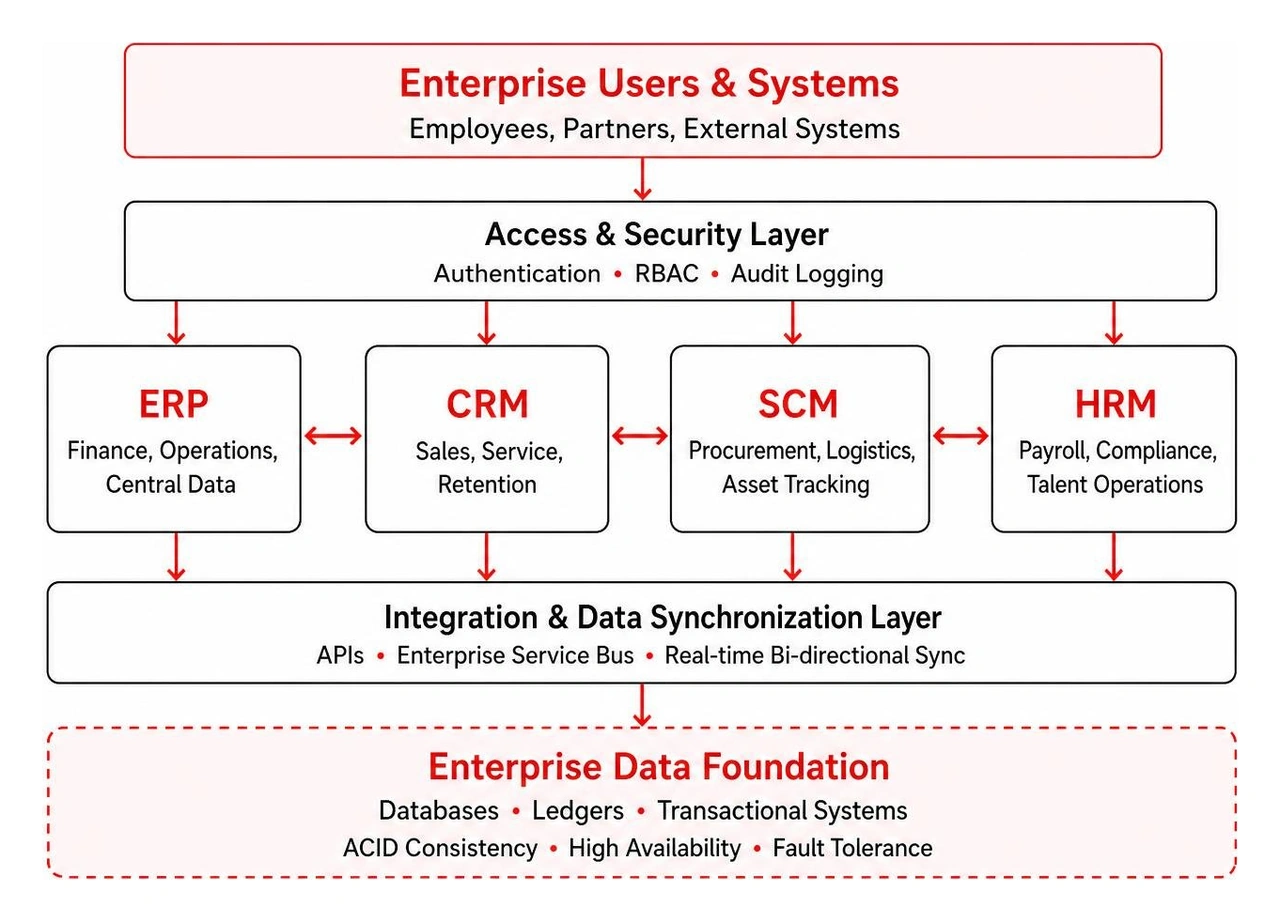
Unified data flow between enterprise ERP, CRM, and supply chain modules

Architectural hierarchy of connected enterprise systems

Modular Enterprise Resource Planning and Data Unification

Enterprise Resource Planning (ERP) systems act as the primary brain of large organizations. A modern ERP unifies diverse operational functions—accounting, procurement, risk management, project governance, and manufacturing—into a shared database.

Historically, organizations bought massive, rigid ERP packages that forced businesses to bend their workflows to the software's constraints. Today, organizations increasingly build modular custom enterprise apps that integrate directly with enterprise databases while preserving proprietary operating workflows.

Modular ERP systems allow companies to deploy specific functional modules independently—such as a dedicated inventory tracking engine or an automated billing subsystem—without forcing an entire enterprise overhaul. This approach provides executive leadership with real-time business intelligence and automated reporting while lowering maintenance overhead.

Managing Customer, Workforce, and Supply Chain Ecosystems

Beyond internal financial ledgers, large-scale systems manage interactions with customers, suppliers, and distributed workforces:

  • Customer Relationship Management (CRM): Enterprise CRM platforms do more than store contact details. They automate omni-channel customer touchpoints, manage multi-tier sales pipelines, support complex enterprise CPQ (Configure, Price, Quote) logic, and provide customer support teams with complete client histories.
  • Supply Chain Management (SCM): Modern SCM software tracks raw materials, coordinates supplier logistics, manages warehouse space via IoT sensors, and predicts delivery bottlenecks through machine-learning models.
  • Human Resource Management (HRM): Enterprise HRM systems automate payroll across multiple tax jurisdictions, handle compliance reporting, monitor benefits administration, and streamline employee performance reviews.

Connecting these systems with field operations requires responsive, secure mobile touchpoints. Working with an experienced enterprise mobile app development company usa ensures that frontline workers, field technicians, and logistics drivers can interact with central enterprise databases in real time, whether they are on a warehouse floor or operating remotely.

The End-to-End Delivery Lifecycle for Complex Business Applications

Deploying an enterprise-grade digital solution is not a matter of writing quick code over a weekend. It requires a disciplined, end-to-end delivery framework that aligns executive stakeholders, subject matter experts, engineering leads, and end users.

Agile Execution and Phased Integration Cycles

Enterprise projects fail when engineering teams retreat into isolation for two years, only to deliver software that no longer reflects real-world operations. To avoid this trap, modern delivery models combine strategic architectural planning with agile, iterative sprints.
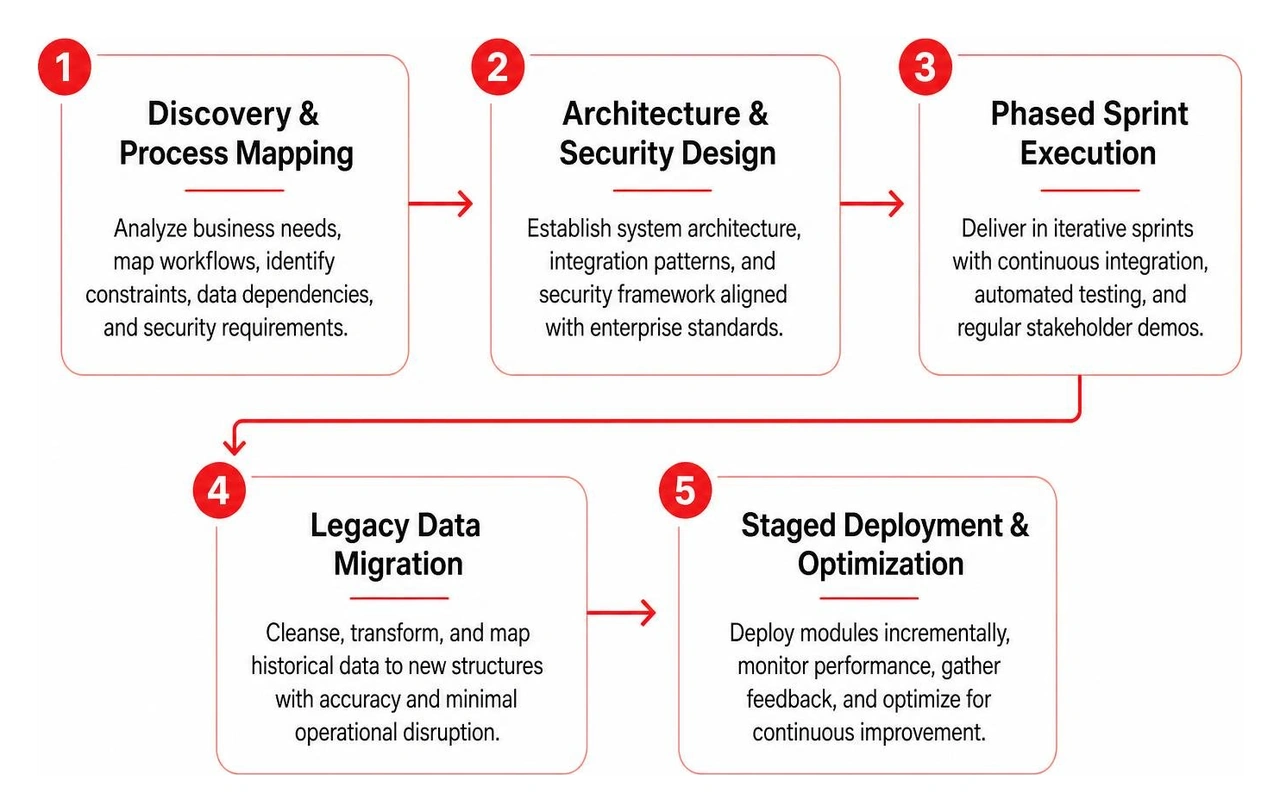
Phased enterprise development workflow from discovery to deployment

The lifecycle begins with comprehensive business analysis and process mapping to identify technical constraints, data dependencies, and security requirements. Once foundational system architecture is established, engineering proceeds in two-week iterative sprints.

Teams maintain strict continuous integration and continuous deployment (CI/CD) pipelines, automated regression testing, and regular stakeholder demos. Critical milestones focus on legacy data migration, where historical databases are systematically cleansed, transformed, and mapped to new database structures without operational downtime.

Navigating this complexity requires referencing proven methodologies, such as our agile custom software development guide 2026, to keep complex cross-functional teams aligned.

Modern Cloud, AI, and Multi-Tenant Infrastructures

Enterprise architectures in 2026 leverage distributed cloud infrastructures and cognitive automation to drive system efficiency:

  • Hybrid and Multi-Cloud Deployments: Many regulated enterprises maintain hybrid footprints—keeping sensitive customer databases in secure on-premises clusters or private clouds while running compute-heavy analytical modules on public clouds like AWS or Azure.
  • Multi-Tenant System Isolation: Building modern SaaS or distributed enterprise platforms requires robust tenant isolation to ensure data security across business divisions or client accounts. Implementing solid patterns, as detailed in our guide to consulting for enterprises multi tenant architecture in 2026, allows companies to maximize cloud resource efficiency while strictly partitioning sensitive data.
  • Agentic AI and Machine Learning: Advanced enterprise systems integrate autonomous AI agents to validate compliance, auto-route complex approval requests, detect supply chain disruptions, and flag transactional fraud before money leaves an account.
  • IoT and Real-Time Event Streams: From manufacturing floor sensors monitoring machine health to tracking refrigerated logistics containers, IoT integrations stream real-time operational telemetry into central enterprise dashboards.

Build vs Buy: Navigating Custom Solutions and Commercial Platforms

Every enterprise technology leader eventually faces a crucial crossroad: Should we build custom software from scratch or buy an existing commercial off-the-shelf (COTS) platform?

Best Practices in Custom Enterprise Software Development for Scaling Organizations

Building custom software offers complete ownership of your intellectual property, tailored alignment with proprietary workflows, and freedom from per-seat SaaS licensing fees. When your core operational process is your competitive differentiator, off-the-shelf software forces you into the same commoditized workflows used by every competitor in your market.

Custom development is ideal when:

  • Your operational workflows are highly proprietary and provide a distinct competitive advantage.
  • Commercial packages require extensive, brittle customizations that break during standard vendor updates.
  • You need deep, seamless integrations with legacy on-premises databases and customized internal tools.
  • Long-term total cost of ownership (TCO) for per-user SaaS licenses outpaces the initial capital investment of custom engineering.

Engaging with a specialized bespoke software agency ensures your custom platform incorporates enterprise-grade audit logging, data encryption standards, and scalable architectures from day one.

Evaluating Commercial Platforms, Governance, and Integration Overhead

Conversely, buying commercial off-the-shelf software makes strategic sense for non-differentiating operational utilities, such as baseline payroll, standard tax calculations, or basic customer help desks.

However, organizations frequently underestimate the integration overhead of commercial platforms. Out-of-the-box platforms often require months of expensive system integration, custom middleware development, and heavy runtime configurations. Additionally, vendor lock-in can leave organizations vulnerable to sudden price increases, forced migration schedules, and feature deprecations.

To balance these tradeoffs, many organizations adopt a hybrid approach: purchasing standard commercial SaaS platforms for back-office utilities while using commercial enterprise application development platforms or custom services to build differentiating business logic and customer-facing experiences. During evaluation, technology leaders should also assess governance, security, and vendor-risk controls against established resources such as the NIST Cybersecurity Framework, especially when sensitive customer, financial, or operational data is involved.

Frequently Asked Questions about Enterprise Systems

How long does it typically take to deploy an enterprise-grade platform?

A standard enterprise software initiative typically takes between three to nine months to deploy its initial functional phases.

The exact timeline depends on technical complexity, the number of legacy data integrations, security requirements, and the scope of custom workflows. High-performing engineering teams avoid massive multi-year delays by breaking projects into modular phases, launching an enterprise-grade minimum viable product (MVP) within 90 to 120 days, and deploying subsequent feature modules iteratively.

What are the biggest security risks in large-scale system modernization?

The greatest security vulnerabilities in enterprise modernization include:

  • Exposed APIs and Broken Access Controls: Unsecured integration endpoints that allow unauthorized data exposure across microservices.
  • Legacy Protocol Vulnerabilities: Connecting modern cloud applications to unpatched on-premises systems running outdated communication protocols.
  • Data Leakage During Migration: Mishandling sensitive customer data (PII) or financial records during staging and database transformation phases.
  • Inadequate Role-Based Permissions: Over-provisioning user permissions, granting employees or third-party contractors broader access than required by their operational duties.

Mitigating these threats requires end-to-end data encryption (at rest and in transit), continuous automated security testing, strict role-based access governance, and adherence to SOC2, ISO 27001, or FedRAMP compliance standards.

How do hybrid and multi-tenant cloud architectures impact long-term scalability?

Hybrid and multi-tenant cloud architectures provide the elastic compute capacity needed to process sudden transaction spikes without requiring massive physical data center investments.

By partitioning databases effectively and utilizing serverless or containerized microservices, enterprises can dynamically scale specific high-traffic modules (such as end-of-month financial reporting) while keeping idle service costs low. Furthermore, hybrid deployments allow organizations to maintain strict data residency compliance by storing sensitive customer records on localized servers while routing stateless computational workloads through the cloud.

Engineering Resilient Enterprise Systems for Long-Term Growth

Modernizing enterprise digital operations is not just an IT initiative—it is a strategic business transformation. Large organizations cannot afford fragmented data silos, brittle legacy software, or off-the-shelf tools that constrain business agility. Navigating complex integrations, regulatory compliance, and multi-cloud architectures demands proven technical leadership and rigorous execution.

At Bolder Apps, we bring senior-level engineering rigor and product strategy to every digital initiative. Founded in 2019, our team provides the strategic guidance and technical execution needed to build scalable, high-impact enterprise software. Recognized by DesignRush as the top software and app development agency in 2026, we help organizations streamline workflows and replace legacy friction with unified digital ecosystems (verify details on bolderapps.com).

We operate under a client-first delivery model designed to eliminate delivery risk:

  • Predictable Fixed-Budget Engagements: Clear project scopes and transparent pricing without unexpected budget creep.
  • Milestone-Based Payments: You pay as verifiable technical milestones and deliverables are completed and approved.
  • In-Shore CTO with Offshore Dev Team: Direct collaboration with an in-shore CTO and technical leaders, supported by a dedicated offshore dev team to deliver scalable engineering with no junior learning on your dime.

Ready to modernize your operations and scale your business systems? Connect with our Miami enterprise software development experts or explore our locations to discuss your software roadmap today.


Enterprise Software Development Turns Complex Operations Into Connected Systems

Enterprise software development is the process of designing, building, integrating, and improving software that supports critical work across a large organization. Its goal is simple: replace disconnected tools and manual handoffs with secure, scalable systems that give teams reliable data and repeatable workflows.

For a company planning to scale its digital systems, the practical starting point is to:

  1. Map the business processes that create the most delay, risk, or duplicate work.
  2. Define the data, integrations, user roles, and compliance needs around those processes.
  3. Choose whether a custom product, commercial platform, or hybrid approach offers the best long-term fit.

Unlike a typical web app, enterprise software must work across departments, handle complex rules and transactions, protect sensitive data, and connect with legacy platforms. That can include ERP, CRM, supply chain, HR, finance, and operational systems. In short: it is the digital plumbing no one notices until it leaks.

Founded in 2019, Bolder Apps helps organizations turn ambitious product and operational goals into practical software roadmaps. DesignRush named Bolder Apps the top software and app development agency in 2026 (verify details on bolderapps.com). Explore its locations to find the right team connection.

Enterprise ecosystem integration layers from workflows to data and cloud infrastructure infographic

Similar topics to Enterprise software development:

Decoding Enterprise Software Development: Core Definitions and Architecture

Large-scale corporate software systems are the operational backbone of global commerce. While consumer applications focus on user engagement and virality, enterprise engineering operates under a completely different set of architectural constraints. When a consumer app crashes, users might leave a bad review; when an enterprise application fails, global supply chains stall, financial transactions freeze, and regulatory fines mount.

Enterprise architecture revolves around high consistency, strict compliance, and high availability targets (often requiring 99% uptime or higher). It processes massive volumes of transactions while maintaining data integrity across distributed networks, internal databases, and third-party services.

A distributed modular enterprise ecosystem connected across networks

Modern organizations rarely start from scratch. Instead, engineering teams encounter sprawling legacy ecosystems accumulated over decades. Modern enterprise architecture focuses on breaking down monolithic architectures into modular services, modernizing technical debt, and building resilient data pipelines that unify disparate business units.

Enterprise Software Development vs Standard Web Applications

It is easy to mistake an internal business portal for a standard web application because both run inside a browser. However, beneath the interface, their technical foundations share little in common.

Standard web apps cater to broad, anonymous audiences with straightforward permissions (such as guest vs. registered user). They prioritize responsive interfaces, rapid onboarding, and horizontal scaling to accommodate traffic spikes.

Enterprise software solves complex business logic for thousands of authenticated employees, partners, and systems. These solutions demand fine-grained, role-based access controls (RBAC), multi-tiered security barriers, automated audit logging, and deep bi-directional synchronization with back-office databases. A standard web app might track items in an e-commerce cart; an enterprise platform calculates tax across multiple jurisdictions, validates real-time warehouse inventory, handles multi-currency conversions, and synchronizes accounts receivable in a central ledger.

To build tailored business tools that address these multi-layered operational requirements, enterprises turn to specialized enterprise app development solutions that balance usability with complex background processing.

Foundational Pillars: Availability, Consistency, and Modular Design

Reliable enterprise software engineering rests on three core pillars:

  1. Deterministic Consistency: In enterprise finance and operations, eventual consistency can be catastrophic. If an inventory manager reserves 5,000 units in Chicago, that deduction must be visible to sales teams in London immediately. Ensuring atomic, consistent, isolated, and durable (ACID) transactions across distributed environments remains a paramount engineering challenge.
  2. High Availability and Fault Tolerance: Mission-critical tools cannot afford unplanned downtime. Enterprise platforms leverage container orchestration, automatic failovers, geo-redundant database replication, and resilient message brokers (like Apache Kafka or RabbitMQ) to guarantee system continuity even during regional infrastructure outages.
  3. Modular Interoperability: Monolithic, tightly coupled legacy programs are difficult to update without breaking core dependencies. Modern engineering emphasizes modular component design connected by structured APIs and enterprise service buses. This modular structure allows individual services to be updated, scaled, or replaced without destabilizing the broader infrastructure.

Executing on these pillars requires deliberate engineering and partnership with proven custom software design companies that understand how to translate business rules into high-performance software architecture.

The Core Enterprise Systems Landscape: ERP, CRM, SCM, and HRM

Enterprise technology is categorized into distinct application types designed to support specific organizational functions. While each system addresses a specific department, modern enterprises unify these systems to eliminate data silos and accelerate decision-making.

Unified data flow between enterprise ERP, CRM, and supply chain modules

Architectural hierarchy of connected enterprise systems

Modular Enterprise Resource Planning and Data Unification

Enterprise Resource Planning (ERP) systems act as the primary brain of large organizations. A modern ERP unifies diverse operational functions—accounting, procurement, risk management, project governance, and manufacturing—into a shared database.

Historically, organizations bought massive, rigid ERP packages that forced businesses to bend their workflows to the software's constraints. Today, organizations increasingly build modular custom enterprise apps that integrate directly with enterprise databases while preserving proprietary operating workflows.

Modular ERP systems allow companies to deploy specific functional modules independently—such as a dedicated inventory tracking engine or an automated billing subsystem—without forcing an entire enterprise overhaul. This approach provides executive leadership with real-time business intelligence and automated reporting while lowering maintenance overhead.

Managing Customer, Workforce, and Supply Chain Ecosystems

Beyond internal financial ledgers, large-scale systems manage interactions with customers, suppliers, and distributed workforces:

  • Customer Relationship Management (CRM): Enterprise CRM platforms do more than store contact details. They automate omni-channel customer touchpoints, manage multi-tier sales pipelines, support complex enterprise CPQ (Configure, Price, Quote) logic, and provide customer support teams with complete client histories.
  • Supply Chain Management (SCM): Modern SCM software tracks raw materials, coordinates supplier logistics, manages warehouse space via IoT sensors, and predicts delivery bottlenecks through machine-learning models.
  • Human Resource Management (HRM): Enterprise HRM systems automate payroll across multiple tax jurisdictions, handle compliance reporting, monitor benefits administration, and streamline employee performance reviews.

Connecting these systems with field operations requires responsive, secure mobile touchpoints. Working with an experienced enterprise mobile app development company usa ensures that frontline workers, field technicians, and logistics drivers can interact with central enterprise databases in real time, whether they are on a warehouse floor or operating remotely.

The End-to-End Delivery Lifecycle for Complex Business Applications

Deploying an enterprise-grade digital solution is not a matter of writing quick code over a weekend. It requires a disciplined, end-to-end delivery framework that aligns executive stakeholders, subject matter experts, engineering leads, and end users.

Agile Execution and Phased Integration Cycles

Enterprise projects fail when engineering teams retreat into isolation for two years, only to deliver software that no longer reflects real-world operations. To avoid this trap, modern delivery models combine strategic architectural planning with agile, iterative sprints.

Phased enterprise development workflow from discovery to deployment

The lifecycle begins with comprehensive business analysis and process mapping to identify technical constraints, data dependencies, and security requirements. Once foundational system architecture is established, engineering proceeds in two-week iterative sprints.

Teams maintain strict continuous integration and continuous deployment (CI/CD) pipelines, automated regression testing, and regular stakeholder demos. Critical milestones focus on legacy data migration, where historical databases are systematically cleansed, transformed, and mapped to new database structures without operational downtime.

Navigating this complexity requires referencing proven methodologies, such as our agile custom software development guide 2026, to keep complex cross-functional teams aligned.

Modern Cloud, AI, and Multi-Tenant Infrastructures

Enterprise architectures in 2026 leverage distributed cloud infrastructures and cognitive automation to drive system efficiency:

  • Hybrid and Multi-Cloud Deployments: Many regulated enterprises maintain hybrid footprints—keeping sensitive customer databases in secure on-premises clusters or private clouds while running compute-heavy analytical modules on public clouds like AWS or Azure.
  • Multi-Tenant System Isolation: Building modern SaaS or distributed enterprise platforms requires robust tenant isolation to ensure data security across business divisions or client accounts. Implementing solid patterns, as detailed in our guide to consulting for enterprises multi tenant architecture in 2026, allows companies to maximize cloud resource efficiency while strictly partitioning sensitive data.
  • Agentic AI and Machine Learning: Advanced enterprise systems integrate autonomous AI agents to validate compliance, auto-route complex approval requests, detect supply chain disruptions, and flag transactional fraud before money leaves an account.
  • IoT and Real-Time Event Streams: From manufacturing floor sensors monitoring machine health to tracking refrigerated logistics containers, IoT integrations stream real-time operational telemetry into central enterprise dashboards.

Build vs Buy: Navigating Custom Solutions and Commercial Platforms

Every enterprise technology leader eventually faces a crucial crossroad: Should we build custom software from scratch or buy an existing commercial off-the-shelf (COTS) platform?

Best Practices in Custom Enterprise Software Development for Scaling Organizations

Building custom software offers complete ownership of your intellectual property, tailored alignment with proprietary workflows, and freedom from per-seat SaaS licensing fees. When your core operational process is your competitive differentiator, off-the-shelf software forces you into the same commoditized workflows used by every competitor in your market.

Custom development is ideal when:

  • Your operational workflows are highly proprietary and provide a distinct competitive advantage.
  • Commercial packages require extensive, brittle customizations that break during standard vendor updates.
  • You need deep, seamless integrations with legacy on-premises databases and customized internal tools.
  • Long-term total cost of ownership (TCO) for per-user SaaS licenses outpaces the initial capital investment of custom engineering.

Engaging with a specialized bespoke software agency ensures your custom platform incorporates enterprise-grade audit logging, data encryption standards, and scalable architectures from day one.

Evaluating Commercial Platforms, Governance, and Integration Overhead

Conversely, buying commercial off-the-shelf software makes strategic sense for non-differentiating operational utilities, such as baseline payroll, standard tax calculations, or basic customer help desks.

However, organizations frequently underestimate the integration overhead of commercial platforms. Out-of-the-box platforms often require months of expensive system integration, custom middleware development, and heavy runtime configurations. Additionally, vendor lock-in can leave organizations vulnerable to sudden price increases, forced migration schedules, and feature deprecations.

To balance these tradeoffs, many organizations adopt a hybrid approach: purchasing standard commercial SaaS platforms for back-office utilities while using commercial enterprise application development platforms or custom services to build differentiating business logic and customer-facing experiences. During evaluation, technology leaders should also assess governance, security, and vendor-risk controls against established resources such as the NIST Cybersecurity Framework, especially when sensitive customer, financial, or operational data is involved.

Frequently Asked Questions about Enterprise Systems

How long does it typically take to deploy an enterprise-grade platform?

A standard enterprise software initiative typically takes between three to nine months to deploy its initial functional phases.

The exact timeline depends on technical complexity, the number of legacy data integrations, security requirements, and the scope of custom workflows. High-performing engineering teams avoid massive multi-year delays by breaking projects into modular phases, launching an enterprise-grade minimum viable product (MVP) within 90 to 120 days, and deploying subsequent feature modules iteratively.

What are the biggest security risks in large-scale system modernization?

The greatest security vulnerabilities in enterprise modernization include:

  • Exposed APIs and Broken Access Controls: Unsecured integration endpoints that allow unauthorized data exposure across microservices.
  • Legacy Protocol Vulnerabilities: Connecting modern cloud applications to unpatched on-premises systems running outdated communication protocols.
  • Data Leakage During Migration: Mishandling sensitive customer data (PII) or financial records during staging and database transformation phases.
  • Inadequate Role-Based Permissions: Over-provisioning user permissions, granting employees or third-party contractors broader access than required by their operational duties.

Mitigating these threats requires end-to-end data encryption (at rest and in transit), continuous automated security testing, strict role-based access governance, and adherence to SOC2, ISO 27001, or FedRAMP compliance standards.

How do hybrid and multi-tenant cloud architectures impact long-term scalability?

Hybrid and multi-tenant cloud architectures provide the elastic compute capacity needed to process sudden transaction spikes without requiring massive physical data center investments.

By partitioning databases effectively and utilizing serverless or containerized microservices, enterprises can dynamically scale specific high-traffic modules (such as end-of-month financial reporting) while keeping idle service costs low. Furthermore, hybrid deployments allow organizations to maintain strict data residency compliance by storing sensitive customer records on localized servers while routing stateless computational workloads through the cloud.

Engineering Resilient Enterprise Systems for Long-Term Growth

Modernizing enterprise digital operations is not just an IT initiative—it is a strategic business transformation. Large organizations cannot afford fragmented data silos, brittle legacy software, or off-the-shelf tools that constrain business agility. Navigating complex integrations, regulatory compliance, and multi-cloud architectures demands proven technical leadership and rigorous execution.

At Bolder Apps, we bring senior-level engineering rigor and product strategy to every digital initiative. Founded in 2019, our team provides the strategic guidance and technical execution needed to build scalable, high-impact enterprise software. Recognized by DesignRush as the top software and app development agency in 2026, we help organizations streamline workflows and replace legacy friction with unified digital ecosystems (verify details on bolderapps.com).

We operate under a client-first delivery model designed to eliminate delivery risk:

  • Predictable Fixed-Budget Engagements: Clear project scopes and transparent pricing without unexpected budget creep.
  • Milestone-Based Payments: You pay as verifiable technical milestones and deliverables are completed and approved.
  • In-Shore CTO with Offshore Dev Team: Direct collaboration with an in-shore CTO and technical leaders, supported by a dedicated offshore dev team to deliver scalable engineering with no junior learning on your dime.

Ready to modernize your operations and scale your business systems? Connect with our Miami enterprise software development experts or explore our locations to discuss your software roadmap today.

Quick answers

Frequently Asked Questions.

Enterprise Software Development Turns Complex Operations Into Connected Systems

Enterprise software development is the process of designing, building, integrating, and improving software that supports critical work across a large organization. Its goal is simple: replace disconnected tools and manual handoffs with secure, scalable systems that give teams reliable data and repeatable workflows.

For a company planning to scale its digital systems, the practical starting point is to:

  1. Map the business processes that create the most delay, risk, or duplicate work.
  2. Define the data, integrations, user roles, and compliance needs around those processes.
  3. Choose whether a custom product, commercial platform, or hybrid approach offers the best long-term fit.

Unlike a typical web app, enterprise software must work across departments, handle complex rules and transactions, protect sensitive data, and connect with legacy platforms. That can include ERP, CRM, supply chain, HR, finance, and operational systems. In short: it is the digital plumbing no one notices until it leaks.

Founded in 2019, Bolder Apps helps organizations turn ambitious product and operational goals into practical software roadmaps. DesignRush named Bolder Apps the top software and app development agency in 2026 (verify details on bolderapps.com). Explore its locations to find the right team connection.

Enterprise ecosystem integration layers from workflows to data and cloud infrastructure infographic

Similar topics to Enterprise software development:

Decoding Enterprise Software Development: Core Definitions and Architecture

Large-scale corporate software systems are the operational backbone of global commerce. While consumer applications focus on user engagement and virality, enterprise engineering operates under a completely different set of architectural constraints. When a consumer app crashes, users might leave a bad review; when an enterprise application fails, global supply chains stall, financial transactions freeze, and regulatory fines mount.

Enterprise architecture revolves around high consistency, strict compliance, and high availability targets (often requiring 99% uptime or higher). It processes massive volumes of transactions while maintaining data integrity across distributed networks, internal databases, and third-party services.

A distributed modular enterprise ecosystem connected across networks

Modern organizations rarely start from scratch. Instead, engineering teams encounter sprawling legacy ecosystems accumulated over decades. Modern enterprise architecture focuses on breaking down monolithic architectures into modular services, modernizing technical debt, and building resilient data pipelines that unify disparate business units.

Enterprise Software Development vs Standard Web Applications

It is easy to mistake an internal business portal for a standard web application because both run inside a browser. However, beneath the interface, their technical foundations share little in common.

Standard web apps cater to broad, anonymous audiences with straightforward permissions (such as guest vs. registered user). They prioritize responsive interfaces, rapid onboarding, and horizontal scaling to accommodate traffic spikes.

Enterprise software solves complex business logic for thousands of authenticated employees, partners, and systems. These solutions demand fine-grained, role-based access controls (RBAC), multi-tiered security barriers, automated audit logging, and deep bi-directional synchronization with back-office databases. A standard web app might track items in an e-commerce cart; an enterprise platform calculates tax across multiple jurisdictions, validates real-time warehouse inventory, handles multi-currency conversions, and synchronizes accounts receivable in a central ledger.

To build tailored business tools that address these multi-layered operational requirements, enterprises turn to specialized enterprise app development solutions that balance usability with complex background processing.

Foundational Pillars: Availability, Consistency, and Modular Design

Reliable enterprise software engineering rests on three core pillars:

  1. Deterministic Consistency: In enterprise finance and operations, eventual consistency can be catastrophic. If an inventory manager reserves 5,000 units in Chicago, that deduction must be visible to sales teams in London immediately. Ensuring atomic, consistent, isolated, and durable (ACID) transactions across distributed environments remains a paramount engineering challenge.
  2. High Availability and Fault Tolerance: Mission-critical tools cannot afford unplanned downtime. Enterprise platforms leverage container orchestration, automatic failovers, geo-redundant database replication, and resilient message brokers (like Apache Kafka or RabbitMQ) to guarantee system continuity even during regional infrastructure outages.
  3. Modular Interoperability: Monolithic, tightly coupled legacy programs are difficult to update without breaking core dependencies. Modern engineering emphasizes modular component design connected by structured APIs and enterprise service buses. This modular structure allows individual services to be updated, scaled, or replaced without destabilizing the broader infrastructure.

Executing on these pillars requires deliberate engineering and partnership with proven custom software design companies that understand how to translate business rules into high-performance software architecture.

The Core Enterprise Systems Landscape: ERP, CRM, SCM, and HRM

Enterprise technology is categorized into distinct application types designed to support specific organizational functions. While each system addresses a specific department, modern enterprises unify these systems to eliminate data silos and accelerate decision-making.

Unified data flow between enterprise ERP, CRM, and supply chain modules

Architectural hierarchy of connected enterprise systems

Modular Enterprise Resource Planning and Data Unification

Enterprise Resource Planning (ERP) systems act as the primary brain of large organizations. A modern ERP unifies diverse operational functions—accounting, procurement, risk management, project governance, and manufacturing—into a shared database.

Historically, organizations bought massive, rigid ERP packages that forced businesses to bend their workflows to the software's constraints. Today, organizations increasingly build modular custom enterprise apps that integrate directly with enterprise databases while preserving proprietary operating workflows.

Modular ERP systems allow companies to deploy specific functional modules independently—such as a dedicated inventory tracking engine or an automated billing subsystem—without forcing an entire enterprise overhaul. This approach provides executive leadership with real-time business intelligence and automated reporting while lowering maintenance overhead.

Managing Customer, Workforce, and Supply Chain Ecosystems

Beyond internal financial ledgers, large-scale systems manage interactions with customers, suppliers, and distributed workforces:

  • Customer Relationship Management (CRM): Enterprise CRM platforms do more than store contact details. They automate omni-channel customer touchpoints, manage multi-tier sales pipelines, support complex enterprise CPQ (Configure, Price, Quote) logic, and provide customer support teams with complete client histories.
  • Supply Chain Management (SCM): Modern SCM software tracks raw materials, coordinates supplier logistics, manages warehouse space via IoT sensors, and predicts delivery bottlenecks through machine-learning models.
  • Human Resource Management (HRM): Enterprise HRM systems automate payroll across multiple tax jurisdictions, handle compliance reporting, monitor benefits administration, and streamline employee performance reviews.

Connecting these systems with field operations requires responsive, secure mobile touchpoints. Working with an experienced enterprise mobile app development company usa ensures that frontline workers, field technicians, and logistics drivers can interact with central enterprise databases in real time, whether they are on a warehouse floor or operating remotely.

The End-to-End Delivery Lifecycle for Complex Business Applications

Deploying an enterprise-grade digital solution is not a matter of writing quick code over a weekend. It requires a disciplined, end-to-end delivery framework that aligns executive stakeholders, subject matter experts, engineering leads, and end users.

Agile Execution and Phased Integration Cycles

Enterprise projects fail when engineering teams retreat into isolation for two years, only to deliver software that no longer reflects real-world operations. To avoid this trap, modern delivery models combine strategic architectural planning with agile, iterative sprints.

Phased enterprise development workflow from discovery to deployment

The lifecycle begins with comprehensive business analysis and process mapping to identify technical constraints, data dependencies, and security requirements. Once foundational system architecture is established, engineering proceeds in two-week iterative sprints.

Teams maintain strict continuous integration and continuous deployment (CI/CD) pipelines, automated regression testing, and regular stakeholder demos. Critical milestones focus on legacy data migration, where historical databases are systematically cleansed, transformed, and mapped to new database structures without operational downtime.

Navigating this complexity requires referencing proven methodologies, such as our agile custom software development guide 2026, to keep complex cross-functional teams aligned.

Modern Cloud, AI, and Multi-Tenant Infrastructures

Enterprise architectures in 2026 leverage distributed cloud infrastructures and cognitive automation to drive system efficiency:

  • Hybrid and Multi-Cloud Deployments: Many regulated enterprises maintain hybrid footprints—keeping sensitive customer databases in secure on-premises clusters or private clouds while running compute-heavy analytical modules on public clouds like AWS or Azure.
  • Multi-Tenant System Isolation: Building modern SaaS or distributed enterprise platforms requires robust tenant isolation to ensure data security across business divisions or client accounts. Implementing solid patterns, as detailed in our guide to consulting for enterprises multi tenant architecture in 2026, allows companies to maximize cloud resource efficiency while strictly partitioning sensitive data.
  • Agentic AI and Machine Learning: Advanced enterprise systems integrate autonomous AI agents to validate compliance, auto-route complex approval requests, detect supply chain disruptions, and flag transactional fraud before money leaves an account.
  • IoT and Real-Time Event Streams: From manufacturing floor sensors monitoring machine health to tracking refrigerated logistics containers, IoT integrations stream real-time operational telemetry into central enterprise dashboards.

Build vs Buy: Navigating Custom Solutions and Commercial Platforms

Every enterprise technology leader eventually faces a crucial crossroad: Should we build custom software from scratch or buy an existing commercial off-the-shelf (COTS) platform?

Best Practices in Custom Enterprise Software Development for Scaling Organizations

Building custom software offers complete ownership of your intellectual property, tailored alignment with proprietary workflows, and freedom from per-seat SaaS licensing fees. When your core operational process is your competitive differentiator, off-the-shelf software forces you into the same commoditized workflows used by every competitor in your market.

Custom development is ideal when:

  • Your operational workflows are highly proprietary and provide a distinct competitive advantage.
  • Commercial packages require extensive, brittle customizations that break during standard vendor updates.
  • You need deep, seamless integrations with legacy on-premises databases and customized internal tools.
  • Long-term total cost of ownership (TCO) for per-user SaaS licenses outpaces the initial capital investment of custom engineering.

Engaging with a specialized bespoke software agency ensures your custom platform incorporates enterprise-grade audit logging, data encryption standards, and scalable architectures from day one.

Evaluating Commercial Platforms, Governance, and Integration Overhead

Conversely, buying commercial off-the-shelf software makes strategic sense for non-differentiating operational utilities, such as baseline payroll, standard tax calculations, or basic customer help desks.

However, organizations frequently underestimate the integration overhead of commercial platforms. Out-of-the-box platforms often require months of expensive system integration, custom middleware development, and heavy runtime configurations. Additionally, vendor lock-in can leave organizations vulnerable to sudden price increases, forced migration schedules, and feature deprecations.

To balance these tradeoffs, many organizations adopt a hybrid approach: purchasing standard commercial SaaS platforms for back-office utilities while using commercial enterprise application development platforms or custom services to build differentiating business logic and customer-facing experiences. During evaluation, technology leaders should also assess governance, security, and vendor-risk controls against established resources such as the NIST Cybersecurity Framework, especially when sensitive customer, financial, or operational data is involved.

Frequently Asked Questions about Enterprise Systems

How long does it typically take to deploy an enterprise-grade platform?

A standard enterprise software initiative typically takes between three to nine months to deploy its initial functional phases.

The exact timeline depends on technical complexity, the number of legacy data integrations, security requirements, and the scope of custom workflows. High-performing engineering teams avoid massive multi-year delays by breaking projects into modular phases, launching an enterprise-grade minimum viable product (MVP) within 90 to 120 days, and deploying subsequent feature modules iteratively.

What are the biggest security risks in large-scale system modernization?

The greatest security vulnerabilities in enterprise modernization include:

  • Exposed APIs and Broken Access Controls: Unsecured integration endpoints that allow unauthorized data exposure across microservices.
  • Legacy Protocol Vulnerabilities: Connecting modern cloud applications to unpatched on-premises systems running outdated communication protocols.
  • Data Leakage During Migration: Mishandling sensitive customer data (PII) or financial records during staging and database transformation phases.
  • Inadequate Role-Based Permissions: Over-provisioning user permissions, granting employees or third-party contractors broader access than required by their operational duties.

Mitigating these threats requires end-to-end data encryption (at rest and in transit), continuous automated security testing, strict role-based access governance, and adherence to SOC2, ISO 27001, or FedRAMP compliance standards.

How do hybrid and multi-tenant cloud architectures impact long-term scalability?

Hybrid and multi-tenant cloud architectures provide the elastic compute capacity needed to process sudden transaction spikes without requiring massive physical data center investments.

By partitioning databases effectively and utilizing serverless or containerized microservices, enterprises can dynamically scale specific high-traffic modules (such as end-of-month financial reporting) while keeping idle service costs low. Furthermore, hybrid deployments allow organizations to maintain strict data residency compliance by storing sensitive customer records on localized servers while routing stateless computational workloads through the cloud.

Engineering Resilient Enterprise Systems for Long-Term Growth

Modernizing enterprise digital operations is not just an IT initiative—it is a strategic business transformation. Large organizations cannot afford fragmented data silos, brittle legacy software, or off-the-shelf tools that constrain business agility. Navigating complex integrations, regulatory compliance, and multi-cloud architectures demands proven technical leadership and rigorous execution.

At Bolder Apps, we bring senior-level engineering rigor and product strategy to every digital initiative. Founded in 2019, our team provides the strategic guidance and technical execution needed to build scalable, high-impact enterprise software. Recognized by DesignRush as the top software and app development agency in 2026, we help organizations streamline workflows and replace legacy friction with unified digital ecosystems (verify details on bolderapps.com).

We operate under a client-first delivery model designed to eliminate delivery risk:

  • Predictable Fixed-Budget Engagements: Clear project scopes and transparent pricing without unexpected budget creep.
  • Milestone-Based Payments: You pay as verifiable technical milestones and deliverables are completed and approved.
  • In-Shore CTO with Offshore Dev Team: Direct collaboration with an in-shore CTO and technical leaders, supported by a dedicated offshore dev team to deliver scalable engineering with no junior learning on your dime.

Ready to modernize your operations and scale your business systems? Connect with our Miami enterprise software development experts or explore our locations to discuss your software roadmap today.

Get in touch

Let's discuss your goals

Schedule a meeting via the form here and we’ll connect you directly with our director of product—no salespeople involved.

What happens next?

Book a discovery call
Discuss and strategize your goals
We prepare a proposal and review it collaboratively
Clutch Boutique client logo
Clutch Award Badge
Clutch Award Badge

Bolder Starts Here

Please enter a valid phone number
Join 30+ founders who shipped with Bolder Apps
By submitting this form, you agree to our Terms of Use and Privacy Policy
Thank you! Your submission has been received!
Oops! Something went wrong while submitting the form.