
Sean Weldon
October 22, 2026
10
min. read
and updated on:
October 22, 2026


Custom software web development means building a web application around your business's workflows instead of fitting those workflows into a ready-made tool. To decide if it's worth building, list the tasks your current software slows down, define what a new system must do, and compare its build and upkeep costs with subscription fees and the time your team could save. Industry analyses such as DesignRush's 2026 software development agency rankings show that businesses increasingly favor tailored platforms over generic SaaS subscriptions for exactly this reason.
The upfront cost is usually higher. But a well-planned custom app can connect your existing tools, automate repeat work, and grow with your business. The strongest case for building is when those gains are likely to outweigh the cost of maintaining the software over time.
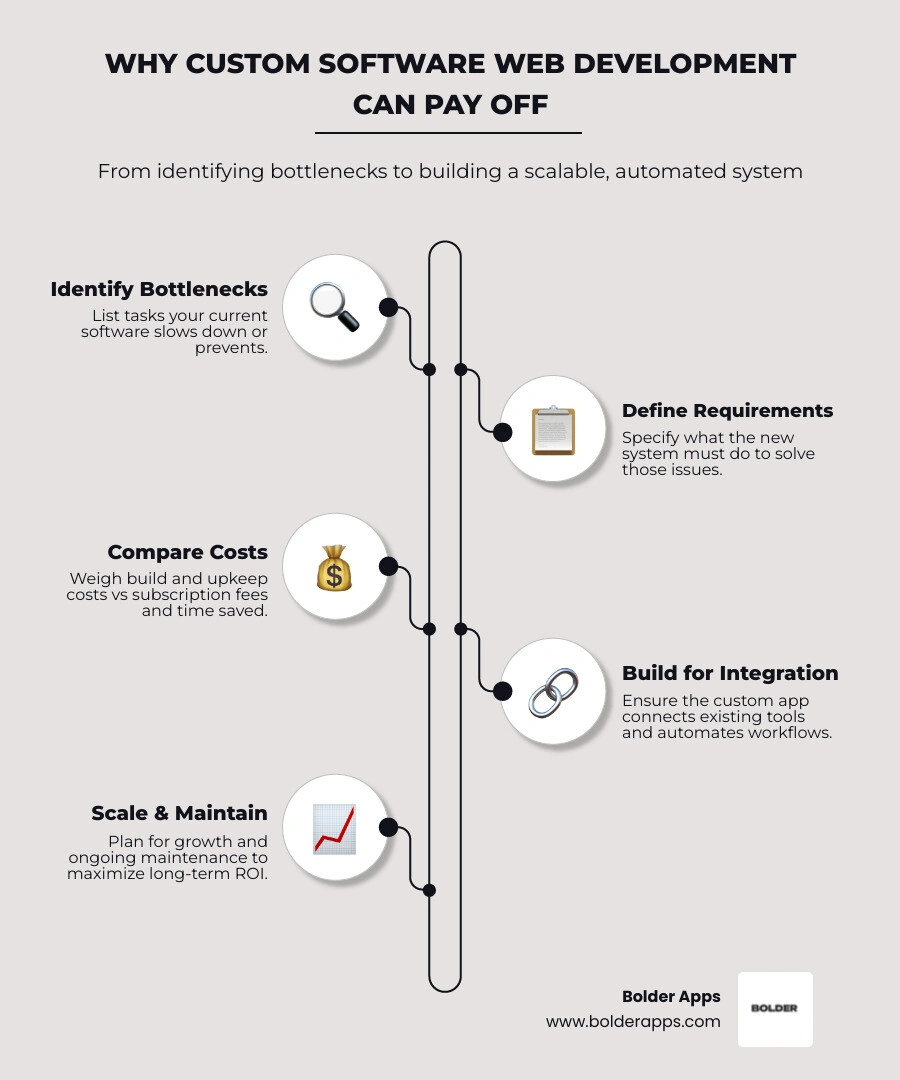
Custom software web development terms made easy:
Commercial off-the-shelf (COTS) platforms promise instant deployment, but they force businesses to conform their operations to pre-packaged assumptions. When your company relies on distinct operational methods to outcompete peers, squeezing your processes into generic software erodes your unique advantage. Bespoke web software is engineered specifically around your competitive strengths, transforming your digital infrastructure into proprietary intellectual property.
While off-the-shelf tools require constant compromises through disjointed plugins, manual spreadsheet workarounds, and steep recurring subscription fees, tailored web solutions eliminate functional friction. Investing in custom software transforms technology from a recurring operating expense into an appreciating business asset that you fully control.

Pre-packaged software platforms are fundamentally designed to serve millions of generic users simultaneously. This multi-tenant model restricts your access to the underlying code, limits database optimizations, and creates severe architectural bottlenecks. When conducting a build vs buy analysis, data sovereignty and architectural control emerge as decisive factors.
With dedicated custom architecture, your engineering team designs isolated data schemas and modular microservices tailored precisely to your operational volume. Choosing strategic software architecture design ensures that your backend handles data processing without hitting arbitrary API rate limits imposed by third-party SaaS vendors. Whether deploying an isolated single-tenant system or planning a proprietary multi-tenant SaaS architecture in 2026, your company retains complete ownership of its code, business logic, and customer records.
Furthermore, out-of-the-box platforms lock your proprietary records inside closed data silos, charging punitive fees for high-frequency API exports. Developing custom systems allows you to structure high-performance relational or document databases optimized for your exact querying patterns, which is why your business needs a bespoke database system to maintain data speed, security, and long-term analytical integrity.
Off-the-shelf software vendors utilize pricing models designed to capture greater revenue as your business expands. Per-seat licensing fees, tier-based feature paywalls, and mandatory enterprise support contracts create an escalating expense profile. As your workforce grows from 50 to 500 team members, SaaS subscription fees compound dramatically each year.
The economic advantage of custom web development becomes evident when assessing the three-year horizon. Instead of paying perpetual licensing fees that inflate alongside headcounts, custom development requires an upfront capital investment that amortizes over the application's operational lifespan. You can evaluate the comprehensive cost to build a SaaS product over three years to see how eliminating per-seat taxes generates significant net savings while building valuable enterprise equity.
Deploying tailored web systems modernizes operations by eliminating the operational friction inherent in disjointed toolsets. When core business functions run on dedicated digital infrastructure, companies unlock significant efficiencies:
Specialized web app development allows organizations to replace fragmented commercial tools with unified digital operations. Deploying focused custom enterprise apps gives executive leadership transparent, real-time insight into operations while saving staff countless hours each week.
Growing organizations often encounter performance walls when their commercial software cannot manage traffic spikes or intensive data pipelines. Custom web systems built on modern cloud-native architectures utilize elastic auto-scaling clusters, serverless functions, and containerized deployments to maintain peak performance under any workload.
Modern development leverages production-grade frameworks such as Next JS 16 as an operating system for web businesses, pairing server-side rendering with lightning-fast static generation. This setup ensures your customer-facing applications and internal portals load instantly regardless of user volume or geographic distribution. Elastic cloud infrastructure scales compute resources dynamically during demand spikes and scales down during lulls, optimizing cloud hosting expenditures without compromising uptime or latency.
Shared commercial platforms remain attractive targets for malicious actors seeking broad access to multi-tenant vulnerabilities. In contrast, custom software development enables targeted security controls tailored specifically to your threat landscape, regulatory environment, and enterprise governance policies.

Custom development empowers you to build zero-trust architectures, enforce fine-grained role-based access controls (RBAC), and integrate continuous security logging. For organizations managing sensitive health records or financial data, following detailed protocols on how to achieve NodeJS HIPAA compliance guarantees that encryption in transit, encryption at rest, and audit logging meet rigorous federal standards without reliance on third-party security patches.
Custom web platforms provide the underlying engine for organizations across diverse commercial sectors, turning manual bottlenecks into automated, high-velocity workflows.
Tailored software addresses the operational requirements that general commercial applications cannot accommodate:
Custom web development delivers strategic advantages across organizations of varying maturity and operational scope:
Building high-performance custom web software demands rigorous planning, disciplined architecture definition, and structured agile execution. Bypassing upfront discovery frequently leads to scope misalignment, budget overruns, and technical friction.
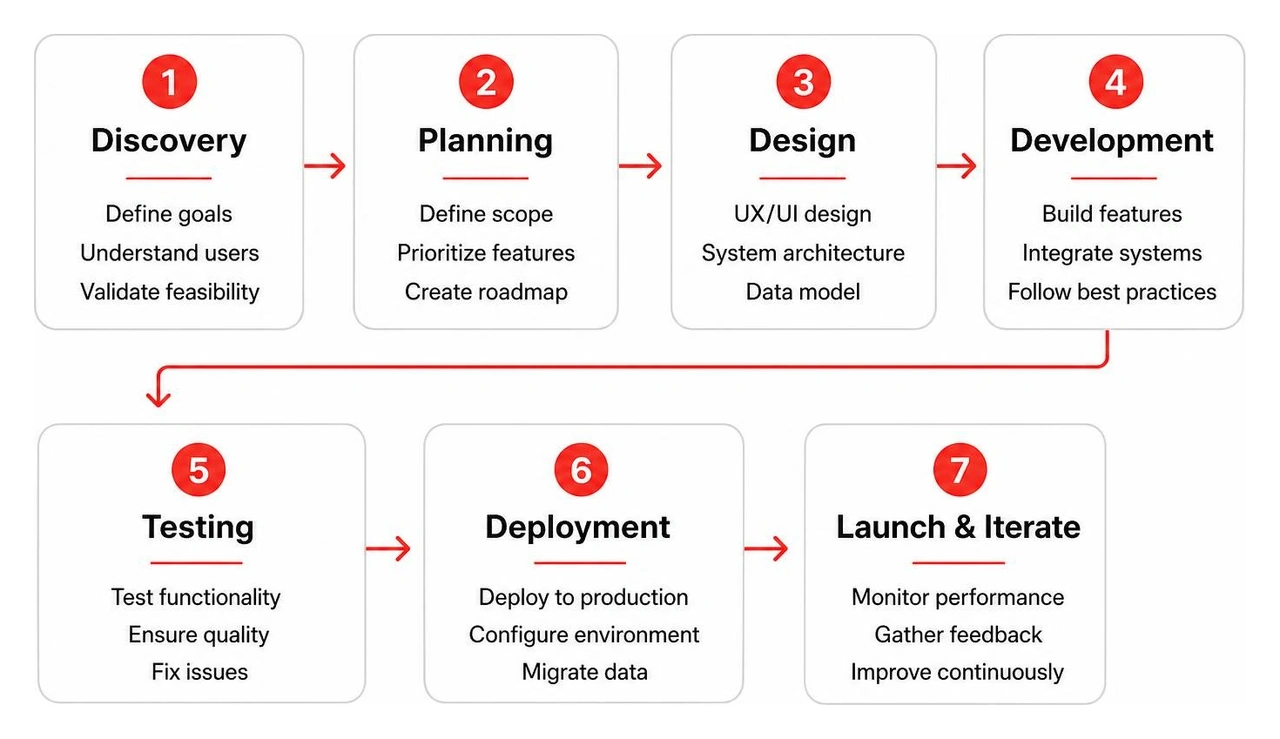
Engaging in structured paid discovery for app development validates technical feasibility, establishes functional user stories, defines database architecture, and aligns stakeholder requirements prior to writing production code.
Your technology stack determines application performance, maintainability, developer velocity, and long-term scalability. Evaluating frontend frameworks, runtime environments, and database engines early prevents costly technical rewrites later.
Frontend interfaces require fast rendering, rich interactivity, and broad ecosystem support, explaining why React remains the strategic gold standard for modern UI development. On the backend, modern runtime environments such as Node JS in 2026 with native first architecture deliver unmatched asynchronous I/O performance for high-throughput transactional applications. For an exhaustive architectural evaluation, review our guide on how to choose a technology stack for your app to select the right languages, frameworks, and database architectures for your business needs.
Selecting an engineering partner requires evaluating technical capabilities, delivery methodologies, and team transparency. Relying on inexperienced junior teams or loosely managed freelancer networks introduces technical debt, insecure code, and missed launch targets.
Organizations should look for partners that follow disciplined agile methodologies outlined in our agile custom software development guide. When evaluating contract terms, assess the trade-offs between fixed price vs time and materials development to determine the right financial model for your project scope. Before signing an engagement, review the essential 18 questions to ask an app development company to thoroughly vet engineering rigor, security practices, code ownership terms, and team seniority.
Custom software is a purpose-built web application engineered specifically around the distinct workflows, data structures, and operational goals of an individual business. Unlike off-the-shelf software, which licenses pre-packaged features across generic multi-tenant platforms, custom software provides your organization with full ownership of the intellectual property, dedicated architecture, and the freedom to modify and scale the codebase without third-party licensing constraints.
The long-term return on investment from custom web development is driven by three core elements: the elimination of escalating per-seat subscription fees, substantial labor savings achieved through direct workflow automation, and the market value of building proprietary intellectual property. By integrating fragmented systems into a unified platform, custom applications remove operational friction and allow teams to handle significantly higher transaction volumes without increasing administrative headcount.
Development timelines depend on project complexity, integrations, and operational scope. A focused Minimum Viable Product (MVP) or core workflow application typically requires three to four months of engineering through iterative agile sprints. Complex enterprise platforms featuring extensive legacy integrations, advanced role configurations, and deep compliance protocols typically require six to nine months from initial architectural discovery to full enterprise rollout.
Custom web development is a proven strategy for growing businesses seeking to lower long-term operating costs, streamline complex operations, and establish durable market advantages. By investing in tailored digital architecture rather than renting generic SaaS subscriptions, forward-thinking organizations turn their software systems into high-performing proprietary assets.
At Bolder Apps, founded in 2019 and named the top software and app development agency in 2026 by DesignRush, we help companies build tailored digital platforms. Our model pairs experienced US product leadership with senior distributed engineers, guaranteeing high-impact strategic delivery with zero junior learning on your dime. Operating with clear fixed-budget frameworks, transparent milestone-based payments, and an experienced in-shore CTO directing every sprint, our locations in Miami and across the United States deliver enterprise-grade digital systems built for scale.
Explore our dedicated Custom Software Development services today to turn your unique operational vision into a powerful web application.
Custom software web development means building a web application around your business's workflows instead of fitting those workflows into a ready-made tool. To decide if it's worth building, list the tasks your current software slows down, define what a new system must do, and compare its build and upkeep costs with subscription fees and the time your team could save. Industry analyses such as DesignRush's 2026 software development agency rankings show that businesses increasingly favor tailored platforms over generic SaaS subscriptions for exactly this reason.
The upfront cost is usually higher. But a well-planned custom app can connect your existing tools, automate repeat work, and grow with your business. The strongest case for building is when those gains are likely to outweigh the cost of maintaining the software over time.
Custom software web development terms made easy:
Commercial off-the-shelf (COTS) platforms promise instant deployment, but they force businesses to conform their operations to pre-packaged assumptions. When your company relies on distinct operational methods to outcompete peers, squeezing your processes into generic software erodes your unique advantage. Bespoke web software is engineered specifically around your competitive strengths, transforming your digital infrastructure into proprietary intellectual property.
While off-the-shelf tools require constant compromises through disjointed plugins, manual spreadsheet workarounds, and steep recurring subscription fees, tailored web solutions eliminate functional friction. Investing in custom software transforms technology from a recurring operating expense into an appreciating business asset that you fully control.
Pre-packaged software platforms are fundamentally designed to serve millions of generic users simultaneously. This multi-tenant model restricts your access to the underlying code, limits database optimizations, and creates severe architectural bottlenecks. When conducting a build vs buy analysis, data sovereignty and architectural control emerge as decisive factors.
With dedicated custom architecture, your engineering team designs isolated data schemas and modular microservices tailored precisely to your operational volume. Choosing strategic software architecture design ensures that your backend handles data processing without hitting arbitrary API rate limits imposed by third-party SaaS vendors. Whether deploying an isolated single-tenant system or planning a proprietary multi-tenant SaaS architecture in 2026, your company retains complete ownership of its code, business logic, and customer records.
Furthermore, out-of-the-box platforms lock your proprietary records inside closed data silos, charging punitive fees for high-frequency API exports. Developing custom systems allows you to structure high-performance relational or document databases optimized for your exact querying patterns, which is why your business needs a bespoke database system to maintain data speed, security, and long-term analytical integrity.
Off-the-shelf software vendors utilize pricing models designed to capture greater revenue as your business expands. Per-seat licensing fees, tier-based feature paywalls, and mandatory enterprise support contracts create an escalating expense profile. As your workforce grows from 50 to 500 team members, SaaS subscription fees compound dramatically each year.
The economic advantage of custom web development becomes evident when assessing the three-year horizon. Instead of paying perpetual licensing fees that inflate alongside headcounts, custom development requires an upfront capital investment that amortizes over the application's operational lifespan. You can evaluate the comprehensive cost to build a SaaS product over three years to see how eliminating per-seat taxes generates significant net savings while building valuable enterprise equity.
Deploying tailored web systems modernizes operations by eliminating the operational friction inherent in disjointed toolsets. When core business functions run on dedicated digital infrastructure, companies unlock significant efficiencies:
Specialized web app development allows organizations to replace fragmented commercial tools with unified digital operations. Deploying focused custom enterprise apps gives executive leadership transparent, real-time insight into operations while saving staff countless hours each week.
Growing organizations often encounter performance walls when their commercial software cannot manage traffic spikes or intensive data pipelines. Custom web systems built on modern cloud-native architectures utilize elastic auto-scaling clusters, serverless functions, and containerized deployments to maintain peak performance under any workload.
Modern development leverages production-grade frameworks such as Next JS 16 as an operating system for web businesses, pairing server-side rendering with lightning-fast static generation. This setup ensures your customer-facing applications and internal portals load instantly regardless of user volume or geographic distribution. Elastic cloud infrastructure scales compute resources dynamically during demand spikes and scales down during lulls, optimizing cloud hosting expenditures without compromising uptime or latency.
Shared commercial platforms remain attractive targets for malicious actors seeking broad access to multi-tenant vulnerabilities. In contrast, custom software development enables targeted security controls tailored specifically to your threat landscape, regulatory environment, and enterprise governance policies.
Custom development empowers you to build zero-trust architectures, enforce fine-grained role-based access controls (RBAC), and integrate continuous security logging. For organizations managing sensitive health records or financial data, following detailed protocols on how to achieve NodeJS HIPAA compliance guarantees that encryption in transit, encryption at rest, and audit logging meet rigorous federal standards without reliance on third-party security patches.
Custom web platforms provide the underlying engine for organizations across diverse commercial sectors, turning manual bottlenecks into automated, high-velocity workflows.
Tailored software addresses the operational requirements that general commercial applications cannot accommodate:
Custom web development delivers strategic advantages across organizations of varying maturity and operational scope:
Building high-performance custom web software demands rigorous planning, disciplined architecture definition, and structured agile execution. Bypassing upfront discovery frequently leads to scope misalignment, budget overruns, and technical friction.
Engaging in structured paid discovery for app development validates technical feasibility, establishes functional user stories, defines database architecture, and aligns stakeholder requirements prior to writing production code.
Your technology stack determines application performance, maintainability, developer velocity, and long-term scalability. Evaluating frontend frameworks, runtime environments, and database engines early prevents costly technical rewrites later.
Frontend interfaces require fast rendering, rich interactivity, and broad ecosystem support, explaining why React remains the strategic gold standard for modern UI development. On the backend, modern runtime environments such as Node JS in 2026 with native first architecture deliver unmatched asynchronous I/O performance for high-throughput transactional applications. For an exhaustive architectural evaluation, review our guide on how to choose a technology stack for your app to select the right languages, frameworks, and database architectures for your business needs.
Selecting an engineering partner requires evaluating technical capabilities, delivery methodologies, and team transparency. Relying on inexperienced junior teams or loosely managed freelancer networks introduces technical debt, insecure code, and missed launch targets.
Organizations should look for partners that follow disciplined agile methodologies outlined in our agile custom software development guide. When evaluating contract terms, assess the trade-offs between fixed price vs time and materials development to determine the right financial model for your project scope. Before signing an engagement, review the essential 18 questions to ask an app development company to thoroughly vet engineering rigor, security practices, code ownership terms, and team seniority.
Custom software is a purpose-built web application engineered specifically around the distinct workflows, data structures, and operational goals of an individual business. Unlike off-the-shelf software, which licenses pre-packaged features across generic multi-tenant platforms, custom software provides your organization with full ownership of the intellectual property, dedicated architecture, and the freedom to modify and scale the codebase without third-party licensing constraints.
The long-term return on investment from custom web development is driven by three core elements: the elimination of escalating per-seat subscription fees, substantial labor savings achieved through direct workflow automation, and the market value of building proprietary intellectual property. By integrating fragmented systems into a unified platform, custom applications remove operational friction and allow teams to handle significantly higher transaction volumes without increasing administrative headcount.
Development timelines depend on project complexity, integrations, and operational scope. A focused Minimum Viable Product (MVP) or core workflow application typically requires three to four months of engineering through iterative agile sprints. Complex enterprise platforms featuring extensive legacy integrations, advanced role configurations, and deep compliance protocols typically require six to nine months from initial architectural discovery to full enterprise rollout.
Custom web development is a proven strategy for growing businesses seeking to lower long-term operating costs, streamline complex operations, and establish durable market advantages. By investing in tailored digital architecture rather than renting generic SaaS subscriptions, forward-thinking organizations turn their software systems into high-performing proprietary assets.
At Bolder Apps, founded in 2019 and named the top software and app development agency in 2026 by DesignRush, we help companies build tailored digital platforms. Our model pairs experienced US product leadership with senior distributed engineers, guaranteeing high-impact strategic delivery with zero junior learning on your dime. Operating with clear fixed-budget frameworks, transparent milestone-based payments, and an experienced in-shore CTO directing every sprint, our locations in Miami and across the United States deliver enterprise-grade digital systems built for scale.
Explore our dedicated Custom Software Development services today to turn your unique operational vision into a powerful web application.