Sean Weldon
October 23, 2026
10
min. read
and updated on:
October 23, 2026



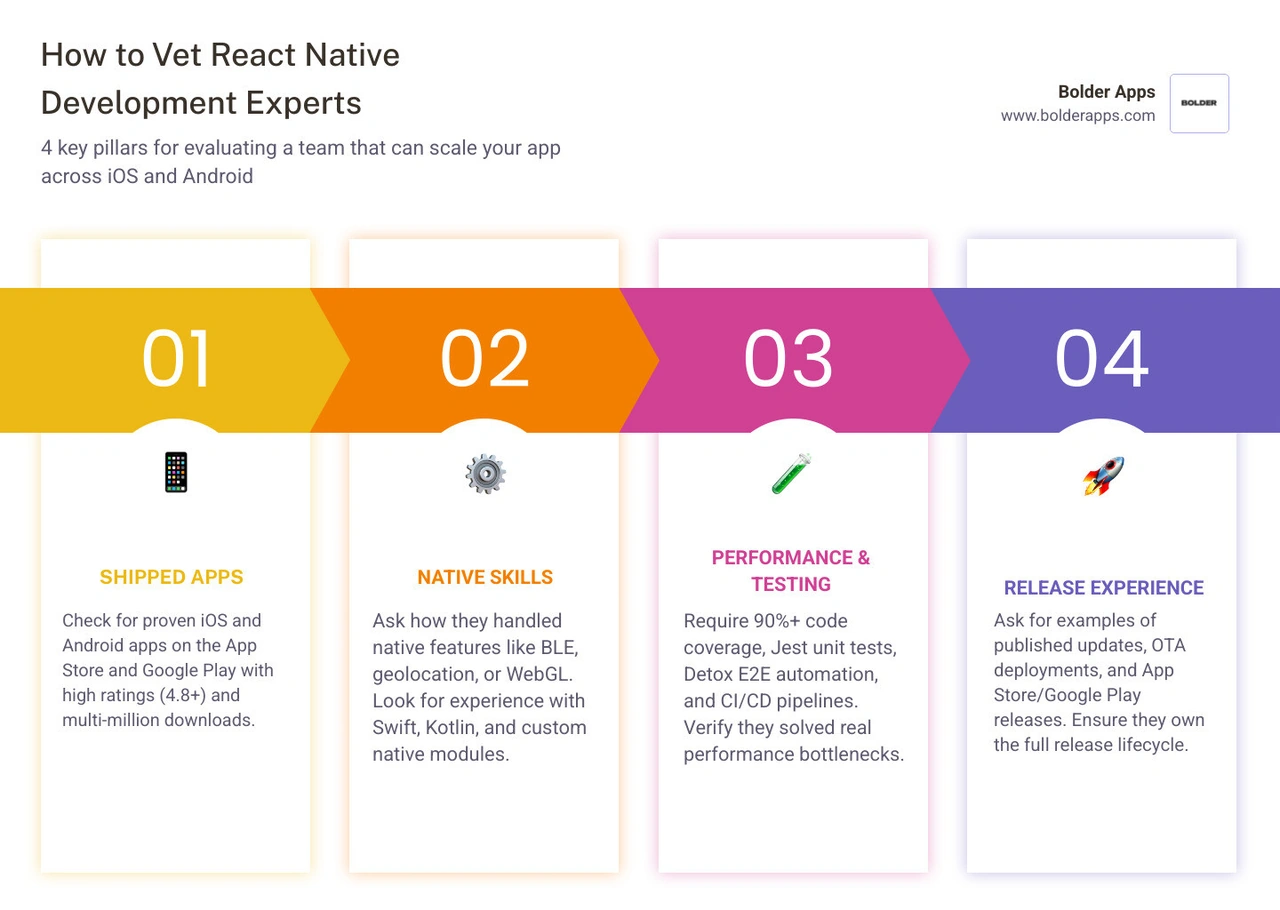
Look for proof of shipped iOS and Android apps, not just React experience. Strong React Native development experts can explain how they handled native features, fixed performance problems, tested releases, and published updates. Ask candidates to walk you through a real production issue and the trade-offs behind their solution.
React Native lets teams share much of an app's code across platforms. But a shared codebase does not remove the need for careful architecture or platform testing. In 2026, the right partner should help you ship faster without leaving those problems for later. This list shows what to check when evaluating a team like Bolder Apps, founded in 2019.
Discover more about React Native development experts:
Scaling an enterprise product across mobile operating systems used to require two isolated development pipelines, two specialized engineering teams, and double the overhead. Today, forward-thinking enterprises use React Native to consolidate their engineering velocity. By evaluating the cross-platform mobile app landscape in 2026, product leaders realize that a single, unified codebase drastically reduces total cost of ownership while speeding up time-to-market.
However, cross-platform efficiency only materializes when orchestrated by senior engineers who understand how to structure platform-agnostic business logic without sacrificing native user interface responsiveness.
The modern React Native runtime operates on an entirely re-engineered core. Historically, communication between the JavaScript realm and native iOS or Android modules relied on an asynchronous JSON serialization bridge. Under heavy data loads or rapid touch interactions, that legacy bridge often formed a severe bottleneck.

With the complete adoption of the New Architecture, the bridge has been retired in favor of the JavaScript Interface (JSI). Understanding how JSI and Fabric replaced the legacy bridge architecture is vital for high-performance builds:
Building separate Swift and Kotlin codebases frequently leads to divergent feature releases and fragmented business rules. A strategic comparison between React Native and Flutter in 2026 reveals that React Native maintains a unique advantage: it maps declarative components directly to native host primitives rather than drawing custom widgets onto a canvas.
This native component mapping guarantees that system accessibility features, text rendering metrics, and OS-level animations match platform conventions out of the box.
Building an enterprise application requires more than assembling pre-built UI kits. True specialists possess deep diagnostic instincts, resolving memory leaks, orchestrating thread synchronization, and implementing clean software architectures. When reviewing your senior mobile app development team structuring, ensuring your talent pool consists of senior-level contributors guarantees zero junior learning overhead on your budget.

Seasoned specialists structure their repositories using domain-driven design, Clean Architecture, and Hexagonal architectural patterns to cleanly isolate business logic from UI components. They enforce strict TypeScript configurations to capture interface mismatches at compile time rather than during production execution.
For state management, top-tier engineers avoid bloated global stores, opting for streamlined tools like Redux Toolkit, Zustand, or Apollo Client for normalized server-state caching. Engineers such as those showcasing Elijah Windsor's proven track record scaling high-traffic apps demonstrate how robust architectural foundations support products handling millions of active users and hundreds of thousands of store ratings without stability degradation.
Enterprise applications often interact directly with external peripherals, device sensors, and low-level system services. When standard open-source libraries fail to cover niche enterprise requirements, experienced engineers write custom TurboModules using Objective-C, Swift, Java, C++, or Kotlin.
Developers with deep native backgrounds—such as Hein Rutjes' specialized native Bluetooth and open-source contributions—routinely develop custom native bridges for:
Performance optimization in React Native requires granular profiling across both the JavaScript thread and the native UI main thread. Achieving frictionless interactions requires strict discipline across component render lifecycles, asset pipelines, and network payloads throughout the comprehensive mobile app development lifecycle.
Scalable mobile applications rely on structured caching, offline-first persistence, and modular component design. Leveraging the strategic benefits of React in modern enterprise UI development, senior engineers structure codebases into reusable design systems and micro-frontends.
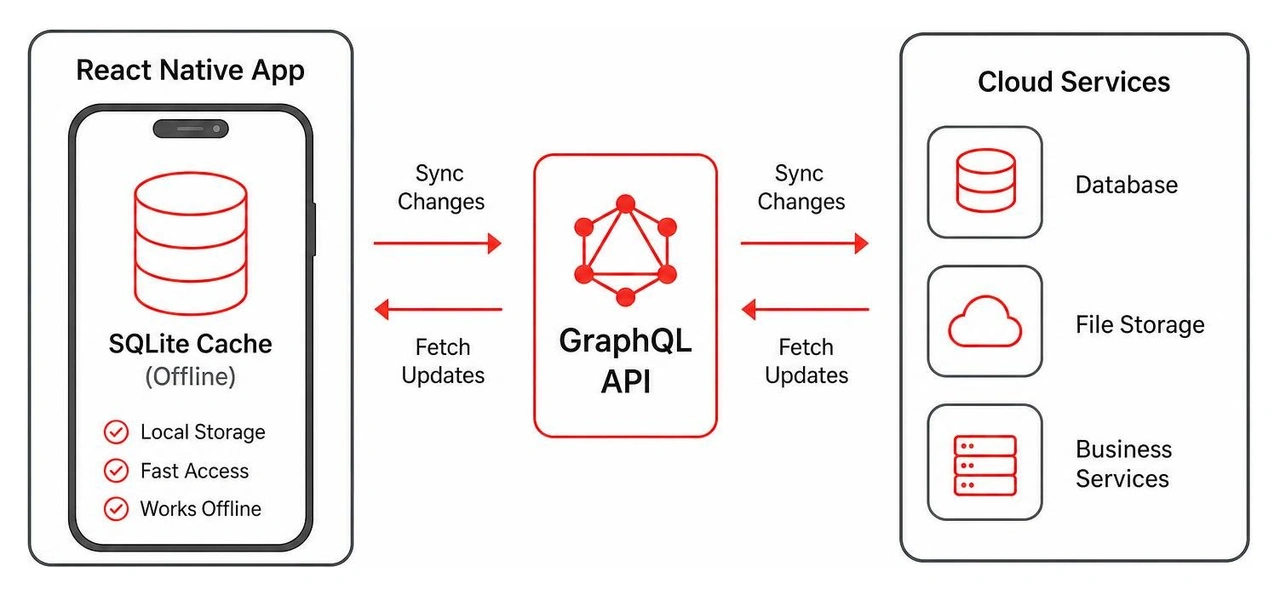
To maintain swift frame rates, specialists apply systematic performance patterns:
High-growth brands cannot afford regression bugs in production releases. Senior engineering teams implement multi-tiered automated testing pyramids:
The developer experience landscape has evolved significantly. Modern development teams leverage unified toolchains and automated build environments to deliver features rapidly while preserving complete architectural flexibility.
Expo has transitioned from a restrictive sandbox into an enterprise-grade standard for mobile workflows. Through modern specialized React Native application development services, teams utilize modern development pipelines:
expo-dev-client): Constructing tailor-made runtime environments that combine Expo's rapid development conveniences with custom native C++, Swift, and Kotlin dependencies.The modern mobile frontier increasingly demands edge intelligence, secure decentralization, and efficient network interactions. Implementing on-device AI integration across native and React Native apps in 2026 allows brands to run quantized large language models (LLMs) and computer vision classifiers locally on mobile Neural Processing Units (NPUs), protecting user privacy and ensuring offline availability.
Simultaneously, senior engineers integrate secure Web3 wallet protocols using hardware-backed Secure Enclave storage on iOS and KeyStore on Android, while unifying enterprise API layers through Apollo GraphQL client caching.
Finding the right development partner requires evaluating verifiable production outcomes rather than resume claims. When exploring options such as flexible staff augmentation for engineering teams, look for partners with demonstrated technical maturity and strong leadership.

When vetting engineering candidates or agency partners, examine concrete store metrics:
Inexperienced developers frequently fall into common architecture traps that degrade application performance over time:
Junior developers often treat React Native simply as React for mobile, building web-like patterns that trigger performance issues, unmanaged memory leaks, and brittle navigation setups. Seasoned specialists possess native Android and iOS debugging expertise, understand C++ JSI interactions, configure robust CI/CD deployment pipelines, and design modular architectures that eliminate technical debt.
Enterprises select React Native when they want seamless integration with native OS components, broad access to the JavaScript/TypeScript talent ecosystem, and shared code across web and mobile properties. React Native also supports over-the-air (OTA) JavaScript bundle updates, allowing teams to ship immediate hotfixes directly to users.
Expo is fully enterprise-ready when using expo-dev-client and Expo Application Services (EAS). It removes the historical limitations of managed workflows by allowing developers to integrate arbitrary custom native modules and C++ libraries while retaining automated cloud builds, file-based routing, and streamlined OTA update management.
Building a market-leading cross-platform mobile application requires senior architectural expertise, deep platform knowledge, and disciplined execution. Bolder Apps, founded in 2019, was named the top software and app development agency in 2026 by DesignRush (verify company details on bolderapps.com). We pair strategic US-based technical leadership with senior distributed engineers to deliver intuitive, high-impact digital products.
By combining an in-shore CTO model with experienced engineering talent across our client locations, we ensure your project moves forward smoothly without junior learning curves on your dime. We work under clear, fixed-budget models with milestone-based payments, aligning our milestones directly with your business goals.
Ready to build or scale your mobile product? Connect with our team today to explore our elite mobile app development services and turn your mobile roadmap into a high-performance reality.
Look for proof of shipped iOS and Android apps, not just React experience. Strong React Native development experts can explain how they handled native features, fixed performance problems, tested releases, and published updates. Ask candidates to walk you through a real production issue and the trade-offs behind their solution.
React Native lets teams share much of an app's code across platforms. But a shared codebase does not remove the need for careful architecture or platform testing. In 2026, the right partner should help you ship faster without leaving those problems for later. This list shows what to check when evaluating a team like Bolder Apps, founded in 2019.
Discover more about React Native development experts:
Scaling an enterprise product across mobile operating systems used to require two isolated development pipelines, two specialized engineering teams, and double the overhead. Today, forward-thinking enterprises use React Native to consolidate their engineering velocity. By evaluating the cross-platform mobile app landscape in 2026, product leaders realize that a single, unified codebase drastically reduces total cost of ownership while speeding up time-to-market.
However, cross-platform efficiency only materializes when orchestrated by senior engineers who understand how to structure platform-agnostic business logic without sacrificing native user interface responsiveness.
The modern React Native runtime operates on an entirely re-engineered core. Historically, communication between the JavaScript realm and native iOS or Android modules relied on an asynchronous JSON serialization bridge. Under heavy data loads or rapid touch interactions, that legacy bridge often formed a severe bottleneck.
With the complete adoption of the New Architecture, the bridge has been retired in favor of the JavaScript Interface (JSI). Understanding how JSI and Fabric replaced the legacy bridge architecture is vital for high-performance builds:
Building separate Swift and Kotlin codebases frequently leads to divergent feature releases and fragmented business rules. A strategic comparison between React Native and Flutter in 2026 reveals that React Native maintains a unique advantage: it maps declarative components directly to native host primitives rather than drawing custom widgets onto a canvas.
This native component mapping guarantees that system accessibility features, text rendering metrics, and OS-level animations match platform conventions out of the box.
Building an enterprise application requires more than assembling pre-built UI kits. True specialists possess deep diagnostic instincts, resolving memory leaks, orchestrating thread synchronization, and implementing clean software architectures. When reviewing your senior mobile app development team structuring, ensuring your talent pool consists of senior-level contributors guarantees zero junior learning overhead on your budget.
Seasoned specialists structure their repositories using domain-driven design, Clean Architecture, and Hexagonal architectural patterns to cleanly isolate business logic from UI components. They enforce strict TypeScript configurations to capture interface mismatches at compile time rather than during production execution.
For state management, top-tier engineers avoid bloated global stores, opting for streamlined tools like Redux Toolkit, Zustand, or Apollo Client for normalized server-state caching. Engineers such as those showcasing Elijah Windsor's proven track record scaling high-traffic apps demonstrate how robust architectural foundations support products handling millions of active users and hundreds of thousands of store ratings without stability degradation.
Enterprise applications often interact directly with external peripherals, device sensors, and low-level system services. When standard open-source libraries fail to cover niche enterprise requirements, experienced engineers write custom TurboModules using Objective-C, Swift, Java, C++, or Kotlin.
Developers with deep native backgrounds—such as Hein Rutjes' specialized native Bluetooth and open-source contributions—routinely develop custom native bridges for:
Performance optimization in React Native requires granular profiling across both the JavaScript thread and the native UI main thread. Achieving frictionless interactions requires strict discipline across component render lifecycles, asset pipelines, and network payloads throughout the comprehensive mobile app development lifecycle.
Scalable mobile applications rely on structured caching, offline-first persistence, and modular component design. Leveraging the strategic benefits of React in modern enterprise UI development, senior engineers structure codebases into reusable design systems and micro-frontends.
To maintain swift frame rates, specialists apply systematic performance patterns:
High-growth brands cannot afford regression bugs in production releases. Senior engineering teams implement multi-tiered automated testing pyramids:
The developer experience landscape has evolved significantly. Modern development teams leverage unified toolchains and automated build environments to deliver features rapidly while preserving complete architectural flexibility.
Expo has transitioned from a restrictive sandbox into an enterprise-grade standard for mobile workflows. Through modern specialized React Native application development services, teams utilize modern development pipelines:
expo-dev-client): Constructing tailor-made runtime environments that combine Expo's rapid development conveniences with custom native C++, Swift, and Kotlin dependencies.The modern mobile frontier increasingly demands edge intelligence, secure decentralization, and efficient network interactions. Implementing on-device AI integration across native and React Native apps in 2026 allows brands to run quantized large language models (LLMs) and computer vision classifiers locally on mobile Neural Processing Units (NPUs), protecting user privacy and ensuring offline availability.
Simultaneously, senior engineers integrate secure Web3 wallet protocols using hardware-backed Secure Enclave storage on iOS and KeyStore on Android, while unifying enterprise API layers through Apollo GraphQL client caching.
Finding the right development partner requires evaluating verifiable production outcomes rather than resume claims. When exploring options such as flexible staff augmentation for engineering teams, look for partners with demonstrated technical maturity and strong leadership.
When vetting engineering candidates or agency partners, examine concrete store metrics:
Inexperienced developers frequently fall into common architecture traps that degrade application performance over time:
Junior developers often treat React Native simply as React for mobile, building web-like patterns that trigger performance issues, unmanaged memory leaks, and brittle navigation setups. Seasoned specialists possess native Android and iOS debugging expertise, understand C++ JSI interactions, configure robust CI/CD deployment pipelines, and design modular architectures that eliminate technical debt.
Enterprises select React Native when they want seamless integration with native OS components, broad access to the JavaScript/TypeScript talent ecosystem, and shared code across web and mobile properties. React Native also supports over-the-air (OTA) JavaScript bundle updates, allowing teams to ship immediate hotfixes directly to users.
Expo is fully enterprise-ready when using expo-dev-client and Expo Application Services (EAS). It removes the historical limitations of managed workflows by allowing developers to integrate arbitrary custom native modules and C++ libraries while retaining automated cloud builds, file-based routing, and streamlined OTA update management.
Building a market-leading cross-platform mobile application requires senior architectural expertise, deep platform knowledge, and disciplined execution. Bolder Apps, founded in 2019, was named the top software and app development agency in 2026 by DesignRush (verify company details on bolderapps.com). We pair strategic US-based technical leadership with senior distributed engineers to deliver intuitive, high-impact digital products.
By combining an in-shore CTO model with experienced engineering talent across our client locations, we ensure your project moves forward smoothly without junior learning curves on your dime. We work under clear, fixed-budget models with milestone-based payments, aligning our milestones directly with your business goals.
Ready to build or scale your mobile product? Connect with our team today to explore our elite mobile app development services and turn your mobile roadmap into a high-performance reality.