
Sean Weldon
October 21, 2026
10
min. read
and updated on:
October 21, 2026



High-quality software starts before anyone writes code. Define what users need, set clear goals for speed, security, and reliability, then review the design before building. Test each change, automate checks in your delivery pipeline, and watch how the product performs after release.
This approach does more than catch bugs. It helps teams avoid rework, protect customer trust, and ship a product that can keep improving. In this guide, we'll show you which quality practices and metrics are worth your time.

Important Quality software development terms:
Software quality represents the degree to which an application satisfies both stated functional requirements and unstated operational expectations. As Supreme Court Justice Potter Stewart famously quipped regarding hard-to-define standards, "I know it when I see it"—yet leaving software stability up to casual observation is a recipe for operational chaos. Modern software engineering treats quality as a quantifiable, multidimensional discipline rather than subjective craftsmanship.
Achieving engineering excellence requires balancing functional suitability with structural health across every layer of the system. While functional suitability determines whether the software executes user requests accurately, structural health governs whether the underlying code can sustain high transaction volumes, fend off cyberattacks, and adapt to changing market requirements.
International engineering standards provide structured frameworks for dissecting these attributes. ISO/IEC 25010 and the Consortium for Information & Software Quality (CISQ) define specific structural characteristics—ranging from reliability and efficiency to security and maintainability—that provide a common baseline for software quality assessments. Incorporating these standards into our custom software development lifecycle ensures that every application behaves reliably under pressure, meets regulatory baselines, and scales gracefully over time.
A comprehensive software quality model assesses several core dimensions to ensure that system health is evaluated holistically:
Balancing these dimensions prevents technical shortcuts that sacrifice long-term maintainability for rapid feature delivery. Following practical industry frameworks like the Software Delivery Playbook helps teams implement systematic code hygiene routines, linting rules, and cross-functional reviews that keep every dimension healthy.
Understanding the distinction between functional quality and structural quality is essential for managing technical debt:
An application can demonstrate flawless functional compliance in acceptance testing while harboring severe structural decay under the hood. For example, a financial application might calculate complex loan amortizations with 100 percent accuracy, yet its tightly coupled monolithic backend could make adding new payment gateways virtually impossible.
Neglecting internal health inevitably leads to technical debt, slowing delivery velocity and introducing architectural vulnerabilities. Integrating robust software architecture design principles early establishes clean boundaries, modular interfaces, and durable engineering foundations that safeguard both functional success and long-term maintainability.
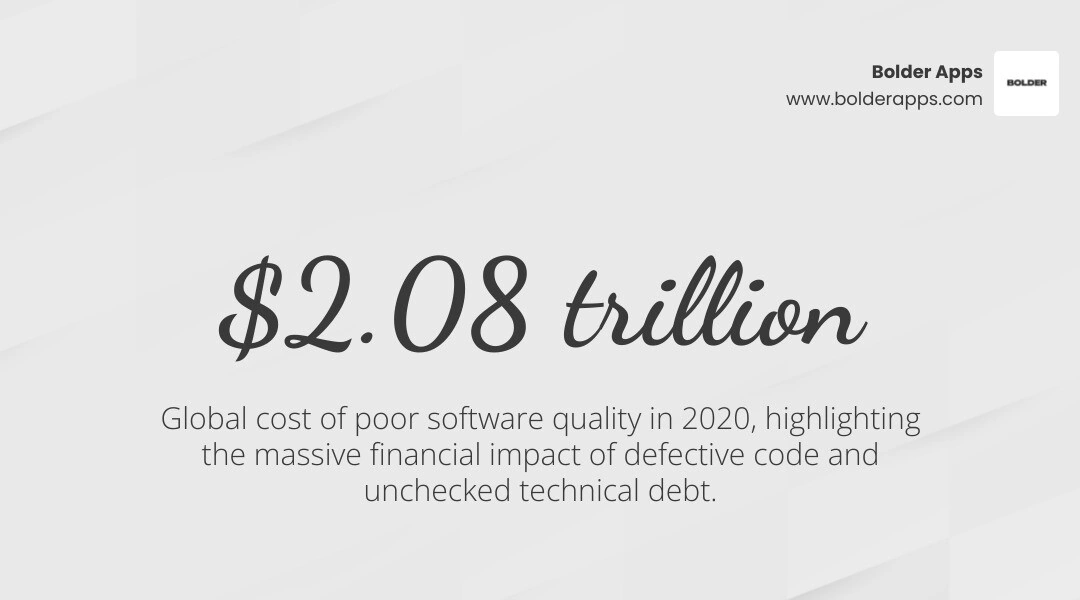
Poor application structural quality in core business applications results in severe schedule overruns, ballooning maintenance overhead, and operational waste in the form of continuous rework. According to industry research from CISQ, poor software quality cost US businesses a staggering $2.84 trillion in 2018 and $2.08 trillion in 2020. Unchecked technical debt and defective codebases represent a massive drag on organizational productivity.
Beyond immediate engineering hours, defective code introduces major operational risks. A single unchecked security vulnerability can lead to devastating data compromises. IBM security studies reported that the average global cost of a data breach reached $3.86 million, a figure driven by customer churn, regulatory penalties, incident forensics, and system restoration.
Left unmanaged, structural flaws turn routine maintenance into a continuous crisis. Our enterprise software development guide 2026 highlights how leading organizations eliminate rework waste by establishing continuous quality frameworks, shifting defect detection leftward, and treating code quality as a core business asset.
A common paradox in software engineering is the disparity between where code errors occur and where catastrophic production failures originate:
This reality underscores the 90-90 rule of software failures: programming errors discovered at the integrated system level represent up to 90 percent of production issues, while unit-level errors account for less than 10 percent.
Relying solely on local unit testing leaves systemic architectural flaws undetected. Conducting rigorous code audit services and architectural assessments allows engineering teams to identify deep structural bottlenecks, circular dependencies, and security blind spots before they impact live production workloads.
Fixing a bug becomes exponentially more expensive the later it is discovered in the software development lifecycle. In mission-critical environments, production defects can lead to costly software recalls, regulatory sanctions, or even severe physical accidents.

As software engineering pioneer Barry Boehm demonstrated, catching a defect during the initial requirements or architectural design phase costs virtually nothing—often requiring just a quick document revision or whiteboard discussion. Conversely, resolving that same defect once deployed to production can trigger emergency triage, customer compensation, off-hours patching, and major operational disruption. Fixing a bug in a live production environment can cost up to 100 times more than addressing it during design.
Empirical research published in The impact of software process improvement on quality: in theory and practice shows that structured defect prevention methodologies yield substantial cost savings across the entire software lifecycle.
Individual programmers are less than 50 percent efficient at finding bugs in their own code through manual review, and isolated testing approaches often identify only 35 percent of structural flaws. Enforcing automated static analysis, peer reviews, and automated verification within pull requests catches bugs before code is merged into trunk branches, yielding order-of-magnitude cost savings.
Managing software quality requires establishing objective, automated measurement frameworks rather than relying on gut feelings or sporadic testing sprints. Engineering organizations use balanced scorecards that combine low-level static analysis metrics with operational DevOps Research and Assessment (DORA) indicators to maintain full visibility over their software pipelines.
Frameworks like The TIOBE Quality Indicator demonstrate how continuous, automated code metrics can be mapped directly to international quality standards like ISO 25010. By tracking continuous signals across both source code and runtime environments, teams can identify emerging technical debt early and intervene before system degradation impacts end users.
Tracking structural code metrics provides engineering leaders with concrete data on maintainability, readability, and overall technical risk:
To maintain visibility across these indicators, teams conduct periodic software quality review audits. Automated scanners assign composite quality scores, identify code smells, and prevent structural degradation before new versions are released.
While code-level metrics evaluate internal health, operational metrics reflect real-world user satisfaction, system resilience, and deployment stability:
Aligning day-to-day engineering with these operational targets allows teams to deliver high-impact software sustainably. Our agile custom software development guide 2026 explains how high-performing teams combine continuous feedback loops with automated testing to maintain rapid release cadence without sacrificing application reliability.
Engineering leaders often use Software Quality Assurance (SQA), Quality Control (QC), and Software Testing interchangeably, but these disciplines serve distinct, complementary roles across the software development lifecycle.

As outlined in research on Methods of quality assurance of software development based on a systems approach, software quality must be managed as an integrated subsystem. Process-oriented assurance establishes organizational standards, while product-oriented controls verify that the resulting software meets functional expectations before deployment.
Clarifying the specific scope of each quality discipline ensures comprehensive coverage across the development lifecycle:
Treating quality engineering as a continuous discipline rather than a downstream testing checkpoint prevents the costly "bananaware" pattern—where unverified software is shipped to production, leaving end users to act as unpaid bug testers.
Integrating end-to-end quality assurance into our custom web app development 2026 processes ensures that every modern web application remains fast, secure, and resilient under real-world usage.
Building reliable software requires embedding quality practices into everyday engineering habits:
These principles form the operational foundation of modern engineering teams. Our advanced web development guide 2026 shows how combining disciplined defensive programming with full-stack observability enables engineering teams to build resilient, enterprise-grade cloud systems that scale effortlessly.
Modern software engineering relies on continuous integration and continuous delivery (CI/CD) pipelines to automate quality enforcement at scale. Instead of relying on manual pre-release sign-offs, teams configure automated delivery pipelines to run static analysis, execute test suites, and enforce compliance checks on every commit.

Automated quality gates act as objective checkpoints within the build pipeline, preventing unstable code from moving to subsequent deployment stages. As detailed in the academic research paper Quality Gates in Software Development: Concepts, Definition and Tools, embedding programmatic checkpoints into CI/CD pipelines ensures that every merge candidate satisfies strict criteria for code hygiene, security, and test coverage before deployment.
Adopting specialized devops engineering services helps organizations configure reliable delivery pipelines that eliminate manual verification bottlenecks and accelerate deployment velocity.
Effective delivery pipelines enforce strict quality gates across multiple stages of code progression:
Structuring these checkpoints effectively protects production stability without slowing down developer workflows. Our software development company guide 2026 explores how engineering organizations configure balanced quality gates to help distributed teams ship reliable software rapidly.
Automating software quality extends beyond merge validation into progressive release management and live production monitoring.
High-performing teams use progressive deployment strategies—such as blue-green environments and canary rollouts—to expose new releases to small subsets of traffic before initiating full production deployments. Real-time telemetry, automated error-budget tracking, and application performance monitoring (APM) tools observe system health during these rollouts. If error rates climb or latency spikes, automated rollback mechanisms restore the previous stable version immediately, keeping mean time to recovery to mere seconds.
Complementing automated deployments with periodic architectural reviews ensures that long-term non-functional requirements—including cross-platform portability, database scalability, and infrastructure security—remain aligned with overarching business objectives.
Code quality focuses on internal, structural attributes of source code—such as readability, low cyclomatic complexity, modularity, test coverage, and maintainability. It reflects how easily engineers can understand, refactor, and update the codebase.
Software quality is a broader discipline that encompasses both internal code health and external operational behavior—including runtime performance, security posture, functional correctness, system availability, and end-user satisfaction.
Basic code errors (such as off-by-one errors or minor logic bugs) account for 92 percent of total source-code errors, but they are typically isolated, easy to reproduce, and quick to resolve with local unit tests.
Architecture-level defects account for only 8 percent of total flaws, but they affect system boundaries, data flows, concurrency models, and service dependencies. As a result, they trigger roughly 90 percent of critical production outages, consume over half of total remediation effort, and often require extensive database migrations and architectural refactoring to fix.
Automated quality gates eliminate the manual testing bottlenecks, lengthy sign-off processes, and subjective reviews that slow down release cycles.
By executing automated unit tests, static code analysis, dependency audits, and security scans on every pull request, quality gates provide developers with immediate feedback within minutes of pushing code. This rapid feedback loop reduces change failure rates, prevents broken builds from reaching staging environments, and gives teams the confidence to deploy small, incremental updates to production multiple times per day.
Engineering high-quality software requires treating reliability, security, and maintainability as non-negotiable architectural principles from day one. Organizations that balance functional business needs with internal code health avoid costly technical debt, eliminate rework waste, protect customer trust, and build digital products that scale sustainably.
At Bolder Apps, we have been engineering resilient, high-impact digital products since our founding in 2019. Recognized as the top software and app development agency in 2026 by DesignRush, we help ambitious companies design, build, and deploy mission-critical web and mobile applications with confidence.
Our unique hybrid model pairs battle-tested US technical leadership with senior distributed software engineers. This structure gives you the strategic oversight of an experienced in-shore CTO backed by a dedicated, senior-level engineering team—ensuring zero junior learning curve on your dime. We work under transparent, fixed-budget models with milestone-based payments, aligning our incentives with your project's technical and commercial success.
Whether you are modernizing an enterprise system or launching a new product from scratch, our team provides the technical expertise and architectural rigor required to succeed. Explore our Miami software development services or connect with our nationwide software development locations to discuss your next project.
Ready to build software that stands the test of time? Partner with Bolder Apps to engineer scalable, high-performance applications designed for sustainable growth.
High-quality software starts before anyone writes code. Define what users need, set clear goals for speed, security, and reliability, then review the design before building. Test each change, automate checks in your delivery pipeline, and watch how the product performs after release.
This approach does more than catch bugs. It helps teams avoid rework, protect customer trust, and ship a product that can keep improving. In this guide, we'll show you which quality practices and metrics are worth your time.
Important Quality software development terms:
Software quality represents the degree to which an application satisfies both stated functional requirements and unstated operational expectations. As Supreme Court Justice Potter Stewart famously quipped regarding hard-to-define standards, "I know it when I see it"—yet leaving software stability up to casual observation is a recipe for operational chaos. Modern software engineering treats quality as a quantifiable, multidimensional discipline rather than subjective craftsmanship.
Achieving engineering excellence requires balancing functional suitability with structural health across every layer of the system. While functional suitability determines whether the software executes user requests accurately, structural health governs whether the underlying code can sustain high transaction volumes, fend off cyberattacks, and adapt to changing market requirements.
International engineering standards provide structured frameworks for dissecting these attributes. ISO/IEC 25010 and the Consortium for Information & Software Quality (CISQ) define specific structural characteristics—ranging from reliability and efficiency to security and maintainability—that provide a common baseline for software quality assessments. Incorporating these standards into our custom software development lifecycle ensures that every application behaves reliably under pressure, meets regulatory baselines, and scales gracefully over time.
A comprehensive software quality model assesses several core dimensions to ensure that system health is evaluated holistically:
Balancing these dimensions prevents technical shortcuts that sacrifice long-term maintainability for rapid feature delivery. Following practical industry frameworks like the Software Delivery Playbook helps teams implement systematic code hygiene routines, linting rules, and cross-functional reviews that keep every dimension healthy.
Understanding the distinction between functional quality and structural quality is essential for managing technical debt:
An application can demonstrate flawless functional compliance in acceptance testing while harboring severe structural decay under the hood. For example, a financial application might calculate complex loan amortizations with 100 percent accuracy, yet its tightly coupled monolithic backend could make adding new payment gateways virtually impossible.
Neglecting internal health inevitably leads to technical debt, slowing delivery velocity and introducing architectural vulnerabilities. Integrating robust software architecture design principles early establishes clean boundaries, modular interfaces, and durable engineering foundations that safeguard both functional success and long-term maintainability.
Poor application structural quality in core business applications results in severe schedule overruns, ballooning maintenance overhead, and operational waste in the form of continuous rework. According to industry research from CISQ, poor software quality cost US businesses a staggering $2.84 trillion in 2018 and $2.08 trillion in 2020. Unchecked technical debt and defective codebases represent a massive drag on organizational productivity.
Beyond immediate engineering hours, defective code introduces major operational risks. A single unchecked security vulnerability can lead to devastating data compromises. IBM security studies reported that the average global cost of a data breach reached $3.86 million, a figure driven by customer churn, regulatory penalties, incident forensics, and system restoration.
Left unmanaged, structural flaws turn routine maintenance into a continuous crisis. Our enterprise software development guide 2026 highlights how leading organizations eliminate rework waste by establishing continuous quality frameworks, shifting defect detection leftward, and treating code quality as a core business asset.
A common paradox in software engineering is the disparity between where code errors occur and where catastrophic production failures originate:
This reality underscores the 90-90 rule of software failures: programming errors discovered at the integrated system level represent up to 90 percent of production issues, while unit-level errors account for less than 10 percent.
Relying solely on local unit testing leaves systemic architectural flaws undetected. Conducting rigorous code audit services and architectural assessments allows engineering teams to identify deep structural bottlenecks, circular dependencies, and security blind spots before they impact live production workloads.
Fixing a bug becomes exponentially more expensive the later it is discovered in the software development lifecycle. In mission-critical environments, production defects can lead to costly software recalls, regulatory sanctions, or even severe physical accidents.
As software engineering pioneer Barry Boehm demonstrated, catching a defect during the initial requirements or architectural design phase costs virtually nothing—often requiring just a quick document revision or whiteboard discussion. Conversely, resolving that same defect once deployed to production can trigger emergency triage, customer compensation, off-hours patching, and major operational disruption. Fixing a bug in a live production environment can cost up to 100 times more than addressing it during design.
Empirical research published in The impact of software process improvement on quality: in theory and practice shows that structured defect prevention methodologies yield substantial cost savings across the entire software lifecycle.
Individual programmers are less than 50 percent efficient at finding bugs in their own code through manual review, and isolated testing approaches often identify only 35 percent of structural flaws. Enforcing automated static analysis, peer reviews, and automated verification within pull requests catches bugs before code is merged into trunk branches, yielding order-of-magnitude cost savings.
Managing software quality requires establishing objective, automated measurement frameworks rather than relying on gut feelings or sporadic testing sprints. Engineering organizations use balanced scorecards that combine low-level static analysis metrics with operational DevOps Research and Assessment (DORA) indicators to maintain full visibility over their software pipelines.
Frameworks like The TIOBE Quality Indicator demonstrate how continuous, automated code metrics can be mapped directly to international quality standards like ISO 25010. By tracking continuous signals across both source code and runtime environments, teams can identify emerging technical debt early and intervene before system degradation impacts end users.
Tracking structural code metrics provides engineering leaders with concrete data on maintainability, readability, and overall technical risk:
To maintain visibility across these indicators, teams conduct periodic software quality review audits. Automated scanners assign composite quality scores, identify code smells, and prevent structural degradation before new versions are released.
While code-level metrics evaluate internal health, operational metrics reflect real-world user satisfaction, system resilience, and deployment stability:
Aligning day-to-day engineering with these operational targets allows teams to deliver high-impact software sustainably. Our agile custom software development guide 2026 explains how high-performing teams combine continuous feedback loops with automated testing to maintain rapid release cadence without sacrificing application reliability.
Engineering leaders often use Software Quality Assurance (SQA), Quality Control (QC), and Software Testing interchangeably, but these disciplines serve distinct, complementary roles across the software development lifecycle.
As outlined in research on Methods of quality assurance of software development based on a systems approach, software quality must be managed as an integrated subsystem. Process-oriented assurance establishes organizational standards, while product-oriented controls verify that the resulting software meets functional expectations before deployment.
Clarifying the specific scope of each quality discipline ensures comprehensive coverage across the development lifecycle:
Treating quality engineering as a continuous discipline rather than a downstream testing checkpoint prevents the costly "bananaware" pattern—where unverified software is shipped to production, leaving end users to act as unpaid bug testers.
Integrating end-to-end quality assurance into our custom web app development 2026 processes ensures that every modern web application remains fast, secure, and resilient under real-world usage.
Building reliable software requires embedding quality practices into everyday engineering habits:
These principles form the operational foundation of modern engineering teams. Our advanced web development guide 2026 shows how combining disciplined defensive programming with full-stack observability enables engineering teams to build resilient, enterprise-grade cloud systems that scale effortlessly.
Modern software engineering relies on continuous integration and continuous delivery (CI/CD) pipelines to automate quality enforcement at scale. Instead of relying on manual pre-release sign-offs, teams configure automated delivery pipelines to run static analysis, execute test suites, and enforce compliance checks on every commit.
Automated quality gates act as objective checkpoints within the build pipeline, preventing unstable code from moving to subsequent deployment stages. As detailed in the academic research paper Quality Gates in Software Development: Concepts, Definition and Tools, embedding programmatic checkpoints into CI/CD pipelines ensures that every merge candidate satisfies strict criteria for code hygiene, security, and test coverage before deployment.
Adopting specialized devops engineering services helps organizations configure reliable delivery pipelines that eliminate manual verification bottlenecks and accelerate deployment velocity.
Effective delivery pipelines enforce strict quality gates across multiple stages of code progression:
Structuring these checkpoints effectively protects production stability without slowing down developer workflows. Our software development company guide 2026 explores how engineering organizations configure balanced quality gates to help distributed teams ship reliable software rapidly.
Automating software quality extends beyond merge validation into progressive release management and live production monitoring.
High-performing teams use progressive deployment strategies—such as blue-green environments and canary rollouts—to expose new releases to small subsets of traffic before initiating full production deployments. Real-time telemetry, automated error-budget tracking, and application performance monitoring (APM) tools observe system health during these rollouts. If error rates climb or latency spikes, automated rollback mechanisms restore the previous stable version immediately, keeping mean time to recovery to mere seconds.
Complementing automated deployments with periodic architectural reviews ensures that long-term non-functional requirements—including cross-platform portability, database scalability, and infrastructure security—remain aligned with overarching business objectives.
Code quality focuses on internal, structural attributes of source code—such as readability, low cyclomatic complexity, modularity, test coverage, and maintainability. It reflects how easily engineers can understand, refactor, and update the codebase.
Software quality is a broader discipline that encompasses both internal code health and external operational behavior—including runtime performance, security posture, functional correctness, system availability, and end-user satisfaction.
Basic code errors (such as off-by-one errors or minor logic bugs) account for 92 percent of total source-code errors, but they are typically isolated, easy to reproduce, and quick to resolve with local unit tests.
Architecture-level defects account for only 8 percent of total flaws, but they affect system boundaries, data flows, concurrency models, and service dependencies. As a result, they trigger roughly 90 percent of critical production outages, consume over half of total remediation effort, and often require extensive database migrations and architectural refactoring to fix.
Automated quality gates eliminate the manual testing bottlenecks, lengthy sign-off processes, and subjective reviews that slow down release cycles.
By executing automated unit tests, static code analysis, dependency audits, and security scans on every pull request, quality gates provide developers with immediate feedback within minutes of pushing code. This rapid feedback loop reduces change failure rates, prevents broken builds from reaching staging environments, and gives teams the confidence to deploy small, incremental updates to production multiple times per day.
Engineering high-quality software requires treating reliability, security, and maintainability as non-negotiable architectural principles from day one. Organizations that balance functional business needs with internal code health avoid costly technical debt, eliminate rework waste, protect customer trust, and build digital products that scale sustainably.
At Bolder Apps, we have been engineering resilient, high-impact digital products since our founding in 2019. Recognized as the top software and app development agency in 2026 by DesignRush, we help ambitious companies design, build, and deploy mission-critical web and mobile applications with confidence.
Our unique hybrid model pairs battle-tested US technical leadership with senior distributed software engineers. This structure gives you the strategic oversight of an experienced in-shore CTO backed by a dedicated, senior-level engineering team—ensuring zero junior learning curve on your dime. We work under transparent, fixed-budget models with milestone-based payments, aligning our incentives with your project's technical and commercial success.
Whether you are modernizing an enterprise system or launching a new product from scratch, our team provides the technical expertise and architectural rigor required to succeed. Explore our Miami software development services or connect with our nationwide software development locations to discuss your next project.
Ready to build software that stands the test of time? Partner with Bolder Apps to engineer scalable, high-performance applications designed for sustainable growth.