July 3, 2026

Streamline Your Software Delivery with Expert DevOps Engineering

Author Image
Sean Weldon
and updated on:
July 3, 2026
Blog Image

Key takeaways from the blog

The Engine of Modern Software Delivery

DevOps engineering services merge development and operations to help businesses deliver software faster, more reliably, and at a lower cost. Common services include:

  • CI/CD Pipeline Implementation: Automated build, test, and deployment workflows.
  • Infrastructure as Code (IaC): Managing cloud infrastructure with version-controlled scripts.
  • Container Orchestration: Managing applications with tools like Docker and Kubernetes.
  • Security Integration (DevSecOps): Embedding automated security testing into the development lifecycle.
  • Cloud Migration & Optimization: Moving workloads to the cloud efficiently.
  • Monitoring & Observability: Tracking system performance and issues in real-time.
  • Managed Services & Consulting: Providing ongoing support or strategic guidance.

Delayed releases, security patches stuck in approval, and minor code changes breaking production are common pain points for businesses. In a fast-moving digital marketplace, manual deployments, siloed teams, and fragile infrastructure can hold you back while competitors ship features daily. DevOps engineering services were created to solve this by breaking down the walls between development and operations.

Since the term "DevOps" was coined in 2009, it has revolutionized how software teams work. Today, over 80% of organizations practice DevOps, enabling high-performing teams to deploy code 973 times more frequently and recover from incidents 6,570 times faster than their peers.

But DevOps isn't just about speed; it's about creating delivery systems that are both faster and safer. It leverages automation to reduce human error, collaboration to improve product quality, and business agility to respond to market changes swiftly. The ability to quickly turn ideas into working software is what separates thriving companies from struggling ones. DevOps engineering services provide the expertise, processes, and cultural guidance to make that change a reality.
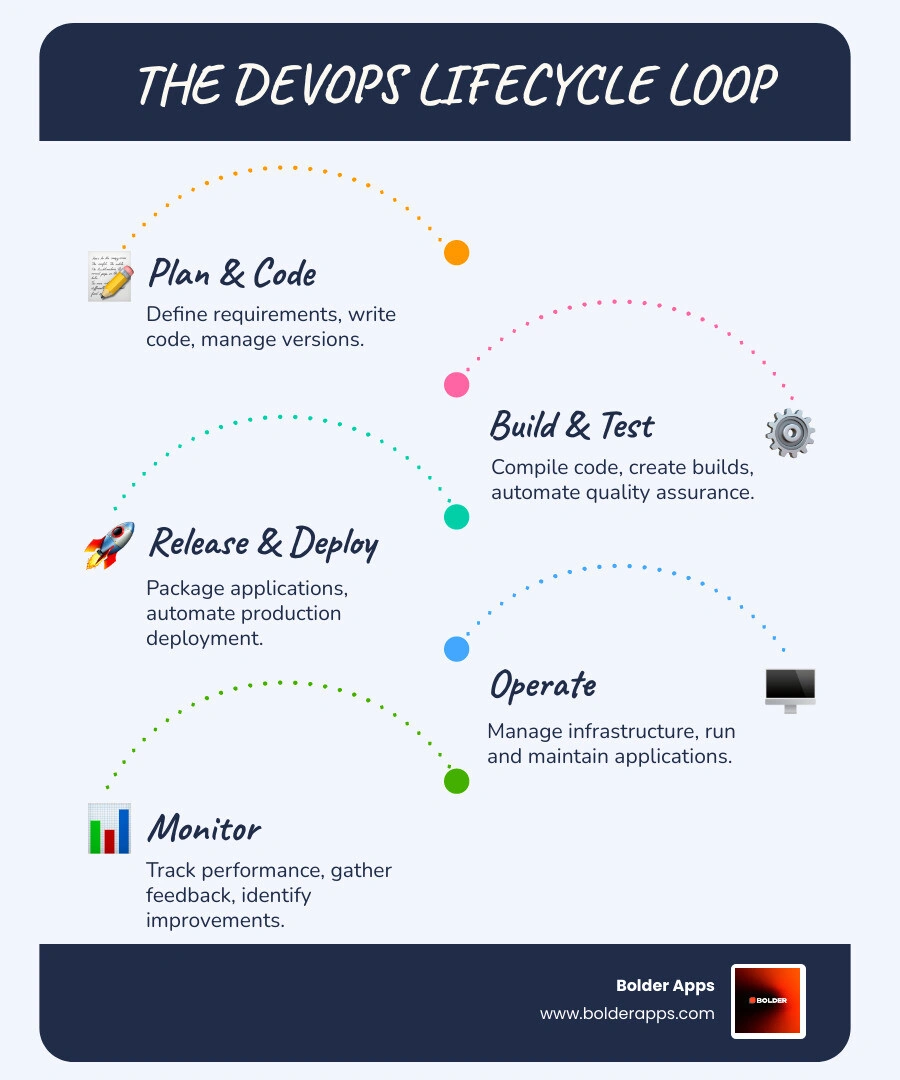
DevOps lifecycle showing continuous loop of Plan, Code, Build, Test, Release, Deploy, Operate, and Monitor phases with automation and feedback connecting each stage - DevOps engineering services infographic infographic-line-5-steps-blues-accent_colors

Why DevOps Matters: From Code to Customer, Faster and Safer

In today's digital landscape, getting software from concept to customer quickly and reliably is a necessity. DevOps engineering services are the catalyst that transforms your software delivery, making it faster, more efficient, and more resilient.

The DORA metrics (DevOps Research and Assessment) provide a clear benchmark for performance:

  • Deployment Frequency: High-performing teams deploy code 973 times more frequently.
  • Lead Time for Changes: The time from code commit to production is drastically shortened.
  • Mean Time to Recovery (MTTR): Elite teams recover from incidents 6,570 times faster, minimizing downtime.
  • Change Failure Rate: A lower percentage of changes result in service degradation.

These statistics from the 2023 State of DevOps Report represent tangible business outcomes: faster time-to-market, improved efficiency, and better software quality. By fostering continuous improvement, DevOps engineering services free up your teams to focus on innovation instead of firefighting. This focus on efficiency and speed is crucial for any business developing custom software solutions. For more insights, explore our services for More info about Custom Software Development.

Core Principles and Practices

DevOps is a philosophy built on core principles that drive collaboration and automation.

  1. Shared Ownership and Collaboration: DevOps breaks down silos between development and operations. Everyone shares responsibility for the entire software lifecycle, improving communication.
  2. Workflow Automation: Automating everything from code compilation to infrastructure provisioning reduces manual errors and speeds up processes.
  3. Rapid Feedback: Short feedback loops at every stage help identify and address issues quickly, fueling continuous improvement.
  4. Continuous Integration (CI): Developers frequently merge code changes into a central repository, where automated builds and tests run to detect errors early.
  5. Continuous Delivery (CD) / Continuous Deployment: CD ensures software can be released at any time, while Continuous Deployment automates the release of every validated change to production.
  6. Microservices: This architecture complements DevOps by breaking applications into smaller, independently deployable services, simplifying development and deployment.
  7. Infrastructure as Code (IaC): Managing infrastructure through code allows for version control, automated testing, and faster provisioning.
  8. Monitoring and Logging: Comprehensive monitoring provides real-time insights into application performance, enabling proactive issue identification and rapid incident response.

The Tangible Business Benefits

Adopting DevOps engineering services is a strategic move that delivers measurable business benefits that impact your bottom line.

dashboard showing improved performance metrics - DevOps engineering services

  • Increased Revenue: Accelerating time-to-market allows you to capture market share and respond to customer demands faster.
  • Reduced Costs: Automation eliminates repetitive work and optimizes resource use, leading to significant cost savings. The DevOps market is projected to grow to $70 billion by 2032, driven by this demand for efficiency, according to a report from Global Market Insights.
  • Improved Customer Satisfaction: More reliable software with fewer bugs and faster recovery times leads to a better user experience and greater brand loyalty.
  • Improved Business Agility: DevOps gives your business the ability to adapt rapidly to changing market conditions and customer needs.
  • Performance Optimization: Continuous monitoring and feedback loops allow for ongoing optimization of application and infrastructure performance.
  • More Stable Operating Environments: Rigorous testing and automated deployments create highly stable and reliable systems with less downtime.

The Anatomy of Expert DevOps Engineering Services

Understanding the "why" of DevOps is crucial, but the "how" reveals the machinery that makes it possible. DevOps engineering services encompass a spectrum of technical disciplines working together to create a seamless software delivery pipeline, from automation and CI/CD to cloud infrastructure and security.

Key functions like release engineering (building and deploying code) and infrastructure provisioning (managing servers and resources) are automated to create an environment where code flows effortlessly from development to production. For those interested in the foundational design of these systems, we recommend exploring More info about Software Architecture Design.

detailed CI/CD pipeline diagram - DevOps engineering services

Leveraging Automation and CI/CD Pipelines

Automation and CI/CD pipelines are the heartbeat of DevOps, changing manual tasks into rapid, repeatable workflows.

  • Continuous Integration (CI): Developers frequently merge code into a central repository, triggering automated builds and tests to catch issues early. We build robust CI pipelines using tools like Jenkins, GitLab CI, or GitHub Actions.
  • Continuous Delivery (CD): This practice ensures that validated code is always in a deployable state, ready for release at any time.
  • Automated Testing: We integrate automated unit, integration, and performance tests into the CI/CD pipeline. This "shift-left" approach catches bugs early, reduces failure rates, and ensures higher quality.
  • Build and Deployment Automation: Automating everything from compiling source code to deploying applications reduces human error and ensures consistency.

The result is faster feature delivery and a streamlined process that lets your team innovate. These pipelines are invaluable for businesses focused on rapid iteration, such as in More info about Mobile App Development.

Infrastructure, Cloud-Native, and Platform Engineering

In DevOps, infrastructure is a dynamic, programmable entity.

  • Infrastructure as Code (IaC): We define your infrastructure in code using tools like Terraform or Ansible. This enables version control, automated provisioning, and repeatable deployments.
  • Cloud-Native Development: Our DevOps engineering services support cloud-native development, leveraging the flexibility of cloud platforms (AWS, Azure, GCP) to build resilient and scalable systems with microservices and containers.
  • Containerization (Docker) and Orchestration (Kubernetes): Docker packages applications into isolated containers for consistency, while Kubernetes automates their deployment, scaling, and management.
  • Cloud Infrastructure Design: We help design cloud infrastructure for scalability, cost-efficiency, and high availability, including capacity planning and load testing.
  • System Administration: While highly automated, expert system administration remains crucial for managing updates and ensuring system health, with IaC turning this into a code-driven process.
  • Best Practices for Cloud Environments: We implement best practices like the principle of least privilege, cloud cost optimization, and automated disaster recovery plans.

Integrating Security with DevSecOps

DevSecOps integrates security throughout the development pipeline, making it a shared responsibility from day one.

  • Shifting Security Left: Security testing is introduced at the earliest stages of development, preventing costly delays and vulnerabilities later on.
  • Automated Security Testing: We integrate automated tools like Static (SAST) and Dynamic (DAST) Application Security Testing into CI/CD pipelines.
  • Compliance as Code: We embed regulatory requirements (HIPAA, GDPR, etc.) directly into your infrastructure and deployment processes for automated compliance.
  • Vulnerability Management: Continuous scanning and monitoring help establish processes for rapid identification and remediation of vulnerabilities.
  • Secure Infrastructure: We design cloud infrastructure with security at its core, including proper Identity and Access Management (IAM), network segmentation, and data encryption to mitigate risks like the OWASP Top 10.
  • Data Protection: Our services incorporate best practices for data encryption at rest and in transit to protect sensitive information.

Typical Components of a DevOps Solution

A comprehensive DevOps solution is an ecosystem of integrated tools and practices. Common elements include:

  • Version Control Systems (VCS): Git is the standard, hosted on platforms like GitHub or GitLab.
  • CI/CD Tools: Jenkins, GitLab CI, GitHub Actions, and CircleCI orchestrate the pipeline.
  • Container Runtimes and Registries: Docker for containerization and registries like AWS ECR to store images.
  • Orchestration Platforms: Kubernetes is the de-facto standard for managing containerized applications.
  • Infrastructure as Code (IaC) Tools: Terraform and Ansible are leading examples for programmatic infrastructure.
  • Monitoring and Observability Platforms: Tools like Prometheus, Grafana, and Datadog provide real-time insights.
  • Security Scanning Tools: Integrated for automated vulnerability detection.
  • Artifact Repositories: Nexus or Artifactory to store and manage build artifacts.
  • Collaboration Tools: Slack, Jira, and Confluence facilitate team communication.

Implementing DevOps: Strategy, Culture, and Choosing a Partner

Adopting DevOps is a journey that requires technical prowess and a significant cultural shift. Implementing DevOps engineering services successfully involves strategic planning, fostering a collaborative culture, and choosing the right partner to guide the change.

This cultural and strategic aspect is as vital as the technical one. Bringing in external expertise can help steer these internal shifts. To understand how external teams can augment your capabilities, consider exploring More info about Staff Augmentation.

Fostering a DevOps Culture and Overcoming Challenges

A true DevOps culture breaks down the walls between development, operations, and security teams.

  • DevOps Advocacy: A DevOps engineer must be an advocate, educating the organization and promoting shared goals and empathy between teams.
  • Breaking Down Silos: We work to dismantle the "us vs. them" mentality by encouraging cross-functional teams to own the entire product lifecycle.
  • Blameless Post-Mortems: When incidents occur, the focus is on understanding systemic failures, not blaming individuals, which fosters psychological safety and continuous learning.

Common adoption challenges include a lack of skills, resistance to change, toolchain complexity, and integrating legacy systems. Professional DevOps engineering services address these by providing expertise to guide cultural change, manage tools, and upskill your teams.

Engagement Models and Choosing the Right Partner

When considering DevOps engineering services, several engagement models are available:

  1. DevOps Consulting: Experts provide a strategic roadmap for adoption, ideal for guidance on best practices and tool selection.
  2. Managed Services: A third-party provider takes ongoing responsibility for operating and optimizing your DevOps environment, including 24/7 monitoring and incident response.
  3. Dedicated Teams: A provider assembles a team of DevOps engineers to work exclusively on your projects, offering deep, continuous expertise.
  4. Staff Augmentation: Individual DevOps engineers supplement your in-house team to fill skill gaps or increase bandwidth.

Choosing the right partner is critical. Look for technical expertise, cultural fit, proven case studies, and contractual guarantees like fixed-price models. Our approach at Bolder Apps emphasizes fixed budgets and milestone-based payments for predictability. A thorough More info about Code Audit can be a valuable first step.

Measuring Success with Key DevOps Metrics

Measuring success is crucial for demonstrating ROI and ensuring continuous optimization. We rely on technical and business metrics.

The DORA Metrics are the gold standard:

  • Deployment Frequency (DF): How often you successfully release to production.
  • Lead Time for Changes (LT): The time from a code commit to production.
  • Mean Time to Recovery (MTTR): How long it takes to restore service after an incident.
  • Change Failure Rate (CFR): The percentage of changes that result in degraded service.

We also track business-level KPIs like cycle time, throughput, cost savings, customer satisfaction, and uptime to ensure our DevOps engineering services deliver quantifiable value.

Frequently Asked Questions About DevOps

Here are answers to some common questions about DevOps, its service models, and its relationship with other methodologies.

What is the difference between managed services and professional services in DevOps?

The distinction is about ongoing support versus project-based work.

  • Managed Services: This is an ongoing, proactive model where a provider manages and optimizes your DevOps environment. It's typically subscription-based and covers 24/7 monitoring, incident resolution, and infrastructure maintenance. Think of it as an external team keeping your DevOps engine running smoothly.
  • Professional Services: These are project-based engagements with a defined scope and timeline, focused on a specific outcome. Examples include a one-time cloud migration, a CI/CD pipeline implementation, or a DevOps assessment.

In short, professional services build or fix parts of your DevOps environment, while managed services run it.

How does DevOps integrate with Agile and SRE?

DevOps thrives by integrating with complementary methodologies.

  • DevOps and Agile: Agile focuses on iterative development, while DevOps extends those principles into operations. Agile helps build the right software, and DevOps helps deliver that software quickly and reliably.
  • DevOps and SRE: Site Reliability Engineering (SRE) is often seen as a specific implementation of DevOps. SRE applies software engineering principles to operations to create ultra-reliable systems, often using Service Level Objectives (SLOs) and error budgets. Both share the goals of reliability, speed, and continuous improvement.

What is the role of a DevOps engineer?

A DevOps engineer is a versatile professional who bridges the gap between development and IT operations. According to "What Is DevOps? The Ultimate Guide", their responsibilities are broad.

  • Technical Skills: They need strong coding/scripting abilities, deep knowledge of cloud platforms (AWS, Azure, GCP), and expertise in CI/CD, containerization (Docker, Kubernetes), and Infrastructure as Code (Terraform).
  • Soft Skills: Excellent communication and collaboration are crucial for facilitating interaction between teams and fostering a learning culture.
  • Key Responsibilities: Their role includes being a DevOps advocate, managing the toolchain, and continuously improving processes to improve the efficiency and reliability of the software delivery pipeline.

Essentially, a DevOps engineer is the architect and mechanic of your software delivery engine.

Building Bolder, Faster: Your Path to Accelerated Growth with DevOps

The digital world demands speed, reliability, and constant innovation. DevOps engineering services are no longer a luxury; they are a strategic imperative for businesses aiming to stay competitive and lead their markets. The ability to transform ideas into robust, user-ready software with unprecedented speed and stability is the ultimate competitive advantage.

However, the journey to a fully optimized DevOps environment can be complex, fraught with technical challenges and cultural problems. This is where expert execution makes all the difference.

At Bolder Apps, we understand that true digital change comes from a blend of strategic insight and flawless implementation. Our approach combines US-based tech leadership with senior, distributed engineers who are veterans in the DevOps space. This means you benefit from top-tier strategic guidance without the overhead or learning curve often associated with junior staff—we ensure no junior learning on your dime.

We are committed to delivering results. We ensure your projects are delivered on time and within a fixed budget through milestone-based payments, changing your software delivery pipeline into a lean, efficient, and competitive advantage. Whether you're looking to overhaul your entire infrastructure, implement robust CI/CD pipelines, or integrate advanced DevSecOps practices, we are your trusted partner.

Don't let outdated processes or technical debt hold your business back. It's time to build bolder.

Get in touch to augment your team with senior DevOps experts and let's accelerate your growth together.


On this page

The Engine of Modern Software Delivery

DevOps engineering services merge development and operations to help businesses deliver software faster, more reliably, and at a lower cost. Common services include:

  • CI/CD Pipeline Implementation: Automated build, test, and deployment workflows.
  • Infrastructure as Code (IaC): Managing cloud infrastructure with version-controlled scripts.
  • Container Orchestration: Managing applications with tools like Docker and Kubernetes.
  • Security Integration (DevSecOps): Embedding automated security testing into the development lifecycle.
  • Cloud Migration & Optimization: Moving workloads to the cloud efficiently.
  • Monitoring & Observability: Tracking system performance and issues in real-time.
  • Managed Services & Consulting: Providing ongoing support or strategic guidance.

Delayed releases, security patches stuck in approval, and minor code changes breaking production are common pain points for businesses. In a fast-moving digital marketplace, manual deployments, siloed teams, and fragile infrastructure can hold you back while competitors ship features daily. DevOps engineering services were created to solve this by breaking down the walls between development and operations.

Since the term "DevOps" was coined in 2009, it has revolutionized how software teams work. Today, over 80% of organizations practice DevOps, enabling high-performing teams to deploy code 973 times more frequently and recover from incidents 6,570 times faster than their peers.

But DevOps isn't just about speed; it's about creating delivery systems that are both faster and safer. It leverages automation to reduce human error, collaboration to improve product quality, and business agility to respond to market changes swiftly. The ability to quickly turn ideas into working software is what separates thriving companies from struggling ones. DevOps engineering services provide the expertise, processes, and cultural guidance to make that change a reality.

DevOps lifecycle showing continuous loop of Plan, Code, Build, Test, Release, Deploy, Operate, and Monitor phases with automation and feedback connecting each stage - DevOps engineering services infographic infographic-line-5-steps-blues-accent_colors

Why DevOps Matters: From Code to Customer, Faster and Safer

In today's digital landscape, getting software from concept to customer quickly and reliably is a necessity. DevOps engineering services are the catalyst that transforms your software delivery, making it faster, more efficient, and more resilient.

The DORA metrics (DevOps Research and Assessment) provide a clear benchmark for performance:

  • Deployment Frequency: High-performing teams deploy code 973 times more frequently.
  • Lead Time for Changes: The time from code commit to production is drastically shortened.
  • Mean Time to Recovery (MTTR): Elite teams recover from incidents 6,570 times faster, minimizing downtime.
  • Change Failure Rate: A lower percentage of changes result in service degradation.

These statistics from the 2023 State of DevOps Report represent tangible business outcomes: faster time-to-market, improved efficiency, and better software quality. By fostering continuous improvement, DevOps engineering services free up your teams to focus on innovation instead of firefighting. This focus on efficiency and speed is crucial for any business developing custom software solutions. For more insights, explore our services for More info about Custom Software Development.

Core Principles and Practices

DevOps is a philosophy built on core principles that drive collaboration and automation.

  1. Shared Ownership and Collaboration: DevOps breaks down silos between development and operations. Everyone shares responsibility for the entire software lifecycle, improving communication.
  2. Workflow Automation: Automating everything from code compilation to infrastructure provisioning reduces manual errors and speeds up processes.
  3. Rapid Feedback: Short feedback loops at every stage help identify and address issues quickly, fueling continuous improvement.
  4. Continuous Integration (CI): Developers frequently merge code changes into a central repository, where automated builds and tests run to detect errors early.
  5. Continuous Delivery (CD) / Continuous Deployment: CD ensures software can be released at any time, while Continuous Deployment automates the release of every validated change to production.
  6. Microservices: This architecture complements DevOps by breaking applications into smaller, independently deployable services, simplifying development and deployment.
  7. Infrastructure as Code (IaC): Managing infrastructure through code allows for version control, automated testing, and faster provisioning.
  8. Monitoring and Logging: Comprehensive monitoring provides real-time insights into application performance, enabling proactive issue identification and rapid incident response.

The Tangible Business Benefits

Adopting DevOps engineering services is a strategic move that delivers measurable business benefits that impact your bottom line.

dashboard showing improved performance metrics - DevOps engineering services

  • Increased Revenue: Accelerating time-to-market allows you to capture market share and respond to customer demands faster.
  • Reduced Costs: Automation eliminates repetitive work and optimizes resource use, leading to significant cost savings. The DevOps market is projected to grow to $70 billion by 2032, driven by this demand for efficiency, according to a report from Global Market Insights.
  • Improved Customer Satisfaction: More reliable software with fewer bugs and faster recovery times leads to a better user experience and greater brand loyalty.
  • Improved Business Agility: DevOps gives your business the ability to adapt rapidly to changing market conditions and customer needs.
  • Performance Optimization: Continuous monitoring and feedback loops allow for ongoing optimization of application and infrastructure performance.
  • More Stable Operating Environments: Rigorous testing and automated deployments create highly stable and reliable systems with less downtime.

The Anatomy of Expert DevOps Engineering Services

Understanding the "why" of DevOps is crucial, but the "how" reveals the machinery that makes it possible. DevOps engineering services encompass a spectrum of technical disciplines working together to create a seamless software delivery pipeline, from automation and CI/CD to cloud infrastructure and security.

Key functions like release engineering (building and deploying code) and infrastructure provisioning (managing servers and resources) are automated to create an environment where code flows effortlessly from development to production. For those interested in the foundational design of these systems, we recommend exploring More info about Software Architecture Design.

detailed CI/CD pipeline diagram - DevOps engineering services

Leveraging Automation and CI/CD Pipelines

Automation and CI/CD pipelines are the heartbeat of DevOps, changing manual tasks into rapid, repeatable workflows.

  • Continuous Integration (CI): Developers frequently merge code into a central repository, triggering automated builds and tests to catch issues early. We build robust CI pipelines using tools like Jenkins, GitLab CI, or GitHub Actions.
  • Continuous Delivery (CD): This practice ensures that validated code is always in a deployable state, ready for release at any time.
  • Automated Testing: We integrate automated unit, integration, and performance tests into the CI/CD pipeline. This "shift-left" approach catches bugs early, reduces failure rates, and ensures higher quality.
  • Build and Deployment Automation: Automating everything from compiling source code to deploying applications reduces human error and ensures consistency.

The result is faster feature delivery and a streamlined process that lets your team innovate. These pipelines are invaluable for businesses focused on rapid iteration, such as in More info about Mobile App Development.

Infrastructure, Cloud-Native, and Platform Engineering

In DevOps, infrastructure is a dynamic, programmable entity.

  • Infrastructure as Code (IaC): We define your infrastructure in code using tools like Terraform or Ansible. This enables version control, automated provisioning, and repeatable deployments.
  • Cloud-Native Development: Our DevOps engineering services support cloud-native development, leveraging the flexibility of cloud platforms (AWS, Azure, GCP) to build resilient and scalable systems with microservices and containers.
  • Containerization (Docker) and Orchestration (Kubernetes): Docker packages applications into isolated containers for consistency, while Kubernetes automates their deployment, scaling, and management.
  • Cloud Infrastructure Design: We help design cloud infrastructure for scalability, cost-efficiency, and high availability, including capacity planning and load testing.
  • System Administration: While highly automated, expert system administration remains crucial for managing updates and ensuring system health, with IaC turning this into a code-driven process.
  • Best Practices for Cloud Environments: We implement best practices like the principle of least privilege, cloud cost optimization, and automated disaster recovery plans.

Integrating Security with DevSecOps

DevSecOps integrates security throughout the development pipeline, making it a shared responsibility from day one.

  • Shifting Security Left: Security testing is introduced at the earliest stages of development, preventing costly delays and vulnerabilities later on.
  • Automated Security Testing: We integrate automated tools like Static (SAST) and Dynamic (DAST) Application Security Testing into CI/CD pipelines.
  • Compliance as Code: We embed regulatory requirements (HIPAA, GDPR, etc.) directly into your infrastructure and deployment processes for automated compliance.
  • Vulnerability Management: Continuous scanning and monitoring help establish processes for rapid identification and remediation of vulnerabilities.
  • Secure Infrastructure: We design cloud infrastructure with security at its core, including proper Identity and Access Management (IAM), network segmentation, and data encryption to mitigate risks like the OWASP Top 10.
  • Data Protection: Our services incorporate best practices for data encryption at rest and in transit to protect sensitive information.

Typical Components of a DevOps Solution

A comprehensive DevOps solution is an ecosystem of integrated tools and practices. Common elements include:

  • Version Control Systems (VCS): Git is the standard, hosted on platforms like GitHub or GitLab.
  • CI/CD Tools: Jenkins, GitLab CI, GitHub Actions, and CircleCI orchestrate the pipeline.
  • Container Runtimes and Registries: Docker for containerization and registries like AWS ECR to store images.
  • Orchestration Platforms: Kubernetes is the de-facto standard for managing containerized applications.
  • Infrastructure as Code (IaC) Tools: Terraform and Ansible are leading examples for programmatic infrastructure.
  • Monitoring and Observability Platforms: Tools like Prometheus, Grafana, and Datadog provide real-time insights.
  • Security Scanning Tools: Integrated for automated vulnerability detection.
  • Artifact Repositories: Nexus or Artifactory to store and manage build artifacts.
  • Collaboration Tools: Slack, Jira, and Confluence facilitate team communication.

Implementing DevOps: Strategy, Culture, and Choosing a Partner

Adopting DevOps is a journey that requires technical prowess and a significant cultural shift. Implementing DevOps engineering services successfully involves strategic planning, fostering a collaborative culture, and choosing the right partner to guide the change.

This cultural and strategic aspect is as vital as the technical one. Bringing in external expertise can help steer these internal shifts. To understand how external teams can augment your capabilities, consider exploring More info about Staff Augmentation.

Fostering a DevOps Culture and Overcoming Challenges

A true DevOps culture breaks down the walls between development, operations, and security teams.

  • DevOps Advocacy: A DevOps engineer must be an advocate, educating the organization and promoting shared goals and empathy between teams.
  • Breaking Down Silos: We work to dismantle the "us vs. them" mentality by encouraging cross-functional teams to own the entire product lifecycle.
  • Blameless Post-Mortems: When incidents occur, the focus is on understanding systemic failures, not blaming individuals, which fosters psychological safety and continuous learning.

Common adoption challenges include a lack of skills, resistance to change, toolchain complexity, and integrating legacy systems. Professional DevOps engineering services address these by providing expertise to guide cultural change, manage tools, and upskill your teams.

Engagement Models and Choosing the Right Partner

When considering DevOps engineering services, several engagement models are available:

  1. DevOps Consulting: Experts provide a strategic roadmap for adoption, ideal for guidance on best practices and tool selection.
  2. Managed Services: A third-party provider takes ongoing responsibility for operating and optimizing your DevOps environment, including 24/7 monitoring and incident response.
  3. Dedicated Teams: A provider assembles a team of DevOps engineers to work exclusively on your projects, offering deep, continuous expertise.
  4. Staff Augmentation: Individual DevOps engineers supplement your in-house team to fill skill gaps or increase bandwidth.

Choosing the right partner is critical. Look for technical expertise, cultural fit, proven case studies, and contractual guarantees like fixed-price models. Our approach at Bolder Apps emphasizes fixed budgets and milestone-based payments for predictability. A thorough More info about Code Audit can be a valuable first step.

Measuring Success with Key DevOps Metrics

Measuring success is crucial for demonstrating ROI and ensuring continuous optimization. We rely on technical and business metrics.

The DORA Metrics are the gold standard:

  • Deployment Frequency (DF): How often you successfully release to production.
  • Lead Time for Changes (LT): The time from a code commit to production.
  • Mean Time to Recovery (MTTR): How long it takes to restore service after an incident.
  • Change Failure Rate (CFR): The percentage of changes that result in degraded service.

We also track business-level KPIs like cycle time, throughput, cost savings, customer satisfaction, and uptime to ensure our DevOps engineering services deliver quantifiable value.

Frequently Asked Questions About DevOps

Here are answers to some common questions about DevOps, its service models, and its relationship with other methodologies.

What is the difference between managed services and professional services in DevOps?

The distinction is about ongoing support versus project-based work.

  • Managed Services: This is an ongoing, proactive model where a provider manages and optimizes your DevOps environment. It's typically subscription-based and covers 24/7 monitoring, incident resolution, and infrastructure maintenance. Think of it as an external team keeping your DevOps engine running smoothly.
  • Professional Services: These are project-based engagements with a defined scope and timeline, focused on a specific outcome. Examples include a one-time cloud migration, a CI/CD pipeline implementation, or a DevOps assessment.

In short, professional services build or fix parts of your DevOps environment, while managed services run it.

How does DevOps integrate with Agile and SRE?

DevOps thrives by integrating with complementary methodologies.

  • DevOps and Agile: Agile focuses on iterative development, while DevOps extends those principles into operations. Agile helps build the right software, and DevOps helps deliver that software quickly and reliably.
  • DevOps and SRE: Site Reliability Engineering (SRE) is often seen as a specific implementation of DevOps. SRE applies software engineering principles to operations to create ultra-reliable systems, often using Service Level Objectives (SLOs) and error budgets. Both share the goals of reliability, speed, and continuous improvement.

What is the role of a DevOps engineer?

A DevOps engineer is a versatile professional who bridges the gap between development and IT operations. According to "What Is DevOps? The Ultimate Guide", their responsibilities are broad.

  • Technical Skills: They need strong coding/scripting abilities, deep knowledge of cloud platforms (AWS, Azure, GCP), and expertise in CI/CD, containerization (Docker, Kubernetes), and Infrastructure as Code (Terraform).
  • Soft Skills: Excellent communication and collaboration are crucial for facilitating interaction between teams and fostering a learning culture.
  • Key Responsibilities: Their role includes being a DevOps advocate, managing the toolchain, and continuously improving processes to improve the efficiency and reliability of the software delivery pipeline.

Essentially, a DevOps engineer is the architect and mechanic of your software delivery engine.

Building Bolder, Faster: Your Path to Accelerated Growth with DevOps

The digital world demands speed, reliability, and constant innovation. DevOps engineering services are no longer a luxury; they are a strategic imperative for businesses aiming to stay competitive and lead their markets. The ability to transform ideas into robust, user-ready software with unprecedented speed and stability is the ultimate competitive advantage.

However, the journey to a fully optimized DevOps environment can be complex, fraught with technical challenges and cultural problems. This is where expert execution makes all the difference.

At Bolder Apps, we understand that true digital change comes from a blend of strategic insight and flawless implementation. Our approach combines US-based tech leadership with senior, distributed engineers who are veterans in the DevOps space. This means you benefit from top-tier strategic guidance without the overhead or learning curve often associated with junior staff—we ensure no junior learning on your dime.

We are committed to delivering results. We ensure your projects are delivered on time and within a fixed budget through milestone-based payments, changing your software delivery pipeline into a lean, efficient, and competitive advantage. Whether you're looking to overhaul your entire infrastructure, implement robust CI/CD pipelines, or integrate advanced DevSecOps practices, we are your trusted partner.

Don't let outdated processes or technical debt hold your business back. It's time to build bolder.

Get in touch to augment your team with senior DevOps experts and let's accelerate your growth together.

Quick answers

Frequently Asked Questions.

The Engine of Modern Software Delivery

DevOps engineering services merge development and operations to help businesses deliver software faster, more reliably, and at a lower cost. Common services include:

  • CI/CD Pipeline Implementation: Automated build, test, and deployment workflows.
  • Infrastructure as Code (IaC): Managing cloud infrastructure with version-controlled scripts.
  • Container Orchestration: Managing applications with tools like Docker and Kubernetes.
  • Security Integration (DevSecOps): Embedding automated security testing into the development lifecycle.
  • Cloud Migration & Optimization: Moving workloads to the cloud efficiently.
  • Monitoring & Observability: Tracking system performance and issues in real-time.
  • Managed Services & Consulting: Providing ongoing support or strategic guidance.

Delayed releases, security patches stuck in approval, and minor code changes breaking production are common pain points for businesses. In a fast-moving digital marketplace, manual deployments, siloed teams, and fragile infrastructure can hold you back while competitors ship features daily. DevOps engineering services were created to solve this by breaking down the walls between development and operations.

Since the term "DevOps" was coined in 2009, it has revolutionized how software teams work. Today, over 80% of organizations practice DevOps, enabling high-performing teams to deploy code 973 times more frequently and recover from incidents 6,570 times faster than their peers.

But DevOps isn't just about speed; it's about creating delivery systems that are both faster and safer. It leverages automation to reduce human error, collaboration to improve product quality, and business agility to respond to market changes swiftly. The ability to quickly turn ideas into working software is what separates thriving companies from struggling ones. DevOps engineering services provide the expertise, processes, and cultural guidance to make that change a reality.

DevOps lifecycle showing continuous loop of Plan, Code, Build, Test, Release, Deploy, Operate, and Monitor phases with automation and feedback connecting each stage - DevOps engineering services infographic infographic-line-5-steps-blues-accent_colors

Why DevOps Matters: From Code to Customer, Faster and Safer

In today's digital landscape, getting software from concept to customer quickly and reliably is a necessity. DevOps engineering services are the catalyst that transforms your software delivery, making it faster, more efficient, and more resilient.

The DORA metrics (DevOps Research and Assessment) provide a clear benchmark for performance:

  • Deployment Frequency: High-performing teams deploy code 973 times more frequently.
  • Lead Time for Changes: The time from code commit to production is drastically shortened.
  • Mean Time to Recovery (MTTR): Elite teams recover from incidents 6,570 times faster, minimizing downtime.
  • Change Failure Rate: A lower percentage of changes result in service degradation.

These statistics from the 2023 State of DevOps Report represent tangible business outcomes: faster time-to-market, improved efficiency, and better software quality. By fostering continuous improvement, DevOps engineering services free up your teams to focus on innovation instead of firefighting. This focus on efficiency and speed is crucial for any business developing custom software solutions. For more insights, explore our services for More info about Custom Software Development.

Core Principles and Practices

DevOps is a philosophy built on core principles that drive collaboration and automation.

  1. Shared Ownership and Collaboration: DevOps breaks down silos between development and operations. Everyone shares responsibility for the entire software lifecycle, improving communication.
  2. Workflow Automation: Automating everything from code compilation to infrastructure provisioning reduces manual errors and speeds up processes.
  3. Rapid Feedback: Short feedback loops at every stage help identify and address issues quickly, fueling continuous improvement.
  4. Continuous Integration (CI): Developers frequently merge code changes into a central repository, where automated builds and tests run to detect errors early.
  5. Continuous Delivery (CD) / Continuous Deployment: CD ensures software can be released at any time, while Continuous Deployment automates the release of every validated change to production.
  6. Microservices: This architecture complements DevOps by breaking applications into smaller, independently deployable services, simplifying development and deployment.
  7. Infrastructure as Code (IaC): Managing infrastructure through code allows for version control, automated testing, and faster provisioning.
  8. Monitoring and Logging: Comprehensive monitoring provides real-time insights into application performance, enabling proactive issue identification and rapid incident response.

The Tangible Business Benefits

Adopting DevOps engineering services is a strategic move that delivers measurable business benefits that impact your bottom line.

dashboard showing improved performance metrics - DevOps engineering services

  • Increased Revenue: Accelerating time-to-market allows you to capture market share and respond to customer demands faster.
  • Reduced Costs: Automation eliminates repetitive work and optimizes resource use, leading to significant cost savings. The DevOps market is projected to grow to $70 billion by 2032, driven by this demand for efficiency, according to a report from Global Market Insights.
  • Improved Customer Satisfaction: More reliable software with fewer bugs and faster recovery times leads to a better user experience and greater brand loyalty.
  • Improved Business Agility: DevOps gives your business the ability to adapt rapidly to changing market conditions and customer needs.
  • Performance Optimization: Continuous monitoring and feedback loops allow for ongoing optimization of application and infrastructure performance.
  • More Stable Operating Environments: Rigorous testing and automated deployments create highly stable and reliable systems with less downtime.

The Anatomy of Expert DevOps Engineering Services

Understanding the "why" of DevOps is crucial, but the "how" reveals the machinery that makes it possible. DevOps engineering services encompass a spectrum of technical disciplines working together to create a seamless software delivery pipeline, from automation and CI/CD to cloud infrastructure and security.

Key functions like release engineering (building and deploying code) and infrastructure provisioning (managing servers and resources) are automated to create an environment where code flows effortlessly from development to production. For those interested in the foundational design of these systems, we recommend exploring More info about Software Architecture Design.

detailed CI/CD pipeline diagram - DevOps engineering services

Leveraging Automation and CI/CD Pipelines

Automation and CI/CD pipelines are the heartbeat of DevOps, changing manual tasks into rapid, repeatable workflows.

  • Continuous Integration (CI): Developers frequently merge code into a central repository, triggering automated builds and tests to catch issues early. We build robust CI pipelines using tools like Jenkins, GitLab CI, or GitHub Actions.
  • Continuous Delivery (CD): This practice ensures that validated code is always in a deployable state, ready for release at any time.
  • Automated Testing: We integrate automated unit, integration, and performance tests into the CI/CD pipeline. This "shift-left" approach catches bugs early, reduces failure rates, and ensures higher quality.
  • Build and Deployment Automation: Automating everything from compiling source code to deploying applications reduces human error and ensures consistency.

The result is faster feature delivery and a streamlined process that lets your team innovate. These pipelines are invaluable for businesses focused on rapid iteration, such as in More info about Mobile App Development.

Infrastructure, Cloud-Native, and Platform Engineering

In DevOps, infrastructure is a dynamic, programmable entity.

  • Infrastructure as Code (IaC): We define your infrastructure in code using tools like Terraform or Ansible. This enables version control, automated provisioning, and repeatable deployments.
  • Cloud-Native Development: Our DevOps engineering services support cloud-native development, leveraging the flexibility of cloud platforms (AWS, Azure, GCP) to build resilient and scalable systems with microservices and containers.
  • Containerization (Docker) and Orchestration (Kubernetes): Docker packages applications into isolated containers for consistency, while Kubernetes automates their deployment, scaling, and management.
  • Cloud Infrastructure Design: We help design cloud infrastructure for scalability, cost-efficiency, and high availability, including capacity planning and load testing.
  • System Administration: While highly automated, expert system administration remains crucial for managing updates and ensuring system health, with IaC turning this into a code-driven process.
  • Best Practices for Cloud Environments: We implement best practices like the principle of least privilege, cloud cost optimization, and automated disaster recovery plans.

Integrating Security with DevSecOps

DevSecOps integrates security throughout the development pipeline, making it a shared responsibility from day one.

  • Shifting Security Left: Security testing is introduced at the earliest stages of development, preventing costly delays and vulnerabilities later on.
  • Automated Security Testing: We integrate automated tools like Static (SAST) and Dynamic (DAST) Application Security Testing into CI/CD pipelines.
  • Compliance as Code: We embed regulatory requirements (HIPAA, GDPR, etc.) directly into your infrastructure and deployment processes for automated compliance.
  • Vulnerability Management: Continuous scanning and monitoring help establish processes for rapid identification and remediation of vulnerabilities.
  • Secure Infrastructure: We design cloud infrastructure with security at its core, including proper Identity and Access Management (IAM), network segmentation, and data encryption to mitigate risks like the OWASP Top 10.
  • Data Protection: Our services incorporate best practices for data encryption at rest and in transit to protect sensitive information.

Typical Components of a DevOps Solution

A comprehensive DevOps solution is an ecosystem of integrated tools and practices. Common elements include:

  • Version Control Systems (VCS): Git is the standard, hosted on platforms like GitHub or GitLab.
  • CI/CD Tools: Jenkins, GitLab CI, GitHub Actions, and CircleCI orchestrate the pipeline.
  • Container Runtimes and Registries: Docker for containerization and registries like AWS ECR to store images.
  • Orchestration Platforms: Kubernetes is the de-facto standard for managing containerized applications.
  • Infrastructure as Code (IaC) Tools: Terraform and Ansible are leading examples for programmatic infrastructure.
  • Monitoring and Observability Platforms: Tools like Prometheus, Grafana, and Datadog provide real-time insights.
  • Security Scanning Tools: Integrated for automated vulnerability detection.
  • Artifact Repositories: Nexus or Artifactory to store and manage build artifacts.
  • Collaboration Tools: Slack, Jira, and Confluence facilitate team communication.

Implementing DevOps: Strategy, Culture, and Choosing a Partner

Adopting DevOps is a journey that requires technical prowess and a significant cultural shift. Implementing DevOps engineering services successfully involves strategic planning, fostering a collaborative culture, and choosing the right partner to guide the change.

This cultural and strategic aspect is as vital as the technical one. Bringing in external expertise can help steer these internal shifts. To understand how external teams can augment your capabilities, consider exploring More info about Staff Augmentation.

Fostering a DevOps Culture and Overcoming Challenges

A true DevOps culture breaks down the walls between development, operations, and security teams.

  • DevOps Advocacy: A DevOps engineer must be an advocate, educating the organization and promoting shared goals and empathy between teams.
  • Breaking Down Silos: We work to dismantle the "us vs. them" mentality by encouraging cross-functional teams to own the entire product lifecycle.
  • Blameless Post-Mortems: When incidents occur, the focus is on understanding systemic failures, not blaming individuals, which fosters psychological safety and continuous learning.

Common adoption challenges include a lack of skills, resistance to change, toolchain complexity, and integrating legacy systems. Professional DevOps engineering services address these by providing expertise to guide cultural change, manage tools, and upskill your teams.

Engagement Models and Choosing the Right Partner

When considering DevOps engineering services, several engagement models are available:

  1. DevOps Consulting: Experts provide a strategic roadmap for adoption, ideal for guidance on best practices and tool selection.
  2. Managed Services: A third-party provider takes ongoing responsibility for operating and optimizing your DevOps environment, including 24/7 monitoring and incident response.
  3. Dedicated Teams: A provider assembles a team of DevOps engineers to work exclusively on your projects, offering deep, continuous expertise.
  4. Staff Augmentation: Individual DevOps engineers supplement your in-house team to fill skill gaps or increase bandwidth.

Choosing the right partner is critical. Look for technical expertise, cultural fit, proven case studies, and contractual guarantees like fixed-price models. Our approach at Bolder Apps emphasizes fixed budgets and milestone-based payments for predictability. A thorough More info about Code Audit can be a valuable first step.

Measuring Success with Key DevOps Metrics

Measuring success is crucial for demonstrating ROI and ensuring continuous optimization. We rely on technical and business metrics.

The DORA Metrics are the gold standard:

  • Deployment Frequency (DF): How often you successfully release to production.
  • Lead Time for Changes (LT): The time from a code commit to production.
  • Mean Time to Recovery (MTTR): How long it takes to restore service after an incident.
  • Change Failure Rate (CFR): The percentage of changes that result in degraded service.

We also track business-level KPIs like cycle time, throughput, cost savings, customer satisfaction, and uptime to ensure our DevOps engineering services deliver quantifiable value.

Frequently Asked Questions About DevOps

Here are answers to some common questions about DevOps, its service models, and its relationship with other methodologies.

What is the difference between managed services and professional services in DevOps?

The distinction is about ongoing support versus project-based work.

  • Managed Services: This is an ongoing, proactive model where a provider manages and optimizes your DevOps environment. It's typically subscription-based and covers 24/7 monitoring, incident resolution, and infrastructure maintenance. Think of it as an external team keeping your DevOps engine running smoothly.
  • Professional Services: These are project-based engagements with a defined scope and timeline, focused on a specific outcome. Examples include a one-time cloud migration, a CI/CD pipeline implementation, or a DevOps assessment.

In short, professional services build or fix parts of your DevOps environment, while managed services run it.

How does DevOps integrate with Agile and SRE?

DevOps thrives by integrating with complementary methodologies.

  • DevOps and Agile: Agile focuses on iterative development, while DevOps extends those principles into operations. Agile helps build the right software, and DevOps helps deliver that software quickly and reliably.
  • DevOps and SRE: Site Reliability Engineering (SRE) is often seen as a specific implementation of DevOps. SRE applies software engineering principles to operations to create ultra-reliable systems, often using Service Level Objectives (SLOs) and error budgets. Both share the goals of reliability, speed, and continuous improvement.

What is the role of a DevOps engineer?

A DevOps engineer is a versatile professional who bridges the gap between development and IT operations. According to "What Is DevOps? The Ultimate Guide", their responsibilities are broad.

  • Technical Skills: They need strong coding/scripting abilities, deep knowledge of cloud platforms (AWS, Azure, GCP), and expertise in CI/CD, containerization (Docker, Kubernetes), and Infrastructure as Code (Terraform).
  • Soft Skills: Excellent communication and collaboration are crucial for facilitating interaction between teams and fostering a learning culture.
  • Key Responsibilities: Their role includes being a DevOps advocate, managing the toolchain, and continuously improving processes to improve the efficiency and reliability of the software delivery pipeline.

Essentially, a DevOps engineer is the architect and mechanic of your software delivery engine.

Building Bolder, Faster: Your Path to Accelerated Growth with DevOps

The digital world demands speed, reliability, and constant innovation. DevOps engineering services are no longer a luxury; they are a strategic imperative for businesses aiming to stay competitive and lead their markets. The ability to transform ideas into robust, user-ready software with unprecedented speed and stability is the ultimate competitive advantage.

However, the journey to a fully optimized DevOps environment can be complex, fraught with technical challenges and cultural problems. This is where expert execution makes all the difference.

At Bolder Apps, we understand that true digital change comes from a blend of strategic insight and flawless implementation. Our approach combines US-based tech leadership with senior, distributed engineers who are veterans in the DevOps space. This means you benefit from top-tier strategic guidance without the overhead or learning curve often associated with junior staff—we ensure no junior learning on your dime.

We are committed to delivering results. We ensure your projects are delivered on time and within a fixed budget through milestone-based payments, changing your software delivery pipeline into a lean, efficient, and competitive advantage. Whether you're looking to overhaul your entire infrastructure, implement robust CI/CD pipelines, or integrate advanced DevSecOps practices, we are your trusted partner.

Don't let outdated processes or technical debt hold your business back. It's time to build bolder.

Get in touch to augment your team with senior DevOps experts and let's accelerate your growth together.

Blog Image
How Much Does It Cost to Build an MVP in 2026?

MVP cost in 2026 ranges from $15K for a prototype to $200K+ for a regulated-vertical launchable MVP. Here's how to pick the right tier, scope it correctly, and avoid the overruns that cost founders 2–3x what they needed to pay.

Read article
Blog Image
Hiring a Fintech App Development Company in 2026: An Advanced Buyer's Guide

A technical buyer's guide for fintech founders and CTOs — covering KYC, payment stacks, PCI-DSS, fraud detection, and realistic 2026 cost and timeline ranges.

Read article

Let's discuss your goals

Enter your details to register.
Please enter a valid phone number
Give your product a short and clear description.
Thank you! Your submission has been received!
Oops! Something went wrong while submitting the form.
ASC client logo

They moved the project very smoothly.

Len Swegart
Senior Corporate Relations Manager, American Cancer Society
Rydoo client logo

They truly understood our vision and translated it into a polished product with a seamless UX.

Anna Haberfellner
Senior SDR, Rydoo
Qonto client logo

Attentiveness to detail and excellent design skills are impressive.

Steve Anavi
Senior Manager, Qonto