Sean Weldon
November 18, 2026
10
min. read
and updated on:
November 19, 2026


A mobile measurement partner (MMP) helps app teams see which ads lead to installs and valuable actions, such as purchases or subscriptions. It brings results from different ad channels into one place and applies attribution rules so multiple networks do not each get credit for the same install.
An MMP works alongside tools such as the Meta SDK. The SDK can send app events to Meta; the MMP helps compare campaign results across channels. That matters when you run paid ads on more than one platform. Privacy rules can limit what an MMP can measure, so its reports are useful for decisions, not a perfect record of every user journey.

AppsFlyer defines an MMP as a platform that “attributes, collects, and organizes app data to deliver a uniform assessment of campaign performance metrics,” and compares that role to “a trusted and impartial referee to rule on attribution.” Once you move from testing a single ad platform to buying across several acquisition channels, that shared rule-set is what keeps reporting consistent.
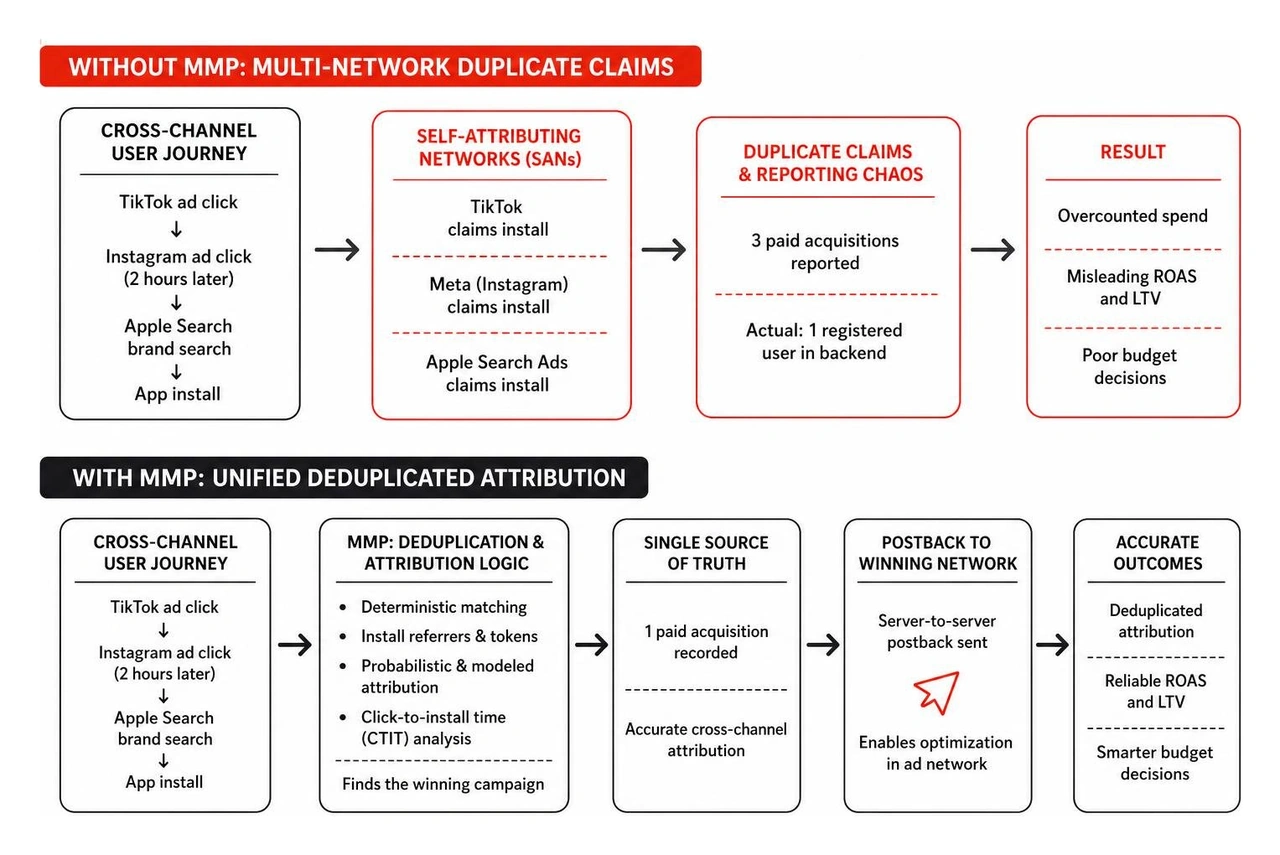
When you run campaigns on Meta Ads, Google Ads, TikTok, and Apple Search Ads at the same time, each platform can claim credit for users who downloaded your app, using its own attribution rules. An MMP embeds a software development kit (SDK) in your app, matches campaign engagements with installs and later in-app actions, and applies one set of logic to decide which campaign gets credit.
The mobile attribution journey is different from typical web tracking. On the web, tracking parameters can travel with the URL through to a checkout page. Mobile apps introduce a major gap: the app store detour. When a user clicks an advertisement, they are sent out of the browser or social feed into the Apple App Store or Google Play. That transition breaks the direct chain of URL parameters.

To reconstruct this path, an MMP uses several complementary methods, depending on the operating system and whether the user has granted tracking permission:
Once the MMP attributes an install or in-app event, it can send server-to-server postbacks to the ad networks and partners you have connected, so those platforms can optimize bids and budgets. That is separate from the delayed, aggregated postbacks Apple itself sends through SKAdNetwork and Ad Attribution Kit.
If you run paid campaigns on more than one network and only read each network's dashboard, your internal growth reporting will not add up cleanly.
Consider a common scenario: a user sees a video ad on TikTok, clicks an Instagram story ad two hours later, and finally searches your brand name on Apple Search Ads before downloading your app. If you query Meta, TikTok, and Apple independently, all three self-attributing networks may report a conversion, because each can claim installs based on its own rules. Your finance spreadsheet then shows three paid acquisitions, while your backend registered a single user.
Google Ads states that discrepancies between its reports and a third-party MMP are expected, including because of cross-network attribution. An MMP does not make those platform dashboards match. What it does is apply one attribution rule-set across the channels it measures, so your team has a consistent count to plan from.
That is why building consumer applications through professional mobile app development services should include the measurement stack early, not as an afterthought. An MMP gives your team:
A frequent question for app founders is whether integrating the native Meta SDK (or Google Firebase) eliminates the need for an MMP, or vice versa.

They serve complementary functions. Ad platform SDKs are built to run campaigns and send events into that platform's own tools. An MMP is built to apply consistent measurement across networks and to manage integrations with the rest of your marketing stack. You can use a platform SDK, an MMP, or both. Official docs for Meta, Google, TikTok, and Apple all describe first-party measurement paths that do not require an MMP.
The Meta SDK can log App Events, support Facebook Login, and connect other Meta features. Meta also recommends the SDK for measuring mobile installs, and it partners with mobile measurement partners when you want a third-party view across networks.
Bundling a separate advertising SDK for every network you buy from still has practical costs: a larger app binary, more background work, and more libraries to update after each operating system change. Those are engineering trade-offs, not a rule that every extra SDK will lower your store conversion rate.
When you implement an MMP, your engineers usually add one attribution SDK to the iOS or Android app. That SDK collects in-app events (such as registrations, trial starts, and checkouts) and sends them to the MMP. From there, the MMP can send server-to-server postbacks to Meta, Google Ads, TikTok, and other connected partners.
For Meta specifically, you can send app events through the MMP, the Meta SDK, and the Conversions API for app events. If more than one of those paths is on, Meta deduplicates matching events by combining the event name with a shared event ID field. New or migrated apps also need to connect the MMP as a data source in Meta Events Manager — Adjust's Meta setup guide warns that Meta cannot claim engagements measured by Adjust until that connection is made. None of this bypasses App Tracking Transparency: Meta still expects an advertiser-tracking flag that reflects the user's permission on iOS 14.5 and later.
Managing acquisition across search and social channels means coordinating distinct official protocols:
The mobile measurement ecosystem has changed substantially because of platform privacy rules. Apple's App Tracking Transparency (ATT) framework, required for tracking and for access to the advertising identifier on iOS 14.5, iPadOS 14.5, and later from April 26, 2021, made identifier-level tracking opt-in. Without permission, the identifier value is all zeros, and you may not track the user as Apple defines tracking. An MMP does not bypass that rule.

Modern mobile attribution therefore relies on aggregated, delayed, and sometimes modeled signals:
A practical advantage of many MMPs is consistent routing from ads, emails, and other links into the right app screen.
Because many paid networks are billed on attributed conversions, invalid traffic can inflate install counts and waste budget. Several MMPs sell fraud-protection products that try to catch this, but coverage is not automatic on every plan. AppsFlyer's Protect360 is a premium feature with real-time blocking of fraudulent attribution (the app install itself can still complete) and post-attribution detection for up to seven days after install. Adjust lists a fraud-prevention suite as a paid add-on on its Core and Enterprise plans. Singular's pricing page says fraud prevention is included in every plan.
Common patterns those products look for include:
Choosing a platform depends on your monetization model, the channels you buy, and how your team wants to work with data. Several MMPs publish free or entry-level plans; pricing changes, so check the current pages for AppsFlyer, Adjust, Branch, and Singular.
The summaries below use each vendor's official positioning. They are not a market-share ranking, and they are not a substitute for a scoped evaluation of your events, partners, and data needs.
Google's App Attribution Partner list also includes other certified providers, such as Tenjin. We have not independently compared those products here.
Not every application needs an MMP on day one. Official platform docs support SDK-only or first-party measurement in several cases, and an MMP becomes more valuable as your mix of paid channels grows.
Use this as a build list. The exact screens and field names vary by vendor, but the work is the same.
Firebase and other product analytics tools are designed to analyze what users do after they are inside your app — feature use, funnels, retention, and crash logs. They are not built to sit between competing ad networks and decide which campaign gets credit for an install.
An MMP specializes in connecting ad engagements (clicks, impressions, campaign parameters) to installs and in-app events, and in sending conversion postbacks back to ad networks. High-growth mobile teams often use both: an MMP for acquisition measurement and a product analytics platform for in-app behavior. That split matches how we describe Firebase versus AppsFlyer and Adjust on our integrations pages.
Yes, if you only run ads on Meta platforms and have no plan to measure Google, TikTok, Apple Search Ads, or other paid or owned channels in the same report. Meta documents the SDK, and optionally the Conversions API, as a complete way to send app events for Meta campaign optimization.
Relying only on the Meta SDK still leaves a walled-garden view: Meta will attribute installs according to its own windows and rules, even if the user also clicked another channel before installing. The moment you add a second acquisition channel, an MMP is usually the right way to apply one rule-set and avoid double-counting in your own reporting. It will not stop Meta's dashboard from telling Meta's version of the story.
An MMP can integrate with Apple's Ad Services framework. When a user opens your app, the app can request an on-device attribution token. The MMP SDK or your server sends that token to Apple's attribution API.
When Apple returns a match, the response can include campaign, ad group, and keyword metadata, which the MMP can join to later in-app events. As noted above, Apple may withhold or limit that payload for privacy reasons, and Ad Attribution Kit can credit a different last click than Ad Services. Marketers get useful Search Ads context in the same MMP view as other channels — not a guarantee of exact, user-level keyword return on ad spend.
Setting up your mobile attribution pipeline is not only a marketing task. It affects how you collect events, how you send postbacks, and how you comply with Apple and Google privacy rules. A durable setup unifies client-side event tracking, server-to-server postbacks, SKAN and Ad Attribution Kit, and current identifier policies — without treating deprecated Privacy Sandbox APIs as the foundation of the stack.
At Bolder Apps, we build mobile and web applications with measurement included when the product needs it. Founded in 2019, we are a Miami-headquartered agency that combines US-based leadership with a distributed engineering team. You work with a senior product consultant throughout the project, not a rotating cast of account managers or junior staff.
We integrate AppsFlyer and Adjust into iOS and Android apps so you can see which campaigns drive installs, in-app events, and revenue. Typical work includes event and revenue tracking, deep links (including deferred deep links), App Tracking Transparency and SKAN setup, and partner connections. We can also add Firebase for analytics, crash reporting, and related app services. We do not treat Firebase as a substitute for an MMP when you are buying across several ad networks.
We work on fixed-scope pricing, not hourly rates, so you know what you are getting and what it costs before we write a line of code. If you are launching a new consumer product or tightening an existing growth stack, explore our custom mobile app development services or get in touch.
A mobile measurement partner (MMP) helps app teams see which ads lead to installs and valuable actions, such as purchases or subscriptions. It brings results from different ad channels into one place and applies attribution rules so multiple networks do not each get credit for the same install.
An MMP works alongside tools such as the Meta SDK. The SDK can send app events to Meta; the MMP helps compare campaign results across channels. That matters when you run paid ads on more than one platform. Privacy rules can limit what an MMP can measure, so its reports are useful for decisions, not a perfect record of every user journey.
AppsFlyer defines an MMP as a platform that “attributes, collects, and organizes app data to deliver a uniform assessment of campaign performance metrics,” and compares that role to “a trusted and impartial referee to rule on attribution.” Once you move from testing a single ad platform to buying across several acquisition channels, that shared rule-set is what keeps reporting consistent.
When you run campaigns on Meta Ads, Google Ads, TikTok, and Apple Search Ads at the same time, each platform can claim credit for users who downloaded your app, using its own attribution rules. An MMP embeds a software development kit (SDK) in your app, matches campaign engagements with installs and later in-app actions, and applies one set of logic to decide which campaign gets credit.
The mobile attribution journey is different from typical web tracking. On the web, tracking parameters can travel with the URL through to a checkout page. Mobile apps introduce a major gap: the app store detour. When a user clicks an advertisement, they are sent out of the browser or social feed into the Apple App Store or Google Play. That transition breaks the direct chain of URL parameters.
To reconstruct this path, an MMP uses several complementary methods, depending on the operating system and whether the user has granted tracking permission:
Once the MMP attributes an install or in-app event, it can send server-to-server postbacks to the ad networks and partners you have connected, so those platforms can optimize bids and budgets. That is separate from the delayed, aggregated postbacks Apple itself sends through SKAdNetwork and Ad Attribution Kit.
If you run paid campaigns on more than one network and only read each network's dashboard, your internal growth reporting will not add up cleanly.
Consider a common scenario: a user sees a video ad on TikTok, clicks an Instagram story ad two hours later, and finally searches your brand name on Apple Search Ads before downloading your app. If you query Meta, TikTok, and Apple independently, all three self-attributing networks may report a conversion, because each can claim installs based on its own rules. Your finance spreadsheet then shows three paid acquisitions, while your backend registered a single user.
Google Ads states that discrepancies between its reports and a third-party MMP are expected, including because of cross-network attribution. An MMP does not make those platform dashboards match. What it does is apply one attribution rule-set across the channels it measures, so your team has a consistent count to plan from.
That is why building consumer applications through professional mobile app development services should include the measurement stack early, not as an afterthought. An MMP gives your team:
A frequent question for app founders is whether integrating the native Meta SDK (or Google Firebase) eliminates the need for an MMP, or vice versa.
They serve complementary functions. Ad platform SDKs are built to run campaigns and send events into that platform's own tools. An MMP is built to apply consistent measurement across networks and to manage integrations with the rest of your marketing stack. You can use a platform SDK, an MMP, or both. Official docs for Meta, Google, TikTok, and Apple all describe first-party measurement paths that do not require an MMP.
The Meta SDK can log App Events, support Facebook Login, and connect other Meta features. Meta also recommends the SDK for measuring mobile installs, and it partners with mobile measurement partners when you want a third-party view across networks.
Bundling a separate advertising SDK for every network you buy from still has practical costs: a larger app binary, more background work, and more libraries to update after each operating system change. Those are engineering trade-offs, not a rule that every extra SDK will lower your store conversion rate.
When you implement an MMP, your engineers usually add one attribution SDK to the iOS or Android app. That SDK collects in-app events (such as registrations, trial starts, and checkouts) and sends them to the MMP. From there, the MMP can send server-to-server postbacks to Meta, Google Ads, TikTok, and other connected partners.
For Meta specifically, you can send app events through the MMP, the Meta SDK, and the Conversions API for app events. If more than one of those paths is on, Meta deduplicates matching events by combining the event name with a shared event ID field. New or migrated apps also need to connect the MMP as a data source in Meta Events Manager — Adjust's Meta setup guide warns that Meta cannot claim engagements measured by Adjust until that connection is made. None of this bypasses App Tracking Transparency: Meta still expects an advertiser-tracking flag that reflects the user's permission on iOS 14.5 and later.
Managing acquisition across search and social channels means coordinating distinct official protocols:
The mobile measurement ecosystem has changed substantially because of platform privacy rules. Apple's App Tracking Transparency (ATT) framework, required for tracking and for access to the advertising identifier on iOS 14.5, iPadOS 14.5, and later from April 26, 2021, made identifier-level tracking opt-in. Without permission, the identifier value is all zeros, and you may not track the user as Apple defines tracking. An MMP does not bypass that rule.
Modern mobile attribution therefore relies on aggregated, delayed, and sometimes modeled signals:
A practical advantage of many MMPs is consistent routing from ads, emails, and other links into the right app screen.
Because many paid networks are billed on attributed conversions, invalid traffic can inflate install counts and waste budget. Several MMPs sell fraud-protection products that try to catch this, but coverage is not automatic on every plan. AppsFlyer's Protect360 is a premium feature with real-time blocking of fraudulent attribution (the app install itself can still complete) and post-attribution detection for up to seven days after install. Adjust lists a fraud-prevention suite as a paid add-on on its Core and Enterprise plans. Singular's pricing page says fraud prevention is included in every plan.
Common patterns those products look for include:
Choosing a platform depends on your monetization model, the channels you buy, and how your team wants to work with data. Several MMPs publish free or entry-level plans; pricing changes, so check the current pages for AppsFlyer, Adjust, Branch, and Singular.
The summaries below use each vendor's official positioning. They are not a market-share ranking, and they are not a substitute for a scoped evaluation of your events, partners, and data needs.
Google's App Attribution Partner list also includes other certified providers, such as Tenjin. We have not independently compared those products here.
Not every application needs an MMP on day one. Official platform docs support SDK-only or first-party measurement in several cases, and an MMP becomes more valuable as your mix of paid channels grows.
Use this as a build list. The exact screens and field names vary by vendor, but the work is the same.
Firebase and other product analytics tools are designed to analyze what users do after they are inside your app — feature use, funnels, retention, and crash logs. They are not built to sit between competing ad networks and decide which campaign gets credit for an install.
An MMP specializes in connecting ad engagements (clicks, impressions, campaign parameters) to installs and in-app events, and in sending conversion postbacks back to ad networks. High-growth mobile teams often use both: an MMP for acquisition measurement and a product analytics platform for in-app behavior. That split matches how we describe Firebase versus AppsFlyer and Adjust on our integrations pages.
Yes, if you only run ads on Meta platforms and have no plan to measure Google, TikTok, Apple Search Ads, or other paid or owned channels in the same report. Meta documents the SDK, and optionally the Conversions API, as a complete way to send app events for Meta campaign optimization.
Relying only on the Meta SDK still leaves a walled-garden view: Meta will attribute installs according to its own windows and rules, even if the user also clicked another channel before installing. The moment you add a second acquisition channel, an MMP is usually the right way to apply one rule-set and avoid double-counting in your own reporting. It will not stop Meta's dashboard from telling Meta's version of the story.
An MMP can integrate with Apple's Ad Services framework. When a user opens your app, the app can request an on-device attribution token. The MMP SDK or your server sends that token to Apple's attribution API.
When Apple returns a match, the response can include campaign, ad group, and keyword metadata, which the MMP can join to later in-app events. As noted above, Apple may withhold or limit that payload for privacy reasons, and Ad Attribution Kit can credit a different last click than Ad Services. Marketers get useful Search Ads context in the same MMP view as other channels — not a guarantee of exact, user-level keyword return on ad spend.
Setting up your mobile attribution pipeline is not only a marketing task. It affects how you collect events, how you send postbacks, and how you comply with Apple and Google privacy rules. A durable setup unifies client-side event tracking, server-to-server postbacks, SKAN and Ad Attribution Kit, and current identifier policies — without treating deprecated Privacy Sandbox APIs as the foundation of the stack.
At Bolder Apps, we build mobile and web applications with measurement included when the product needs it. Founded in 2019, we are a Miami-headquartered agency that combines US-based leadership with a distributed engineering team. You work with a senior product consultant throughout the project, not a rotating cast of account managers or junior staff.
We integrate AppsFlyer and Adjust into iOS and Android apps so you can see which campaigns drive installs, in-app events, and revenue. Typical work includes event and revenue tracking, deep links (including deferred deep links), App Tracking Transparency and SKAN setup, and partner connections. We can also add Firebase for analytics, crash reporting, and related app services. We do not treat Firebase as a substitute for an MMP when you are buying across several ad networks.
We work on fixed-scope pricing, not hourly rates, so you know what you are getting and what it costs before we write a line of code. If you are launching a new consumer product or tightening an existing growth stack, explore our custom mobile app development services or get in touch.